Archives for November 4, 2018

Six questions to help you make your open enrollment selections

Each year, employers offer an open enrollment period — a window of time to select your benefits package for the coming year. It’s easy to overlook this opportunity and maintain the status quo, but this could be a costly mistake given the significant role benefits play in your financial life. This year, resolve to review your options with a fresh perspective. Consider the following six questions to get started:

1. Have you experienced a major life change recently?

If you’re on the verge of having a child, recently sent a college graduate off on financial independence or the job status of your spouse has changed, reconsider your health insurance options to accommodate your current situation. If you are experiencing or anticipating major health expenses, you might decide to choose a health plan with a lower deductible. Or, perhaps you may decide you are better off paying a lower monthly premium with a higher deductible.

2. How do your employer’s benefits selections compare to those offered to your spouse?

Employers change their offerings from time to time, so make it a priority to compare your options every year. If you’re considering changing healthcare providers or opting in for legal assistance, check to see if your current professionals are covered under the new plans. If not, consider the cost and whether you want to work with someone new as you make your decisions.

3. Is a Health Savings Account (HSA) worth considering?

If you choose a high deductible health plan, you may be able to set up a Health Savings Account (HSA). With an HSA, you defer pre-tax dollars into the account. The money can be used to pay out-of-pocket costs (such as deductibles and co-pays for medical services) that are not covered by your health insurance. The maximum amount you could contribute in 2018 was $3,450 for an individual and $6,900 for a family. Any unused dollars can be carried over to the following year.

4. Is there value in a Flexible Spending Account (FSA)?

Out-of-pocket costs not covered by insurance, ranging from deductibles and copays to prescription drugs, eyeglasses and dental work, can be reimbursed through an FSA. By directing pre-tax dollars into this account, you can reduce your net out-of-pocket costs. However, unlike HSAs, these dollars do not carry over from year to year. Any leftover money is lost, so you’ll want to plan in advance to determine an appropriate amount to save in the account.

5. Are there other benefits I should contemplate?

Benefit options vary by employer. Depending on where you work, you might have the ability to enroll in benefits such as dental coverage, eye exams, legal assistance, term life insurance or other specific services that may be useful. Carefully weigh these options to see if they are cost effective.

6. Consider your financial goals.

Kick off open enrollment season by reviewing your financial goals. If you’re married, talk to your spouse and realign on key priorities for the next year. Having a clear vision can help you evaluate benefit options with your lifestyle and financial situation for the coming year at the forefront. If you would like additional support, consult a financial advisor before you finalize your enrollment form.


7 in 10 Baby Boomers Are Making This Big Money Mistake

When it comes to your financial health, one important factor can affect your short-term and long-term finances: the emergency fund.

An emergency fund is something that most people probably know they should have, but many don’t actually have one. In fact, 7 in 10 baby boomers say they have less than $5,000 stashed in an emergency fund, according to the Insured Retirement Institute — and that’s a problem.

Now, some people may think that saving for retirement or paying monthly bills is more important than establishing an emergency fund. And while those other financial priorities are crucial, if you’re not also putting money aside for a rainy day, a big unexpected expense could drain your bank account quickly.

While putting money toward an emergency fund is hard work and may seem to take money away from other priorities (like retirement saving) in the short term, it can actually help you save more in the long run — here’s how.

The consequences of skipping the emergency fund

If you don’t have much spare cash after you pay all your bills each month, it’s tempting to put whatever you do have toward bigger financial goals, like saving for retirement. And while it is always important to be saving for your golden years, you could be putting your retirement fund at risk if you don’t have an emergency fund.

For example, say you’re 40 years old with $50,000 in your retirement fund. You’re saving $250 per month and earning a 7% annual return on your investments. At this rate you’ll have around $460,000 in your retirement fund by the time you turn 65.

However, let’s say you get hit with an unexpected medical expense of $5,000. You don’t have an emergency fund, so to cover that bill, you take out a 401(k) loan. You pay back the $5,000 over two years at an annual interest rate of 5%, and over that time you end up paying around $265 in interest (which goes back into your account).

Meanwhile, you’re not making any additional contributions to your 401(k), but the rest of your money continues to grow. So after two years, when the loan is repaid, you have about $56,800 in your 401(k). If you then go back to saving $250 per month for another 23 years (still earning a 7% annual return), you’ll have around $429,000 saved total.

In other words, that $5,000 loan could end up costing you more than $30,000 in lost investment opportunity by the time you retire.

Balancing goals: Saving for rainy days and retirement

It’s important to be saving for retirement and putting money aside into an emergency fund. And even if you don’t have much money to spare, it is possible to do both at the same time.

Using the previous example, let’s say you’re 40 years old with $50,000 saved for retirement. But instead of putting the full $250 per month toward your 401(k), you put $150 toward retirement and $100 toward your emergency fund each month.

For your emergency fund, it’s best to aim for enough money to cover at least six months’ worth of expenses. If you typically spend, say, $2,000 per month, that’s a goal of $12,000. If you’re saving $100 per month, it will take roughly 10 years to reach that goal.

In the meantime, you’re still contributing $150 to your retirement fund each month. After 10 years, assuming you’re still earning an annual 7% return on your investments, you’d have around $123,000 saved. Then, once your emergency fund is sufficient, you go back to saving $250 per month for another 15 years, giving you a total of $414,000.

While that total isn’t as much as you’d have saved by foregoing the emergency fund, keep in mind that you also have that $12,000 on hand in case an unexpected expense pops up. So if the car breaks down, your kid takes a tumble during football practice, or you lose your job, your retirement funds should remain untouched — which will help them grow more over time.

Are You Smarter About Personal Finance Than Your Fellow Americans? Answer These 4 Questions to Find Out

There’s a lot to know about your money. Unfortunately, many Americans don’t know some of the basics that are important to making sound financial decisions. In fact, the Federal Reserve reported recently on how well Americans did when answering four basic financial literacy questions — and there were a surprising number of incorrect answers.

Can you correctly answer the questions that 30% or more of your fellow Americans could not? Read on to find out.

1. Can housing prices in the U.S. ever go down?

When asked whether it was true that housing prices in America could ever fall, just 60% got the answer correct; 19% percent got it wrong, and the rest said they didn’t know or failed to answer.

The correct answer, of course, is that housing prices can fall — sometimes dramatically. In fact, from 2005 to 2008, the average price of existing single-family homes in the United States dropped by around 26%.

While it is true that over time, real estate prices tend to rise, the increase has only slightly beaten the level of economic inflation. Plus, while your home value may increase slowly over many decades, that doesn’t help you much if you bought at the height of a housing bubble and have to sell two years later.

Knowing housing prices can do down is essential to understand the importance of a home down payment. If you buy a house with no down payment and prices fall, you’ll be trapped in your home unless you come up with cash to pay off any balance remaining on your mortgage above what your home sells for. Otherwise, you would have to get the bank to agree to a short sale, and would ruin your credit rating — and you don’t want that.

2. Is it safer to buy a company stock or a mutual fund?

When asked whether buying a company stock provides a safer return than a stock mutual fund, just 46% of survey-takers answered correctly, compared with 4% who were incorrect and 50% who said they just didn’t know or chose not to answer.

The answer: buying mutual funds provides a safer return. With a mutual fund, your money is pooled with cash from other investors, and all that money is invested in many different assets. For example, a mutual fund might buy stocks of many large or small U.S. or foreign companies.

By spreading your cash around among different companies, you ensure you don’t lose everything if one of the companies goes bust. Since it’s impossible to predict with 100% certainty that the company you’re investing in will never fail, spreading around your cash is a safer move.

3. How will inflation affect your buying power?

Survey participants were told the interest rate on a savings account was 1% annually and inflation was 2% annually. They then had to answer: Would you be able to buy more than today, the same as today, or less than today, after keeping your money in the account for one year?

Sixty-two percent got this one correct, compared with 12% who got it wrong, and roughly a quarter who didn’t know or didn’t answer. You would be able to buy less than today because prices went up 2% thanks to inflation while you earned only 1% on your invested funds.

Understanding the impact of inflation is important. Inflation is a general increase in prices that causes a decline in purchasing power. Because of inflation, $1 sitting in your wallet today won’t buy you as much tomorrow.

You need to know this because it can guide your investment decisions. If you leave your money under your mattress or invest it in anything that doesn’t earn at least as much as the inflation rate, your purchasing power will continually erode. You may think you’re keeping your money safe, but you’re actually getting a little bit poorer every day.

4. How will interest affect you?

Finally, survey respondents were asked a question aimed at determining if they understand how interest works. They were told they had $100 in a savings account paying 2% annually and asked how much they’d have in the account after 5 years.

Seventy-one percent correctly said they’d have more than $102, but 12% incorrectly guessed they’d have $102 or less, and the rest didn’t know or didn’t answer.

When an account pays interest, the interest payments are added onto your principal balance — thus your account balance grows. The frequency at which interest payments are added onto your balance depends how often interest compounds.

  • If interest compounds daily, 1/365th of your annual interest is added onto your principal balance each day.
  • If interest compounds monthly, 1/12 of your annual interest is added onto your principal balance every month.
  • If interest compounds annually, annual interest is added onto your principal balance each year.

Once interest compounds, you’re paid interest on the interest. That would mean each day, month, or year, you’d earn interest on a slightly higher principal amount. After 5 years, your $100 initial investment would always have grown to more than $102 if you’re paid 2% interest because you’d earn 2% interest every one of those five years. The exact amount, though, would depend on how often interest compounds.

Understanding how this works is important not only so you can better understand how much you stand to earn from an investment, but also so you can see how damaging it can be to get into debt and owe interest. If you carry a credit card balance and interest compounds daily, the amount you owe goes up a little bit every day.

Understanding the basics is key to financial success

Understanding basic concepts about investing, interest, and inflation is essential so you can make informed choices about your funds. Hopefully, now you know the answers to these questions if you didn’t before. You can learn more about personal finance and money management by checking out some of our guides, including our guide to investing for beginners.

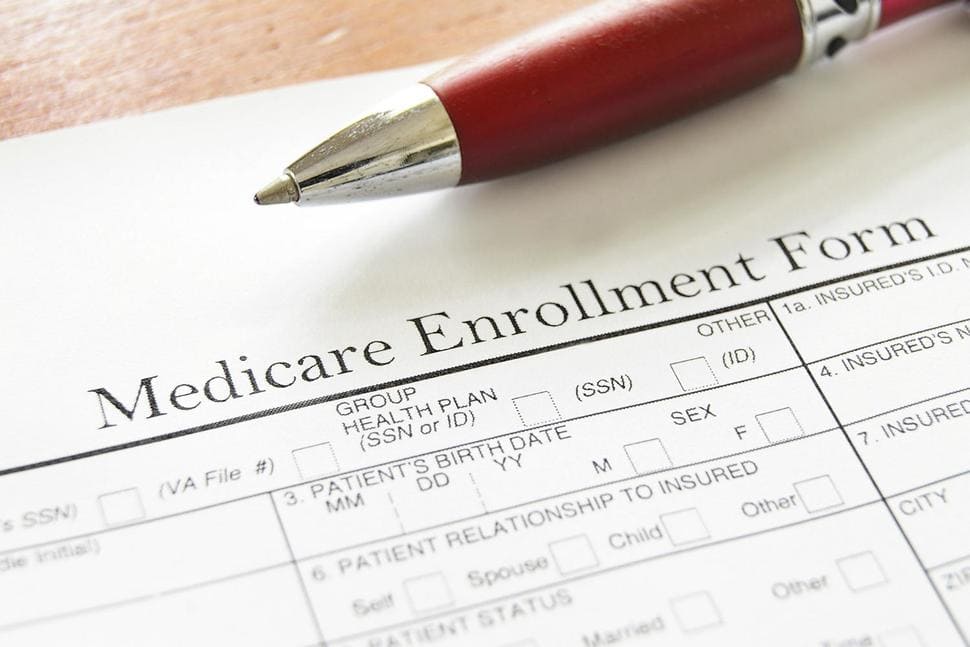
What to Watch for During Medicare Open Enrollment for 2019

IT’S OPEN ENROLLMENT season – the period when Medicare beneficiaries across the country can change their health insurance plan through Dec. 7. While making smart choices and comparison-shopping is key to maximize benefits and savings, the process of reviewing new coverage options and existing policies can be daunting.

“A lot of seniors tell us it’s almost impossible to feel confident they are making the right decision,” says Ryan McCostlin, head of healthcare financial planning for benefits brokerage Bernard Health. The government’s Medicare.gov website has a tool to compare options or a financial planner may be able to help, McCostlin says.

To dodge costly missteps and help ease the enrollment process, experts recommend keeping the following factors and policies in mind.

There are increasing out-of-pocket costs. While Medicare costs are going up in 2019, increases will be minimal for most people.

Standard Part B premiums are increasing from $134 per month (or higher, based on your income) in 2018 to $135.50 per month (or higher, based on your income) in 2019. The Part B deductible, which applies to outpatient care, is rising from $183 to $185 next year. Meanwhile, the deductible for Part A, which covers inpatient services, is increasing from $1,340 to $1,364. Coinsurance payments for extended hospital stays are going up as well.

People may likely see the biggest change in the availability of zero-deductible Medicare Advantage plans. These policies are offered by private insurers and can have different deductibles and copayments than original Medicare, which comes directly from the government.

“Last year, we could find a lot of plans without a deductible,” says John Hill, president of independent insurance agency Gateway Retirement Inc. in Rock Hill, South Carolina. “This year, it’s very hard to find a plan without a deductible.”

The Part D ‘donut hole’ is closing. Medicare Part D was founded in 2003 to provide prescription drug coverage. As originally created, it included a coverage gap in benefits, commonly known as the “donut hole.” After initial benefits were exhausted, beneficiaries would need to pay thousands of dollars out of pocket before a plan’s catastrophic coverage kicked in.

In 2019, the coverage limit for initial Part D benefits will be $3,820, up from $3,750 in 2018. Hill says beneficiaries often confuse how costs are calculated for the coverage limit. “It’s not what they pay,” Hill says. Instead, it includes the insurance portion of the price as well. “It’s the total drug cost.”

The government has been slowly phasing in changes to minimize out-of-pocket costs in the coverage gap. Next year, those in the gap will pay no more than 25 percent of the cost of a brand-name drug or 37 percent of the cost of a generic drug. Those numbers are down from 35 percent and 44 percent, respectively, in 2018.

There are drug updates for Part D. Whether you get your prescription drug coverage through a separate Part D plan or have it wrapped into a Medicare Advantage policy, don’t renew without double-checking covered drugs and costs.

“There are so many changes every year when it comes to the drug plans,” McCostlin says. Formularies, which dictate which medications are covered at what copay level, are commonly adjusted. Pharmacy networks can also change, meaning you’ll pay more if your preferred location no longer participates with the plan.

Because Part D plans are so variable, McCostlin calls them low-hanging fruit when it comes to comparison shopping. Competition by insurers can mean lower prices can often be found.

With Medicare Advantage, you can benefit from trial runs. Medicare beneficiaries have two main ways to receive their benefits. Original Medicare means receiving benefits directly from the government while Medicare Advantage plans are sold by private insurers. A Medicare Advantage plan includes all the benefits of original Medicare and often adds other coverage such as vision or dental.

During open enrollment, beneficiaries can switch between original Medicare and Medicare Advantage. Previously, the government provided a 45-day period in which people who elected Medicare Advantage could switch back to original Medicare. However, in 2019, a new system will be in place.

Medicare Advantage enrollees will have a special period, from Jan. 1 to March 31, in which they can switch back to original Medicare or change to a different Medicare Advantage plan. This provides seniors with a chance to try a policy without locking themselves in for the entire year. “If it’s not a good fit, they’ll be able to switch back,” McCostlin says.

Access to supplemental plans may be limited. Those switching from Medicare Advantage to original Medicare may be subject to medical underwriting if they want to buy a supplemental policy.

Supplemental Medigap plans cover costs not paid by original Medicare. Those signing up for Medicare for the first time are guaranteed the right to purchase a Medigap plan, but individuals enrolling later may be denied. It can be an expensive mistake to drop a Medicare Advantage plan before getting approval for Medigap first.

“You should never disenroll from Medicare Advantage without having a supplement,” says Chris Alberta president and senior financial advisor for advisory firm Principium Tactical Wealth Management in Brighton, Michigan.

Medigap plans are being discontinued. Medigap plans are labeled A through N, with each letter representing a different, standardized set of benefits. In 2020, they will no longer be allowed to cover the Part B deductible. As a result, Medigap Plans C and F will not be sold after this year.

Those currently enrolled will be able to continue their coverage, but without new members entering the plans, Alberta says premium costs could increase significantly. “There are a lot of folks scrambling to find another plan,” he says.

Since supplemental policies can be purchased at any time, people who want to switch can take their time shopping for a new Medigap plan. Alberta recommends looking at a high-deductible version of Plan F.

“Agents hate selling this plan because they earn a percentage of the premium,” he says. The plan premiums are low enough that, even when balanced against the deductibles, consumers often come out ahead financially by selecting this option.

There are network changes for Medicare Advantage. Medicare beneficiaries shouldn’t assume their current plan will keep the same network in 2019. Hill says using an out-of-network provider could cost consumers anywhere from two to 10 times more than an in-network provider.

Seniors should double-check plan networks to make sure their existing providers participate and also to ensure there aren’t better policies available. In some cases, competing insurers may move into a new area and provide lower prices.

That’s been the case in Michigan, according to Alberta. “Our networks have gotten so much better,” he says. While the east side of Michigan has long been dominated by Blue Cross Blue Shield, insurer Priority Health expanded east in recent years, offering new competition and savings for those on Medicare.

Plans are rated by Medicare. Hill recommends those shopping for Medicare coverage use the plan finder service on Medicare.gov/find-a-plan. “They will tell you the good and the bad of every plan,” Hill says.

In addition to out-of-pocket costs and prescription drug coverage, Medicare.gov assigns a star rating to each plan. This rating takes into account factors such as a policy’s ability to manage chronic conditions, deliver preventive care and offer customer service. These are all important aspects to selecting the right plan. “Medicare should be like buying shoes,” Hill says. “It should fit and it should be comfortable.”

How to write NaNoWriMo this year with the help of Apple technology

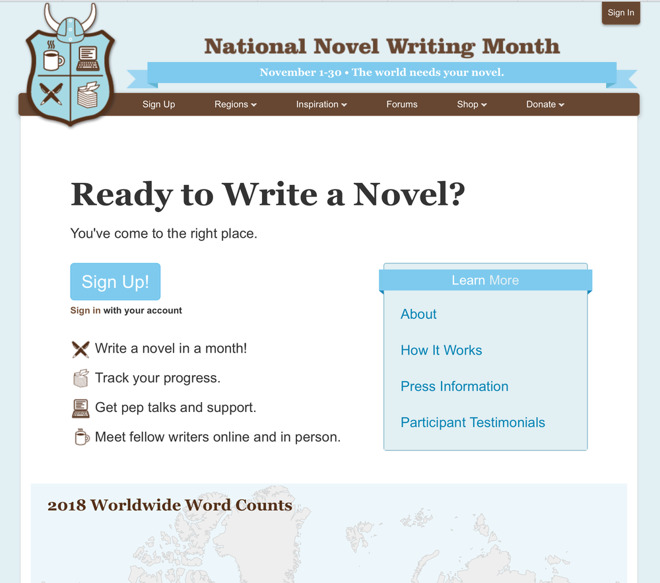
You’re already behind on NaNoWriMo, the National Novel Writing Month. That’s okay, everybody doing it is going to fall behind at some point before the end of November. The thing is to catch up and to use the tools you’ve got in your Mac and iOS devices to get you to the finishing line.

It might help to add some more software, it might just help to get more hardware.

NaNoWriMo

All you have to do is commit to writing 50,000 words of fiction this November —and then write it. It must be a new book, it can’t be a continuation of something, but otherwise all that matters is that word count.

It’s not as if what you write has to be good. In fact, that’s really the point of the exercise. Instead of thinking about the quality so much that you never get around to actually writing anything, NaNoWriMo forces you to get on with it.

You can make it great later, for now just get words down.

Unless you are taking the month off work, though, you need some help fitting this writing in with your other commitments. And that’s where software comes in.

Where to start

If you like Microsoft Word, you go right ahead and write in it. If you love the simplicity of Apple’s TextEdit, we wouldn’t have a word said against you. However, with these two examples and so very many others in between, it’s left to you to organize yourself and your work.

You have to remember where your Great American Novel document is and you need to get to it quickly. We’re not saying that it’s a burden going to your Mac, launching Word and choosing File, Open. However, we are saying that’s a bit of a problem when the only time you have to write today is on a train halfway across the country.

Save your novel to Dropbox, iCloud, OneDrive or anywhere else that you know you will be able to quickly access.

Then test it out to be sure. Open that novel on your Mac, on your iPhone. Open it on every device you may be using and when you’ve seen that you can read the file, close it again before you have multiple different versions.

Better yet

Buy Scrivener for Mac. This is a word processor that is primarily dedicated to writing long form books, whether they’re fiction or not. Most of its features come into their own when you’re editing and revising a book and you don’t have time to do that during NaNoWriMo.

However, even simply for getting words down, Scrivener is a pleasure to write in. We’d recommend it for that even if it didn’t then have features like the ability to seamlessly switch from showing you all of your novel to focusing on one chapter. It can just as easily then show you, say, chapters 11 and 19.

For our NaNoWriMo purposes and the need to be able to write as soon as you have one spare minute, Scrivener wins because it’s on all devices. Whether you use a Mac, iPad or iPhone, you can write in Scrivener. It’s a separate purchase for Mac and iOS but both work together seamlessly.

If you have to use a PC at work, you could also buy Scrivener for Windows and then that’s every lunch hour in November sorted.

There are alternatives, though, and a major one is Ulysses, which is also available on Setapp.

Like Scrivener, Ulysses is on Mac and iOS. It’s not on Windows but whichever Apple devices you have, you can turn to any of them and be writing immediately. Ulysses syncs your writing over iCloud and does it so quickly that if you write half a sentence on your iPad you can immediately turn to your iPhone and finish it.

Ulysses is best suited for when you’re writing a lot of fairly short documents rather than a single long one, though. You can and people do use it for novels but we want you carrying on writing your book after November is finished and Scrivener is best for that.

Quick aside

There is a good argument that you haven’t got time to learn how to use a new app when you’re under pressure to write 1,667 words every day. Nuts to that: you’re a writer, you’ll be using Scrivener in moments.

However, if you are tempted to stick with something you know, be careful not to get distracted into anything else. You can write a novel in OmniOutliner, for instance, but if you do, you’re going to be tempted into outlining your book instead of writing it.

NaNoWriMo is not about planning. It’s not even really about writing a novel: if it were, the target for the month would be between 80,000 and 120,000 words. Instead, this month is about getting words down on the screen. And the best writing tools from Scrivener, Ulysses and Word have ways of helping you push through to the finishing line.

Distractions and encouragement

Microsoft Word 2019 has a new Focus Mode that is intended to let you cut out everything else but your writing. It’s really the old version’s Focus View renamed and you even get to it via the View menu and Focus option.

However, this version does improve things. Previously you had to switch back out of Focus View to do any kind of editing. It’s better that you now don’t have to mentally switch gears to do, say, search and replace but you shouldn’t be doing any editing yet.

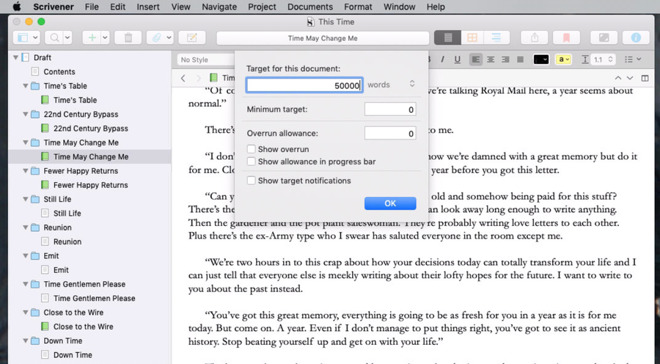
Scrivener has a very similar view, though it’s slightly more complicated to get to. One document in Scrivener can have very many sections, such as chapters, and these are displayed in what’s called the Binder. Click on one section in the Binder and then at the bottom right of the text, there is an icon of concentric circles.

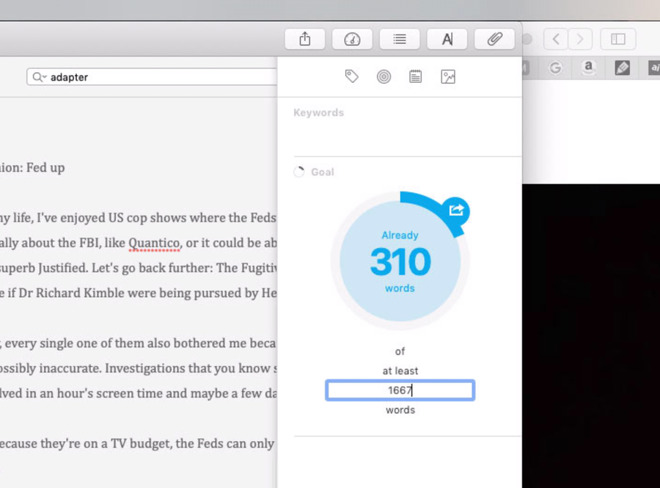
This is the Word Target feature. Click on that and Scrivener asks you what word count you’re aiming for plus some other details. Fill out as much or as little as you like, then you can choose to have it notify you as you progress toward that count.

Visual writing

Rather than a number slowly counting up as you type, both Scrivener and Ulysses can give you visual encouragement.

In Scrivener, tap on the word count and you get to set up a circular graphic that will get closer and closer to filling in as you type. With Ulysses, start a new sheet —this app’s term for a document —and tap on the paper clip icon at top right.

That pulls out into a pane with different options. Tap the concentric circles and now you’re able to set a word count goal.

When you’ve done that, you can have that circle on the screen all the time and it is usually encouraging. With Ulysses, for instance, you don’t keep watching the details but it changes the color of the circle from blue to green so you get a constant sense of how you’re doing.

Hardware

We wouldn’t dream of saying that NaNoWriMo is your excuse to buy a new iPad Pro, but you’re thinking about it now. An iPad is a great thing for this, however, because it means you can have your novel with you and ready, right there on the screen, for you to add to whenever you can.

Similarly, the new iPhones are a pleasure to write on with their particularly gorgeous screens.

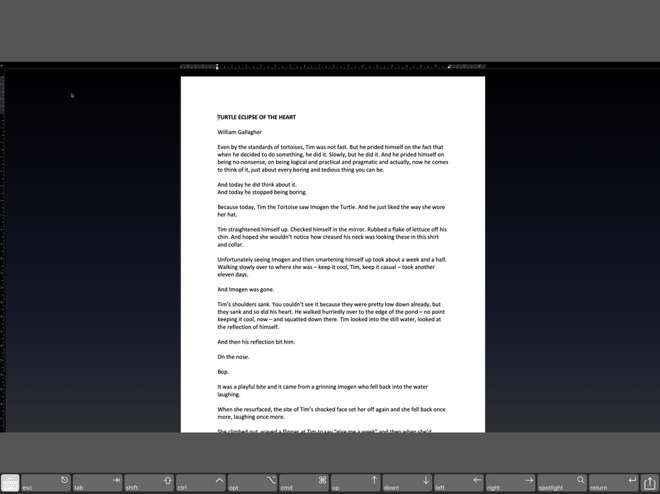
Still, iPhones and iPads are not great for typing on unless you add an external keyboard. Don’t get too far down the rabbit hole of examining keyboards, but do have a look to see what might suit you.

Advice

Whatever you use, there are some techniques that will help you. No matter what anyone tells you, there is no way to make writing 50,000 words of fiction easy.

However, there are two ways we’d recommend to help you get through it. First, write every day to the end of November.

Second, if you possibly can, write first thing in the morning. It’ll probably mean getting up earlier but if you do it, you’ll feel great all day. If you wait until evening and most especially if you wait until after you’ve eaten, it will feel much harder.

That’s it. There’s no trick, there’s just hard work but you can help yourself by making that work a bit more manageable. And you can help by making it so that when you have a single spare minute, you don’t have to spend 50 seconds of it finding and opening that document.

New technology set to revolutionise keeping buildings cool

Metamaterials could help engineers cool buildings without the need for expensive air conditioning systems.

Scientists believe seemingly magical properties of metamaterials could help cool our buildings without the use of energy

A 21st century twist on an ancient method of making ice could revolutionise ways of staying cool on our ever-hotter planet.

Everyone knows there’s no way to beat the laws of physics. Drop a metal bar in water, and it sinks. Throw a stick in the air, and it’ll come back to earth. Put something cold in the noon-day sun, and it’ll warm up.

But some of mankind’s biggest scientific breakthroughs have come from spotting loopholes in these iron-clad laws.

Hammer the metal bar into a tin can, and it’ll float. Carve the wood into an aerofoil, and it will glide.

Now scientists have found a way of seemingly defying thermodynamics, and its insistence that you can’t make objects cooler than their surroundings without using energy.

A team from the University of Colorado, Boulder, have created a thin sheet of material made from a polymer coated in silver and embedded with tiny glass balls.

Known as a metamaterial, it’s a combination that subtly alters the thermal properties of whatever it covers, allowing it to cool even in the searing heat of the day – and without using any energy.

It pulls off this trick by exploiting a phenomenon used by ancient desert civilisations to make ice during the summer, thousands of years before the invention of the refrigerator.

After sunset, water would be poured into shallow trenches exposed to the clear night sky. As the hours passed, ice would start to form in the trenches – despite the temperature still being well above freezing.

On the face of it, this defies the laws of thermodynamics, according to which heat flows from hot to cold bodies, unless energy is used to reverse the flow.

And while summer nights are cooler than the days, they’re still typically pretty warm – so why does the cooling keep going?

The answer is literally out of this world.

Space is bitterly cold, and it’s only the famous “greenhouse effect” of our atmosphere that stops temperatures plummeting far below zero after sunset.

Put simply, the molecules of gases and water vapour that make up the atmosphere block most of the heat radiation from seeping out into the bitter-cold cosmos.

Most – but not all. There’s a “hole” in our planet’s greenhouse: a range of radiation wavelengths which the atmospheric gases allow through.

Water exposed to a clear night sky loses much of its warmth through this “hole” and into the icy cold of deep space.

As a result, the water can become colder than its surroundings – while keeping the laws of physics intact.

Known as radiative cooling, it’s a phenomenon with the potential to do more than make ice on clear summer nights.

In principle, it could provide a zero-energy source of cooling for buildings – ideal for future cities in an ever-hotter planet.

But to make the most of it, some way of channelling as much heat as possible through the “hole” is needed – and making it work all day long, not just at night.

That’s the challenge, and it seems the University of Colorado team have pretty much cracked it.

The mirror-like sheen of their metamaterial foil acts as an incredibly efficient mirror, bouncing back 96 per cent of the sunlight striking it. That alone helps keep whatever is under the foil cool.

But the real secret of the material lies in the tiny glass spheres embedded in it. These channel heat radiation into those wavelengths that can pass through the atmosphere and into deep space.

As a result, even during the day time, anything covered by the foil behaves as if it’s night – and cools to temperatures lower than its surroundings, without requiring any energy.

In real-life tests reported in the monthly international energy research journal Joule, the team reports that water covered by the foil stayed around 10°C cooler than its surroundings, even in intense summer sunlight.

The foil itself is said to be cheap and simple to mass-produce, with just 10 – 20 square metres of it being enough to keep a small house cool in summer.

But the team believes the foil will also have industrial applications, such as for use in power plants and data centres, where shedding heat cheaply is a priority.

They also see applications in boosting the efficiency and lifetime of solar panels.

Constant exposure to sunlight can cause these panels to overheat, reducing performance. According to the team, applying the foil to the surface of solar panels could boost their efficiency by 1 to 2 per cent – which adds up to a lot of power over the whole area of an array.

Energy-free cooling is just the latest breakthrough made possible by the seemingly magical properties of metamaterials.

In recent months, researchers have unveiled a slew of such materials. They include a composite metamaterial that bends sound waves around small objects until they levitate, and a stretchy film made from aluminium and plastic that makes objects invisible to heat detectors – ideal for military camouflage.

Some researchers think it may one day be possible to make objects disappear completely, using a metamaterial “invisibility cloak”. Already, Chinese scientists have been reported to be experimenting with metamaterials that bend microwaves around aircraft, making them invisible to radar.