Archives for October 22, 2018

Using data analytics, AI technology to curb benefits fraud

The numbers in the Toronto Transit Commission’s benefits fraud investigation are staggering — 725 total cases, 220 dismissals, 120 arbitrations, 10 employees charged and more than $3 million in exposure.

“All this stuff is still ongoing. The insurance company hasn’t cut us a cheque yet,” Mark Russell, staff sergeant, investigative services at the TTC, told attendees at the Canadian Pension and Benefits Institute’s 2018 Ontario regional conference in Ottawa on Friday.

The case came to the TTC’s attention through a pilot program in 2013 that created an anonymous ethics reporting system within the organization. “We identified the fact that there was a lot of things going on that people weren’t willing to talk about openly,” said Russell.

In April 2014, a tip came in identifying a specific vendor. It outlined the scheme in detail, referring to cash kickbacks to employees with no product dispensed and noted it had gone on for a significant length of time, explained Russell. “To determine whether the allegations could be corroborated, we knew we had to go to our benefits provider and develop a history of the claims that came through.”

Over a couple of months, the TTC’s investigation identified close to 400 employees who had been going to HealthyFit, a vendor in Toronto, for a number of years and making claims for orthotics, compression stockings and braces, said Russell, noting the exposure of potential fraud for the TTC was climbing up into the millions of dollars.

Working with Toronto police services, the investigative team began action against HealthyFit and its vendor Adam Smith. The TTC’s benefits provider was responsible for providing data it could act on, while the organization was leading the labour relations investigation and supporting the civil action and the criminal investigation, said Russell.

In July 2015, charges were laid against Smith and the TTC identified 725 employees, or five per cent of its workforce, who had submitted claims through HealthyFit. “As of last week, there’s been 250 cases and there are 120 arbitrations ongoing right now,” said Russell. “The decision was made to charge 10 of our employees with criminal charges.”

The TTC has recovered $130,000 through the courts so far, according to Russell, who noted the organization almost immediately saw a $5-million annual reduction in claims, comparing 2015 to 2016. “It had a lot of impact in our organization. It’s a budget line item now.”

Data analytics became more and more relevant throughout the process, said Russell, noting the case led the TTC to start working on a corporate ethical compliance program. He also suggested that a lot of the things that happened in the case were driven by standards within the providers’ world.

Also speaking during the session, Steven Richardson, supervisor of benefits management and investigation services at Green Shield Canada, agreed the industry has to look at its weaknesses. These include unregulated providers, such as a massage from someone who isn’t a registered massage therapist. “Those are things that make us vulnerable.”

Green Shield Canada has a team dedicated to investigations looking for fraud and abuse, said Richardson. “We’re looking for fraud . . . and we’re also looking for other things, over-utilization of benefits, misuse of benefits . . . the data and the numbers I consistently see is anywhere from two to 10 per cent of all the claims we do are fraudulent or abusive.”

Among Richardson’s suggestions for curbing benefits fraud, he pointed to a greater sharing between providers and smart plan design. “Putting reasonable controls onto your benefits plan,” he said. “Things like reasonable and customary prices . . . the markup on compression socks is better than heroine . . ..”

He also suggested setting dollar and frequency maximums, noting a plan sponsor with unlimited benefits will have problems. It also comes down to educating employees, he said. “I’m always amazed when I talk to plan members how they just don’t get it.”

And the growing opportunities with analytics and reporting is a huge area for helping to curb benefits fraud, noted Richardson. “You need to be able to analyze, to mine your data, to look for those things, those outliers, those trends, look for those inconsistencies . . . A whole bunch of plan members all going to one provider for thousands and thousands of dollars, those are the things you need to be looking for.”

Going even further, Green Shield Canada is using an artificial intelligence platform. Every week, it dumps data into the platform, which then spits out the outliers.

“If you have a chiropodist seeing 28 patients a day, she will flag that up to you . . . and she does it through things like peer analysis,” said Richardson. “She’ll compare all the chiropractors and will look for things that stand out. She’s a bit of a tattle-tale, she just wants you to look at it. Sometimes it’s fraud and abuse, and sometimes it’s not. But that’s what she does, she just points out the outliers.”

The organization also uses social network analysis to look for any links it wouldn’t normally see. “I think that’s really where the industry is going, where the future is.”


“Movement ecologists” are turning technology against the global trade in illegal seafood

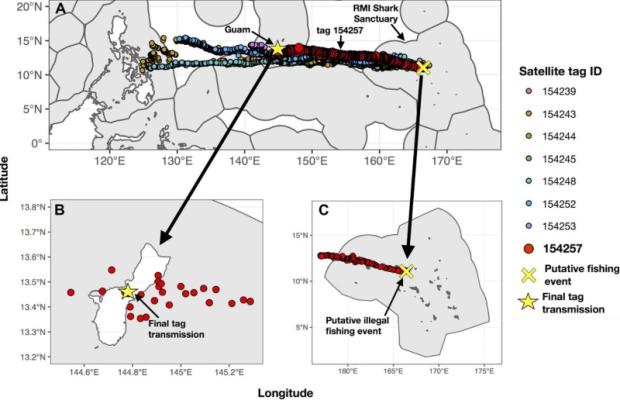
Conservationists were eager to track grey reef sharks’ as they swam across a protected shark sanctuary in the South Pacific. Excited researchers watched the movements of tagged sharks leaving the Marshall Island’s Bikini Atoll. Suddenly, eight tags were beelining across the ocean toward the island of Guam.

The scientists thought they had stumbled across some unknown migration. “Nope,” movement ecologist Darcy Bradley, told them. “Your tags are on boats.”

Technology is helping ships find and extract ever-larger quantities of ocean life for human consumption. Now it’s also being used to stop it. Bradley, a postdoctoral researcher at the University of California Santa Barbara, said the South Pacific researchers were too late. Bradley had informed authorities, but by then the illegal fishing boats nabbing grey sharks in the sanctuary (commercial sharks fishing is banned within an area covering more than 2 million square kilometers) were already thousands of kilometers away.

That wasn’t the case in Europe this month when police caught 79 suspected tuna smugglers through Operation Tarantelo. Europol says it used the traffickers’ tablets, phones, GPS devices, and catch records to track down 80,000 kg (88 tons) of illegal bluefin tuna. Law enforcement agencies in Span, Portugal, and Italy uncovered false papers, fake boat bottoms, and a massive smuggling ring to bring the fish to market.

Money in illegal seafood is massive. In Europe, the volume of illicit bluefin tuna sold last year was double the annual legal trade, which is estimated to be around 1.25 million kg (1,377 tons), according to Europol. The profits are larger too. Illegal fishing is the world’s sixth most valuable crime, reports the non-profit Global Financial Integrity). That was illustrated by Operation Tarantelo’s confiscation of US$576,000 in cash and seven luxury vehicles. And that’s only one species. Overall, nearly a quarter of seafood humans catch each year is fished illegally.

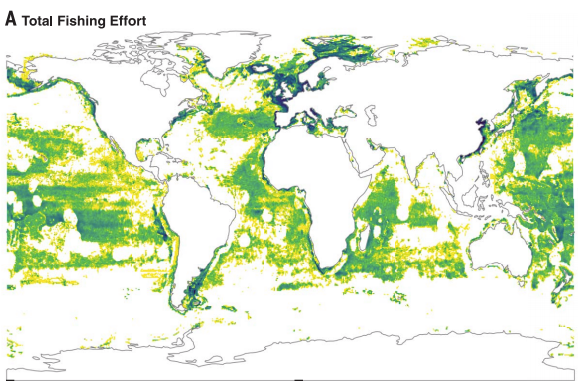
What can be done about it? One of the major problems is keeping track of illegal vessels. “Mother ships,” or enormous fishing vessels that may stay at sea for years, can offload illegal catches onto other boats, which sell the harvest at distant harbors. Satellites and automatic identification system (AIS) tracking devices are now being repurposed to monitor fishing effort. AIS devices, originally designed to avoid ship collisions, send back signals to reveal a ship’s location, identity, and speed. A recent study published in Science (paywall) analyzed AIS messages from more than 70,000 industrial fishing vessels between 2012 to 2016. The data showed the scale of the industry that must be tracked over at least 55% of ocean, an area four times larger than agriculture. Of course, many illegal vessels aren’t tracked at all.

But safe harbors must also be eliminated. Europe has among the strictest controls in place to track landings of seafood. Irregularities in production numbers were the first sign that tipped off authorities to the illegal tuna ring. No such tracking regime exists in countries like China and the Philippines, where many officials may be willing to look the other way. The spread of high seas fishing, which takes place outside of individual nations’ economic zones is where many illegal fishing fleets operate. High seas fishing is dominated by just five countries, Smithsonian reports: China, Spain, Taiwan, Japan, and South Korea. Their cooperation will be needed to reign in illegal operations.

There are signs that things are changing. An international effort is underway to enforce a “legal, sustainable, and transparent” tuna supply chain by 2020. Indonesia recently banned foreign fishing fleets and transshipment at sea, forcing boats to return to port to offload catches. That constrained tuna supplies by nearly doubling the price of some species, primarily yellowfin tuna and skipjack tuna, in local markets according to Singapore’s Straits Times.

Whether Indonesia will manage its resources to sustain them into the future or merely shift overfishing practices to local fleets remains to be seen.

Efforts to Acknowledge the Risks of New A.I. Technology

SAN FRANCISCO — In July, two of the world’s top artificial intelligence labs unveiled a system that could read lips.

Designed by researchers from Google Brain and DeepMind — the two big-name labs owned by Google’s parent company, Alphabet — the automated setup could at times outperform professional lip readers. When reading lips in videos gathered by the researchers, it identified the wrong word about 40 percent of the time, while the professionals missed about 86 percent.

In a paper that explained the technology, the researchers described it as a way of helping people with speech impairments. In theory, they said, it could allow people to communicate just by moving their lips.

But the researchers did not discuss the other possibility: better surveillance.

A lip-reading system is what policymakers call a “dual-use technology,” and it reflects many new technologies emerging from top A.I. labs. Systems that automatically generate video could improve movie making — or feed the creation of fake news. A self-flying drone could capture video at a football game — or kill on the battlefield.

Now a group of 46 academics and other researchers, called the Future of Computing Academy, is urging the research community to rethink the way it shares new technology. When publishing new research, they say, scientists should explain how it could affect society in negative ways as well as positive.

“The computer industry can become like the oil and tobacco industries, where we are just building the next thing, doing what our bosses tell us to do, not thinking about the implications,” said Brent Hecht, a Northwestern University professor who leads the group. “Or we can be the generation that starts to think more broadly.”

When publishing new work, researchers rarely discuss the negative effects. This is partly because they want to put their work in a positive light — and partly because they are more concerned with building the technology than with using it.

As many of the leading A.I. researchers move into corporate labs like Google Brain and DeepMind, lured by large salaries and stock options, they must also obey the demands of their employers. Public companies, particularly consumer giants like Google, rarely discuss the potential downsides of their work.

Mr. Hecht and his colleagues are calling on peer-reviewed journals to reject papers that do not explore those downsides. Even during this rare moment of self-reflection in the tech industry, the proposal may be a hard sell. Many researchers, worried that reviewers will reject papers because of the downsides, balk at the idea.

Still, a growing number of researchers are trying to reveal the potential dangers of A.I. In February, a group of prominent researchers and policymakers from the United States and Britain published a paper dedicated to the malicious uses of A.I. Others are building technologies as a way of showing how A.I. can go wrong.

And, with more dangerous technologies, the A.I. community may have to reconsider its commitment to open research. Some things, the argument goes, are best kept behind closed doors.

Matt Groh, a researcher at the M.I.T. Media Lab, recently built a system called Deep Angel, which can remove people and objects from photos. A computer science experiment that doubles as a philosophical question, it is meant to spark conversation around the role of A.I. in the age of fake news. “We are well aware of how impactful fake news can be,” Mr. Groh said. “Now, the question is: How do we deal with that?”

If machines can generate believable photos and videos, we may have to change the way we view what winds up on the internet.

Can Google’s lip-reading system help with surveillance? Maybe not today. While “training” their system, the researchers used videos that captured faces head-on and close-up. Images from overhead street cameras “are in no way sufficient for lip-reading,” said Joon Son Chung, a researcher at the University of Oxford.

In a statement, a Google spokesman said much the same, before pointing out that the company’s “A.I. principles” stated that it would not design or share technology that could be used for surveillance “violating internationally accepted norms.”

Technology to the rescue of worker-starved restaurant sector

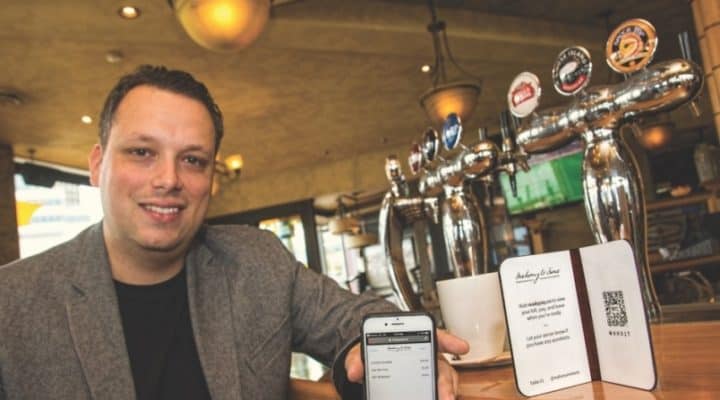
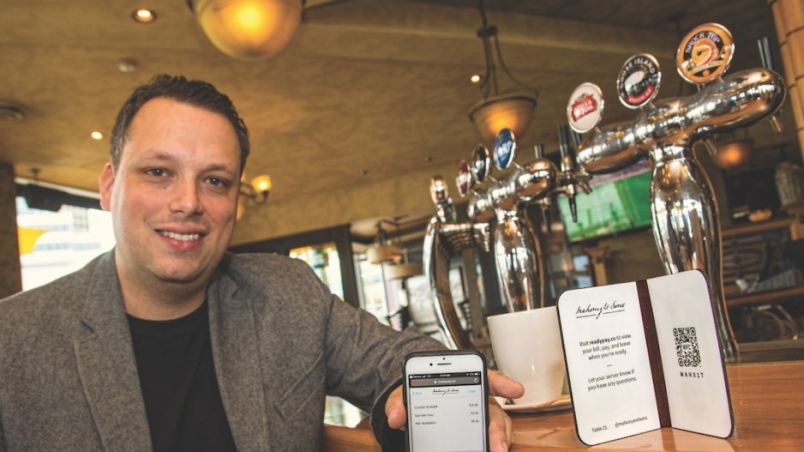
Ready boss Laurent May plans to roll out technology in the coming months that would enable restaurant patrons to order food via smartphones at pubs. Photo: Chung Chow

Bill payments and meal ordering via smartphone easing need for servers

Metro Vancouver’s severe shortage of hospitality workers has restaurant owners tweaking business plans and looking to new technology to operate efficiently with fewer servers.

Fast-food restaurants have long been adopting self-serve kiosks to enable customers to order meals without speaking with restaurant employees. Pubs and more casual restaurants are starting to test technology to allow customers to order food and pay bills from their smartphones.

Two Vancouver companies – Glance Technologies Inc. and iQmetrix-owned Ready – offer competing technologies to allow restaurant patrons to pay bills using smartphones. Both also intend to offer technology in restaurants that enables customers to order meals with smartphones and have those meals delivered to tables by servers or have counter staff call out names.

“They probably got the idea [for ordering food by smartphone] from us,” said Glance CEO Desmond Griffin, who in June staved off a boardroom coup attempt.

“We announced plans for that a long time ago.”

Glance, however, has yet to offer the food-ordering option to customers while Ready unveiled that technology at a trade show in Florida on October 1.

Glance Technologies is the bigger player of the two, as owners of more than 500 restaurants in B.C., Alberta and Ontario allow customers to use Glance’s app to pay bills via smartphone, Griffin told Business in Vancouver.

The company added 59 new locations that are using its technology in the quarter that ended May 31.

Most of its client restaurants provide paper bills to customers, who take a photo of a QR code on their bill. The app invites customers to enter credit card details or pay via Apple Pay or Google Pay. Griffin said restaurants are charged a range of fees, depending on size, volume and the kinds of credit cards that customers use.

Glance has started to provide technology to some restaurants that have advanced point-of-sale systems to allow customers to scan QR codes at tables and be taken directly to a digital bill. That way, the server need not drop a paper bill at the table, Griffin said.

That approach is similar to the way that Ready’s technology works.

One difference between technologies offered by Glance and Ready is that Ready does not require customers to first download an app.

“There’s a lot of friction on the app side,” explained Laurent May, who heads the seven-employee Ready. “Downloading an app just to make a payment in a restaurant without any incentives? There’s a lot of barriers to have customers doing that.”

Restaurants such as Mahony & Sons’ convention centre location, Ceili’s Irish Pub in Richmond and Burrard Public House in Port Moody allow patrons to use Ready technology to pay bills. May said Ready charges restaurants owners a 2.9 per cent fee plus $0.30.

No restaurant in Vancouver is currently using Ready’s new food-ordering technology. However, Tap & Barrel Restaurants owner Daniel Frankel told Business in Vancouver that his restaurant chain has been testing Ready’s bill payment and ordering technology at his Brewhall restaurant but that it is not yet available for the public.

Brewhall opened this summer and has an innovative business plan for a large pub in that customers are expected to go to a counter to order meals. Frankel said that if Ready’s technology gets the green light, likely within a month, customers will be able to order drinks and meals by smartphone so they can bypass what can sometimes be long drink lineups.

Brewhall’s counter-service business plan means that Frankel can employ about 95 staff for what he said was a 400-seat restaurant. Had he chosen to offer table service, Frankel said he would have had to find and hire more than 200 employees.

“We’re trying to stress-test the technology before we make it available to the public,” Frankel said. “We just want to make sure that the tech is not glitchy and we have no lost orders.”

Other pub chains, such as Blueprint’s Colony chain, for example, are in no hurry to implement technology to reduce the need for servers.

Blueprint director of people and culture, Hanna Jane Price told BIV that training allowances, bonuses and starting wages at $15 per hour for kitchen staff are instead its strategy to attract the necessary workforce to operate its three Colony pubs and its Charles Bar.

“Our customers haven’t really shared any desire to lean on the tools that you’ve described, like automatic ordering” Price said. “It’s more about the vibe when they walk in. It’s more of a community pub [feel.]”

Bitcoin off slightly; stablecoin Tether regains footing, but losing popularity

Tether trades back toward $1, but investors are already shopping elsewhere

Cryptocurrency prices are trading mostly unchanged to begin the week.

Bitcoin, the world’s largest digital currency, is showing small losses in early Monday trading, with a single bitcoin BTCUSD, -0.62% last going for $6,446.21, down 0.6% since Sunday at 5 p.m. Eastern Time on the Kraken crypto exchange.

Coming off a week in which Tether, the most popular stablecoin, broke its peg, investors in the U.S. dollar-backed cryptocurrency have begun packing up shop for more stable options. A stablecoin is meant to be precisely that, stable. Most stablecoins trade at or around $1, often gravitating between 99 cents and $1.01

“For traders, the instability of Tether provides an interesting conundrum of whether to opt into other more regulated stablecoin options such as Gemini dollars, Circle dollars or TrueUSD, which offer the same 1:1 to USD option to Tether, but with more apparent robustness and security,” wrote Aditya Das, economist at Brave New Coin, a blockchain and crypto asset market data company.

“Liquidity and availability have likely been Tether’s greatest driver of value and popularity, but with a new number of stablecoin options tradable on major exchanges like Huobi and Okex, the stablecoin flippening may continue to unfold.”

After falling to below 90 cents, Tether, which should trade at 1-to-1 with the U.S. dollar has regained its footing trading at 99 cents.

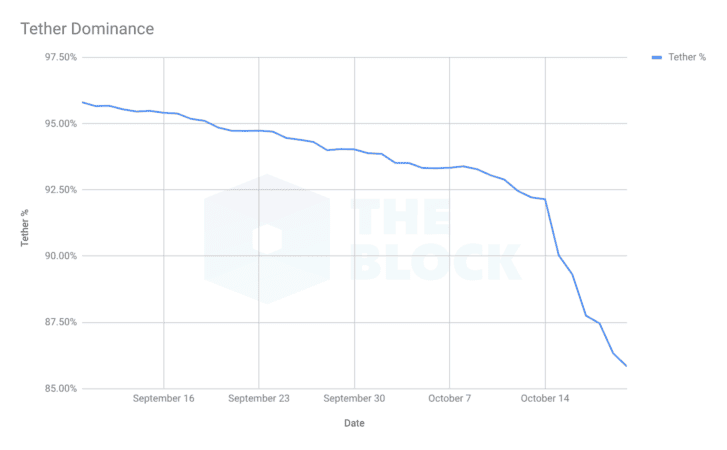
According to a chart from The Block, Tether’s dominance of the stablecoin market has fallen from more than 95% to 86%, the lowest level since November 2015.

Tether market share of stablecoins

Altcoins, or coins other than bitcoin, have kicked off the week on a quiet note with most trading marginally lower than Sunday’s closing levels. Ether ETHUSD, -1.02% was down 0.5% at $201.85, Bitcoin Cash BCHUSD, -2.26% was down 1.6% at $443.20, Litecoin LTCUSD, -1.40% was off 1.3% at $51.99 and XRP, XRPUSD, -1.91% had lost 1.1% at 45 cents.

Bitcoin futures are off to a slow start to begin the trading week. The Cboe Global Markets November contract XBTX8, -0.04% was up 0.1% $6,390, while the CME Group October contract BTCV8, +0.16% had gained 0.2% at $6,390.

Big stock rally in China bolsters markets across Asia

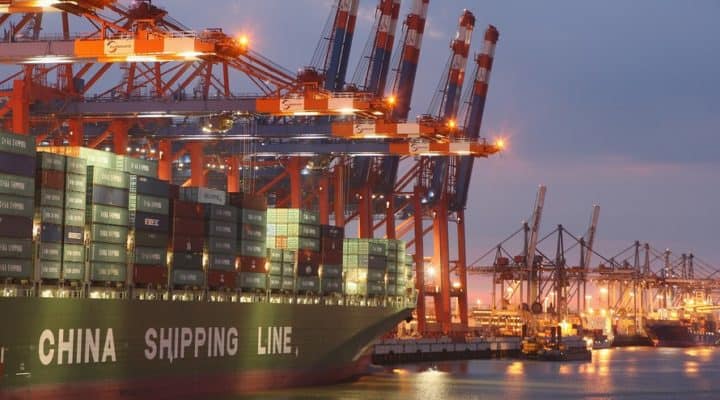
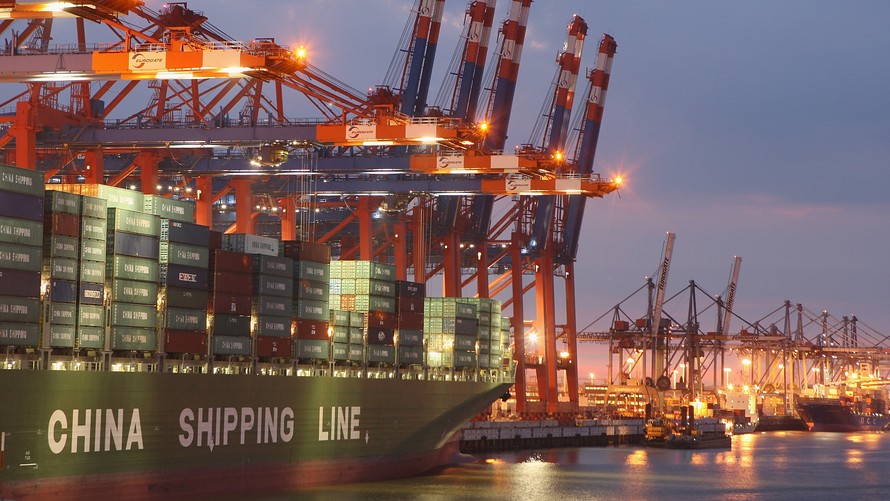
A container ship from China Shipping Line.

Chinese stocks surged for a second day on Monday, propelled by a chorus of reassuring comments from leaders and top regulators.

The Shanghai Composite rallied 4.6% to 2668 and the smaller Shenzhen Composite soared roughly 5.4%, putting both on pace for their best day in more than three years.

The Shanghai Composite SHCOMP, +4.09% closed up 4.1%, while the smaller Shenzhen Composite 399106, +4.90% soared 5.2%. That helped lift equities in not-as-beaten-up Hong Kong HSI, +2.32% by 2.2%. The rebound in both also helped ease the early selling seen elsewhere in the region.

Over the weekend, President Xi Jinping emphasized China’s support for the private sector, according to the official Xinhua News Agency. Beijing also released new details on proposed personal income tax cuts, Xinhua said. The Chinese president’s comments followed concerted moves on Friday by Vice Premier Liu He — Xi’s top economic official — as well as the head of the central bank and two financial regulators to reassure investors.

More stimulus is on the way, including major tax and fee cuts that could be worth more than 1% of GDP, the state-owned Shanghai Securities News quoted Ma Jun, a policy adviser to the People’s Bank of China, as saying.

China’s rally comes after last week’s report on weaker-than-expected third-quarter GDP growth. Investment bank Nomura said Monday it expects Beijing to roll out more easing and stimulus measures in the months ahead. Chinese officials made attempts to boost the beaten down market via supportive statements Friday about the economy and financial markets, which helped stocks Friday, but for the week, the Shanghai Composite still lost 7.6%.

Nomura adds 6.5% GDP might occur this quarter as well “due to a frontloading of exports” ahead of possible additional U.S. tariffs in January and “a loosening of restrictions on the anti-pollution campaign this winter.” However, the bank expects a further Chinese economic-growth slowdown next year.

600837, +9.99% Among the big gainers, Chinese brokers soared. In Hong Kong, shares of Haitong Securities gained 16% and those of Citic Securities 0267, +0.52% advanced 14%, while on the mainland stocks in several brokerage companies rose by the maximum possible 10%.

Japan’s Nikkei NIK, +0.37% closed up 0.4% after opened lower. The South Korea Kospi SEU, +0.25% finished up 0.3%, while Taiwan Y9999, +0.55% stocks rose 0.6% and Australia’s S&P/ASX 200 XJO, -0.58% lagged with a 0.6% drop. S&P 500 futures rose 0.4%.