Archives for October 20, 2018

Dollar slides; euro finds footing as EU softens Italy criticism

Investors digest sluggish China GDP and central bank comments

Foreign exchange markets reflected an improvement in risk sentiment after sluggish data on Chinese economic growth was offset by words of support Chinese authorities on Friday.

Also, a European Union official attempted to ease tensions with Italy over the government’s fiscal plans, helping soothe fears of a budget showdown between Rome and Brussels and boosting the euro.

European Economic Affairs Commissioner Pierre Moscovici said Italy was strongly committed to the EU and the euro, and that Brussels was not going to interfere in Italian economic policies. Moscovici said he wanted to reduce tensions with Rome. Moscovici also said the next move was up to Italy after the commission sent the government a letter criticizing its plan to allow the budget deficit to rise to 2.4% of GDP next year, news reports said.

The euro EURUSD, +0.5326% improved following the comments, extending its modest gains to $1.1510, up from $1.1453 late Thursday.

The fear of a budget battle between Italy and the EU over Rome’s deficit-expanding budget plans have been a concern for investors, driving up Italian bond yields and putting pressure on shares of Italian banks.

The eurozone’s third-largest economy is feared to be too big for a Greece-style bailout, and the threat of a budget fight has amplified worries about demand for Italian government bonds after the European Central Bank stops purchasing assets.

The full draft budget law will be submitted to the Italian parliament by Saturday, where it will need to get approved by the end of the year.

Late Thursday, China released its third quarter GDP growth numbers—a highly anticipated data point for investors everywhere as the health of China’s economy has global growth implications. Beijing reported 6.5% growth year-over-year between July and September, down from 6.7% in the prior quarter and undercutting expectations of 6.6%. It is the country’s worst growth read since 2009.

The People’s Bank of China, its securities regulator and banking and insurance regulator issued statements Friday in support of the stock market and positive economic fundamentals, soothing investor concerns and leading Asian equities higher. China’s Shanghai Composite Index SHCOMP, +2.58% ended Friday 2.6% higher after dropping almost 3% on the previous trading day.

The Chinese yuan, which had touched levels not seen since January 2017 earlier this week, strengthened against a subdued U.S. dollar in Friday trading. One buck bought 6.9296 yuan USDCNY, -0.1182% in Beijing, and 6.9397 yuan USDCNH, -0.0807% in the offshore market.

The popular ICE U.S. Dollar Index DXY, -0.36% was meanwhile down 0.2% at 95.708. Its slide deepened after Atlanta Fed President Raphael Bostic said the case of missing Saudi journalist Jamal Khashoggi was a downside risk for the U.S. economy because it could lead to sanctions impacting the price of oil. The gauge is on track for a 0.5% gain for the week, reversing the previous week’s losses.

On the Brexit front, U.K. Prime Minister Theresa May said London would be willing to extend its transition period by a year, which was met with sharp criticism by pro-Brexit members of her own party. An additional year of talks would mean more uncertainty for the battered British pound GBPUSD, +0.3687% for longer. In the year so far, sterling has dropped some 3.5%.

One pound last bought $1.3065, up slight from $1.3018 late Thursday.

According to a report by the Times of London, former Brexit Secretary David Davis is angling to serve as interim leader in a potential leadership challenge to May amid anger some Conservative members of parliament over the prospect of an extension.

Elsewhere, the New Zealand dollar NZDUSD, +0.6877% was leading top gainers among developed market currencies, buying $0.6585, up from $0.6544 late Thursday in New York, despite a lack of significant headlines.

“On the contrary, there was New Zealand-negative news in that immigration continued to fall in September to nearly a four-year low,” said Marshall Gittler, chief strategist of ACLS Global. “That hit the New Zealand dollar but only temporarily. It looks like investors are just continuing to cut their short positions.”


Amazon and other battered tech stocks to buy after an ugly October for the Nasdaq

Critical information for the U.S. trading day

So far, October is shaping up just as we suspected it might: volatile, scary and brutal.

Investors in the Nasdaq can attest to that fact after the index received a drubbing in the first three weeks of the month that has thusly slashed nearly 7% from the tech-heavy benchmark.

So, is it time to throw in the towel? Not so fast, according to our call of the day from analysts at Piper Jaffray. The strategists make the case that now may be an opportune time to pick up big names that have been hard hit by the recent pullback that still leaves the Nasdaq Composite Index COMP, -0.48% with a 8.43% year-to-date gain—but very badly bruised.

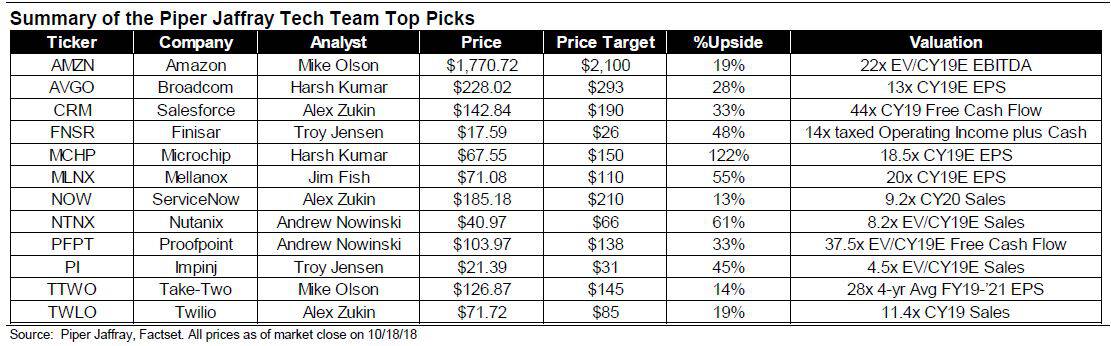
Kicking off that Piper list is Amazon.com AMZN, -0.38% Harsh V. Kumar, senior research analyst and the team, expect Amazon to report revenue and earnings above forecast when it delivers its quarterly results Oct. 25. Shares of the e-commerce giant have gained a whopping 79% so far this year, but have pulled back 11% in October.

“Our reformulated Amazon search index points to FXN online retail revenue growing 26.0% [year-over-year], above street estimates calling for 18.1%,” they said in a separate note, ahead of results due next Thursday.

And in-game content and growth—the “rising tide that lifts all ship”— is going to keep driving profits for Take-Two TTWO, -3.48% another big pick. Kumar says few investors have factored in potential popularity of Wild West adventure game “Red Dead Redemption 2.” Take-Two’s stock is down 8% this month so far, shares are up 21% for the year. Piper’s price target is $145.

Among chip makers, Piper Jaffray endorses the solid fundamentals at Broadcom AVGO, +0.11% and believes that management will cut costs to deliver a fillip to shares of Microchip Technology MCHP, -0.77% Both stocks are pretty embattled this year, with Broadcom off 11% for 2018 thus far and around 8% for October, while Microchip is down 23%.

Here’s the rest of the list from those analysts. Under security, storage and networking, they like Proofpoint PFPT, -2.78% Nutanix NTNX, -5.39% and Mellanox MLNX, -0.70% Enterprise software name picks are Salesforce CRM, -1.65% ServiceNow NOW, -4.34% and Twilio TWLO, -7.42% And for the Internet-of-things and optics category, Freestone Resources FSNR, +0.00% and Impinj PI, -6.36% are a pair they say investors should revisit.

Here’s the chart that lays out Piper’s views:

And in case you’ve forgotten what day it is, Friday is the 31st anniversary of the biggest stock-crash in history. Columnist Mark Hulbert thinks another a one-day 5% or 10% plunge is totally on the cards. TGIF…

The market
The Dow DJIA, +0.26% S&P SPX, -0.04% and Nasdaq COMP, -0.48% are all up in early action.

But Europe SXXP, -0.12% is mostly a mess, with Italy budget problems back to haunt that market. Italian bond yields shot to fresh multiyear highs over those concerns.

China stocks SHCOMP, +2.58% rebounded from Thursday’s huge rout, even after disappointing GDP. Helping out a bit, Chinese officials have been trying to calm investors, with banking and insurance regulatory chief Guo Shuqing talking up the country’s “stable financial system.”

Gold US:GCU8 and the dollar DXY, -0.36% are flat, and crude US:CLU8 is modestly higher.

The chart
In a note to clients Thursday, JPMorgan Chase & Co. suggested investors hit up some big-name stocks primed for buybacks and made cheaper by the latest pullback. They estimate buyback activity for S&P 500 companies to come in at around $800 billion this year, and think that’s conservative.

Our chart of the day from the Daily Feather blog (h/t The Daily Shot) shows how some of the biggest spenders on buybacks are waaay behind on pension contributions.

It is worth noting that blogger The Fly did a deep dive on the subject earlier this week, referring to underfunded pensions by both companies and the government as a terrifying “red nightmare” hanging over markets. Check that out here.

The buzz
Honeywell HON, -1.11% and Procter & Gamble PG, +8.80% are up after results, SunTrust STI, +2.11% and State Street STT, -8.53% are still to come. American Express AXP, +3.78% is up a bit after beating forecasts, while PayPal PYPL, +9.42% is seeing a bigger pop after better-than-expected results.

A Stifel downgrade isn’t doing eBay EBAY, -8.87% any favors this morning.

SolarWinds SWI, +0.20% priced its IPO at the lower end of a forecast range. Shares will start trading Friday.

Tesla TSLA, -1.48% is up after CEO Elon Musk announced over Twitter a new and cheaper Model 3.

DowDuPont DWDP, -1.86% is crawling back after a late plunge Thursday on news of a $4.6 billion impairment charge.

A U.S. official is asking the World Trade Organization to weigh in on a clash over metals tariffs after retaliatory moves by China, the EU, Canada and Mexico, who are expected to ask the same, says Reuters.

The Saudis may be ready to point the finger at a top Saudi general for the death of Jamal Khashoggi, to take huge global heat off the crown prince, says the NYT. The Saudis say they are conducting their own investigation.

Existing home sales are the only data on tap for Friday, coming after the open.

Quote of the day
“When you look at last week, some of the selling is the result of programmatic selling, because as volatility goes up some of these algorithms force people to sell,” Goldman Sachs CEO David Solomon tells CNBC’s Wilfred Frost.

Random reads
Taliban insurgents killed a powerful Afghanistan leader, just missing a top U.S. commander

Nat. Sec. Advisor John Bolton and White House chief of staff John Kelly, got into a screaming match, say sources

Pope Francis has been invited to North Korea, and he’s thinking it over

Friday night’s Mega Millions jackpot drawing is up to nearly $1 billion

Tesla ‘damned if you do, damned if you don’t’ on $35,000 Model 3: analyst

Tesla introduced a Model 3 with a base price of $45,000 on Thursday.

Elon Musk has decision between angering customers who were promised lower price or destroying Tesla’s margins, Bernstein analyst writes

Tesla Inc.’s move to offer a slightly cheaper Model 3 sedan before launching the $35,000 version of the car that Chief Executive Elon Musk has promised for years shows that the company is “damned if you do, damned if you don’t,” an analyst said Friday.

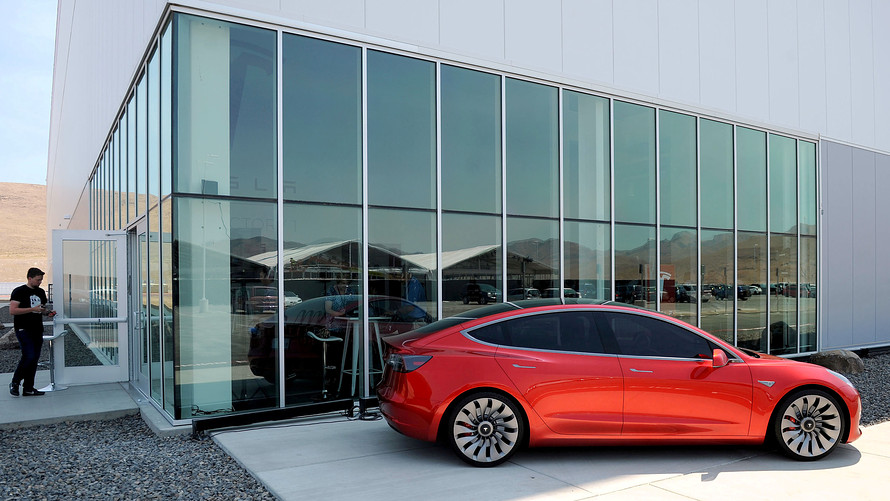
Tesla TSLA, -1.48% announced a mid-range Model 3 with a base price starting at $45,000 Thursday, $4,000 cheaper than the previous lowest base price on the car that Musk has promised would be aimed at the mass market. Musk pointed out that the car would cost $35,000 after tax incentives (in California, at least), but the federal tax credit will begin phasing out for the company at the end of the year.

In a Friday note, Bernstein analyst Toni Sacconaghi wrote that the unexpected launch of a car slightly cheaper than the high-end Model 3 but still nearly 30% higher than the promised base price shows the issue with Musk’s promised price tag. In hindsight, the analyst wrote, Musk probably shouldn’t have made the promise.

“In retrospect, it is unclear whether Elon Musk should have ever promised a $35K Model 3,” Sacconaghi wrote. “The car is years ahead of its peers, and likely would have generated huge demand along with a tremendous consumer following, even with a base sticker price of $40K or $45K.”

By promising that price, Musk now faces a choice between angering customers who placed deposits expecting a $35,000 car, or hurting the company by putting out a car that won’t be profitable enough for Tesla to satisfy promises it made to investors, Sacconaghi wrote.

“In some senses, Tesla may be ’damned if you do, damned if you don’t’ regarding the $35K Model 3,” wrote the Bernstein analyst, who has a market perform rating and $325 price target on the stock. “If it does offer the base price Model 3 in early 2019 as CEO Musk has stated, gross margins are likely to be pressured, perhaps materially. On the flip side, if Tesla chooses to delay introduction of the base model, or make it available on a limited basis/with long delivery times, the company risks facing order cancellations/demand pressure (and an incrementally frustrated customer base).”

Tesla shares were trading 2.5% lower with about an hour to go in Friday’s trading session. The stock has declined 17.4% so far this year, as the S&P 500 index SPX, -0.04% has gained 3.6%.

Rogers profits up

A Rogers Communications Inc. logo is shown outside the Rogers Building in Toronto on Tuesday, April 22, 2014.

Rogers Communications Inc. says it had a net income of $594 million in the third quarter for a 17 per cent increase from the same quarter last year as it boosted its full-year outlook.

The telecom company says the earnings per share for the quarter that ended Sept. 30 worked out to $1.15 per diluted share, up from 98 cents per share last year.

Adjusted net income hit $625 million, or $1.21 per share, which beat analyst expectations of $601 million and $1.17 per share according to Thomson Reuters Eikon.

Rogers has boosted its growth range by two percentage points for cash flow and adjusted earnings before taxes and other charges, while sticking to its earlier revenue growth and spending guidances.

The company says it saw three per cent total revenue growth to $3.77 billion, driven by a five per cent increase in its wireless service segment.

Cable revenue grew by one per cent, while media revenue was down five per cent because of lower revenue from the Toronto Blue Jays.

Stantec out of construction

Canadian engineering-design giant Stantec Inc. is selling its construction arm in a much-anticipated deal following a review begun last spring of how to best extract value from the operation it bought 2 1/2 years ago.

The Edmonton-based company says it has an agreement to sell MWH Constructors, including its U.K. and U.S. divisions and subsidiary Slayden Constructors, Inc., to funds managed by Oaktree Capital Management, L.P., of Los Angeles.

No financial details were provided but RBC analyst Derek Spronck said in a report he estimates Stantec will get proceeds of between $250 million and $350 million, assuming the price is five to seven times adjusted earnings.

The construction company which focuses mainly on water and wastewater projects in the United States and the United Kingdom was included in Stantec’s $1-billion purchase of Colorado-based engineering, consulting and construction firm MWH Global, Inc. in 2016.

The purchase also included water software business, Innovyze, Inc., which Stantec sold for $359 million in 2017.

In a news release, Stantec says selling both allows it to continue to focus on its core consulting services business globally. The company says on its website it has 22,000 staff in 400 locations on six continents.

Calgary opens drone park

The sky’s the limit as Calgary opens what it believes is the first testing area in Canada for drones, autonomous vehicles and other technologies.

The city has set aside a 50-hectare site in its industrial southeast to offer airspace for an increasing demand from companies and educational institutions wanting to do mass tryouts of commercial drones.

A downturn in the energy industry when oil prices took a free fall in 2014-15 spurred the development of geospatial sciences, said Patti Dunlop of Calgary Economic Development.

“There’s many companies that came out of the downturn that actually took their engineers, mathematicians and … transitioned into … another burgeoning technology,” she said. “Energy will always be our backbone but we are more than that.”

Geographic information systems are designed to capture, store, analyze and manage spatial or geographic data.

Mayor Naheed Nenshi said the Calgary testing site will be a boon to many sectors, including oil and gas, film and financial services.

“We have a part of the city that is part of the endless prairie where there are no buildings, so the concept of the living lab, here, for the first time in Canada … really allows us to help these companies grow,” he said Friday at the official opening of the testing area.

Nenshi gave an example of how new technology can be used in everyday life.

“I had my roof damaged in a hailstorm. The insurance company was able to send a drone over my roof to look at the damage without having to send someone over to climb a ladder and have a look there.”

Dunlop said a pilot project last year offering a test area within the city was so successful it led to the permanent site that opened Friday.

“From what I know, nobody else has started doing this. There’s places in the United States that have testing, but in Calgary we’re the first municipality that’s allowing this type of testing to happen.”

There are requirements companies have to meet to use the test centre. They include licensing fees, proof of $2 million in corporate liability insurance and a special flight operations certificate for drone technology.