Archives for October 20, 2018

‘Masterpiece of British engineering’ – technology at heart of Bepicolombo Mercury mission

An artist’s impression of Bepicolombo approaching Mercury

THE COUNTDOWN is underway for the launch of a pioneering spacecraft which scientists hope will help unlock the mysteries of Mercury – and British innovation is at the very heart of the exciting project.

Bepicolombo, a collaboration between the European Space Agency (ESA) and the Japan Aerospace Exploration Agency (JAX), is due to lift off from European Space Agency’s (ESA) base in Kourou, French Guiana, in the early hours of tomorrow morning.

Taking seven years to reach the planet closest to the Sun, the challenges are formidable – but Joe Zender, deputy project scientist with ESA, said the potential rewards were likewise enormous.

He said: “Mercury is the least understood rocky planet.

“If we look at the origins of the other planets in our solar system, we have an idea of how they formed.

“There is one exception – Mercury, which does not fit with our model.

“It’s a mystery – it does not fit with our current understanding.”

Bepicolombo – named after Italian mathematician Giuseppe “Bepi” Colombo, who died in 1984, will be taken into space by an Ariane 5 rocket which will be launched from the ESA’s base in Kourou, French Guiana – with Mr Zender and his colleagues facing an anxious wait until then.

It will take the BepiColombo spacecraft into orbit around Earth, the first stage of a five billion mile journey to Mercury which will take seven years.

Bepicolombo on the launchpad in French Guiana

Mr Zender said the probe will study the structure and evolution of Mercury, which previous NASA missions have suggested the planet has a molten core far larger than Earth’s.

He said: “If we look at the densities of planets, Mercury is much too dense for where it is, according to what we know.

“It also has an atmosphere and a magnetosphere.

“It reveals a huge gap in our understanding.”

Mercury, pictured from NASA’s Messenger probe in 2015

Mr Zender said the journey to Mercury was difficult because of the enormous gravitational pull of the Sun.

In order to compensate for this, ESA scientists will attempt to reduce its speed by performing “slingshots” around the Earth, Venus and Mercury itself.

And crucially, the spacecraft is fitted with four T6 ion thrusters, fuelled by the inert gas xenon, which were designed and built right here in the UK by QinetiQ at its base in Farnborough.

Mr Zender said: “They are masterpieces of engineering.
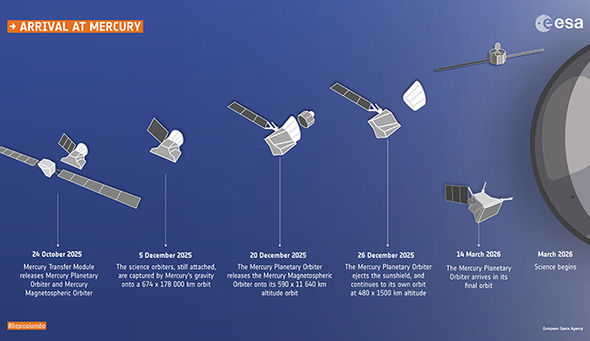
Bepicolombo’s journey to Mercury

“What is really new is the way that they use ion propulsion.”

The thrusters carried an extremely high voltage of 1200 watts, Mr Zender explained, significantly more than previous similar devices, which reached a maximum of 900 watts.

Nor is this the only British involvement. Aerospace company Airbus is responsible for the systems design and building of the mission’s Mercury Planetary Orbiter (MPO), which will study the planet’s surface and internal composition; the Mercury Transfer Module (MTM), providing solar-electric propulsion on the trajectory to Mercury; and MOSIF, the sunshield which will protect it from the colossal temperatures it will face at it approaches the Sun.

Assuming all goes well with the launch, Bepicolombo should start getting data by April 2026, so Mr Zender is facing a long and anxious wait for news.

He said: “Tomorrow’s a big moment but it is exciting.

“This is a chance to do some tremendous science.”

Cityblock CEO says technology can “stitch together” broken health ecosystem

Christopher Huang

Cityblock Health’s Iyah Romm talks about how to combine technolgoy and hyper local resources to remedy patient distrust in the system.

Distrust in the healthcare system is a major obstacle in providing needed care to some of the most vulnerable populations in the US.

“[M]illions of Americans all across the country … are failed by the healthcare system everyday. Specifically we don’t understand the services that they need,” Iyah Romm, founder and CEO of Cityblock Health, an Alphabet spinout focused on urban-focused public health, said at the Connected Health Conference in Boston. “We haven’t built a system that is [tuned] in on how to engage, facilitate interaction and fundamentally to solve, what I believe is a foundation problem in healthcare today, trust.”

Only about half of Americans say they can trust their doctor—and the number of distrust goes up considerably for people living in poverty and people of color, he went on to say. But he argues that relationships are at the heart of solving this problem.

“We have to invest time in meaningful relationships. We are focused on building technology that does just that,” Romm said. “Trust and technology together will build care that works. Building a foundational system that builds relationships that matter, that are available, and always on, and do the most fundamental thing in healthcare, which is keep our promises.”

While health tech tools have been increasingly available for consumers—those tools often focus on white upper middle class or upper class individuals, he said. That doesn’t mean that people living in poverty don’t have smartphones—he notes that 97 percent of people in that demographic do have smartphones.

One of the ways that Romm and his team at Cityblock have proposed solving this issue is through a platform called The Common. The tool allows a care team to wrap around a patient and connect.

“Part of the notion here is that technology has to stitch this ecosystem together,” he said. “The notion that health is local and pervades everything we all talk about across why these models don’t scale. So as opposed to running away from that and saying ‘it’s impossible’ we’ve embraced it. We said ‘How do we build a tech platform that adapts to locality?’”

But it isn’t just about the technology platform. Cityblock employs a new model of care, where a Community Health Partner (CHP), who ise hired from the community and trained in empathy and relationships, acts as the point person for the patient. Then the technology puts the CHP at the center of the care and communication team.

“Importantly [the CHPs] are the culture center for the team. If a patient doesn’t like how a doctor is interacting with them—the community health partner is never going to say don’t prescribe that medication—that’s not their job—but they are going to say check your bias. That is a statement that this member now no longer trusts you and we can push [the doctor] off the care team to bring in another member.”

The system is also designed to help teams look at the patient holistically and take different cultural norms into consideration.

“We have to be responsive in how we conductive assessments like this so it isn’t checking boxes,” Romm said. “It is a dynamic learning system that allows us over time to adapt to race sex, gender, trauma geography, religion, whatever those factors may be, so that over time we are adapting.”

Since Romm and his team prioritize trust, he said providing transparency to patients is key. With permission, Cityblock lets its patients get their health records through their Gmail account.

“In a trusting relationship. [providers] do not have something different than our members have,” Romm said. “So we give them free access to everything we say and do — side notes and all.”

While this platform maybe be targeted at people living with poverty, Romm said that these tools could help the entire health ecosystem in the future.

“Solutions for the one percent simply do not trickle down. We have had this solution in healthcare over and over again,” Romm said. “We believe the inverse is true however, that if you build for those with the most complexity there is tremendous value. So we don’t build with the notion that we are only building for poor people, we build with the notion that you have to take into consideration those who have the most complexity first. This drives all new ways of thinking and it drives us to check our biases in design.”

Sky’s the limit as Calgary opens testing area for drones and new technologies

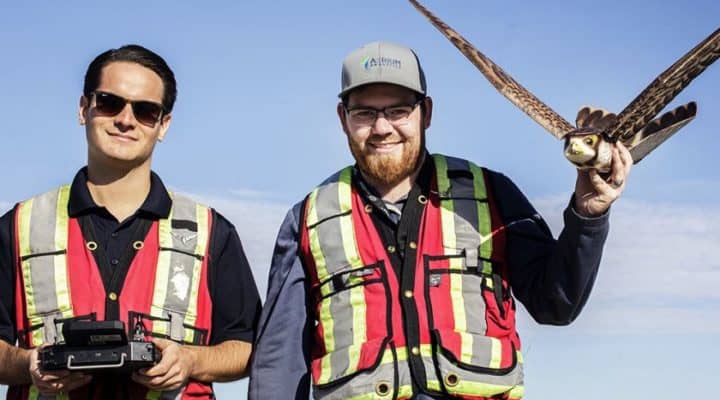
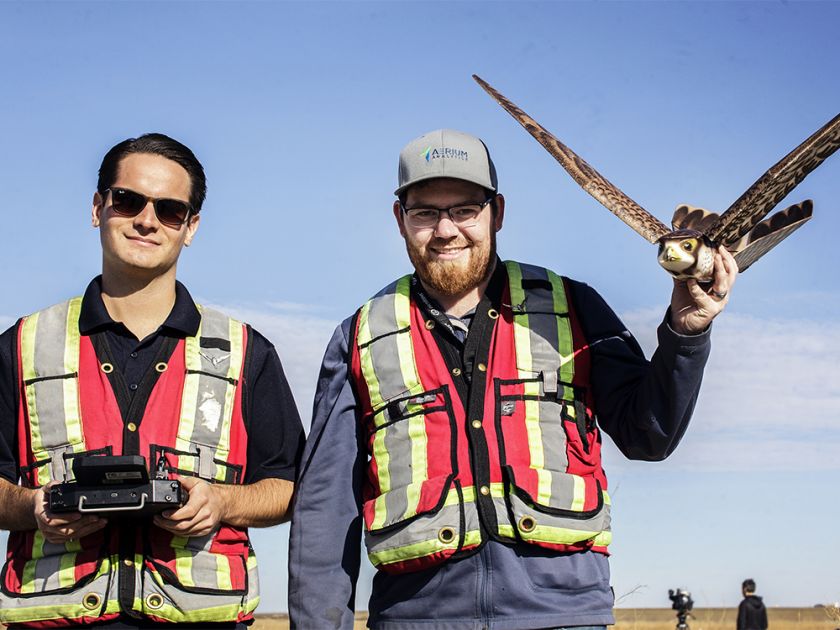
AERIUM Analytics Inc. pilots show off the Robirdóa remote controlled birdófollowing a drone testing demonstration at the newly opened Point Trotter Autonomous Systems Testing Area (Point Trotter ASTA) in Calgary.

The sky’s the limit as the city of Calgary opens what it believes is the first testing area in Canada for drones, autonomous vehicles and other technologies.

The city has set aside a 50-hectare site in its industrial southeast to offer airspace for an increasing demand from companies and educational institutions wanting to do mass tryouts of commercial drones.

A downturn in the energy industry when oil prices took a free fall in 2014-15 spurred the development of geospatial sciences, said Patti Dunlop of Calgary Economic Development.

“There’s many companies that came out of the downturn that actually took their engineers, mathematicians and … transitioned into … another burgeoning technology,” she said. “Energy will always be our backbone but we are more than that.”

Geographic information systems are designed to capture, store, analyze and manage spatial or geographic data.

Calgary mayor Naheed Nenshi launches a drone with the help of Tanner McEwan, a co-pilot from IN-FLIGHT Data on Friday, Oct. 19, 2018. Nenshi was participating in a drone testing demonstration at the newly opened Point Trotter Autonomous Systems Testing Area (Point Trotter ASTA)

Mayor Naheed Nenshi said the Calgary testing site will be a boon to many sectors, including oil and gas, film and financial services.

“We have a part of the city that is part of the endless prairie where there are no buildings, so the concept of the living lab, here, for the first time in Canada … really allows us to help these companies grow,” he said Friday at the official opening of the testing area.

Nenshi gave an example of how new technology can be used in everyday life.

“I had my roof damaged in a hailstorm. The insurance company was able to send a drone over my roof to look at the damage without having to send someone over to climb a ladder and have a look there.”

Photo illustration showing the flight movements of the Robirdóa remote controlled birdóduring a drone testing demonstration at the newly opened Point Trotter Autonomous Systems Testing Area (Point Trotter ASTA) in Calgary on Friday, Oct. 19, 2018. Illustration includes five photos.

Dunlop said a pilot project last year offering a test area within the city was so successful it led to the permanent site that opened Friday.

“From what I know, nobody else has started doing this. There’s places in the United States that have testing, but in Calgary we’re the first municipality that’s allowing this type of testing to happen.”

There are requirements companies have to meet to use the test centre. They include licensing fees, proof of $2 million in corporate liability insurance and a special flight operations certificate for drone technology.

Did reliance on technology contribute to fetal demise?

The interim update of the ACOG Practice Bulletin on Tubal Ectopic Pregnancy1provides a review of information on the current understanding of tubal ectopic pregnancy and offers comprehensive guidelines for timely diagnosis and management options. Compared to the previous publication, the current bulletin provides comprehensive management options for ectopic pregnancy by incorporating new guidance on pregnancy of unknown location and on surgical management of ectopic pregnancy, as well as revised guidance on use of hCG levels for diagnosis.

ACOG recommends not using serum hCG values alone to diagnose an ectopic pregnancy and that they be correlated with the patient’s history, symptoms, and ultrasound findings. If the concept of the hCG discriminatory level is to be used as a diagnostic aid in women at risk of ectopic pregnancy, the value should be conservatively high (eg, as high as 3500 mIU/mL) to avoid the potential for misdiagnosis and possible interruption of an intrauterine pregnancy that a woman hopes to continue.

Overall, in this Practice Bulletin, ACOG is advocating use of a comprehensive approach and more conservative guidelines to avoid the potential for misdiagnosis, possible interruption of an intrauterine pregnancy or unnecessary medical treatment that could lead to teratogenicity in surviving pregnancies.

While this Practice Bulletin specifically and clearly emphasizes the importance of discussion of risks versus benefits with patients in determining treatment method, there are also other logistical issues that may arise and affect decisions about treatment. Most ectopic pregnancies are managed in the outpatient setting and with minimal variation in the team involved. However, depending on individual hospital and office setup, if different laboratories and/or hCG assays are used for trending hCG levels, it is possible that these inter-assay/laboratory variabilities in hCG values could significantly affect the clinical decision-making process. In addition, the issue concerning insured and uninsured patients deserves special consideration. It has been shown that there exists substantial insurance-related variation in treatment. Uninsured women and Medicaid recipients were less likely to receive treatment with methotrexate and were less likely to undergo salpingostomy. In the same article, the authors also discuss the disparity in that black and Hispanic women were less likely to receive tube-conserving surgery.

Some of the recent changes that have facilitated a more conservative approach in treatment of tubal ectopic pregnancy include wider availability of methotrexate, use of early sonography and management of pregnancy of unknown location with uterine aspiration to distinguish between early intrauterine pregnancy loss and ectopic pregnancy. These factors are leading to earlier diagnosis of the disease and subsequent growth in medical management in the outpatient setting. When indicated, surgical management with minimally invasive surgical techniques is preferable to laparotomy. It is important to note that ACOG recommends that the decision to perform a salpingostomy or salpingectomy for treatment of ectopic pregnancy be guided by the patient’s clinical status, her desire for future fertility, and the extent of damage to the fallopian tube.

There has been a decline in rates of salpingostomy compared to salpingectomy. Although cumulative rates of intrauterine pregnancy and recurrence of ectopic pregnancy in patients who had salpingostomy versus salpingectomy are not statistically significantly different in randomized controlled trials, the move towards salpingectomy is increasing.This is likely due to a combination of many factors, including patient history, intraoperative findings, physician preference and comfort with the procedure as well as increased availability of in vitro fertilization. As the number of salpingostomies being performed nationwide continues to decrease,it is possible that over time, younger physicians will become unskilled in performing the procedure and the frequency could drop even more drastically. Furthermore, recent publications favoring opportunistic salpingectomy for risk reduction of ovarian cancer may be leading physicians towards complete tubal removal whenever feasible.

Facebook Recruits EU Veteran to Help With Tougher Scrutiny

Facebook has hired former U.K. deputy prime minister Nick Clegg to head its global policy and communications teams, enlisting a veteran of European Union politics to help it with increased regulatory scrutiny by the bloc.

LONDON — Facebook has hired former U.K. Deputy Prime Minister Nick Clegg to head its global policy and communications teams, enlisting a veteran of European Union politics to help it with increased regulatory scrutiny in the region and snowballing challenges to its reputation.

Clegg, 51, will become a vice president of the social media giant, and report to Chief Operating Officer Sheryl Sandberg. He described the new job Friday as “an exciting new adventure,” after 20 years in British politics.

Clegg will particularly be called upon to help Facebook grapple with a changing regulatory landscape globally. EU regulators are interested in reining in mostly American tech giants who they blame for avoiding tax, stifling competition and encroaching on privacy rights.

In a post on his Facebook page, Clegg described the company as being not just part of many people’s lives, “but also at the heart of some of the most complex and difficult questions we face as a society: the privacy of the individual; the integrity of our democratic process; the tensions between local cultures and the global internet; the balance between free speech and prohibited content; the power and concerns around artificial intelligence; and the wellbeing of our children.

“I believe that Facebook must continue to play a role in finding answers to those questions – not by acting alone in Silicon Valley, but by working with people, organizations, governments and regulators around the world to ensure that technology is a force for good,” he wrote.

It’s not the first time a major corporation or non-profit has poached a former political leader to offer clarity on the inner workings of government. After wrapping up his work as president of the European Commission, Jose Manuel Barroso joined Goldman Sachs as non-executive chairman in 2016. Former German chancellor Gerhard Schroeder went on to chair oil company Rosneft; former U.K. Foreign Secretary David Miliband moved to New York to become CEO of the International Rescue Committee.

Tech companies have been poaching British talent for years as well, though Clegg appears to be the highest-ranking departure to date. Steve Hilton, a former director of strategy to ex-Prime Minister David Cameron, decamped to California and now hosts a Fox news show. Tim Chatwin, another Cameron aide, now works for Google, as does Theo Bertram, who worked in Downing Street for Labour Party Prime Ministers Tony Blair and Gordon Brown.

Clegg led the Liberal Democrats from 2007 to 2015, including five years in the coalition government with the Conservatives. He lost his seat at last year’s general election. Before that, he was a member of the European Parliament from 1999 to 2004.

In recent months, he has been an active campaigner for a second referendum on Brexit, in hopes of preventing Britain’s departure from the EU. Clegg argued that supporters of Brexit failed to explain the sacrifices that will follow an exit, but he said it was nonetheless time for him to go.

Clegg, who starts Monday, said that he and his family will be moving to California to take on the new job in the coming year. He had been discussing a new role with Sandberg and CEO Mark Zuckerberg over the summer.

Sandberg also posted a welcome to Clegg on Facebook which also echoed his comments that technology can be used “to do good.”

“Our company is on a critical journey,” she wrote. “The challenges we face are serious and clear and now more than ever we need new perspectives to help us though this time of change.”

Gold secures weekly gain as dollar slips, stocks trade mixed

Gold futures fell Friday but secured a weekly advance, their third in a row, as a leading dollar index softened and stocks put in a mixed session.

Investors kept tabs on budget tensions in Europe, which could have consequences for broader market sentiment.

December gold GCZ8, -0.01% fell $1, or 0.1%, to $1,229.10 an ounce after spending time in positive and negative territory. The ICE U.S. Dollar Index DXY, -0.36% slipped 0.3% at 95.68 but has strengthened 0.6% so far in October and is up roughly 4% year to date in the wake of interest-rate hikes at the Federal Reserve, another of which is expected before the year is out.

“The attempt by gold to lastingly exceed the 100-day moving average looks promising,” said Carsten Fritsch, commodities analyst with Commerzbank, in a note. “If it succeeds, technical follow-up buying should push the gold price further up. At the same time, gold is resisting the firm U.S. dollar.”

As Italy continues to spar with officials in the wider regional bloc, the spread between German and Italian bond yields—a measure of concerns in Europe and among market participants worried about contagion—stands at 3.375 percentage points. That is the widest in about five years.

Haven gold “is finding support from increased risk aversion among market participants, as reflected in falling stock markets [U.S. markets were mixed Friday as gold closed], and from additional ETF inflows,” Fritsch said. “The conflict between Italy and the EU over the Italian draft budget for 2019 is escalating. The question is already being raised of how sustainable Italian debts are, especially if yields continue to climb.”

Gold futures are headed for a 0.6% weekly gain, according to FactSet data, while the metal has advanced 2.8% so far in October; it is down roughly 7% for 2018 to date.

“Technically, gold bulls have the near-term technical advantage. This week’s pause is not bearish,” said Jim Wyckoff, senior analyst with Kitco.com. He said bulls are watching for a futures close above “solid resistance” at $1,250 to confirm their viewpoint. For bears, the next near-term downside price breakout objective is below solid technical support at $1,200.

Meanwhile, December silver SIZ8, +0.31% was up 4 cents, or 0.3%, at $14.65 an ounce, attempting to snap what had been a string of three weaker sessions. The contract did salvage a 0.3% weekly gain.