Archives for May 30, 2018

Why Universal Display Corporation Stock Popped Today

Shares of Universal Display Corporation (NASDAQ: OLED) jumped as much as 17% early Tuesday before settling to close up 4% following reports that Apple (NASDAQ: AAPL) has chosen to adopt OLED displays across its entire iPhone line.

More specifically, according to “industry sources” speaking to South Korea’s Electronic Times, Apple will expand its use of OLED displays from just a single model — as it currently does with only its high-end iPhone X — to all three of its newer iPhone models to be launched in 2019.

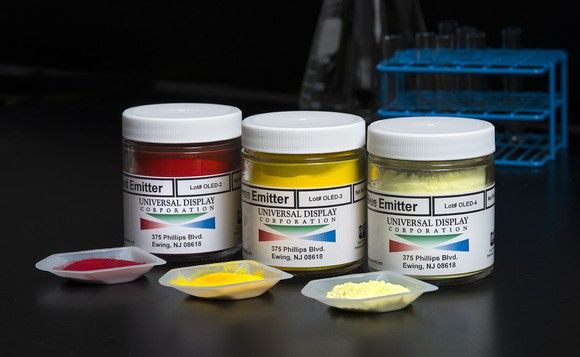
Three jars containing red, blue, and green phosphorescent OLED material with Universal Display logo

So what

The same sources noted that if Apple ultimately opts to launch more than three iPhone models in 2019, it may be forced to continue using LCD displays in at least one model because of manufacturing bottlenecks. But assuming Apple moves forward with its OLED-centric plans, it’s likely it will continue sourcing OLED panels from Samsung Display — which currently serves as Apple’s sole OLED display provider — while enlisting LG Display (NYSE: LPL) as a secondary supplier.

To be clear, Samsung Display and LG Display are Universal Display’s two largest customers; both companies have long-term patent license and OLED material supply agreements with the OLED technologist.

Now what

The move shouldn’t be terribly surprising to longtime Universal Display investors. In fact, shortly after Apple incorporated OLED into its first-generation Apple watch in 2015, I even wrote, “I think it’s quite possible that, over time, Apple will completely transition away from LCD and toward OLED.”

And when Universal Display announced strong first-quarter 2018 results earlier this month, CFO Sidney Rosenblatt insisted their story was still in its early stages, adding that “we continue to expect 2019 to be a meaningful year of growth.”

Still, it’s equally unsurprising that Universal Display stock would pop on these fresh reports of Apple’s dedication to its flagship technology. And I think Universal Display shareholders have every reason to celebrate.


These 3 Stocks Shot Up 50% in 2017 — Are They Still Buys?

Most financial literature stresses the point that impressive past financial returns don’t guarantee good results in the future. And while that’s strictly true, market-thumping stock price growth often results from the type of fundamental improvements in a company’s business that can drive many years of gains.

With that in mind, we asked Motley Fool investors to scour the pool of recent high-flying stocks for investments that might keep rising. Read on to find out why Boeing (NYSE: BA), Constellation Brands (NYSE: STZ), and Geron (NASDAQ: GERN) topped this list.

A space shuttle taking off.

This stock keeps flying higher

Dan Caplinger (Boeing): You don’t often see stocks in the Dow Jones Industrial Average make aggressive upward moves over short periods of time, but Boeing gained a lot of altitude in 2017. The aerospace giant saw its shares soar almost 90% last year, riding the wave of aircraft orders from an airline industry that’s healthier than it’s been in decades. With plenty of available cash flow, buyers are investing in new aircraft to modernize their fleets and increase efficiency, and Boeing’s new models are among the most popular in the world. Boeing’s strength has continued into 2018, with the stock higher by more than 20% so far this year as well.

Fundamentally, Boeing is doing a lot of things right. Moves to emphasize its most popular lines of aircraft and to look at internal efficiency gains have had a big impact on margin for its key commercial business, and that’s boosting profit substantially. In particular, the workhorse 737 series of planes has been more popular than ever, and new variants are getting a lot of attention from buyers. Add to that expected demand for wide-body models like the 757, 767, and 777, and Boeing seems to have its engines revved up for maximum growth. As long as airlines continue to thrive, Boeing and its shareholders should keep reaping the rewards.

An attractive risk-to-reward ratio

George Budwell (Geron Corporation): Geron Corporation has nearly doubled in value so far this year, but the best may be yet to come for this tiny drugmaker. If you’re not familiar with this story, Geron is developing a first-in-class telomerase inhibitor called imetelstat with the biopharma giant Johnson & Johnson for two blood cancers known as myelofibrosis (MF) and myelodyspastic syndromes (MDS).

J&J currently owns an exclusive global license to the drug and the company is expected to decide whether to keep this license by the end of the third quarter of this year. In short, Geron is staring down a critical binary event that could make or break its stock later this year.

The good news, though, is that imetelstat seems to be bending the curve in terms of overall survival for its MF indication, and generating substantial improvements in patients with MDS as well. The downside is that J&J is keeping a tight lid on the results for both trials; so investors won’t known anything concrete until the company unveils its Continuation Decision regarding the collaboration in Q3.

Now, if J&J walks, Geron will have to make some tough choices. After a recent capital raise, for instance, the biotech seems to have enough cash to at least get imetelstat’s planned late-stage trial in MDS under way, but the drug’s MF indication would almost certainly be tabled in the event J&J cuts bait. But the silver lining here is that Geron no longer appears to be in imminent danger of folding if J&J does end the collaboration.

So, with a viable path forward on the table in a worst-case scenario, and a monstrous short-squeeze possible if J&J decides to stay the course, Geron’s stock appears to offer a rather enticing risk-to-reward ratio right now. That said, this penny biotech stock is arguably only suited for the most aggressive of investors due to the strong possibility that its shares will tank — at least temporarily — if J&J leaves the picture.

More gains ahead for this alcoholic beverage giant

Demitri Kalogeropoulos (Constellation Brands): The broader beer industry saw little growth last year, but Constellation Brands’ impressive sales and profitability gains left peers like Anheuser-Busch InBev, Molson Coors, and even Boston Beer far behind. In fact, its imported beers like Corona and Modelo were responsible for most of the industry’s growth in 2017, and Constellation Brands amplified that success by boosting selling prices and lifting its operating margin to a new high.

Friends drinking beer at a bar.

After five consecutive years of 20% or better earnings growth, Constellation Brands is on track for a significant slowdown this year. Management is targeting a 10% profit increase in 2018 as they spend aggressively on marketing support for core beer and wine products and for promoting the launch of Corona Premier, the first national expansion of that brand in over 25 years.

Yet Constellation Brands still looks like a good buy today. Its beer business is expected to grow at a healthy 10% pace this year while the wine and spirits segment boosts sales and profitability. Looking further out, the company’s massive capacity expansion project should soon start reducing costs, and investors can also look forward to increased direct cash returns in the coming years now that the capital spending has peaked. There’s the potential that the company will profit from the sale of marijuana, too, as its legalization begins to open the door to edible cannabis products starting in 2019.

Micron Investors Might Have a Tough Decision to Make Soon

The blistering growth in memory prices over the past couple of years has taken Micron Technology’s (NASDAQ: MU) business to the next level. The chipmaker has enjoyed terrific top- and bottom-line momentum thanks to booming memory demand that has outpaced supply, but cracks could soon appear in its primary growth engine.

Artists’s rendering of a processor mounted on an integrated circuit.

Greed could bring an end to the memory chip boom

Just like Micron, SK Hynix (NASDAQOTH:HXSCL) and Samsung (NASDAQOTH:SSNLF) are also riding the memory price boom. The operating profit of Samsung’s semiconductor business nearly doubled during the first quarter of 2018 thanks to the strong demand for NAND (negative-AND) flash and DRAM (dynamic random access memory) chips. SK Hynix, meanwhile, saw a 77% jump in first-quarter operating income on the back of similar catalysts.

Such terrific growth at Samsung and SK Hynix, which together hold almost half of the NAND flash market and nearly three-fourths of the DRAM market, could lead investors into believing that the industry’s momentum is here to stay. However, this massive earnings growth seems to have made both Samsung and SK Hynix overconfident and greedy.

I say overconfident because both seem to believe that the price momentum is here to stay, and greedy because they are going to boost their memory production capacity. For instance, Samsung has set aside another $12 billion to make DRAM chips at a second semiconductor production line in South Korea’s Pyeongtaek, which it plans to complete in the second half of 2019. The South Korean giant had earlier spent over $14 billion on a NAND flash production line that it is currently busy ramping up.

SK Hynix, on the other hand, announced a $2.6 billion investment at the end of 2016 for building a NAND flash facility in China, and also for upgrading a DRAM plant. It expects this facility to go into production late next year.

Micron doesn’t want to be left behind in this race and the chipmaker recently broke ground on a new facility in Singapore to make 3D NAND that it expects to complete by late 2019, and it will reportedly spend “billions of dollars” on this facility, according to AnandTech.

These chipmakers are hoping that all the new production that’s going to come into the market will be absorbed by smartphones, servers, the Internet of Things, and other emerging tech trends such as autonomous cars. But an increase in demand isn’t guaranteed just yet. For instance, both SK Hynix and TSMC have warned of a slowdown in smartphone chip sales this year.

Smartphone sales fell 5.6% in the fourth quarter of 2017, followed by a 2.9% drop during the first quarter of 2018. What’s even more alarming is that Chinese smartphone sales growth came to a halt in 2017 after eight years.

So, the smartphone industry seems to be maturing, and this spells bad news for both NAND and DRAM demand as smartphones reportedly account for a third of global memory chip demand.

Demand-supply parity spells bad news for Micron

The demand-supply parity in the NAND business has started hurting Micron already. Its NAND revenue dropped 3% sequentially in the most recent quarter, as an increase in shipments was negatively offset by a mid-teens percentage drop in the average selling price. As a result, the segment’s gross margin dropped 2 percentage points sequentially.

NAND prices reportedly fell between 3% and 10% during the first quarter of the year, and a steeper drop of 10% to 15% is projected in the current quarter. The price declines could accelerate as more NAND supply comes into the market thanks to the capacity investments being made by SK Hynix and Samsung. Some estimates suggest that NAND supply is expected to rise 43% this year as compared to a 34% increase in 2017.

Meanwhile, Micron’s DRAM business is still in good shape, as average selling prices had increased in the mid-single digits last quarter, but higher production and lower smartphone shipments could make things ugly. For instance, Apple CFO Luca Maestri said that mobile DRAM prices will peak by the end of the year, and this prediction doesn’t look like a long shot considering the dynamics at play in the smartphone space.

The worst-case scenario

Micron grew impressively last quarter despite the NAND decline as it gets 71% of its revenue from the DRAM segment. But if DRAM prices start taking a turn for the worse, the chipmaker will be in deep trouble.

UBS analysts believe that DRAM prices could crash as much as 50% in the second half of 2018 as new production comes online. UBS’ forecast might seem too aggressive, since we saw that the wave of new production capacity could come online only by next year, but this still means that Micron might have just one good year left before it gets crushed by unfavorable market dynamics.

Even then, Micron will remain under pressure, as investors will be on the lookout for potential signs of weakness in the memory industry and likely won’t be afraid of pulling the trigger to sell the stock if they find negative developments. And, in my opinion, they will be right in doing so, because Micron has a terrible record when faced with unfavorable chip prices.

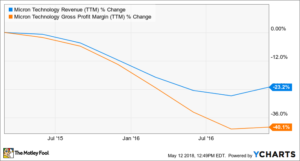
For example, Micron had a really bad time back in 2015 and 2016. Weak PC demand coupled with industry oversupply led to a 50% crash in DRAM prices in 2015, which was followed by a 20% slump for the majority of 2016. And this led to the following drops in revenue and gross profit margin:

MU Revenue (TTM) data by YCharts

The above chart is a far cry from what Micron investors have experienced since the recovery started in the second half of 2016, so they may soon have to decide if they want to start booking profits in case DRAM and NAND prices get into a downward spiral.

3 Growth Stocks That Could Put Shopify’s Returns to Shame

Investing in high-growth stocks can be both exciting and financially rewarding. But the largest returns are reserved for patient investors who buy shares of great businesses early, then hold on for the long term.

Shopify (NYSE: SHOP) is one such business that illustrates that point nicely. Shares of the leading e-commerce platform provider have soared more than 400% since shortly after its mid-2015 initial public offering — and this despite falling into the crosshairs of a noted short-seller late last year.

Of course, many investors believe that, with e-commerce still in its earliest stages, Shopify still has room to run in the coming years. But its incredible gains so far also raise the question: Are there any stocks on the market that could put even Shopify’s returns to shame?

So we put that question to three Motley Fool contributors. Read on to learn why they put New Relic (NYSE: NEWR), XPO Logistics (NYSE: XPO), and eBay (NASDAQ: EBAY) on their short lists of stocks capable of outperforming a five-bagger.

Man in suit pointing to a line graph indicating volatile gains

A promising cloud-computing play

Steve Symington (New Relic): In today’s high-tech world — especially in the world of cloud computing — it’s easy to take for granted that most things just work as intended. But that’s largely thanks to businesses like New Relic, whose cloud platform offers real-time insight and performance-tracking to its base of over 15,000 customers in 101 countries.

It’s latest quarterly report, released earlier this month, shows that New Relic is absolutely thriving. Revenue increased 34% year over year to $98.4 million, and adjusted earnings swung from a loss of $0.11 per share a year ago to a profit of $0.09 per diluted share, or $5.4 million. Both figures arrived significantly above analysts’ average expectations for earnings of $0.05 per share on revenue of $96.3 million. And new Relic forecasts that revenue will rise another 28% in the coming fiscal year, representing only a slight deceleration in its growth.

“We attribute our continued momentum in the enterprise market to our success in helping companies solve business-critical issues including mastering the complexity of modern software, reducing the risk of service interruptions for customer-facing applications, and competing in the digital era,” explained founder and CEO Lew Cirne.

To be clear, New Relic is perfectly positioned to benefit from the rapid growth of cloud computing. And as more enterprise customers realize the value that its platform brings to the table, I think its stock has plenty of room to rise from here.

Another way to play e-commerce

Jeremy Bowman (XPO Logistics): Shopify stock has been a popular way for investors to play the growth opportunity in e-commerce, and the software provider’s blockbuster revenue growth shows the potential in the sector. However, I believe e-commerce will create many big winners in the stock market, and one of them, XPO Logistics, could easily outperform Shopify.

Over the last year, XPO has been the better stock to own: It jumped 106% against a 63% gain for Shopify. A specialist in last-mile delivery of heavy goods like furniture and appliances, it handles the other end of the supply chain from Shopify. As e-commerce orders continue to surge, the need for the delivery and logistics services provided by companies like XPO will only increase.

XPO has grown largely through acquisitions. It used a “roll-up strategy” to take over trucking companies, logistics services, warehouses, and technology companies en route to becoming a leader in the “less-than-truckload” heavy-item delivery segment — an area that rivals like UPS and FedEx have shown little interest in. CEO Brad Jacobs said last year that the company had set aside $8 billion to make additional acquisitions, and in February said its next major one would come by the end of 2018.

XPO is a favorite delivery partner of retailers like Amazon, IKEA, and Wayfair, and its stock surged late last year on rumors that Home Depot might be angling to acquire it, in part to keep it out of the hands of Amazon. While neither of those deals materialized, the rumors were a reflection of the company’s unique status and value.

Finally, unlike Shopify, XPO is profitable, and its adjusted net income more than doubled to $248.5 million last year, in part due to the benefits of synergies from its acquisitions. I’d expect the stock to continue its strong run as investors realize the magnitude of the opportunities ahead for the company.

A more profitable platform

Demitri Kalogeropoulos (eBay): eBay’s business lacks a head-turning sales growth pace, but it makes up for that weakness with impressive finances. The e-commerce platform kicked off fiscal 2018 with a 7% revenue boost as its base of active shoppers rose by 4%. And, while that’s far from Shopify’s 68% revenue increase, eBay’s steadier sales base generated impressive earnings and cash flow. Operating profits amounted to 23% of sales, compared to between 2% and 4% for integrated e-commerce retailers like Amazon and Walmart. eBay routinely converts a large portion of its sales into free cash, which gives management ample resources to direct toward improving the customer shopping experience and elevating the brand.

Investors should brace for more volatility in eBay’s turnaround effort. Sales volumes are sluggish right now, for example, and profitability is on track to tick lower this year. But CEO Devin Wenig and his team still believe revenue growth will speed up in 2018 and deliver a second straight year of accelerating gains. Combined with aggressive stock buybacks — and the possibility of other shareholder-friendly moves down the line, such as initiating a dividend — eBay’s returns for investors could significantly outpace the broader market over the next few years.

The bottom line

Shopify shares have set a high bar for performance over the past few years, and we obviously can’t guarantee that these three stocks will outpace those gains over the next few. But given New Relic’s position at the forefront of cloud computing, XPO’s enviable strength in delivery and logistics, and eBay’s rock-solid financials and ongoing turnaround, we think the chances are high that they’ll do exactly that.

Weed-plucking robot designed in Nova Scotia wins international competition

Nexus Robotics beat out teams from U.S. universities at the agBOT Challenge in Indiana

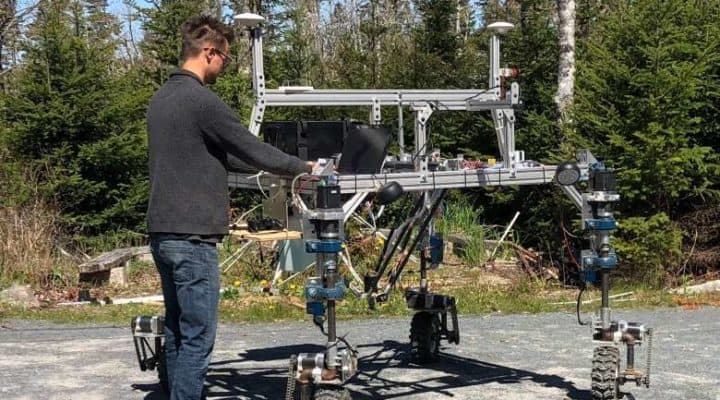
Marlon Wauchope says the robot is designed to autonomously navigate farm fields and it can make 360-degree turns. (Jerry West/CBC)

A new robot created in Nova Scotia may mean farmers could get some help tackling troublesome weeds in their fields.

This month, Nexus Robotics, a technology startup based in Dartmouth, N.S., won the weed-and-feed competition at the agBOT Challenge, an international showdown between agricultural robots in Rockville, Ind.

Dubbed R2 Weed2 or Hal-Bot, the autonomous machine uses artificial intelligence to distinguish between weeds and crops and is designed to both pluck weeds and spray herbicide.

“We want to get rid of the weed and keep the crop and even fertilize it. So one of the advancements … we made is vision systems can be better than humans at distinguishing them,” said Thomas Trappenberg, part of the small team behind the battery-powered robot.

The robot has a 1.5-metre square frame with a central nozzle for spraying fertilizer or herbicide and a cutting wheel to slice the weeds that have a less developed root system.

“We can treat different types of weeds differently because it’s more advantageous to cut certain weeds versus spray other weeds,” said Teric Greenan, who grows vegetables on a farm in Lunenburg County in addition to his work with Nexus.

Teric Greenan, who has a farm in northern Lunenburg County in addition to working with Nexus Robotics, says because the machine can identify weeds, it uses a ‘drastically lower’ volume of herbicides than would be sprayed when using a tractor. (CBC)

Greenan came up with the idea, and hopes it will save time and money for farmers who would otherwise fight weeds with a combination of herbicides and manual labour.

The machine uses a “drastically lower” volume of herbicides than what would be sprayed using a tractor, Greenan said.

“Because the robot is super accurate with where it’s spraying … it actually allows the robot to use a much more effective herbicide because it’s just hitting the weeds. Whereas before, if that was to just be sprayed randomly by a tractor, it would actually kill your crop,” he said.

“I think that our robot, it’s going to have a really big part to play in integrated pest management and making sure that weeds don’t become resistant to herbicides.”

The team created a program to give the robot images of plants and weeds of varying shades of green to help it distinguish between them.

Jad Tawil, who writes the software, said it could operate with up to 99 per cent accuracy if the plants were in a row.

“Basically with machine learning, if you feed a network enough data, it’ll learn the necessary features to distinguish between the classes of items you want it to distinguish between,” he said.

“Every pixel in the camera, in the image, is labelled with a certain probability that it is a certain kind of plant. This is used to steer the delta robot arm to it,” said Trappenberg.

Trappenberg said the startup’s team worked 16-hour days, seven days a week for two months in preparation for the competition, where they faced off against teams from large U.S. universities.

“I have to say, it was worth it,” he said. “This gives us the encouragement to work even harder.”

“Using our expertise, using people who know about it in this province, and showing that Nova Scotia can win a competition in North America, it … gives us the encouragement to work even harder.”

Though the robot is now in Trappenberg’s garage in Hatchet Lake, the work hasn’t stopped.

This summer, the team plans to work with farmers who are interested in trying out the prototype. They plan on designing a second version that they hope to get to farmers by next year, with hopes of eventually selling it.

Nvidia set to begin construction of 750,000-square-foot Voyager campus

nvidia gamescom gtx 1000 mobile gpus booth sign building headquarters convention group

Nvidia is gearing up to begin the second phase of construction at its Santa Clara, California headquarters. After completing construction on phase 1 — a 500,000-square feet building called Endeavor on its campus — in 2017, Nvidia is ready to break ground on a second building called Voyager totaling 750,000 square feet. Both buildings will be situated next to each other and share a similar futuristic design with a dramatic and flowing sculptural roof that was conceived by architectural firm Gensler.

For Voyager, Nvidia changed its mind on the total size of the building, adding 50 percent more space to the 500,000-square-foot plan by adding a third story to the construction, according to The Mercury News. “It was to be identical to phase 1, which they just occupied, which is 500,000 square feet in two stories,” Julie Leiker, a market research director with Cushman and Wakefield, told the newspaper. “They will add a third story to make it 750,000 square feet.”

Nvidia said it was still working out staffing plans, according to TechCrunch, but given that Endeavor’s 500,000-square-foot two-story structure houses 2,500 workers, the larger Voyager structure could potentially accommodate up to 3,750. Likely, the headquarters can staff up to 6,250 employees across Endeavor and Voyager. Nvidia employees approximately 11,500 people globally with some 5,000 in Santa Clara, so the larger Voyager building could allow Nvidia room to grow in the future without requiring more space for expansion.

Credit: TechCrunch

Like Endeavor, Voyager was shown in a photo-realistic rendering featuring a similar sculptural rooftop design with skylights and underground parking. The buildings appear to be connected via an open space area. Devcon, which was hired to construct Endeavor, will return for work on Voyager once construction begins in June.

Although it sounds like Nvidia drew inspiration from Star Trek for the names of its buildings, the real reason is that these words start with the sounds of “En” and “V,” which has the initial sounds as Nvidia, the company told TechCrunch.

Silicon Valley has recently become a hotbed of new construction for the technology industry. After having completed work on its headquarters in neighboring Cupertino, Califonia, Apple is also working on a second campus in Sunnyvale, California featuring a similar spaceship design. Google’s proposed campus in San Jose, California is expected to bring 15,000 to 20,000 jobs to the area, according to ABC News.

In addition to Voyager and Endeavor, Nvidia has a third phase. In total, the city of Santa Clara had authorized Nvidia to construct 1.95 million square feet of offices, so this could mean that Nvidia will have to scale down plans for a third building.