
Archives for May 29, 2018

5 steps to build a budget that works

At the centre of personal finance is budgeting. We can’t stop talking about it anytime money management is the topic of discussion.

A lot of people have lost interest in budgeting because it is not working for them. There are reasons for that. You can check them here.

However, budgeting is not a rocket science. It is very simple. Though not as ABC, but trust me, you don’t need a degree in money management to have a budget that works.

Here are the five simple steps to building a budget that works.

1. Set goals

Before you think of managing your money, you need to identify what is important to you.

This will help you to recognise your needs as against wants. Whatever you come up with will serve as your list of financial goals.

2. Identify your income and expenses

Once you’re able to identify your goals, it is important you take a look at your expenses and income. You’ll need to look at your source of income and how you spend it. Identify all the bills you pay. And everything you spend money on every month.

3. Separate needs from wants

When you are spending your money, you either spend it on needs or on wants. It is important to identify and separate your needs from wants while building your budget.

4. Design your budget

When some people think about the word budgeting, they think it involves lots of details and calculations. If this is how you see budgeting, you may not find it useful.

Relax, your budget is the spending plan that allows you to spend according to your means and at the same time help you reach your financial goals.

One thing you must be careful of while planning your budget is to ensure that your expenses are not more than your income.

5. Put your plan into action

This is where execution comes in. Having set goals, identify your income and expenses as well as your needs, it is time to follow the budget plans.

This will require you to be very disciplined in following the budget as you may render the budget useless if you do not track it.


Saving in a 529 is great, for those who can afford it

Still, only 29 percent of Americans know that 529 plans are an education savings tool, according to a new survey by the investment firm Edward Jones. That’s down from last year when 32 percent of the more than 1,000 people polled said they understood what the state-sponsored plans did.

These plans offer many tax benefits that are better than using a bank savings account. And, by having college money saved, you’re less likely tap your retirement savings.

Not only can you get a tax deduction or credit for contributions (over 30 states and the District of Columbia offer a direct state tax deduction for your contributions), earnings grow on a tax-advantaged basis and, when you withdraw the money, it is tax-free if the funds are used for qualified education expenses, such as tuition, fees, books and room and board.

The new tax law even expanded the use of plans to include private-school tuition from elementary through high school. Families now have the option to use up to $10,000 in annual tax-free 529 plan withdrawals to cover those early educational expenses. (While this addition sounds like a good idea, making early withdrawals could forfeit the benefit from long-term compounding.)

In 2017, the average account size jumped to a record high of $24,057, up 13 percent from the year earlier, according to the College Savings Plans Network, or CSPN.

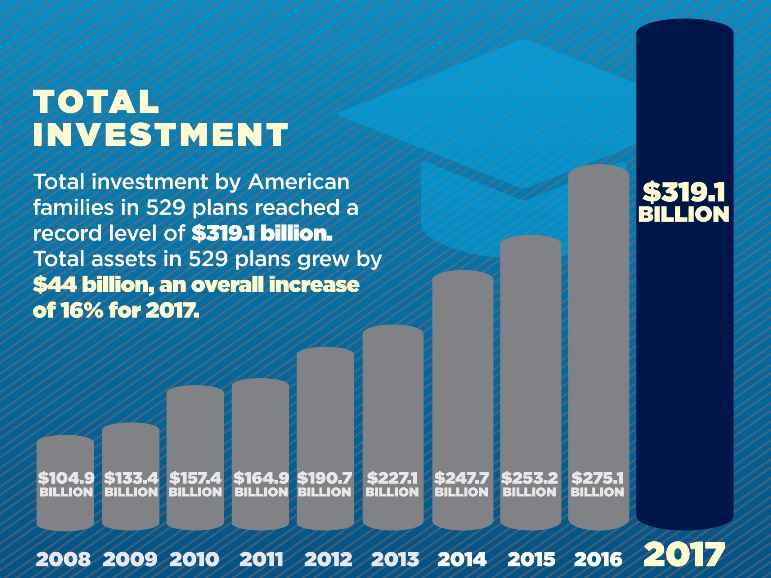
Total investments in 529s also reached a record $319.1 billion last year, 16 percent higher than 2016 (see the chart below from the College Savings Plans Network).

While 529 balances have been growing, so have college costs.

All in, families with students in four-year private colleges spent almost $47,000 in 2017–18; that’s up 3.5 percent from the year earlier, according to the College Board.

“We are all concerned about [college] debt and 529 plans are part of the solution,” said James DiUlio, the chair of CSPN. “Any time you can start and any amount you can save is better than borrowing on the other end.”

However, many people are left out altogether when it comes to being able to afford higher education. Exactly half of Americans are not saving anything on an annual basis for future education expenses, Edward Jones found.

“A lot of people fall below the line when it comes to resources,” said Josh Andrews, the financial advice director for education at USAA, the credit union and financial services firm that specializes in customers with a military connection. “There’s just not any money left to fund a 529.”

To that point, “529s are a great vehicle if you are sure you want to allocate funds for higher education,” added Kyle Ryan, a certified financial planner and executive vice president of advisory services for Personal Capital in San Francisco. “However, it’s not the best thing for everyone.”

With an Roth IRA, for example, savers under the age of 50 can make after-tax contributions up to $5,500 a year, and then take tax-free withdrawals in retirement. Account holders can also withdraw their contributions at any time — say, to cover college expenses — without taxes or penalties.

“It gives you the flexibility to save for retirement and use it for education as well,” Ryan said.

Half of Americans won’t take a vacation this summer—and not just because they can’t afford it

Vacation is often a time to relax and refresh. Some experts think it could even make you more productive when you head back to work. But a whopping 49 percent of Americans won’t be taking one this summer, and while lack of money certainly plays a role, it’s not the only reason so many people are deciding to stay home.

Bankrate, which conducted a survey of 1,000 people aged 18 or older, found that, of the 49 percent who aren’t planning a vacation, 50 percent said they can’t afford it, 24 percent have other family obligations and 22 percent can’t take time off work.

Younger people “are most likely to say they can’t go on vacation because there’s too much on their plates,” the survey notes. “They’re also more inclined to say that their financial situation is keeping them from taking time off.”

A 2017 GoBankingRates survey found that millennials between 18 and 24 years old had less than $1,000 in savings, which doesn’t leave a lot of room for discretionary spending. Nearly half of respondents had nothing saved at all.

Older Americans, on the other hand, are more likely to cite family obligations rather than work-related commitments as the reason they won’t take a vacation.

Even when Americans have paid time off, the survey points out, they’re reluctant to use it: Only 36 percent of respondents who have paid vacation time plan to use all of it this year. And 13 percent of workers with paid time off don’t intend to use any of their vacation days.

Bankrate chief financial analyst Greg McBride suggests issues related to workload and staffing could be why more people aren’t taking time off. “There [are] 6 million open and unfilled jobs in the economy right now because employers can’t find qualified workers,” he says in the survey. “A lot of existing employees are carrying a heavier load and that might keep them tethered to the desk instead of taking the time off that they would otherwise like to take.”

If you’re trying to get away from work, consider spending a day or two out even if you’re overwhelmed or don’t have enough money to travel. “A vacation doesn’t have to be something where you fly somewhere,” Melanie Ross, a senior financial adviser for NCA Financial Planners,” tells Bankrate.

“A lot of people do something they call ‘staycations,’ where they just will stay local. Maybe they’ll travel two hours in a two-day period or stay at home and take advantage of things that they don’t have time to while they’re working.”

Some people do plan to take a vacation, though, the survey notes. And among them, the average amount they intend to spend is $1,000. But there are ways to cut back, like traveling during an off-season. And consider opening a high-yield savings account, a certificate of deposit or some sort of interest-earning account designed specifically for vacation, as well, if you don’t already have one. Dedicating a bit of money with each pay could add up over time.

Consumer finance expert Andrea Woroch recommends being flexible when it comes to travel dates and destinations. The median amount Americans in the Northeast plan to spend this summer is $1,500, for example, or $500 more than the national average.

If you’re flying, Woroch tells Bankrate, “compare prices at different airports and consider booking one-way rather than round-trip flights.” She also suggests opening a co-branded airline credit card to get bonus miles toward a free flight. “As long as pay your balances on time and in full every month, it’s OK to open a card that can reduce the cost of your trip.”

You can also save on housing by using a service like Airbnb. If you’re staying at a hotel, though, look for perks like free breakfast, parking, Wi-Fi and shuttles, Carrie Sumlin, digital consumer executive at Ally Financial, tells Bankrate. And if you’re traveling abroad, she adds, “choose destinations with favorable exchange rates, like Mexico, Iceland and New Zealand.”

It is possible to take a vacation, as long as you budget your time and money wisely. Look for deals, too. With a combination of airline miles and hotel rewards points, Grace Cheng and Pedro Pla flew to five continents for free.

Self-made millionaire: Here’s why you should work on holidays

Self-made millionaire Grant Cardone believes in logging a lot of hours, even on weekends and holidays. “There are 168 hours in a week. You should be working most of them,” says the entrepreneur, who himself puts in about 95 hours a week.

If you want massive success, you have to grind, he tell CNBC Make It. And you have to be prepared to do it when no one else is: Instead of doing what the crowds do, “work when others aren’t.”

That means using Memorial Day and other conventional days off to focus on earning and getting ahead, he says: “Spend your time working holidays when no one else is.” Ultimately, “if you want to change your condition, you have to work. If you can outwork the rest of the population, you’re going to get lucky.”

“Shark Tank” star Daymond John, who built a billion dollar brand while living on the tips he made waiting tables at Red Lobster, has a similar mentality. Ultimately, the secret to success boils down to one thing, says John: “Work. Bust your butt. Get up before everybody, go to sleep after everybody, and bust your butt. That’s it.”

Not everyone agrees with this approach. “More work is never the real answer,” said billionaire LinkedIn co-founder Reid Hoffman on “The Tim Ferriss Show” podcast. “The sort of grit you need to scale a business is less reliant on brute force. It’s actually one part determination, one part ingenuity and one part laziness. Yes, laziness.”

Hoffman continued: “You want to minimize friction and find the most effective, most efficient way forward. You might actually have more grit if you treat your energy as a precious commodity.”

But for some, long hours are always the answer. As Cardone says, “If you gave me $5 billion, I’d still be grinding tomorrow.”