Archives for May 29, 2018

Smartphones may get ‘smell-o-vision’ thanks to this tiny electronic nose

On a surface level, the idea of giving your smartphone a nose-like ability to smell sounds kind of gimmicky. But, just like previous gimmicky concepts such as incorporating a camera in your phone or speaking to your computer, the more you think about it the more sense it makes. From detecting rotten or spoiled food to smelling potentially noxious fumes, it’s easy to imagine how such an innovation could turn out to be pretty useful.

At least, that’s what researchers from Germany’s Karlsruhe Institute of Technology (KIT) think. They have been developing a so-called “smelldect” project involving an “electronic nose” that is capable of sniffing out a range of different scents faster than a human can.

Dr. Martin Sommer, who coordinates the smelldect project for KIT’s Institute of Microstructure Technology, said that it uses the workings of the biological nose as its model. The human nose boasts around 10 million olfactory cells with around 400 different olfactory receptors. These receptors allow the nose to perceive different scents and generates a specific signal pattern to inform the nose owner’s brain what it is that they are smelling.

“In our electronic nose, nanofibers react to complex gas mixtures — i.e. scents — and also generate signal patterns, on the basis of which the sensor identifies the scents,” Sommer said in a statement.

The nose is just a few centimeters in size and contains all the necessary electronic components, including the tech to evaluate the gases. In the event that the specific patterns for a scent have been “taught” to the chip previously, the sensor can reportedly identify it in mere seconds.

“The difficulty consists in the fact that a scent does not always remain the same. For instance, the smell of a rose in the sun differs from that of a rose in rain,” Sommer continued. “Currently, we are training the electronic nose for specific uses which can be chosen universally, however.”

The researchers suggest that it could be used as an ambient air detector or smoke alarm, or as a shopping aid to determine how fresh meat or fish is. Beyond that, there is always the opportunity to give next-generation robots a sense of smell to join all their other increasingly smart senses.

Color-changing fibers make compression bandages easier to use

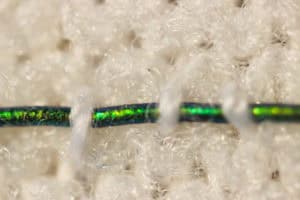
Pressure bandages are typically used to treat medical issues around veins that don’t return enough blood from your legs or arms. Compression stockings, for example, can help stimulate blood flow, but there’s no way to know if the pressure being applied is optimal for the specific condition. Engineers at MIT have developed color-changing fibers that can be woven into pressure bandages to help solve this problem: the fibers change color according to how much the bandage is stretched.

Once a caregiver has stretched a patient’s bandages enough to apply a certain amount of pressure, the photonic fibers can be used as a visual check on the amount of pressure the bandage is providing. “Getting the pressure right is critical in treating many medical conditions including venous ulcers, which affect several hundred thousand patients in the US each year,” said MIT’s Mathias Kolle in a statement. “These fibers can provide information about the pressure that the bandage exerts. We can design them so that for a specific desired pressure, the fibers reflect an easily distinguished color.”

The fibers change color due to their structure, which consists of rolled up ultrathin layers of transparent rubber material. That way, light reflects off each individual layer which reflects specific wavelengths of light depending on thickness of the layers. When stretched, the layers thin out, reflecting different colors. “Structural color is really neat, because you can get brighter, stronger colors than with inks or dyes just by using particular arrangements of transparent materials,” said Joseph Sandt, the first author on the paper. “These colors persist as long as the structure is maintained.”

This article originally appeared on Engadget.

Quebec’s daycare model provides inspiration for provinces to develop their own

MONTREAL — When it comes to affordable daycare, Quebec’s low-fee program is the envy of many a parent in other parts of Canada.

Under the much-vaunted but polarizing program introduced in 1997, the bulk of Quebec parents pay but a fraction of the astronomical amounts their counterparts shell out elsewhere.

Some pundits argue the Quebec model is too costly and fails to deliver, but others say the benefits of getting more women into the workforce and improving work-life balance help offset the annual $2.5 billion investment.

But how exportable is the made-in-Quebec solution?

One political scientist says Quebec’s lesson to other provinces is they should chart their own path and not wait for a federally driven daycare plan as some have in the past.

“When the federal government tried to implement a national program, it met a lot of resistance in the different provinces,” said Olivier Jacques, a post-doctoral student at McGill University and one of three authors of a recent study published by the Institute for Research on Public Policy that examined Quebec daycare.

“So maybe it’s better that each of the provinces does their own so they can make something sustainable.”

In 2005, the Liberals under Paul Martin tried to implement a national childcare program, setting aside $5 billion and signing on with all 10 provinces before losing power to the Conservatives, who then eliminated the program.

Some detractors have been critical of Quebec’s universal approach and believe the province should have instead targeted certain segments of the population. But Jacques counters the wide appeal has allowed Quebec’s plan to persist.

“If a provincial government wants to make a program that will be politically robust and survive a change of government, they need to make sure the program will be broadly popular and covers most children and most parents,” he said.

One factor that favoured Quebec was that the political divide in the province along federalist and sovereigntist lines meant the absence of a true small-c conservative opposition — the very type of government that historically has cut such programs elsewhere, Jacques noted. The other is that activists and proponents insisted the province promote such a program.

In Ontario, where daycare is a hot-button issue in the current election campaign, Kathleen Wynne’s Liberals are pushing free care for preschoolers aged two-and-a-half and older, until they reach kindergarten at a cost of $2.2 billion over three years. The Conservatives are pushing a tax rebate program at a cost of $389 million per year.

The New Democrats are proposing free child care for all families making less than $40,000 year and are aiming to have childcare costs average about $12 a day for those making more, drawing some similarities to Quebec. The price tag is around $11.4 billion over five years.

What’s clear is the costs will be an obstacle for any province.

Canada as a whole ranks near the bottom of OECD countries when it comes to childcare spending — roughly 0.2 per cent of GDP — while Quebec vastly outspends the rest of the provinces on daycare by a margin of about five to one.

That’s where Jacques believes the federal government could help by easing the financial burdens on provinces to allow them to invest in affordable child care.

In 2017, the federal Liberal government announced plans to spend $7 billion over the next decade to help ease the burden of childcare costs, including up to 40,000 new subsidized spots nationwide by 2019.

Since the Parti Quebecois introduced $5-a-day subsidized daycare in Quebec 21 years ago, the daily fee has increased a few times.

The Liberals also introduced a sliding scale three years ago, under which parents pay a base amount of about $8, and as much as nearly $22, depending on their income.

The most popular daycares are the non-profit, subsidized centres known commonly as CPEs, which provide for trained educators and specific standards. But the number of spots — about 230,000 to date — are too few.

In a bid to shorten those long lists, the Liberals have favoured expanding the number of private daycare centres — for-profit entities where parents pay upfront costs of $40 or more and benefit from federal deductions and provincial tax credits to bring the daily costs close to the subsidized system.

The number of private daycare spots has boomed to 65,000 in less than a decade.

That’s where the competing daycare narratives collide, says Universite de Montreal economist Pierre Fortin: while the province has seen the economic benefits of accessible child care, it is struggling to maintain quality.

Fortin, himself a father of five, said the program has met one major goal of getting more women into the workforce. That has helped absorb the program’s expenses through increased tax revenues and transfers to families.

The participation rate in the Quebec workforce of women between the ages of 20 and 44 stands at 87 per cent, compared to just 74 per cent in 1997. In a speech this year, Bank of Canada governor Stephen Poloz even credited the Quebec program for the percentage hike.

In the same speech, Poloz noted the rate nationally is about 83 per cent.

The federal government committed to increasing women in the workforce in the budget last February through a number of measures, but did not provide a solution to the childcare quandary.

“All the research looking into the matter has concluded the main cause of increase in labour force participation has been the low-fee universal childcare program and the extended parental leave,” Fortin said.

Fortin says the Quebec program has stumbled in overall quality. On average, the subsidized CPEs get very positive reviews for a highly qualified staff and environment, but the privately owned daycares offer a lower level of quality.

That discrepancy was noted in a study released by the Observatoire des tous petits, a charitable foundation that studies child development.

While the province’s subsidized educational childcare centres scored very well, the same couldn’t be said for privately held daycares or the other subsidized models.

“The right verdict to give is that we have a two-tier system,” Fortin said.

“One is spectacularly good but the other is spectacularly mediocre.”

Sidhartha Banerjee, The Canadian Press

‘I thank him for my own life’: Swiss diplomat used legal ruse to save tens of thousands of Hungarian Jews

Carl Lutz was initially reprimanded for his actions; Holocaust survivors in Canada want him honoured

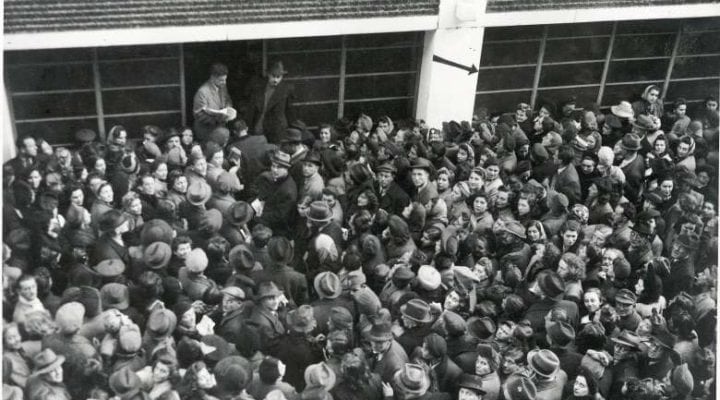
Hungarian Jews crowd around officials at what is believed to be the Glass House, a factory in Budapest that temporarily served as a safehouse, in 1944. (Archives of Contemporary History/ETH Zurich)

On New Year’s Eve 1944, six-year-old Andras Spiegel watched as Nazi troops stormed the former glass factory where he, his parents and 2,000 other Jews had taken shelter in Budapest, Hungary.

They were all marched outside, lined up and told to hold their hands in the air. They stayed there for three hours until a man in a foreign diplomat’s car arrived. The man argued with the soldiers and soon Spiegel and the others were allowed back inside, but not before some had been killed. Spiegel, who is now known as Andrew Simon, recalled seeing three dead bodies.

“And what I know now, what I didn’t know then, is that we were about to be marched to the Danube [River] to be shot because they had no other way of getting rid of us,” Spiegel, now 80 years old, said in an interview.

Spiegel and his family survived the Nazi occupation and in 1950 escaped what was by then Communist Hungary by “sneaking through a barbed wire fence at night with the aid of a generously bribed border patrol officer” and enter ed Austria, he said.

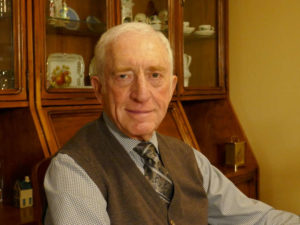
Andras Spiegel, who changed his name to Andrew Simon when he immigrated to Canada, is shown at his suburban home in Toronto. He was six years old when he took refuge at the Glass House. He credits Swiss diplomat Carl Lutz with saving his life there. (John Lesavage/CBC)

Once in Canada, Spiegel became Simon. He spent most of his working life at the CBC in radio and television. He was the founding producer of the radio program Cross Country Checkup.

He wants more recognition for the man he believes saved his life — and the lives of tens of thousands of others.

“I thank him for my own life and my parents’ lives. All the thousands of Jews he saved,” he said at his home in suburban Toronto.

‘Swiss Schindler’

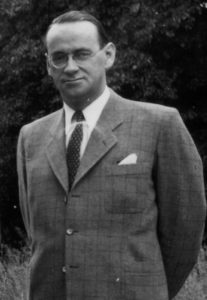
That man was Carl Lutz. Known informally by some as the Swiss Schindler, Lutz was the diplomat who arrived on the scene in Budapest and ensured Simon and others were not killed that night.

Historical accounts credit Lutz with saving between 40,000 and 60,000 Jews.

Lutz is credited with saving the lives of tens of thousands of Jews through the use of ‘protective letters’ that were intended for individuals but applied to whole families. (Archives of Contemporary History/ETH Zurich)

Yet unlike German businessman Oskar Schindler, whose heroism was depicted in the Oscar-winning film Schindler’s List directed by Steven Spielberg, or Swedish diplomat Raoul Wallenberg, who was given honorary Canadian citizenship for his role in saving Jewish lives, Lutz has remained relatively little known.

A room was named in Lutz’s honour in a palace in Bern. But for some survivors, it is not nearly enough recognition.

Survivor testimonies

A new book, Under Swiss Protection, includes testimonies from some of those who survived because of Lutz’s actions. The book was edited by University of Victoria professor Charlotte Schallié and Lutz’s daughter, Agnes Hirschi.

There have been other accounts of Lutz’s actions through the years, including one from Yad Vashem, the Holocaust remembrance centre in Israel. Upon declaring Lutz “righteous among the nations” in 1964, it noted he had risked his life many times and that is actions jeopardized his diplomatic career.

By 1944, the Nazis had surrounded Budapest, working in co-operation with Hungarian troops known as the Arrow Cross, who were loyal to Adolf Hitler.

As a boy, Simon saw and heard the bombings. He and his friends tried to make a game of it.

“We would stand on the balcony and watch the skies to see if there were any enemy planes and scream, ‘Air raid,'” he said. “We thought it was a big gag. It was fun to run down to the air-raid shelter.”

But the attacks, both from the air and on the streets, intensified. That’s when Lutz stepped in — without orders from Switzerland.

According to the new book, Lutz, who was vice-consul and head of the foreign interests division in the Swiss legation in Budapest, led a risky operation to save Jews between March 1944 and February 1945.

Co-editor Schallié, who specializes in Holocaust education, has tried to uncover why this quiet bureaucrat would take on such a mission.

“He was a deeply religious man,” she said in an interview. “But he was also a great humanitarian. And so I think it was a combination of deep sense of justice and a deep religious commitment.”

Negotiations with Nazis

By October 1944, Budapest was seeing repeated raids on Jewish homes and executions on the banks of the Danube before bodies were dumped in the river.

Lutz negotiated with the Nazis, including Adolf Eichmann, a high-ranking Nazi official and member of the SS who oversaw the rounding up and deportation of Jews in Hungary and elsewhere to death camps. He obtained authorization to issue “protective letters” that gave the individuals named within them permission to emigrate.

It was, according to the book, a legal ruse. Lutz only had authorization for 7,000 individuals but expanded the protection to entire families. He is said to have issued 50,000 such documents.

Lutz then persuaded authorities in Hungary to let the holders of the letters move into special safehouses where residents had diplomatic immunity, according to the book.

Inside the Glass House

One of them, an old glass factory known as the Glass House, became the largest Swiss-protected safehouse in the city.

It’s where Simon turned up with his mother in the fall of 1944.

“I go with her, and she knocked on the door and said, ‘Please let us in because my child and I need protection, and we are Jewish,'” he said. “Initially, they didn’t let us in because they said it was overcrowded. She somehow persuaded them.”

Conditions inside were horrendous, according to another survivor, Gabor Maté, a physician who now lives in Vancouver.

“You can imagine toilet facilities were completely overwhelmed,” he said. “There were feces and manure on the floor. Food was very uncertain. A lot of disease.”

Maté was not yet one year old when he and his mother entered the Glass House. She kept a diary and told him about their lives in later years after they, too, escaped to Canada.

Even with the protection offered by the Glass House, Maté said his mother fell into despair as he became sickly. She already knew her parents had been killed in a death camp and her husband was in a labour camp.

“My mother decided to actually give me away because she didn’t think she could guarantee her life let alone mine,” he said. “And so she handed me to a passing Christian woman on the street and said, ‘Please get him out of here.'”

The woman delivered Maté to his mother’s relatives, who were in hiding underground and therefore less likely to be caught, he said.

Maté and his mother were reunited after the Glass House was liberated on Jan. 18, 1945. His family eventually escaped Hungary and moved to Canada.

Maté, 74, is one of Canada’s leading authorities on childhood trauma and addiction. He has no doubt his choice of work is linked to what he experienced in Budapest.

He also has no doubt Lutz is a hero.

“I want to say thank you,” he said. “I can’t imagine where you found the resourcefulness and the sheer wit and the sheer chutzpah, the sheer guts.”

Maté said the Canadian government should give Lutz honorary citizenship, as it did to Wallenberg.

“Certainly, Carl Lutz belongs in the same ranks,” he said.

‘It was a most dangerous and difficult task’
Lutz died in Bern, Switzerland, in 1975.

In the new book, there is a copy of a letter he wrote in 1970. It is one of the few times he shared any insight into what he did in Budapest. By that time, word had spread that he was struggling financially.

“I feel sorry that I could not save more of my fellow beings,” Lutz wrote to one couple who sent him $50 US with their thanks. “But it was a most dangerous and difficult task to negociate (sic) with SS. Eichmann as I did.”

In February, the Swiss government formally honoured Lutz’s memory by naming a room in the Swiss Federal Palace in Bern after him.

But Switzerland initially reprimanded Lutz for taking the actions he did.

That still bothers Simon.

“This guy was a great man,” he said. “We should never forget his name.”

Langley Hospital receives big donations for new emergency department

The Martini and Skidmore families combine to donate $7 million of the $15 million needed

An artist’s rendering of the new Langley Memorial Hospital emergency room. (Langley Memorial Hospital)

Langley Memorial Hospital kicked off its campaign to raise $15 million for a new emergency room with an announcement that two families are contributing almost half the amount needed.

A $5 million donation from Maria Martini and her family and a $2 million donation from Allan Skidmore kicked off the campaign, which is being called “Emergency Response.”

“We are grateful to the Martini and Skidmore families for their generosity,” said campaign chair Phil Jackman. “The people of Langley, one of Canada’s fastest growing communities, desperately need a new emergency department.”

Langley Memorial Hospital opened in 1948. The new emergency department will be twice the size of the existing one. It is set to open in the fall of 2020.

Vancouver lumberjack powers to world title

Stirling Hart out-chopped, out-sawed and out-sprinted all comers at the Stihl Timbersports Champions Trophy

After finishing second last year, Vancouver’s Stirling Hart is all smiles as he poses with the 2018 Timbersports Champions Trophy. (Stihl Timbersports)

B.C.’s best axe man is finally a world champion, although, on the phone, lumberjack Stirlng Hart sounds more relieved than elated with his big win.

“It feels a lot better than second place, I’ll tell you that,” said the 28-year-old Maple Ridge native.

Hart out-chopped, out-sawed and out-sprinted all comers at the gruelling Stihl Timbersports Champions Trophy in Marseille, France, over the weekend, handily beating hulking New Zealander Jason Wynyard in the gold medal final.

The victory was sweet, but it was also redemption for losing by half a second in last year’s final and finishing fourth the year before.

“I’ve always been right there and to finally get over that hurdle is a good feeling,” he said.

Timbersports isn’t a sports page fixture, but Hart hopes his win will attract a little media attention in Canada.

The sport couldn’t ask for a better spokesman.

About that scar

Hart is a third generation lumberjack (his father and grandfather both competed) with a gift of the gab and an instantly identifiable 12 cm scar across his right cheek.

The scar is a subject of intrigue, especially on first viewing, when onlookers can’t help imagining the awful accident that left the mark.

The actual story isn’t nearly so dramatic.

During a competition several years ago, Hart planted his axe in a tree, only to have it fall out and graze him in the face. The bloody mess that resulted (his axes are very sharp) required more than 80 stitches both inside and outside his cheek.

At first he was grateful not to lose an eye. Over time, he’s become grateful for the scar itself.

“I love it,” he said. “It’s become my defining feature, because when I go places I’m instantly recognizable.”

“It’s been very good for marketing actually.”

Normally, you’d be able to catch Hart performing in the Grouse Mountain Lumberjack Show where he’s been a fixture for 13 years. However, life among the trees has now taken him in a new direction.

Go climb a tree

Last year the certified arbourist and tree faller launched Alpine Acceleration, a company that thins forests for growth and for forest fire protection.

That means this summer he’ll have to balance contracts in Whistler with his training, coaching and competition schedule.

And while he may feel a pang of envy over international rivals who are able to make timbersports a full time job, Hart says climbing and cutting down trees in Whistler might actually be the secret to his success.

“It’s essentially what won me the world championships — my conditioning,” he said. “Turns out it was the best training I could have done.”