Archives for May 29, 2018

These 3 Optical Networking Stocks Are Ridiculously Cheap

The optical networking sector has fallen on hard times lately. Many stocks in this category skyrocketed in 2016 and early 2017, only to come crashing back down.

There is no doubt in my mind that high-speed network equipment and components will be in high demand for many years to come. That’s why I’m salivating over the rock-bottom prices that some of the best names in the industry are trading for right now. So, let’s have a closer look at Finisar (NASDAQ: FNSR), Applied Optoelectronics Inc. (NASDAQ: AAOI), and NeoPhotonics (NYSE: NPTN), all of which have seen share prices sliding at least 20% lower over the last 52 weeks. These are great companies in a high-growth industry with legs that are good for miles and miles, and they should be snapped up at these ridiculously low prices.

A bundle of fiber-optic networking cables set against storm clouds and a lightning bolt.

Finisar

Finisar’s stock price has plunged 32% over the last year. The drop was partly triggered by disappointing optical equipment orders, but Apple (NASDAQ: AAPL) played a larger role in this drama.

Apple uses Finisar 3D-sensing arrays to power the iPhone’s TrueDepth camera and the proximity-sensing features of the wireless AirPods earbuds. So when Apple showed a weak iPhone hand in January, Finisar’s share price plunged. But Finisar is shipping its so-called VCSEL sensors as fast as it can make them, and Apple’s order volume is not a limiting factor there, so that’s not a terribly valid reason for Finisar’s sliding stock price. When Apple sneezes, its component suppliers catch the flu — with or without sensible support from the actual business case.

The company’s management sees much larger end markets for VCSEL sensors than just Apple’s smartphones with face recognition features. Cupertino just happens to be a pretty sweet early contract for this bleeding-edge technology.

While waiting for the VCSEL market to mature, Finisar is also a leading supplier of high-speed fiber optic transceivers and ROADM connection cards. Both of these markets are currently champing at the bit and ready to explode when telecoms around the world finally start to roll out next-generation 5G wireless networks. These ultra-fast systems will require huge bandwidth feeds on the back end, hooking up wireless towers and small-cell arrays to the internet at large. Finisar is not the only fiber optic specialist that will benefit from that groundswell, but it’s certainly on that list.

And the dramatic drop in Finisar’s share price has led to a frugal price-to-earnings ratio of just 13.9 times trailing earnings or 1.4 times trailing sales. That’s a steal for investors who are willing to wait for the 5G and VCSEL catalysts to kick in — and who can ride out some rough seas until Finisar reaches that destination.

Applied Optoelectronics Inc.

Data center networking specialist Applied Optoelectronics (AOI) rode a big wave in early 2017 thanks to massive orders from leading customers Amazon.com (NASDAQ: AMZN) and Facebook (NASDAQ: FB). But it came crashing back down when the same clients tapped the brakes on their infrastructure upgrade plans. All in all, AOI investors have endured a 51% haircut in 52 weeks.

Neither one of these huge customers are planning to stop investing in high-speed networks anytime soon. Nor is AOI losing market share in these accounts in the long haul. In fact, several rivals are reportedly using generous pricing discounts to have a fighting chance at competing with AOI’s top-quality transceivers.

No, Facebook and Amazon are simply taking their time to do proper component testing and network planning before launching into their next big fiber optic order surges. AOI and others recently introduced new transceivers and networking lasers at double the bandwidth of the last round, and another big leap is planned in 2019. Doing these upgrades right can be tricky when you run data centers on a grand scale, so AOI and its investors must simply live with these order delays until the infotech giants get their ducks in a row.

Like Finisar, Applied Optoelectronics is really just waiting for another swing in a highly cyclical industry. That patience should be rewarded within the next three or four quarters, and the bounce could also start sooner than that.

NeoPhotonics

Here’s a game of international intrigue on a high level. NeoPhotonics makes optoelectronic networking modules and systems, and most of its orders come from China. In 2017, 40% of the company’s total revenues came from Chinese networking giant Huawei, while smaller peer ZTE accounted for another 5%. All told, 55% of NeoPhotonics’ revenue last year was based on Chinese orders.

That heavy dependence on China turned into a liability when Beijing and Washington started rattling sabers over their international trade relations. Along the way, ZTE was slapped with heavy-handed sanctions that stopped the company from using American technologies for the next five years, effectively putting that company out of business. NeoPhotonics issued a press release explaining how small ZTE’s revenue impact really was. But investors worried about the ZTE action leading up to similar sanctions on Huawei someday soon. That would be terrible news for NeoPhotonics. So the stock plunged.

But the tenor of U.S.-China relations quickly changed when President Trump said that he wanted to save ZTE’s business by modifying the company’s sanctions. In that light, Huawei no longer looks like a target for huge regulatory actions, so NeoPhotonics investors have relaxed their attitudes against the stock. The share price has soared 33% higher in May.

On top of that, rumor has it that NeoPhotonics is looking for a buyer, and Finisar might be ready to launch a buyout bid for the company. Stay tuned for more on that potential drama, which could unlock a lot of shareholder value in a hurry.

The stock still trades 26% below its year-ago price, but the bottom of the bounce may be in the rearview mirror already.
JetBlue Ramps Up Share Buybacks as Its Stock Price Stumbles

JetBlue Airways (NASDAQ: JBLU) reported strong first-quarter results a month ago and a solid outlook for the rest of the year. However, investors didn’t seem to care, sending JetBlue stock down further — perhaps due to concerns about whether the carrier can offset the cost headwind from rising fuel prices.

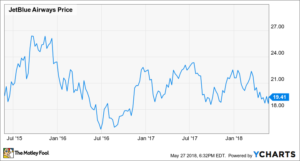
Whatever the reason, JetBlue stock has barely budged in three years. Based on its Friday closing price of $19.41, the stock trades for less than 10 times analysts’ 2019 earnings estimates. This is extraordinarily cheap, considering the carrier’s massive growth opportunities.

JetBlue Airways stock performance. Data by YCharts.

JetBlue’s management is wisely reacting by increasing its share repurchase activity. Share buybacks will accelerate the company’s EPS growth, providing a huge windfall for long-term investors.

JetBlue authorizes another big buyback program

In 2016, JetBlue’s board authorized a $500 million share repurchase program that was supposed to be carried out between 2017 and 2019. Instead, JetBlue spent the entire $500 million during 2017. As a result, in December, the board authorized a new — and even larger — buyback plan. JetBlue now officially plans to repurchase $750 million of stock during the 2018-2019 period.

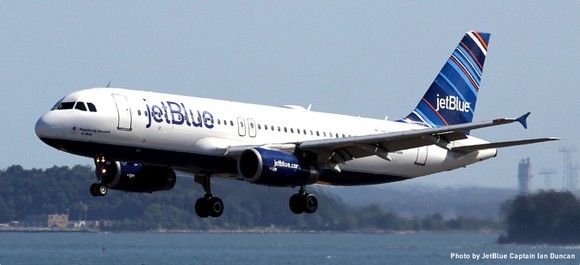
A JetBlue Airways plane preparing to land

JetBlue expanded its share repurchase program last December. Image source: JetBlue Airways.

JetBlue got started last quarter by implementing a $125 million accelerated share repurchase (ASR) program. Last week, the company launched a second $125 million ASR program, which will be completed sometime during the third quarter.

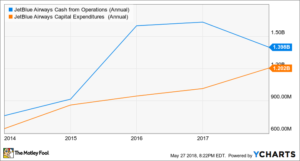
While JetBlue may not complete the entire $750 million buyback program by year-end, it should be able to buy back at least as much stock as it did in 2017. Last year, JetBlue generated $1.4 billion of operating cash flow, compared to capex of $1.2 billion. This resulted in free cash flow of approximately $200 million.


JetBlue Airways Cash from Operations vs. Capital Expenditures (Annual). Data by YCharts.

Rising fuel costs may put pressure on JetBlue’s pre-tax earnings in 2018, but lower taxes should allow the company to grow (or at least maintain) its operating cash flow. Meanwhile, JetBlue expects capex to decline to around $1 billion this year (plus or minus $100 million). As a result, free cash flow could double or even triple year over year in 2018.

Catching up with peers

The recent surge in share buybacks at JetBlue is helping the carrier make up for lost time, after it lagged rivals like Southwest Airlines (NYSE: LUV) for many years in terms of returning cash to shareholders.

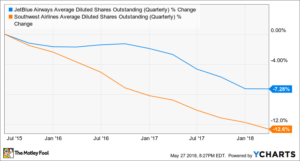
In fact, over the past three years, JetBlue has reduced its share count by just 7%, with nearly all of that coming since the beginning of 2017. By contrast, Southwest Airlines has reduced its share count by about 13% over that period.

JetBlue Airways vs. Southwest Airlines Average Diluted Shares Outstanding (Quarterly),

Southwest Airlines has managed to shrink its share count faster than JetBlue even though it has also invested heavily in new aircraft in recent years. (In addition, Southwest has typically had a more expensive stock, which makes it harder to shrink the share count. It also pays a dividend, unlike JetBlue.) The main reason for this discrepancy is that Southwest Airlines has gradually increased its debt and capital lease obligations to help pay for its capex. That has freed up cash to be returned to shareholders.

Despite raising its debt load by nearly $1 billion since the beginning of 2015, Southwest Airlines’ leverage ratio was just 30% as of the end of March, due to the company’s strong profitability. That’s near the low end of Southwest’s leverage target range.

However, JetBlue ended March with an even lower leverage ratio of roughly 28%. Over the past five years, it has steadily paid down debt as it worked to fix its balance sheet. Now, management realizes that the balance sheet is in excellent shape. As a result, JetBlue plans to offer new debt sometime later this year, according to CFO Steve Priest. This will provide even more cash that can be returned to shareholders.

Buybacks should boost JetBlue stock — in the long run

JetBlue stock looks like a bargain at its recent sub-$20 price. Based on its current market cap, the ongoing $750 million share buyback plan will repurchase roughly 12% of JetBlue’s outstanding shares. That would provide a double-digit boost to earnings per share, relative to the baseline of no share buybacks.

Given that JetBlue has a relatively modest capex plan for the next few years and doesn’t need to reduce its debt any further, it should be able to repurchase significantly more than $750 million of its stock by the end of 2020. This should eventually lead to robust EPS growth, once JetBlue’s cost-cutting initiatives stabilize the carrier’s profitability. Since JetBlue has a very modest valuation today, a return to strong EPS growth could drive huge stock price gains.

3 Questions Costco Should Answer on Thursday

Costco (NASDAQ: COST) will announce its fiscal third-quarter earnings results after the market closes on Thursday, May 31. And if recent history is any guide, the warehouse retailer is likely to reveal strong growth on both the top and bottom lines. But there will be much more to this report than just those headline sales and earnings numbers.

Below, we’ll look at a few of the biggest investor questions that should get answered in this earnings announcement.

A shopper walks through a warehouse aisle.

Where is the growth coming from?

Costco releases monthly sales updates, so we already know revenue expanded at a healthy pace this past quarter. Sales at existing locations jumped 7% in March and rose at the same robust pace in April, too. Thus, the retailer should announce an expansion rate that’s still running at about twice that of peers like Walmart and Target.

Looking beyond the headline numbers, I’ll be watching customer traffic for signs that Costco is still having no trouble convincing its members to trek out to its stores. Both Walmart and Target had to rely on e-commerce sales to deliver an increasing portion of their sales growth this quarter, after all. If Costco noticed the same trend, then traffic growth figures might have dropped from the 5% rate it posted in the most recent quarter. Such a move would be more worrisome for Costco, since its smaller sales footprint gives it less flexibility to drive shopper traffic through digital initiatives that stress in-store order pickups.

How many new members joined this quarter?

Whereas traditional retailers earn their profits through product markups, most of Costco’s earnings come from its subscription sales. That fact makes membership fees a critical number for investors to watch. The figure jumped 13% in the fiscal second quarter thanks to the combination of a growing pool of members and higher average annual fees.

Subscriber income growth should be especially strong this year as the company continues to roll its membership base on to its higher annual rates. And Costco is also on track to launch 23 new locations this year even as Walmart shuts down dozens of Sam’s Club stores. These factors should allow for healthy gains over the 92.2 million members the company had on its books as of the end of the fiscal second quarter.

Are subscribers still loving the shopping experience?

Investors had been waiting for a rebound in Costco’s membership renewal rate for almost a year following a credit card switchover that disrupted its signup trends. We finally saw a modest uptick last quarter when the rate ticked up to 90.1% from the 90% it had been stuck at for the prior six months. Management sounded relieved to see that critical metric moving in the right direction again, too. “I’m happy to see what we expected came true and we’re seeing a slight improvement [in the renewal rate] now,” CFO Richard Galanti told investors in a conference call.

The renewal rate peaked as high as 91% in fiscal 2014 and fiscal 2015 before falling in the next two years. A solid rebound this year will boost important metrics like membership fees and customer traffic. It would also add weight to management’s claim that the value of a Costco membership isn’t being diminished as customers shift more of their home and grocery spending toward online sales channels.

Pandora Launches Premium Family Plans

Music-streaming pioneer Pandora (NYSE: P) has just released a new tier for its on-demand Premium music streaming service. Premium Family plans are now available for $15 per month and can include up to six users. The new offering largely resembles comparable plans offered by rivals Spotify Technology (NYSE: SPOT) and Apple. Both of those larger competitors have long offered family plans at the same price point. Pandora’s Premium Family plan includes a feature called “Our Soundtrack,” which is a personalized playlist that is created based on a combination of all family members’ listening preferences.

Here’s what the new tier means for investors.

Man listening to music on his phone

Family plans help user retention

By looking at what happened to Spotify’s business after the Swedish company introduced family plans in 2014, investors can get a sense of what might play out for Pandora. Spotify has seen average revenue per user (ARPU) decline meaningfully in the years since, which is expected since the plans allow more users to join and use the service at discounted rates. However, the upside is that churn has declined substantially as well, as family plans tend to enjoy much higher retention rates.

“From a product perspective, while the launches of our Family Plan and our Student Plan have decreased Premium ARPU (as further described below) due to the lower price points per Premium Subscriber for these Premium pricing plans, each of these Plans has helped improve retention across the Premium Service,” Spotify wrote in its F-1 Registration Statement.

How family plans may affect Pandora

Pandora offers different tiers than Spotify, though, so the impact will be harder to predict. In addition to Pandora Premium, there’s also Pandora Plus, which costs $5 per month. Pandora Plus is the ad-free version of Pandora’s flagship personalized internet radio service. Pandora’s user base is also mostly free ad-supported users.

Unlike Spotify, Pandora has been steadily growing ARPU, mostly from adding new Pandora Premium subscribers, who pay more than Pandora Plus subscribers. Pandora Premium launched less than a year ago. Introducing a family plan could undermine some of that ARPU growth for the same reasons why family plans hurt Spotify’s ARPU, although it would be worth it if Pandora can bolster user retention. Too bad Pandora does not report user churn.

Meet Gita: A rolling robot that carries your groceries

Tired of lugging things around?

Meet Gita, the new mobile carrier that follows people on the go. It’s from the makers of Vespa scooters.

The rolling robot is about two feet tall and can carry up to 44 pounds of items. Think of the equivalent of a case of wine, a loaded backpack or two stuffed grocery bags.

“You just have to stand in front of Gita and press the center button and she will sync up to you and it will basically track your legs,” Sasha Hoffman, chief operating officer at Piaggio Fast Forward, a Boston-based division of Vespa, tells FOX Business.

The device can follow people at speeds of up to 22 miles per hour and is designed to help anyone from millennials to the elderly do mundane chores.

“If you’re at the grocery store, you just pop it open and put your groceries in it and keep it moving,” Hoffman says.

The company stresses that it’s not trying to make people lazy.

“Our whole goal is to help people actually walk, bike, skate and move more and really think about this as an external trunk so you can do that,” she adds.

As of now, Gita can only operate on flat surfaces, excluding hilly terrains or stairs.

Hoffman says the company is working on determining Gita’s price, which is expected to be a “couple thousand dollars,” with plans to go on sale early next year.

HoloLens acts as eyes for blind users and guides them with audio prompts

Microsoft’s HoloLens has an impressive ability to quickly sense its surroundings, but limiting it to displaying emails or game characters on them would show a lack of creativity. New research shows that it works quite well as a visual prosthesis for the vision impaired, not relaying actual visual data but guiding them in real time with audio cues and instructions.

The researchers, from CalTech and University of Southern California, first argue that restoring vision is at present simply not a realistic goal, but that replacing the perception portion of vision isn’t necessary to replicate the practical portion. After all, if you can tell where a chair is, you don’t need to see it to avoid it, right?

Crunching visual data and producing a map of high-level features like walls, obstacles, and doors is one of the core capabilities of the HoloLens, so the team decided to to let it do its thing and recreate the environment for the user from these extracted features.


They designed the system around sound, naturally. Every major object and feature can tell the user where it is, either via voice or sound. Walls, for instance, hiss (presumably a white noise, not a snake hiss) as the user approaches them. And the user can scan the scene, with objects announcing themselves from left to right from the direction in which they are located. A single object can be selected and will repeat its callout to help the user find it.

That’s all well for stationary tasks like finding your cane or the couch in a friend’s house. But the system also works in motion.

The team recruited seven blind people to test it out. They were given a brief intro but no training, and then asked to accomplish a variety of tasks. The users could reliably locate and point to objects from audio cues, and were able to find a chair in a room in a fraction of the time they normally would, and avoid obstacles easily as well.


This render shows the actual paths taken by the users in the navigation tests.

Then they were tasked with navigating from the entrance of a building to a room on the second floor by following the headset’s instructions. A “virtual guide” repeatedly says “follow me” from an apparent distance of a few feet ahead, while also warning when stairs were coming, where handrails were, and when the user had gone off course.

All seven users got to their destinations on the first try, and much more quickly than if they had had to proceed normally with no navigation. One subject, the paper notes, said “That was fun! When can I get one?”

Microsoft actually looked into something like this years ago, but the hardware just wasn’t there — HoloLens changes that. Even though it is clearly intended for use by sighted people, its capabilities naturally fill the requirements for a visual prosthesis like the one described here.

Interestingly, the researchers point out that this type of system was also predicted more than 30 years ago, long before they were even close to possible:

“I strongly believe that we should take a more sophisticated approach, utilizing the power of artificial intelligence for processing large amounts of detailed visual information in order to substitute for the missing functions of the eye and much of the visual pre-processing performed by the brain,” wrote the clearly far-sighted C.C. Collins way back in 1985.

The potential for a system like this is huge, but this is just a prototype. As systems like HoloLens get lighter and more powerful, they’ll go from lab-bound oddities to everyday items — one can imagine the front desk at a hotel or mall stocking a few to give to vision-impaired folks who need to find their room or a certain store.

“By this point we expect that the reader already has proposals in mind for enhancing the cognitive prosthesis,” they write. “A hardware/software platform is now available to rapidly implement those ideas and test them with human subjects. We hope that this will inspire developments to enhance perception for both blind and sighted people, using augmented auditory reality to communicate things that we cannot see.”

This article originally appeared on TechCrunch.