Archives for May 26, 2018

Apple’s Next iPhone Chip Is Now in Mass Production

Arguably the most important component inside of a smartphone is the applications processor. This controls how quickly and efficiency apps run, how smoothly 3D games run, and the quality of the photos and videos that users take. Each year, Apple (NASDAQ: AAPL) makes substantial advances in the performance and capabilities of the chips that power its latest iPhones, which ultimately helps Apple build devices with new and exciting features to get people to buy its latest devices.

According to a new report from Bloomberg, which generally provides accurate information about Apple products, Apple’s contract chip manufacturing partner, Taiwan Semiconductor Manufacturing Company (NYSE: TSM), has begun cranking out Apple’s latest A12 processor using the former’s new 7nm chip manufacturing technology. Apple’s current A11 Bionic chip inside of the company’s latest iPhones is manufactured using TSMC’s 10nm technology.

Apple’s iPhone X.

Since Apple likely intends to launch its latest iPhones in just three months (assuming a typical product announcement in September), it makes sense that TSMC would be cranking the A12 out now. Indeed, once those chips are manufactured, they need to be sent to Apple’s contract manufacturers who will then assemble all of the required components into finished devices — a process that can take a while.

The Apple A12 will clearly allow Apple to market new levels of mobile performance and features, but a question that chip investors might be interested in is the following: What does the mass production of the A12 mean for TSMC?

Let’s dive in.

7nm will be huge for TSMC in 2018

On its most recent earnings conference call, TSMC said that it expects its revenue from 7nm product shipments to make up 10% of its total revenue for 2018. The current average analyst estimate for TSMC’s 2018 sales is $35.6 billion, so this means that TSMC expects to sell about $3.5 billion worth of 7nm wafers to its customers.

Now, Apple won’t be the only company to use TSMC’s 7nm technology this year — Apple rival Huawei is likely to use it to manufacture its next-generation high-end mobile applications processor — but it’ll certainly be, by far, the largest buyer of 7nm wafers for the foreseeable future. TSMC’s prediction that 7nm will make up 10% of overall revenue in 2018 when that figure was 0% for the first two quarters of 2018 means that TSMC is expecting Apple to buy a lot of 7nm chips in support of the next-generation iPhone ramp up.

Keep in mind, though, that while Apple will be buying a lot of 7nm chips, it’s in the process of ramping down its 10nm production volumes. In fact, on TSMC’s most recent earnings call, CFO Lora Ho said that the company’s inventory increased to 63 days of sales “due to an increase of raw wafer[s] and the 10nm wafer pre-build before the capacity is converted to 7-nanometer.”

In other words, TSMC is going to be dramatically reducing its 10nm production capacity and reusing much of the factory space and equipment that’s used to build those chips to manufacture new 7nm chips. So, TSMC’s 7nm ramp up for Apple isn’t all upside for the company — 7nm revenue should increase dramatically but much of that growth will be offset by a big reduction in 10nm chip sales.

Investor takeaway

Ultimately, TSMC beginning the production of Apple’s A12 chip isn’t groundbreaking news, but it’s a sign that the development of both Apple’s A12 chip as well as TSMC’s 7nm technology went as expected to support Apple’s upcoming iPhone launch. What’ll matter to both TSMC and Apple investors shortly is how well Apple’s new iPhones powered by the A12 chip will be received by consumers.


Is Walmart Paying Too Much for Its E-Commerce Crown in India?

Walmart’s (NYSE: WMT) acquisition of Indian e-commerce giant Flipkart marks the American big-box retailer’s entry into a lucrative market that’s going to be worth at least $200 billion by 2026. Even then, online sales will account for just 12% of India’s overall retail sales, according to Morgan Stanley estimates, which means that the opportunity could be much bigger in the long run.

Ideally, Walmart investors should applaud such a deal, but many shareholders don’t seem convinced about the price that Walmart is paying for a piece of this opportunity. Walmart shares fell after the deal was announced, and they are still down as of this writing.

Here’s why Walmart’s valuation of Flipkart might not have gone down well with some investors.

Cartoon of online shopping on a mobile phone.

The valuation problem

Walmart is shelling out $16 billion for a 77% majority stake in Flipkart, which values the Indian e-commerce giant at nearly $20.8 billion. So Walmart is paying a massive premium over the $11.4 billion valuation put on Flipkart in Apr. 2017, which was originally down from $15.2 billion in 2015.

This drop in the valuation isn’t surprising, because the company has encountered mixed results tapping the Indian e-commerce opportunity so far. Its revenue growth in fiscal 2017 slowed down to just 29% as compared to the 50% growth reported previously, losses swelled 68% that same year to $1.3 billion.

Meanwhile, AIG subsidiary Valic had trimmed Flipkart’s valuation to $8 billion at the end of 2017, just months after the company raised $3 billion in its a funding round from investors such as SoftBank, eBay, Microsoft, and Tencent.

In fact, Flipkart’s fundraising last year was essentially a down round (which means that its shares were sold at a lower price than in the previous round). The company had to accept a lower valuation, as it was in need of cash to fight Amazon’s (NASDAQ: AMZN) growing market share in India.

Independent data from three research platforms indicates that Amazon’s mobile app and website are more popular than Flipkart’s. In fact, Amazon has trumped Flipkart on mobile downloads, monthly desktop visits, and daily active users quite consistently over the past few quarters. So while the American company clocked an average of 868 million monthly mobile visits in the period from August to October 2017, Flipkart lagged behind with 389 million visits.

Walmart might not have picked a sure thing, but it paid the premium associated with one. However, a close look at the potential gains from the deal suggests that the big-box retailer has its sights set on a worthy prize.

Why the premium is justified

Walmart is in no mood to let the Indian e-commerce opportunity slip through its hands, and it can quickly scale up its operations once the acquisition is through thanks to the synergies that Flipkart offers.

Walmart currently operates 21 Best Price Modern Wholesale stores in India in a cash-and-carry format. These stores sell close to 5,000 items, including fruits and vegetables; fresh, frozen, and chilled food; dry groceries; hotel and restaurant supplies; personal and home care items; clothing; and office supplies.

The company also claims that it sources over 95% of its goods for Best Price from local producers. This could allow the company to build its network in the grocery and household products market, where Amazon is already turning its focus. The e-commerce giant believes that groceries and consumables will supply half of the company’s business in the next five years, so this is an area that Walmart can now target with the help of its local contacts and Flipkart’s existing distribution.

Moreover, most of these Best Price stores are located in the northern and central parts of the country, so they should complement Flipkart’s infrastructure plans to build a massive logistics facility in south India.

Playing the bigger game

Walmart is getting its hands on an established e-commerce player that has its fingers on the pulse of the Indian consumer. For instance, Flipkart knows that products such as smartphones are in strong demand among Indian consumers, so it has been rolling out offers such as no-cost installments to push sales.

Not surprisingly, Flipkart had an impressive 51% share of the online smartphone market in India last year. With Walmart’s money and existing infrastructure, Flipkart can expect to build its dominance in other categories as well, making the acquisition worth Walmart’s while in the long run.

3 Terrible Reasons to Buy Procter & Gamble

Procter & Gamble (NYSE: PG) has long been an investor favorite. According to the conventional wisdom, the company has a lot going for it. P&G is nearly 200 years old. It’s an S&P 500 Dividend Aristocrat, having raised its dividend every year for 62 years in a row, and the company has 22 billion-dollar brands, household names including Tide, Bounty, and Crest.

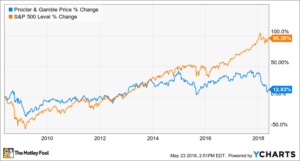
While Procter & Gamble has historically been a winner on the stock market as it has steadily grown over the years and paid a reliable dividend, it’s struggled more recently. In fact, the household-products giant has significantly underperformed the S&P 500 during any meaningful time interval in the last 10 years. Over the last decade, for instance, the stock has gained just 12% while the broad market has nearly doubled.

PG data by YCharts.

As the chart shows, that disparity has become more pronounced over the last few years as P&G is one of the few megacap stocks that is down over the last five years.

Nonetheless, the stock still has its supporters: Out of the 22 analysts covering it, only two rate it below a hold, and 10 of those analysts consider it a buy or even a strong buy, with the average one giving it a price target of $81.74, 10% above its current trading price.

You may already be familiar with some of the popular bull arguments for Procter & Gamble. Below, I’ll review them and explore why they are bad reasons to invest in the stock.

Procter & Gamble’s 20 most popular brands

1. The brand portfolio

P&G corporate and investors love to tout the company’s portfolio of brands, which is unmatched by any consumer packaged goods (CPG) company except for Coca-Cola. However, growth is king in investing, and even brands that generate billions of dollars in revenue annually can become albatrosses if they can’t deliver sales growth. For example, Gillette, the razor brand that P&G acquired in 2005 for $57 billion, has been a leader in razors for more than a century, but the brand has now become threatened by online upstarts like Dollar Shave Club, which was acquired by rival Unilever, and Harry’s. As a result, Gillette has been forced to lower prices and has lost market share in recent years. In P&G’s grooming division, which is led by Gillette, net sales have fallen 1% through the first three quarters of the current fiscal year, and operating profits are down 13%.

The rise of e-commerce is also shaking up the company’s traditional strength in supermarkets and drugstores where it commands valuable shelf space. Smaller brands have become more popular with consumers, who are searching for unique and authentic brands, and online retailers like Amazon can push their own private-label products, rather than branded ones, if they choose.

2. The dividend

Procter & Gamble’s dividend is often cited as a reason to invest in the company, and indeed, few of its peers can claim to have paid rising dividends for 62 years. The Pampers maker also offers a strong dividend yield at 3.9%. However, its growth has been lacking in recent years. Since 2015, its highest dividend increase was 4%, and in 2016 it was as low as 1%. Dividend growth has been slow as earnings growth has essentially stalled during that time, and considering its payout ratio, or the percentage of its profits that go to dividends, is at 72%, the company only has so much room to raise its dividend without growing its profits in line.

Furthermore, the 3.9% yield may be appealing to income investors, but with the Federal Reserve expected to continue raising interest rates, even 10-year treasuries will likely offer a better yield soon. Even for income investors, there are simply better options out there.

3. Safety

As a consumer-staples company and a Dividend Aristocrat, Procter & Gamble is a classic defensive stock, or a stock that should outperform the market in a recessionary climate. After all, consumers still need products like detergent even in tough times, and the company’s dividend makes it an appealing investment when stocks are falling. However, that perceived safety has come at a steep price as the chart at the top of the article shows, as investors have missed out on nearly all of the market’s growth over the last 10 years.

While it’s true that P&G is less risky than many other stocks, again there are simply better options for investors concerned about wealth preservation or income. Berkshire Hathaway (NYSE: BRK-A) (NYSE: BRK-B), for example, is a classic example of a well-diversified company that has successfully weathered many economic downturns. Elsewhere, utility stock Consolidated Edison (NYSE: ED) has risen alongside the market over the last 10 years and has offered a better yield than P&G most of that time.

CPG companies like General Mills and Campbell Soup have struggled broadly in recent years as consumer tastes and shopping habits have changed, and Procter & Gamble, though not a food company, isn’t much different. The stock is likely to continue to underperform as consumer trends favoring e-commerce and smaller brands are unlikely to change — and they undermine the company’s historical strengths.

3 Stocks That Could Double Your Money

Investing in the stocks of stable, well-run, innovative businesses is one of the surest ways to generate wealth. Not every company will produce epic gains, but that isn’t necessary for an investor to be successful.

So how do you go about finding these potential opportunities? One way is to look to the stock market and identify companies whose winning streak has already begun, and will likely continue into the future.

To help with that, I’ve done some of the legwork and selected three companies that are pioneers in their respective fields, have already produced outsized gains, and have a clear runway to future growth. Read on to see why Shopify Inc. (NYSE: SHOP), NVIDIA Corporation (NASDAQ: NVDA), and Netflix, Inc. (NASDAQ: NFLX) fit the bill.

Sprouts growing out of stacks of coins overlaid with clock.

Help navigating e-commerce

The story has it that Shopify co-founders Tobias Lutke and Scott Lake were searching for a simple online platform to sell a line of high-end snowboards. When no suitable solution was found, Shopify was born. What began as a way to help small and medium-sized businesses navigate the path to online sales has blossomed into a worldwide e-commerce dynamo.

Over 600,000 businesses from 175 countries have chosen Shopify’s easy-to-implement solutions for creating an online presence and simplifying the e-commerce experience. The company provides more than 100 ready-to-use website templates and more than 2,300 apps to customize the experience.

Shopify has gone on to incorporate solutions for other business necessities like payments, shipping, invoicing, order tracking, and working capital loans. It also created Shopify Plus to cater to the needs of enterprise-level businesses, now one of the fastest-growing segments of the company’s business.

Barefoot couple lying on floor at home shopping on a laptop with credit card.

Providing a much-needed service has proven particularly lucrative for Shopify. Since going public in mid-2015, the company’s revenue has risen nearly 500%, and its stock has more than quadrupled. Shopify is not yet profitable, having chosen to pour all its profits into its expansion, as the majority of its customers are still in North America.

With a track record of stellar growth, a market cap of just $15 billion, and ongoing international expansion, it’s easy to see how Shopify’s stock price could double from here.

Teaching an old chip new tricks

NVIDIA revolutionized modern gaming with the introduction of the graphics processing unit (GPU) and remains the worldwide leader in the technology it pioneered two decades ago. The company still controlled more than 66% of the discrete desktop GPU market to close out 2017.

NVIDIA’s flagship gaming business is exploding, with revenue growing 67% year over year in its most recent quarter. That growth could continue, as battle-royale games like Fortnite add new gamers to the fold and esports continues to gain wider adoption.

While processors used in video games still generate the majority of NVIDIA’s business, it’s the potential from emerging technologies that could drive significant growth. Researchers found that the same massive parallel processing capabilities that made GPUs perfect for rendering images was also the ideal solution for training artificial intelligence (AI) systems. NVIDIA’s data center segment, which houses revenue from AI and cloud computing uses, has exceeded 70% year-over-year revenue growth in each of the last eight quarters, though it has slowed somewhat from the triple-digit growth it had produced. This has led to a stock that is up over 77% during the trailing 12 months.

Four young adults sitting on a couch with controllers playing video games.

NVIDIA’s GPUs are also found at the heart of several other emerging technologies, including augmented reality (AR), virtual reality (VR), and self-driving cars. The autonomous car market may represent the one of the greatest opportunities, as the data collected by the multitude of sensors in each vehicle needs to be processed to facilitate the self-driving functions — and that task falls to the GPU. NVIDIA believes the total addressable market for autonomous vehicles will be $60 billion by 2035, with the first truly self-driving cars hitting roads between 2020 and 2021.

With a commanding lead in its primary market, and a number of emerging technologies that could drive blockbuster growth, NVIDIA stock is a prime candidate to double from here.

The future of television

From its humble beginnings as a DVD-by-mail service, Netflix has emerged as a worldwide entertainment powerhouse. Since the debut of streaming in 2007, the television landscape has undergone a paradigm shift. The world has begun to move away from linear TV, with more consumers content to watch programs on their own schedule.

With that paradigm shift well under way in the U.S., Netflix took its show on the road, setting up operations in over 190 countries. Its global subscriber count just topped 125 million, but many believe that’s just the beginning, which explains why Netflix stock has doubled over the past year. The nearly 57 million subscribers in the U.S. equates to about 50% penetration in its home market.

If the company succeeds in growing its customer count by just 8% annually between now and 2030, its subscriber base will grow to 360 million, nearly triple its current level. Considering the 25% viewer growth Netflix has generated in each of the last four quarters, it certainly seems achievable.

Creating a growing library of original content and a massive international expansion has given bears reason to growl, as the company expects its cash flow for the coming year to be in a range of negative $3 billion to negative $4 billion. While some view this growing cash burn as a red flag, some analysts believe the company will turn cash flow positive with five years.

Netflix has said that the programs it produces are much less expensive on a per-subscriber basis, and as the company marches toward its goal of 50% self-generated content, the economics of its model will continue to improve, along with the company’s improving operating margins and its ever-increasing profitability.

Even given the company’s $145 billion market cap, its addressable market remains massive, and Netflix could double shareholders’ money.

Final thoughts

While past performance is no guarantee of future results, each of the companies presented here has proven it has what it takes to get the job done. Each is a pioneer in a specific area, has generated significant returns for shareholders, and still has massive opportunity. While they may not all double from here, the potential is there, and my money’s where my mouth is: I’m invested in all three!

It just got easier to share locations with friends on Snapchat

When Snap Maps launched last June, some privacy concerns were raised. But the company had the right idea, turning off sharing with all for everyone by default.

Today, Snapchat is providing an update to Snap Maps that I wish had been included earlier. You can now request a location or share yours on an individual basis through Chat. Simply hold down on a friend’s name, and you’ll be given the option to “Request Location” or “Send My Location.”

This update will clearly make it easier to share location quickly. You’ll appear on the user’s Snap Maps, and they in return will appear on yours.

You can only share location with bi-directional friends, this is an important note. And you can’t request or share your location with a celebrity or influencer on the platform.

Snapchat is probably hoping this will get more people to use the feature. Snap Maps original on-boarding process is still here, meanwhile, and still sets you to private, aka Ghost Mode, from the start. (You can also remove any friend’s access to your location at any time in Chat or via Snap Maps.)

The feature has gotten some heat in the past — specifically, that it could tell what activities you were doing or where you were traveling. A good rule of thumb is to share only with select friends. Also good to know: If a user has shared their location but not opened the map in 8 hours, they’ll disappear from the map. And if you decide you don’t want your location to be visible, you can enter Ghost Mode.

Snap Maps is approaching its year anniversary. We’ll be on the lookout for more features coming soon.

Surgeons might soon train in VR simulations instead of using real cadavers

vr cadavers for training using the haptic device application

It’s not the most glamorous part of medicine, but cadavers, aka dead bodies used for training, are an essential resource for learners. Unfortunately, they are also not readily available. An increasing number of physician assistant and nurse practitioner programs, along with a shortage of donations, means that there is frequently a strain on supply. Could cutting-edge technology help?

Quite possibly so, suggests a project from Montpellier Medical University in France, Artec 3D and medical assessment company IMA Solutions. They are using the latest 3D scanning and virtual reality technology to create photorealistic virtual cadavers which can be used by students and professionals to carry out realistic dissections — without necessarily having to touch a real dead body in the process. The tool is being turned into an app, which is planned for release later in 2018.

“Two surgeons from the Montpellier Medical University city anatomy laboratory, Dr. Guillaume Captier and Dr. Mohamed Akkari, had the idea to create a VR application so medical students will be able to practice dissecting bodies in VR before attempting the task on a real cadaver,” Andrei Vakulenko, chief business development officer at Artec 3D, told Digital Trends. “In the app, there will be a practice mode and also an examination mode for the professors to run. In the practice mode, the user can select a part of the anatomy, will be given information on how best to dissect this area and can attempt it. In the examination mode, the student will need to answer questions and show his or her dissection ability. Once a student passes the examination mode, he or she will have sufficient practice and experience to try dissecting a real corpse.”

The cadavers in the app are 3D-scanned versions of real bodies. These were scanned with a metrological grade Artec Space Spider 3D scanner to ensure that the visuals look as realistic as possible. Vakulenko noted that the scanning had to be carried out very quickly because of the changes the body undergoes over time, and the fact that it needed to appear consistent in the app itself. The dissection itself can be carried out using haptic tools which will allow trainee surgeons to practice their operating skills.

“The app is still in development, but the plan is to make the dissection as realistic as possible, working at high 3D real-time refresh rates and also simulating the use of surgical tools with a device like the 3D Systems’ haptic device, which gives the actual sense of touch and physical pressure,” Vakulenko said.