Archives for May 25, 2018

‘Black widow’ star sighting one of the highest-resolution observations in astronomy history

Researchers use universe as a microscope to make historically significant discovery

The pulsar PSR B1957+20 is seen in the background through the cloud of gas enveloping its brown dwarf star companion in this artist’s rendering. (Dr. Mark A. Garlick; Dunlap Institute for Astronomy & Astrophysics, University of Toronto)

Imagine walking out to your backyard, setting up a telescope, pointing it at Pluto and being able to see something the size of a flea on its surface.

That’s the equivalent of what astronomers from the University of Toronto have done.

In a new study published in Nature, researchers using data collected from the Arecibo Observatory in Puerto Rico, have observed two intense areas of radiation only 20 kilometres apart that are 6,500 light-years from Earth. It is one of the highest-resolution observations in astronomical history.And they used the universe as a microscope to do it.

The objects themselves are pretty impressive, too.

One is a star called a pulsar, which is sometimes referred to as a cosmic lighthouse. Such stars rotate rapidly — more than 600 times a second. As they do this, they emit two powerful beams of radiation from their poles outward into space.

Scientists know of roughly 2,000 pulsars and about 30 of them are eclipsed every so often. But it’s not known what’s causing the eclipse: Is it dust or another body, like a planet?

These new observations helped answer the question for one of them.

‘This can’t be right’

When examining data on the first eclipsing pulsar to be discovered, a star known as PSR B1957+20, University of Toronto PhD student Robert Main noticed that every so often, it pulsed about 100 times brighter than normal. Near the time of the eclipse, the signal went “wild.”

“I was detecting about 10 times as many of these bright pulses as I should be,” he said. “At first I thought, ‘Hm. This can’t be right.'”

But it was.

“Occasionally, the whole signal would be boosted by factors of 10 or 30 or more for many pulse rotations and then it would go away. And that happened right before and right after the pulsar was completely eclipsed.”

Basically, we used the universe as a microscope or a magnifying glass.
– Robert Main, University of Toronto

The eclipse was caused by a brown dwarf, an object that is somewhere between a star and a massive planet like Jupiter. This particular brown dwarf is about the third of a diameter of our sun, but with roughly less than two per cent its mass.

As the two entities orbit each other — once every nine hours and just two million kilometres apart — the pulsar’s strong radiation makes the brown dwarf shed its layers, creating a kind of cosmic wake behind it. In about a billion years, the brown dwarf will completely disappear and its material will be forever dispersed into space. Because of this interaction, a pulsar in this type of system is known as a “black widow.”

Main discovered that stream of shed material was causing the eclipse. It’s also what magnifies the signal.

“Basically, it’s acting exactly the same as if you were to put up an aberrated lens in front of [the pulsar], which will sometimes perfectly focus all the light to us,” Main said.

It’s akin to a pool on a sunny day: the water bends light and creates bright patterns of sunlight where all the light is focused.

Material shed from the brown dwarf in orbit with PSR B1957+20 scatters the pulse much like water does with light in a pool on a sunny day. (Shutterstock/Oppdowngalon)

Using this lensing method, the team was able to make an extremely precise measurement.

“This gives us a remarkable new tool to do measurements that are otherwise not possible on Earth,” Main said. “That’s a million times finer than you can get with telescopes on Earth.”

It may also be used as a tool for better understanding fast radio bursts (FRBs), mysterious bursts, short pulses of radiation that astronomers still don’t understand.

And the fun part is that they used the universe to learn more about the universe.

“Basically, we used the universe as a microscope or a magnifying glass,” Main said.

GDPR: How to demand all the data companies know about you

Citizens can demand that companies hand over the personal information they hold – Alamy

Desperate to know what information companies and organisations hold about you, but unsure how to find out? A legal mechanism for discovering exactly this is already in place, and is weeks away from being strengthened under new EU laws.

The “subject access request”, created in the Data Protection Act 1998, is your right to find out what information is held about you by companies or organisations, including an employer, and get copies of it.

Requests must be submitted in writing to an organisation, via email or letter, and limited only to personal data. Employees can request information on an assessment of performance at work, for instance. There are some exemptions on releasing data, however, such as information relating to trade secrets.

Currently, organisations can take 40 days to respond to a request and charge a fee of up to £10, with a special rule for paper based health records which can slide up to £50. But with the introduction of the General Data Protection Regulation (GDPR) on May 25 2018, this will become free and the time limit for organisations to respond will be reduced to 30 days.

Those curious about the proliferation of their data are also currently entitled to be told whether their personal information is being processed, the reasons for that, as well as if their data will be given to any other organisations or people. Those who make requests should also be given details of the source of the data, where available.

How does it work?
The Information Commissioner’s Office (ICO) recommends a relatively straightforward process for obtaining your data.

Step 1 – Find out who has your data

Before writing, research ahead to find the correct place to send your request to. If you don’t find the right person or department, you could end up having to send the request all over again.

To find out where to direct an inquiry, call the helpline of an organisation or check their website, which could include the information you need in the privacy policy.

Step 2 – Double-check everything

Make sure that all the information you’re after is included in your first email or letter. The cost of £10 per request can be re-charged if you miss something out in your initial request. If you forget to ask, you could wait up to 40 days – just to find you need to fork out again.

Step 3 – Write out a letter or email

Once you’ve done your research, you’re ready to get hold of your data. Write to the organisation with your name, address and phone number, as well as any information used by the organisation to identify you from others of the same name, such as an account number.

Within the letter or email, the ICO recommends mentioning the 40-day deadline for a response, your right to the request under the Data Protection Act 1998 and also referring to the advice that the ICO can provide to organisations. It could be worth including their website, https://ico.org.uk, or phone number at 0303 123 1113, in your request.

Step 4 – Be specific

The key part of your request is including details of the specific information you require, as well as relevant dates. Examples could include asking for all emails between ‘A’ and ‘B’ between two dates, as well as CCTV footage or your personnel file from your employer.

If you’re after how much Netflix has been keeping tabs on binge-watching this year, you could ask for “all data Netflix holds on the account ‘StrangerThings123’ between 1/1/2018 to 26/4/2018, and who it has been passed to”. You could limit that to “viewing hours data”, if you wanted to get more specific. If you’re struggling with how to phrase anything in your letter, the ICO have a template here.

Alternatively, you can ask for all data a company holds on you.

Step 5 – Follow up

In an ideal world, the organisation has quickly complied with your request and you now know what your boss has been saying about you on email. But it’s also possible that companies won’t scramble to provide you with data that they’d prefer to keep to themselves.

For this reason, the ICO recommend following up with a further reminder of Data Protection Act obligations if no response is received within the 40 day period, which starts from the day the organisation receives the fee and the information they need to identify you. The ICO also advise keeping a copy of all correspondence involved in the process of the request.

Step 6 – Demand your data

When a gentle nudge fails, data subjects have another method of challenging for their information.

If the organisation refuses or ignores the request, or has not provided all the information you asked for, individuals can appeal and report concerns to the ICO. The ICO will then work with the organisation to solve the problem and see if it has not complied with obligations – though its possible the organisation may have.

To begin an appeal, visit https://ico.org.uk/concerns/ and fill out the questions to explain the nature of your issue. Then, fill in the ‘accessing personal information concerns form’ and send it along with any other documents you wish to casework@ico.org.uk. Alternatively, print the form out and post it to the ICO office: Customer Contact, Information Commissioner’s Office, Wycliffe House, Water lane, Wilmslow, SK9 5AF.

Peanuts to profits: Lambton College students win competition for helping African farmers

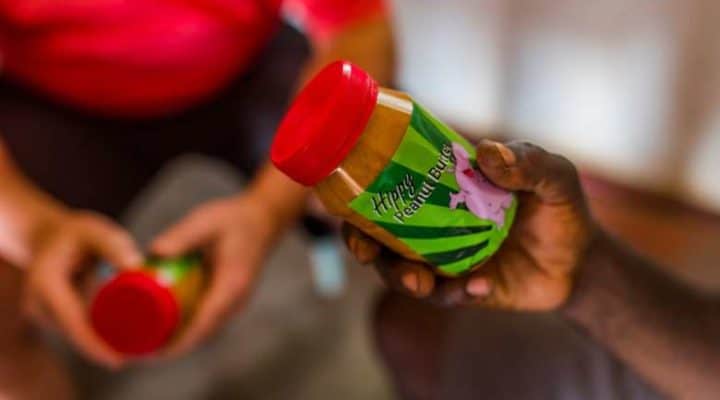
Lambton College students have created a company called Hippy’s Peanut Butter in Zambia, Africa. The peanut butter is now earning more than 20 times the amount of money than the peanuts would being sold on their own. (Lambton College)

Lambton College in Sarnia, Ont. has won a national contest for their work in a southern African country after training 30,000 farmers to become more efficient and successful.

In addition, the project also included starting up a peanut butter company, building infrastructure for alternative energy, increasing the amount of clean water in the region and building a clinic.

One Seed Project

The project, called ‘One Seed,’ earned students the title of Enactus Canada National Champions — a competition that challenges universities and colleges around the world to come up with innovative ideas to help others.

“It is an amazing thing for [students] to come here and put into practice what they are learning in the classroom and see it actually change lives forever,” said Jon Milos, the faculty advisor for the Enactus club at Lambton College.

Milos, who is currently in the small Zambia town of Monze, started the project in June 2012 after a student who was learning about solar panels approached him.

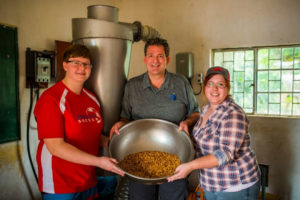
Jon Milos, the faculty advisor for the Enactus club at Lambton College stands between two students in Zambia, Africa. (Lambton College )

The student wanted to bring alternative energy back to the African village he grew up in, and Milos, along with his former and current students, have been able to accomplish even more than that.

The Enactus program has partnered with an organization called Southwest Ag Partners, the group goes to Africa twice a year with a team of agronomists who development the best farming techniques and practices for the land.

Milos said they’ve been able to quadruple the crop yields and farmers have three to five times more than their traditional revenue.

Milos believes the program has changed the lives of a quarter of a million people living in Zambia who were living in poverty.

“We have put food in their stomachs and we have put money their pockets ands now they are starting to build their communities because of that,” he said.

Milos said the farming techniques have proven to be so success that the Minister of Education in Zambia has agreed to adopt the farming program in 145 schools across the province.

Peanuts to 20x the profits

One of the clubs most recent projects in Zambia has been the creation of Hippy Peanut Butter. Milos said the Zambian people are able to grow peanuts easily but were selling the product for cheap at the markets.

“Our students said ‘What if we took those peanuts and we cleaned them and we processed them and we made peanut butter, packaged, marketed and sold it and we owned the value chain right from the ground to store shelves,'” said Milos.

Milos said Hippy Peanut Butter is now earning 20 times the amount of money than the peanuts would being sold on their own.

Students are also in negotiations with one of Zambia’s top grocery stores to get the product on the shelves.

Courtney Neilson is the co-president for the Enactus program at Lambton College, she was one of the students who launched the peanut butter company.

Enactus World Cup

Neilson, who has been to Zambia once, said the project has “changed her life,” and she can’t wait to go back.

“It has transformed my student experience completely, we took everything we learned in the classroom from market research, business development and we implemented it in the real life,” she said.

The Enactus team is preparing for the world competition held in San Jose, California in October.

Lambton College, with a population of only 3,000 students, will represent Canada next to 36 other countries.

Apps and social media helping Calgary Muslims navigate Ramadan 2018

Muslims in Calgary are turning to their mobile devices to help organize their busiest time of the year: the Islamic holy month of Ramadan.

There are more Ramadan-related apps than ever available to download, along with Calgary-based Facebook groups and pages that provide hyper-local resources and information for local Muslims.

During Ramadan, Muslims don’t eat or drink between dawn and sunset. It’s a time for spiritual reflection, prayer and spending time with family and friends while connecting with the community and helping those in need.

Social media can help provide all kinds of information and answers to a long list of questions throughout the month.

“When will Ramadan start? When will I break my fast? When will I start my fast? When is the prayer time? When is Ramadan finishing?” said Abid Khan, who helps manage a Facebook group for Calgary’s Pakistani community and uses Ramadan apps himself.

“It’s so easy now, everything came to my cellphone,” said Khan, who remembers not so long ago when it wasn’t quite as easy to stay informed.

“Before social media, we had to call the Imam of the mosque and ask him what is happening, or we have to watch TV or listen to radio. Back home, we had to go to the mosque ourselves to find out what is happening,” Khan said. “Now we have so many good apps.”

“I use an app called Isalam, an Arabic app, and it has prayer times and what time we will break our fast and the duration of each fast over the next 30 days. It tells me almost everything about Ramadan,” Khan said.

There are apps to help children and adults know, learn and memorize different duas, or personal prayers. Apps like Muslim Pro keep people updated on fasting times and recommend nearby mosques and restaurants for when it comes to breaking the fast each night.

Other prayer-based apps like Quran Majeed help users read the Quran while they are on the move with different languages and verse-by-verse recitations. In the spirit of Ramadan, other apps allow you to make donations, with some helping to feed Syrian refugees.

Apps tailored to Ramadan

Apps like Lose It track your weight and calorie intake during Ramadan and allow users who are fasting to keep on top of nutritional information. There are also apps similar to Skip The Dishes, offering a culinary lifeline to those without the time or skills to cook, linking users to restaurants where they can access their favourite iftar meals.

Iftar is the evening meal Muslims eat at sunset to break their daily fast. Fasting is one of Islam’s five pillars, along with faith, prayer, charity and making a pilgrimage to the holy city of Mecca, in Saudi Arabia.

“We know from social media how we have to fast, where we have to go, where are our mosques, where we have to go for musallahs [open spaces for praying], how many iftar parties there are in our city,” said Junaid Bahadur Khan.

“I use social media a lot to look for where I have to go for iftar parties in Calgary because there are a lot of parties during Ramadan. Ramadan is about getting together, having family dinners every day and you have to talk to other people, if someone needs anything. It’s about sharing, caring and getting together, and I use social media to get together,” said Khan.

Khan says social media is also helping non-Muslims learn more about Muslims and Islam at this time of year, helping demystify Ramadan.

“Now you can talk to people and even experience and observe what they are doing. You know people are fasting, what they are doing, what they have to do and how they’re interacting with each other,” said Khan.

“Social media is creating a new sense of understanding between different civilizations. It’s creating a new kind of paradigm where we can interact with each other,” he said.

Unique landscaping program helps grads cultivate new careers

Ready, Set, Grow! grooms graduates for work in landscaping, an industry facing a serious labour shortage

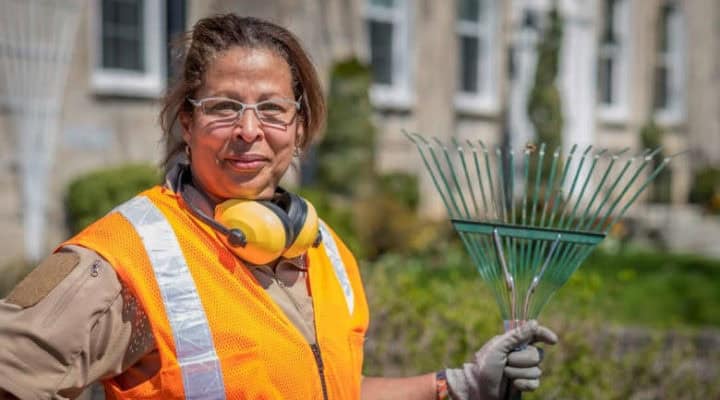
Wendy Harper, 64, is retraining for a job in the landscaping industry. (Michel Aspirot/CBC)

Seven years ago a repetitive strain injury to her wrists and shoulders forced Wendy Harper to give up hairstyling, a career she loved.

With a learning disability and poor reading and writing skills, the prospect of starting over in a new job was daunting.

She persisted, last summer, at the age of 63, she finally received her high school diploma. The Ottawa literacy agency that helped Harper graduate suggested she enrol in something called Ready, Set, Grow!

The free, Ontario government-sponsored training program matches adult students facing challenges with local landscaping companies facing a desperate shortage of workers.

Some trainees are older and have been out of the workforce for years, while others dropped out of high school more recently.

A professional landscaper teaches them technical skills such as proper pruning techniques and plant selection. The intensive two-month course ends with a two-week job placement with a local landscaping business.

12 to graduate

Twelve students will graduate from the program at the end of May, including Harper.

“I just figured if I could [graduate] then I could do anything,” she said “The most important thing was that I was going to be working outside and doing what I love.”

Harper, who immigrated from Trinidad and Tobago in 1974, recalls growing vegetables with her grandfather, and today maintains a large garden at her Ottawa home.

She knows that embarking on a new career at a time when many are retiring won’t be easy.

“There are days that I am young in my mind but my body isn’t all there,” she said. “My husband thinks I’m crazy, but I want to give it 110 per cent.”

Important life skills

In addition to teaching gardening techniques, Ready, Set, Grow! also imparts important life skills.

“It’s a huge confidence builder for the students. It really makes them feel valued and feel they can go out after the program and participate in the workforce,” said Georgina Smith, a literacy and basic skills instructor at St. Nicholas Adult High School, and co-ordinator of Ready, Set, Grow!

Smith teaches the importance of punctuality, clear communication and how to accept constructive criticism.

The graduates are filling a need in the industry. According to estimates, Ontario’s landscaping companies are short more than 25,000 workers across the province.

Living Green Landscaping co-owner Lindsey Ross jumped at the chance to take Harper on for her two-week job placement, and said there could be a job opening if she can cope physically with the tasks at hand.

“For someone who hasn’t done it before there is a learning curve for your body to get used to,” Ross said. “But she has a fantastic attitude and she learns really quickly and she’s done really well.”

‘We’ve changed people’s lives’

Ready, Set, Grow! was developed by the Rideau-Ottawa Valley Learning Network, an umbrella organization for adult literacy groups in eastern Ontario.

It began when Landscape Ontario, the provincial trade association, approached the network to help develop a curriculum that would groom graduates for the industry — not the way government-sponsored programs are typically born. (The $149,000 it takes to run the program comes from the Ontario Centre for Workforce Innovation.)

“We’ve changed people’s lives and we’ve given them really strong skills,” said Lisa Ambaye, the learning network’s director. “We’ve opened doors that were otherwise closed.”

Organizers will follow the students’ progress over the next year and offer more training, whether they land a landscaping job or not.

Grade 5 student in Simcoe County writes book on youth mental health

Madison McDermott, 11, wants her peers to know they are never alone

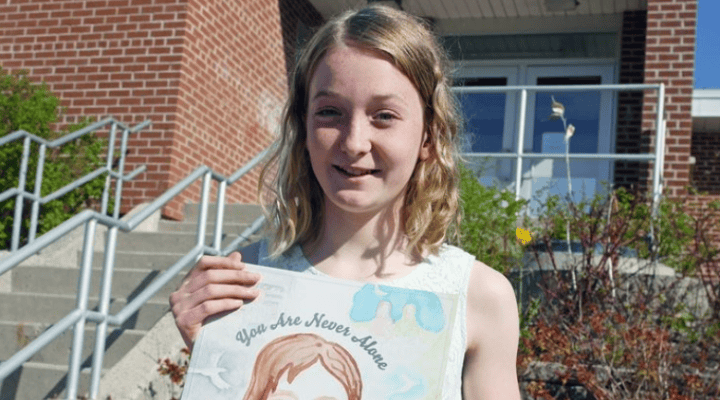
Madison McDermott, 11, will have her new book about youth mental health, You Are Never Alone, distributed to schools throughout Simcoe County. (Jennifer McDermott)

A book about youth mental health, written and illustrated by a Grade 5 Shanty Bay student will be distributed to schools throughout Simcoe County.

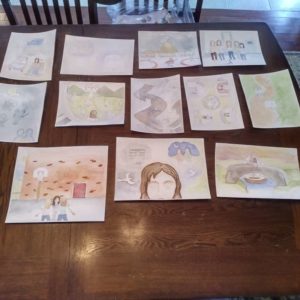
Madison McDermott, 11, is the author and illustrator of You Are Never Alone, a story that explores the life of a local woman who navigates her way through her parents’ divorce, the pressures of high school, teen pregnancy, and the battle with drug and alcohol addiction.

“I wrote a book because it’s a great way to share primary prevention and it’s really accessible,” she said.

Madison said she was part of a group called Change Agents at her school. They were challenged to pick a United Nations global goal issue and try to make change in that area.

She decided to interview a local resident about her personal struggles with mental health and addiction.

In an excerpt from the book, it’s clear Madison doesn’t shy away from the painful and complex details of the story.

“When I was 18 years old, I became pregnant and had a baby girl. Sadly because of the chaos and the pain connected to my low self esteem and addiction, life was unmanageable and I couldn’t raise my baby,” it reads.

Madison says the topic of mental health is regular dinner-table talk for her family as her grandfather was an addictions medicine doctor who battled alcoholism, and her mother is a counsellor.

“A lot of youth experience mental health and addictions, one-in-five youth, actually. Our family, we talk a lot about mental health and addictions and we think it’s important to talk about it and not have the stigma.”

Madison’s mother, Jennifer McDermott, describes her daughter as hard working and always up for a challenge.

“She had a certain vision, and it was a big one but it doesn’t surprise me” she explained. “It’s been a great experience because I think she wanted to set out to create awareness and she absolutely has.”

Jennifer McDermott said researching, writing, and illustrating this book has helped Madison herself become more aware.

Madison McDermott also did all the illustrations in her new book about youth mental health. (Jennifer McDermott)

“I think it’s a real understanding of mental health and addiction so that not only she can take care of herself and understand different experiences that she’ll go through so that she won’t feel alone, but she’ll also be a great resource and advocate in the community.”

The book describes coping mechanisms, discussion points for parents and teachers, as well as a list of resources at the back.

Madison said she simply hopes that when people read her book, they get the message.

“Know that there are many resources and that you are never alone, and also that all feelings are ok.”