Archives for May 24, 2018

How NASA Tech Is Helping Hawaii’s Kilauea Volcano Response

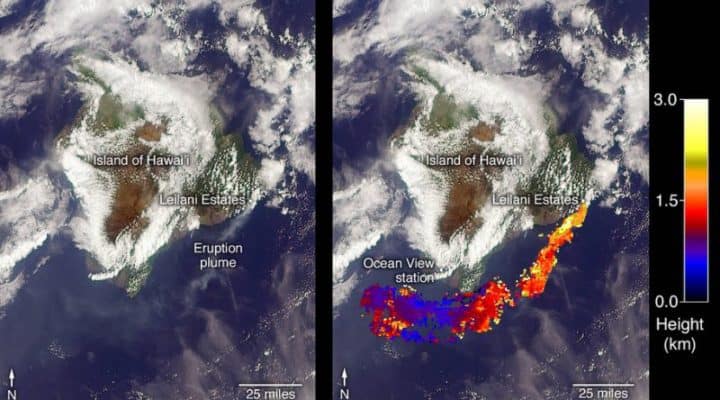
NASA’s Terra satellite captured this view of the ash plume wafting from Hawaii’s Kilauea volcano on May 6, 2018, using its Multi-angle Imaging SpectroRadiometer instrument. The right-hand frame shows the height of the plume.

NASA assets in space and in the air are helping first responders deal with the ongoing volcanic outburst in Hawaii.

Kilauea volcano, on Hawaii’s Big Island, has been erupting pretty much continuously for the past 35 years. But Kilauea’s activity ratcheted up considerably on May 3 after an earthquake rattled the region; lava began spilling from newly created fissures and spreading through neighborhoods, turning parts of the Big Island into disaster zones.

The response teams on the ground quickly turned to NASA for help, agency officials said. [In Photos: Hawaii’s Kilauea Volcano Eruption as Seen from Space]

“One of the first things emergency responders wanted to know was where the lava was coming out — where are all the fissures?” J. Carver Struve, NASA emergency management co-lead at NASA Headquarters in Washington, D.C., said in a statement.

Seven scientific instruments aboard five NASA and partner satellites helped answer this question and have provided a wealth of other important data — the composition and size of newly emitted volcanic plumes, for example, and how, exactly, the movement of molten rock underground is deforming the ground on the Big Island.

NASA scientists are also measuring the eruption from the air, using a G-III aircraft outfitted with an instrument called the Glacier and Land Ice Surface Topography Interferometer (GLISTIN). GLISTIN was designed to monitor ice sheets, but it can also detect changes in the Kilauea landscape caused by the outburst, agency officials said.

Photographs by astronauts aboard the International Space Station have also helped researchers and responders better understand the outburst, as has data contributed by the European and Japanese space agencies, NASA officials said.

“We’re providing actionable scientific products to teams on the ground to support response activities and fill any gaps they may have in their information as the disaster is evolving,” Struve said.

You can learn more about NASA’s Kilauea efforts here. Such work is part of the agency’s Earth Science Disasters Program, which provides and helps to coordinate important data about wildfires, floods, hurricanes, earthquakes, oil spills and other disasters, both natural and human-caused.
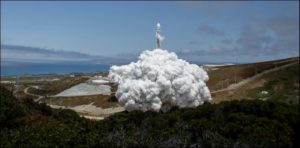
This NASA Camera Melted During a SpaceX Rocket Launch, But the Photos Survived!

Veteran NASA photographer Bill Ingalls is no stranger to rocket launches, but even he seemed surprised when one of his remote cameras melted in a fire sparked by a SpaceX Falcon 9 launch Tuesday but — wait for it — still managed to snap photos of the liftoff.

“Well, one remote cam outside the pad perimeter was found to be a bit toast(y),” Ingalls wrote on Facebook after the launch, “and yes – it made pix until [its] demise.”

The “toasty” camera was a Canon DSLR that Ingalls placed about a quarter mile (1,320 feet, or 402 meters) from SpaceX’s pad, called Space Launch Complex 4E, at Vandenberg Air Force Base in California. It was one of six remote cameras that the photographer set up to chronicle the launch of NASA’s twin GRACE-FO satellites on Tuesday (May 22). Five commercial Iridium Next communications satellites also rode the Falcon 9 into orbit. [See more awesome photos of SpaceX’s GRACE-FO launch]

The camera melted in a brush fire triggered by the Falcon 9 launch, Ingalls told Space.com today (May 23). Vandenberg’s fire department arrived to the launchpad after liftoff (which is typical of Vandenberg launches, to secure the site). A firefighter then found the camera and had it waiting for Ingalls when he arrived to collect his remote cameras.

“The Vandenberg Fire Department put the fire out pretty quickly, but unfortunately my camera got toasted” before they got to it, Ingalls said.

It was the first time that one of Ingalls’ cameras has been melted during a launch, and he’s been snapping photos for NASA since 1989.

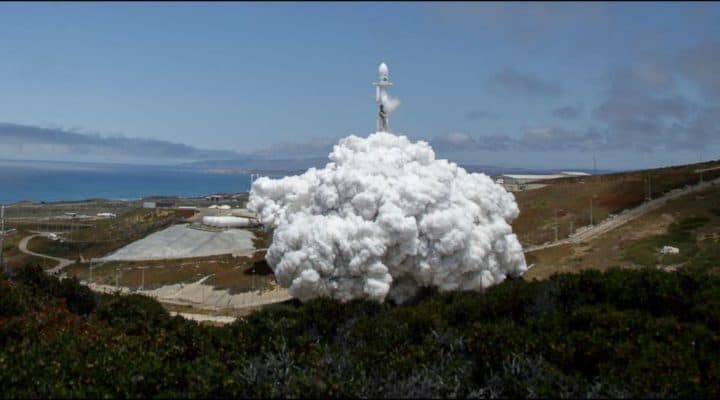
But despite being melted, the camera still managed to do its job. In one photo, the camera snapped a single frame of the SpaceX Falcon 9 as it began to lift off. “At least [it] got a frame before the camera bit the dust,” Ingalls wrote.

This photo of SpaceX’s Falcon 9 rocket launch was captured by a remote camera set up by NASA photographer Bill Ingalls before a brush fire melted the camera on May 22, 2018 at California’s Vandenberg Air Force Base. Bill Ingalls/NASA

Then came the fire.

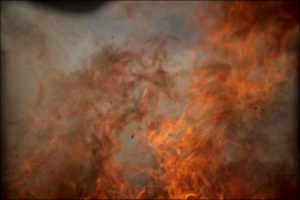
The next photo clearly shows flames overtaking the camera. “Reason for the toasty remote camera,” Ingalls wrote.

One final photo by Ingalls shows the remains of the camera, its lens a charred mess of bubbled plastic. “Toasty remote camera,” Ingalls wrote.

Flames from a brush fire are clearly visible this this final image from a remote camera set up by NASA photographer Bill Ingalls for SpaceX’s Falcon 9 rocket launch on May 22, 2018. The brush fire ultimately melted the camera, but its memory card was still accessible. Bill Ingalls/NASA

The brush fire that scorched Ingalls’ camera seems to have just been bad luck. He had four other remote cameras located much closer to the launchpad that made it through unscathed and worked flawlessly.

The biggest worry for a remote camera near the launchpad is usually debris, Ingalls said. A rocket launch can kick up rocks and other bits of debris that can damage or destroy a camera.

Cameras close to launchpads have protective housings, while lens filters can help protect cameras located farther away, he said.

La Loche modular farm to grow fresh produce for school, community

Dene High School recieves $220K grant from PC Children’s Charity

Produce, like kale, can grow along the modular farm’s four vertical walls using automated lighting, heating and watering systems. (CBC)

By fall there will be fresh, locally-grown produce in La Loche for the high school’s breakfast and lunch programs and the wider community, thanks to a modular farm the size of a shipping container.

Students from Dene High School are training to grow and harvest their own produce using a $220,000 modular farm they’ll receive through a grant from President’s Choice Children’s Charity.

The farm will arrive in the community in the coming months and last week, five students and three staff members were in Toronto for training.

Grade 10 student Brelanda Montgrand said she was expecting a greenhouse but was surprised by the size and capacity of the farm.

Grade 10 student Raynimae Fontaine says she wants to teach others how to plant and grow their own food. (CBC)

She said she’s looking forward to working as a team with her fellow students to produce healthier food for the community.

Sometimes access to fresh food can be an issue in the area. The North West Company food store in La Loche burned down in April; the company has relocated grocery sales to its other dry goods store in the community.

“It’s really expensive and you could just throw some fish sticks into the oven and fries because it’s easier, instead of making a nutritious meal,” Montgrand said.

Learning and then teaching others

RaynimaeFontaine, who’s also in Grade 10, said she hopes the idea catches on in the community.

“[We’ll] be able to show people how to plant if they want to make some kind of garden in their yard,” she said.

“It’s something that we’ve never had before at the school and we get to learn how to get it up and running and start planting everything and be able to harvest them … and actually eat them.”

The unit, developed by Modular Farms Co., contains a workspace for planting and harvesting and four vertical walls of produce which are sustained by automated lighting, heating and watering systems. It is built for a northern environment.

The system uses 95 per cent less water than a typical farm and can produce up to 1,000 heads of lettuce or 6,000 plum tomatoes per week.

Principal Greg Hatch said the food will supply the school’s breakfast and lunch program. He expects to see other benefits as well.

“It definitely supports the academic program. It also gives us the opportunity to be entrepreneurs,” said Hatch.

Art students at the school will also have the opportunity to decorate the farm’s exterior.

UWindsor board of governors gives final approval to $73M sports facility

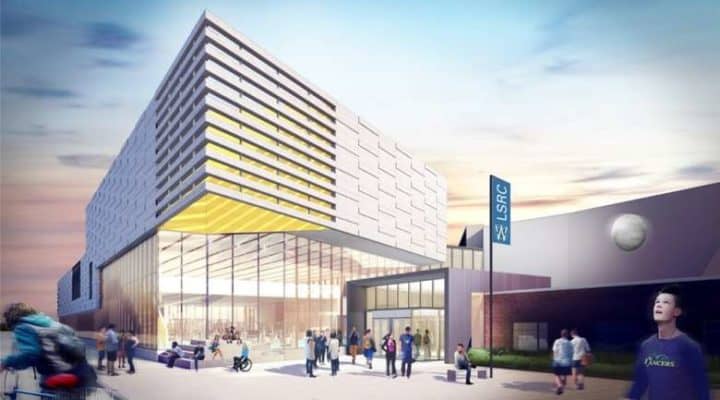
This artist rendering shows the main entrance of the proposed Lancer Sport and Recreation Centre. (University of Windsor)

The University of Windsor’s board of governors has approved the building of a new athletics facility.

Both undergraduate and graduate students voted in favour of the Lancer Sport and Recreation Centre back in 2017. A vote by the board of governors was the last hurdle before development on the new sports upgrade could leave the starting line.

The groundbreaking is targeted for the spring of 2019 with early work starting this fall.

“No student will pay any fee until the academic year in which the building is open [has started] … The initial fee will be $125,” said human kinetics dean Michael Khan.

Students voted in favour of funding $55 million of the project over the next 30 years. The university agreed to fund the remaining $18 million of the capital — along with the operating costs of the project.

University of Windsor students will be able to watch their Lancer athletes play from a press box. (University of Windsor)

What to expect

The facility will include a new triple gymnasium with seating for about 2,700 spectators, housing events such as convocation and numerous community events.

An eight-lane pool will replace the existing 50-year-old pool found in the St. Denis Centre.

At 12,000-square-feet, the Lancer Sport and Recreation Centre’s new fitness facility will be almost twice the size of the existing one.

Five multi-purpose rooms will provide students with a place for yoga, dance and spin classes, martial arts and CrossFit.

For more than just athletics

Khan said the Lancer Sport and Recreation Centre is meant to serve as a new student hub.

“It’s going to be a place that students can call their home. The idea here is that they will all gather up afterward for social time and there would be spaces provided for study,” adding the facility will host summer camps and events like FIRST Robotics tournaments.

Getting ready

Public membership rates have yet to be confirmed, but Khan promises the facility will be heavily utilized by the community.

The facility will be built up around the St. Denis Centre and will take up space on some of the existing soccer fields.

“We’ll be adding on a new artificial turf field and then refurbishing some of the grass fields.”

The Lancer Sport and Recreation Centre is expected to open in the fall of 2021.

Island veterans launch campaign to raise awareness of PTSD and suicide

‘We have an epidemic on our hands that we’re not discussing’

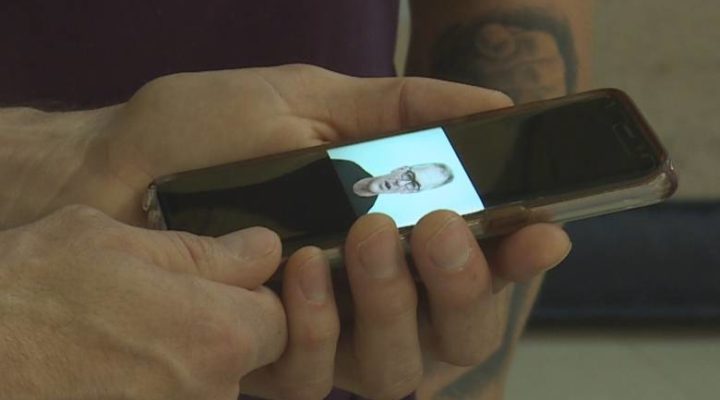
A group of veterans created a video campaign to raise awareness about PTSD and suicide within the veteran community. (Brittany Spencer/CBC)

A group of Island veterans is using social media to raise awareness of the impact of post-traumatic stress disorder (PTSD) and suicide within the veteran community.

The new campaign is called “If I Take My Life” and it asks veterans to talk about their experiences with PTSD and how mental health issues have impacted their lives.

The video launched online last week and already has nearly 50,000 views on Facebook.

One of the voices behind the campaign belongs to Dennis MacKenzie, a veteran who served for nine years with the Canadian Armed Forces and now runs Brave and Broken — an organization that offers support to veterans and first responders.

MacKenzie said he was released from his duties and returned home to P.E.I. because of his PTSD following a tour in Afghanistan.

“The message is pretty simple, but raw,” MacKenzie said. “If I take my life, please talk about it.”

Dennis MacKenzie says he has lost a number of comrades to substance abuse and suicide as a result of PTSD. (Brittany Spencer/CBC)

It’s still a stigma. … It’s not something that is just a day to day conversation, but that’s what I’m hoping to do. I’m hoping this video can make it a day to day conversation.”

MacKenzie said he’s lost eight comrades to suicide or substance abuse as a result of PTSD and wants the campaign to raise awareness of how severe suicide and mental health issues are among Canada’s veterans.

“I’m just tired of seeing veterans die suddenly and us left to question and find out why,” MacKenzie said. “We have an epidemic on our hands that we’re not discussing and if we’re not going to talk about it there’s going to be no way of finding a solution.”

‘Unfortunately our injuries are invisible’

The video features several Island veterans calling on Canadian veterans, their families and their communities to share their own experiences with PTSD, suicide and mental illness.

For Jennifer Young, a veteran who served for 16 years with the Royal Canadian Air Force as a supply technician, the campaign is a way to reduce stigma surrounding mental illness and suicide within the veteran community.

“People are OK to talk about somebody who has cancer, people are OK to talk about somebody that has a broken leg. Unfortunately our injuries are invisible.”

Putting out a video like this, she said, lets people know they’re not alone.

“We just want other people to know that there are people out there that go through those feelings,” Young said.

MacKenzie said he also wants the campaign to change the way society talks about suicide and PTSD-related deaths.

“All of these are going underreported and my hope is to change that,” he said. “There are thousands and thousands of Canadian veterans and first responders suffering with the same thing and we need to be made aware of the severity of the situation.”

‘Don’t be afraid’

Jay Power, a veteran who served for 21 years, also lent his voice to the campaign. He said he has lived with PTSD for the last nine years and has lost several comrades to suicide in that time.

He added that he was hesitant to share his story, but has realized how his experience can help others.

You need to let the person know you love them, you care and you’re here to listen.
— Dennis MacKenzie

“It’s important for people to know that they’re not alone,” Power said.

“That there are people that feel this way and feel like me or feel like them and it’s very important that we start talking about it.”

With the help of his loved ones, he started attending meetings and found that in sharing his story he feels better and wants others to know there are many people out there who want to hear their stories.

“Don’t be afraid to show your story, don’t be afraid to be judged, don’t be afraid of the stigma,” he said. “Just get out there, you’re going to save lives, you’re going to help people and that’s what we need to do. Not just as veterans but as a whole nation, a community.”

MacKenzie said he hopes this campaign will be helpful for people — even those who may not be ready to share their story.

“By witnessing their community open up and talk about it,” MacKenzie said. “It gives you that pillow to land on to know that ‘OK, if I come forward my community has their arms open for me.'”

MacKenzie said he and other members of the group plan to release more videos, sharing their message in their own words in the hope of inspiring veterans across Canada to create their own videos.

“I just want people to find some level of comfort level in being able to talk about this,” he said.

“People need to understand you just need to listen. You need to let the person know you love them, you care and you’re here to listen.”

Montreal students learn about Cree culture on eye-opening trip

Aloysius Chan was 1 of 46 students that visited Indigenous communities in Quebec

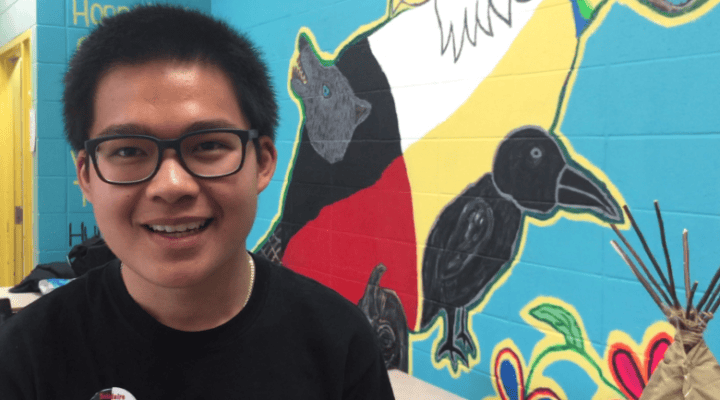
Aloysius Chan says the trip to Indigenous communities in the Abitbi and James Bay regions of Quebec was ‘an eye opener.’ (Susan Bell/CBC )

Aloysius Chan is proud of his new found Cree syllabics skills.

The 16-year-old, who emigrated from Malaysia to Montreal just a year and a half ago, now wears a button with his name in Cree through the halls of his Montreal high school, École Saint-Henri.

“They are very nice people, the Cree. They are very welcoming,” said Chan, who was one of 46 students — some of them newly arrived immigrants — on a recent trip to Indigenous communities in the Abitibi and James Bay regions of Quebec.

“It was an eye opener for me because we get to learn their way of life, which is very different from Montreal,” said Chan.

The trip was organized to improve the students’ understanding of Indigenous history and culture, according to Jérôme Jolin, a history professor who organized the excursion along with fellow professor Véronique Ledoux.

“We don’t talk enough about Indigenous people in the new [history] curriculum,” said Jolin.

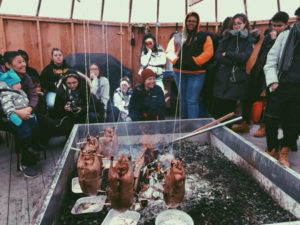
46 Montreal high school students learned to make a traditional meal, spent time in a sweat lodge and played basketball with local teens. (Submitted by Caroline Molie)

“The best way to break down prejudices is to meet, to get to know other people,” said Ledoux, who also helped organize a similar trip last year to the Innu community of Pessamit, Que., on the north shore of the St. Lawrence River.

“When we get to know other people we realize that we have much more in common than [we have] differences. That’s what we want to build on,” she said.

‘To actually see it, it’s very important’

This year’s group hit the road in mid-May, visiting the Algonquin community of Lac Simon and the Cree of Waskaganish.

They learned to make a traditional meal, spent time in a sweat lodge, played basketball with local teens and enjoyed a dazzling display of Northern lights.

They also learned about residential school and about local traditions and customs, such as a walking out ceremony, where an infant is welcomed into Cree society, and a first goose ceremony, where a young hunter is celebrated for making his first kill goose kill.

While in Waskaganish, they also got a crash course in Cree syllabics from Lucie Trapper, who teaches French to students at Wiinibekuu School.

“I think it’s important for other people to know our language is very strong and our culture is very alive,” said Trapper, who also taught Chan and others to traditionally prepare a goose and prepare bannock on a stick along with canned moose meat. “I’m very proud to say our children speak Cree.”

For many of the visitors, it was their first time out of Montreal, according to Lysanne Sévigny, another teacher at Wiinibekuu. She says the trip opened up their eyes to a wider reality of Quebec.

“It’s crucial because as new (Quebecer) you have to find out what Quebec is,” said Sévigny. “They hear about [Indigenous culture] at school, but to actually see it, it’s very important.”

“When you don’t know things, you start making up stories. That’s when you start developing racism,” she said, adding more than a few of the visitors and teachers expressed a desire to move there one day.

In recent years, the school has become a hub for newly arrived immigrants to Quebec. According to Ledoux, in 2016 the school had four groups of what are known as “class d’accueil,” where newly-arrived immigrants get intensive language training in smaller-size classrooms and extra support to be able to integrate into a regular classroom.

By this year, École Saint-Henri had 18 such classes, with plans to add more next year.

For École Saint-Henri, the trip is a focal point of efforts to break down the notions of prejudice, according to Ledoux. She and Jolin see the students who made the trip as agents of change, who will confront ignorant notions about Indigenous people in the wider school population.

“They are the ambassadors,” said Ledoux. “They are going to be the ones who speak with the other students and we hope make a difference.”

Both École Saint-Henri and Wiinibekuu School hope to develop a deeper connection and exchange with each other. École Saint-Henri is also hoping to visit other Indigenous nations in the years to come.