Archives for May 24, 2018

3 Dividend Stocks That Pay You More Than Verizon Does

Long-term business tailwinds and market-trouncing dividends have made Verizon Communications (NYSE: VZ) a staple in income investors’ portfolios. But Verizon isn’t the only top stock that’s rewarding investors with an envy-inspiring yield. BP PLC (NYSE: BP), Ford Motor Company (NYSE: F), and AT&T Inc. (NYSE: T) offer higher yields than Verizon does, and according to three Motley Fool contributors, each has catalysts that could make now the perfect time to add it to your income portfolio.

Time to warm up to energy

Todd Campbell (BP PLC): Energy exploration and production stocks took a drubbing after crude oil prices peaked in 2014, but commodity prices have been marching higher for over a year now, and that’s translating into increased profits at companies like BP.

A man points at a drawing of an ascending bar chart floating in front of him.

One of the biggest energy producers on the planet, BP has its hands in upstream (finding and extracting oil and gas), midstream (transport, including pipelines), and downstream (selling to consumers) businesses.

Last quarter, BP reported its best quarterly profit in three years. I expect that we’ll see more of those “bests” as some very important new projects come online.

In 2017, the company started up seven new projects — on time and under budget — and as a result, its upstream production grew 14% year over year last quarter. In 2018, six new projects are coming online, including Atoll in Egypt and the massive Shah Deniz in the Caspian. Between 2016 and 2021, BP’s goal is to add 1 million new barrels of oil production per day.

Higher prices for that higher production could be a big driver of future profit growth, but BP’s also benefiting from operating leverage because of its cost-cutting during the downturn. According to management, margins on major projects through 2021 will be, on average, over a third higher than margins were on production in 2015.

BP’s also growing downstream by entering new markets, like Mexico, where it has 200 locations currently, and it’s expected to have 1,500 locations by 2021. BP’s also getting in on the renewable energy boom via its Lightsource partnership, and it hopes to grow its midstream business via a spin-off it did last year, BP Midstream Partners.

Overall, it’s hard to predict where oil and gas prices are heading, but it appears that the worst is behind BP. If so, then buying it now may pay off in more than the chance to collect its 5.35% dividend yield.

Hello, China

Daniel Miller (Ford Motor Company): If you’re scanning the market for dividends paying more than Verizon’s, take a look at Detroit’s second-largest automaker and its 5.3% yield — and that figure doesn’t include its annual supplemental dividend. Yes, new vehicle sales in North America have peaked, but Ford is determined to slash its budget, focus on SUVs, and expand in China. All those factors should help power Ford’s bottom line in the near term.

Last month, Ford announced its largest new vehicle launch in China. Those launches include the new Focus, Escort, and Ranger Wildtrak, as well as the Lincoln Aviator, MKC, and Nautilus. It’s the first wave of the 50 new products Ford plans to launch in China by 2025, in an attempt to capitalize on the world’s largest automotive market.

Meanwhile, back in the heartland, Ford is doubling down on cost-cutting. Originally Ford’s cost-cutting goal was $14 billion, a figure that was plenty big. Now, CEO Jim Hackett has bumped the cost-cutting target to a staggering $25.5 billion and expects to reach 8% global profit margin by 2020 (Ford’s global profit margin was 5.2% during the first quarter). It’s even possible that Ford could exit certain geographic regions and markets if reasonable returns aren’t viable in the medium term, similar to General Motors’ move to sell its European operations.

Ford is an intriguing automaker as it expands in China, cuts costs to boost the bottom line, and dishes out a juicy 5.3% yield. But to be more than a dividend stock for income investors, the company must find a way to generate revenue from the coming driverless-car trend.

Millennials sitting on a floor together using smartphones, a tablet, and a laptop

A fallen Dividend Aristocrat

Leo Sun (AT&T;): Verizon’s rival AT&T; pays a forward dividend yield of 6% — its highest yield since 2011. That yield was inflated by the stock’s 17% year-to-date decline, which was caused by concerns about the sluggish growth of its postpaid smartphone, wireline, and pay-TV businesses. AT&T’s planned takeover of Time Warner, which could transform it into one of the biggest media companies in the world, also remains in limbo.

Yet AT&T is still the second-largest wireless carrier in the US, and the nation’s top wireline and pay-TV service provider. Those businesses give it a wide moat against its potential challengers, and the telco has rebounded from plenty of market downturns in the past.

AT&T generated $18.3 billion in free cash flow over the past 12 months, and spent just 66% of that total on dividend payments. That gives it plenty of room to hike its payout, as it did annually for 33 straight years. That streak makes AT&T an elite “Dividend Aristocrat” — a member of the S&P 500 which has raised its dividend for over 25 straight years.

Wall Street expects AT&T’s revenue to slip 3% this year, but its earnings — boosted by buybacks, potential divestments, and better cost controls — to rise 12%. AT&T’s big drop reduced its forward price-to-earnings ratio to just 9, which is lower than Verizon’s multiple of 10. Therefore, I think AT&T’s downside is fairly limited at these prices.


American Airlines vs. High Fuel Prices: This Could End Badly

For the past several years, American Airlines (NASDAQ: AAL) CEO Doug Parker has been one of the most prominent proponents of the idea that the airline industry has been permanently transformed and will produce big profits going forward. In the past year, he has doubled down on this argument, saying that in the new environment, airline managers don’t have to worry much about short-term profitability and can focus on making long-term investments.

If Parker is right, you wouldn’t know it from his company’s financial results. American Airlines’ profitability has been plunging ever since oil prices began to recover from a 2014-2016 slump. Furthermore, American Airlines cut its 2018 earnings per share (EPS) guidance last month due to rising fuel prices.

The rally in oil prices has continued in the month following American’s Q1 earnings report. This could cause the company’s earnings to fall even further behind management’s original forecast.

Profit comes under pressure

American Airlines’ adjusted pre-tax margin peaked at 15.3% in 2015. While a 41% drop in the carrier’s average fuel cost played a big role in that strong result, airline industry earnings had already started to rise in 2013 and 2014, before the oil price collapse. Thus, investors had some reason to hope that American could sustain a double-digit adjusted pre-tax margin regardless of where fuel prices went in the future.

A rendering of an American Airlines jet on the ground

American Airlines’ adjusted pre-tax margin reached 15.3% in 2015. Image source: American Airlines.

However, American Airlines’ adjusted pre-tax margin slipped to 12.6% in 2016 despite a further decline in fuel prices and plunged to 9.1% last year, when fuel costs started to rise again.

In conjunction with its first-quarter earnings report, American Airlines reduced its 2018 adjusted EPS guidance range from $5.50-$6.50 to $5.00-$6.00. This change in its earnings forecast was entirely driven by a higher fuel price assumption. Based on this updated guidance range, American expects to post an adjusted pre-tax margin of roughly 7% to 8% this year.

The oil price rally hasn’t ended

Unfortunately, oil prices have continued to rise since American Airlines revised its forecast. On April 20 — the day that the carrier updated its fuel price assumption — the price of Gulf Coast jet fuel was $2.07 per gallon. Gulf Coast jet fuel reached $2.21/gallon as of Monday.

American Airlines uses about 4.4 million gallons of jet fuel each year. Thus, on an annualized basis, a $0.14-per-gallon increase in the price of jet fuel would add more than $600 million to its fuel bill. The cost headwind for the remainder of 2018 could be close to $400 million if jet fuel prices stabilize near current levels.

Unless American Airlines can push through bigger fare increases — which would be tough in the current ultra-competitive environment — this cost headwind will drive almost 1 percentage point of incremental margin pressure in 2018.

Cash flow is becoming a concern

Even with the recent spike in fuel costs, American Airlines is likely to earn an adjusted pre-tax profit of roughly $3 billion this year. This might make it seem like shareholders have nothing to worry about. However, the company needs a higher level of earnings to support its substantial capex commitments and its weak balance sheet.

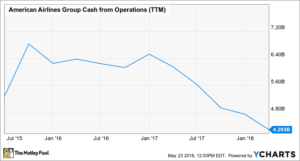
Operating cash flow has fallen steadily since the beginning of 2017. Over the past 12 months, American Airlines has generated just $4.3 billion in cash from operations. That figure could move even lower during the next few quarters as higher fuel costs pinch profits.

American Airlines Cash from Operations (TTM), data by YCharts.

On the other side of the ledger, American Airlines plans to spend $3.7 billion on capital expenditures (capex) in 2018, including $1.9 billion for new aircraft. This means that free cash flow will be close to zero.

Last month, management projected that aircraft capex would rise to $2.5 billion in 2019 before receding to $1.7 billion in 2020. Since then, American has ordered 30 additional regional jets, 29 of which will be delivered next year. This could increase 2019 capex (including non-aircraft spending) to nearly $5 billion, potentially pushing free cash flow into negative territory.

The balance sheet is a mess

During the past four years, American Airlines has dealt with weak free cash flow by borrowing heavily to finance new aircraft. This allowed it to return about $12 billion to shareholders, mainly through an aggressive share repurchase program.

American Airlines can continue to finance most of its new aircraft purchases to reduce its cash outflows. However, the bill for its previous financing activity is starting to come due. American has about $2 billion of debt maturing in the last three quarters of 2018. It also has nearly $10 billion maturing between 2019 and 2021.

With cash flow falling and interest rates rising, American Airlines will face some unpleasant choices as its debts come due over the next few years. As a result, while American Airlines stock has fallen more than 20% since March, investors should still stay away from this looming train wreck.

Canalys: Apple Shipped 3.8 Million Watches in Q1

Smartwatches are taking over the wearables market. That product category continues to cannibalize other types of wearable devices like basic fitness trackers, a trend that is expected to continue for the foreseeable future. Apple (NASDAQ: AAPL) is now the top dog in wearables thanks to the strength of Apple Watch. In fact, the company beat out all competing smartwatch vendors combined in 2017, after excluding other wearables categories.

As Apple obfuscates Watch results, investors still have to rely on third-party estimates to gauge how the device is faring.

Man wearing Apple Watch

Still on top

Canalys estimates that Apple again grabbed the top spot in the wearables market in the first quarter, shipping 3.8 million units. That was good enough to grab 18% of the market, which saw overall unit volumes jump 35% to 20.5 million. China’s Xiaomi, which is preparing to go public, came in a close second with 3.7 million units. However, Xiaomi’s unit volumes predominantly consist of Mi Bands, the company’s low-cost basic fitness trackers. Thanks to the relatively higher prices of smartwatches, they now comprise 80% of global wearables revenue, despite only representing 43% of unit volumes.

Much like other analysts have found, the recent inclusion of cellular connectivity is helping drive demand. “Key to Apple’s success with its latest Apple Watch Series 3 is the number of LTE-enabled watches it has been able to push into the hands of consumers,” Canalys analyst Jason Low said in the release. “Operators welcome the additional revenue from device sales and the added subscription revenue for data on the Apple Watch, and the list of operators that sell the LTE Apple Watch worldwide is increasing each month.”

For the cellular-equipped subset of the smartwatch market, the Mac maker now enjoys market share of 59%. However, that could be more related to the fact that there simply aren’t many other smartwatches out there that feature cellular connectivity. Alphabet subsidiary Google is reportedly working on a Pixel-branded smartwatch that could include cellular connectivity, which has the potential to jump-start competition, as third-party Android Wear manufacturers are shifting their focus away from the platform.

Fitbit (NYSE: FIT) came in No. 3, with 11% market share (2.2 million devices sold) as that company continues to try navigating the transition to smartwatches, most recently with the Versa, which Fitbit hopes will appeal to mainstream consumers. Fitbit’s first smartwatch, the Ionic, fell flat, which Fitbit attributed to it being “more of a performance product.” Note that Canalys includes Fitbit’s Blaze as a smartwatch, even as Fitbit itself does not consider the Blaze to be a full-fledged smartwatch.

In many ways, Apple Watch is following in the footsteps of the iPod. The iPod wasn’t the first MP3 player, but quickly became the most popular product and defined the category. Apple Watch is now doing likewise.

Why Ford’s Stock Is Still Struggling Under CEO Jim Hackett

Tuesday marked one year since Ford Motor Company’s (NYSE: F) board of directors ousted Mark Fields as CEO, replacing him with Jim Hackett — a futurist and former Steelcase CEO who had joined Ford to run its future-mobility subsidiary.

It has been a year of ups and downs. Hackett’s promotion was followed by a broad reshuffling of Ford’s senior executives and a lot of talk about improving Ford’s “fitness” as a company.

A year later, Ford’s share price looks to be stuck in neutral.

To understand why, I think we need to look back at why Ford’s board chose Hackett — and at what he has and hasn’t done in the year since then.

Hackett is shown standing before a white background with a blurred blue Ford logo.

Jim Hackett marked his one-year anniversary as Ford’s CEO on May 22. Image source: Ford Motor Company.

Why Ford ousted Fields and promoted Hackett

Hackett’s selection as Ford’s CEO was about more than the company’s stock price. Executive chairman Bill Ford told me at the time that the decision to replace Fields with Hackett was driven by a need to accelerate the transformation of the company in the face of impending disruption from new high-tech entrants.

The fact is that we are in unprecedented times, both in terms of opportunities and potential landmines. I believe that we need a transformational leader who has done it, who has reimagined a company into a future and then brought that company along with him. We’re very fortunate to have that in Jim.

To be clear, I absolutely think that was sincere. At the time, analysts were questioning the state of Ford’s future-tech efforts, particularly given the very visible work being done at rival General Motors (NYSE: GM) around self-driving, electric vehicles, and shared mobility.

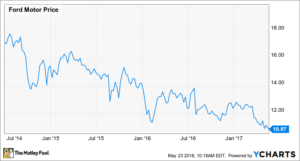
But I think Ford’s board of directors might have also had another, more blunt reason for replacing Fields. Ford’s share price had taken a big dive during his tenure as CEO.


F data by YCharts. Chart shows the price of Ford’s common stock from July 1, 2014, when Mark Fields took over as CEO, through May 19, 2017, the last trading day before his departure.

Those things are related, of course. In the last year or so of Fields’ tenure, it became clear that GM was making significant progress toward a future vision of mobility, and its stock price was reflecting that progress. Ford’s directors were right to wonder if Fields had let the company fall behind its old rival.


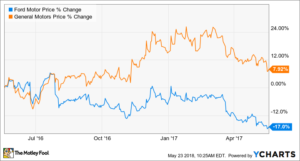
F data by YCharts. Chart shows the price change of General Motors and Ford stock from May 19, 2016 through May 19, 2017 — the last year of Mark Fields’ tenure as Ford’s CEO.

I think Ford’s board hoped that Hackett would be able to drive a more rapid transformation of Ford into a company that could thrive in a post-disruption automotive future. I think they also hoped that investors would reward his work with a higher stock price, just as they had been rewarding GM’s efforts.

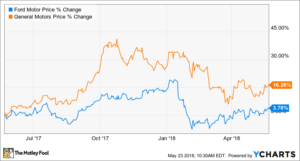
But while Ford’s stock hasn’t tanked under Hackett, it still hasn’t kept pace with GM’s share-price growth.


F data by YCharts. Chart shows the price change of General Motors and Ford stock from May 22, 2017 through May 22, 2018 — the first year of Jim Hackett’s tenure as Ford’s CEO.

What’s the problem here?

Why Ford’s stock has yet to soar

I think the problem is that after a year in office, Hackett still has yet to articulate a clear, detailed plan for improving Ford’s profitability and ensuring that it remains competitive in the high-tech near future. He has said quite a bit about his intentions in general terms, but the details are still lacking.

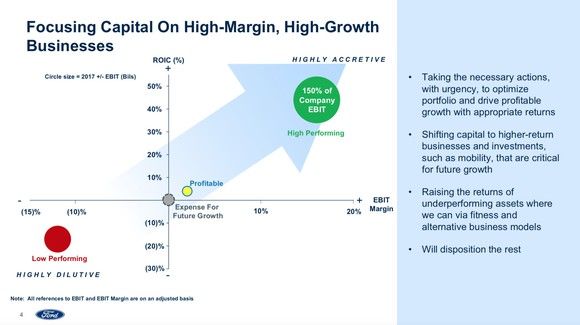
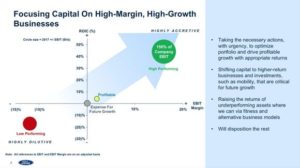
Here’s an example of what I mean. During Ford’s first-quarter earnings presentation last month, Hackett showed this slide.

Image source: Ford Motor Company.

As you can see, the slide makes clear how Hackett and his team are thinking about the challenge of boosting Ford’s profitability. Some of Ford’s products and businesses are very profitable, and some are unprofitable. The clear hint is that Ford is looking at jettisoning some or all of the latter. But we don’t yet know what those “low-performing” products or businesses are, or when that jettisoning might happen.

We’ve seen some bits and pieces of the effort, of course. Ford’s much-talked-about move to eliminate most of its sedan models from its lineup in North America is a big one. But we still don’t know what else might be coming — or what any of these moves will do for Ford’s profitability and competitiveness.

That’s one thing that has changed in a big way under Hackett. Fields had his ups and downs as Ford’s CEO. But as with his highly lauded predecessor, Alan Mulally, investors always felt informed. We knew where Ford was going and why.

Though it’s still true to some extent under Hackett, we have had to squint through an awful lot of vagueness to see it. Simply put, I think Ford’s share price is unlikely to rise significantly until (or unless) that haze of vagueness clears.

Or put another way, until Hackett — or someone — explains Ford’s plan in clear terms that resonate with investors.

Xbox Adaptive Controller first look: A new, necessary gamepad

Microsoft stumbled into the accessibility market about three years ago, with the launch of the Xbox One Elite controller. The Elite wasn’t designed to help people with disabilities play video games — in fact, it was built for hardcore players who wanted more mapping options by adding rear paddle buttons, more sensitive triggers and interchangeable analog sticks to the classic dual-grip Xbox gamepad.

It just so happened these features were also in high demand at organizations like AbleGamers, whose goal is to make gaming accessible to anyone with disabilities via education, community support and the creation of custom controllers.

(Microsoft)

Around this time, Xbox’s inclusive lead for product research and accessibility, Bryce Johnson, reached out to AbleGamers with a proposal. Johnson and a small team of developers had just submitted a prototype of an accessibility-focused controller to the annual Xbox hackathon, and they wanted feedback on the design.

“We started jumping onto multiple calls with Microsoft employees and Xbox hardware developers and talking about this controller,” AbleGamers COO Steven Spohn said. “Bryce had been working with us on the Elite and wanted to bring in our input for this new controller. It was to be a device much like our own Adroit — a standard Xbox controller that could use switches, only this new project could be everything we ever wanted to do better and more.”

That was two and a half years ago. Today, Microsoft revealed the Xbox Adaptive Controller, the latest and most disparate evolution of its gamepad line.


Taking input from AbleGamers, Warfighter Engaged, SpecialEffect, Craig Hospital and the Cerebral Palsy Foundation, the Xbox accessibility team designed the Adaptive Controller with a new type of player in mind. The Elite may have been a step in the right direction in terms of inclusion, but it still relied on a handful of assumptions, like the fact that players had two hands and complete control of their fine motor functions.

For many people with disabilities, this simply isn’t the case.

“It assumes that I have the reach to get around to these bumpers and triggers, and that I have the endurance to hold it for a long-period gaming session,” Johnson said, before describing the myriad partnerships and playtesting that went into the Adaptive Controller’s design. “We met a lot of really unique people. And we got to design a device that we think — we know it’s going to empower them.”

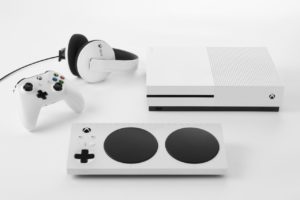
The Xbox Adaptive Controller is the first of its kind. It’s a plug-and-play option for people with disabilities — it connects to the Xbox One or Windows 10 PC via Bluetooth and powers on just like the Elite. The controller itself is a clean white rectangle, about 11 inches long and 6 inches wide, with two large black buttons on its face. The buttons aren’t touchpads, but they are light-touch enabled, clicking down with the softest of taps so players can roll their palm between the two or otherwise click them without exerting much force. Each button makes a slightly different noise as well, offering an extra layer of sensory input.

To the left of those big black circles is a D-pad, classic Xbox power button and a profile button that allows players to quickly shift between three different mapping options, even mid-game. There’s one USB-C port on either side of the controller — not micro USB, developers noted, because that format is orientation-specific, while USB-C accepts plugs either way.

Some of the controller’s most impressive features are on back of the rectangle. Nineteen 3.5mm ports line the backside, one for each button on the traditional Xbox gamepad. This allows players to plug in their existing accessibility tools, such as air-powered input methods, big buttons or small clickers, and have them instantly mapped to the proper function. If a particular set-up isn’t working out for any reason, players or their caregivers can quickly change ports to manually remap their controller, all without pausing the game.

This is a massive change from existing accessibility controllers, most of which are hodgepodge tools that require players to restart the console every time something goes wrong. And with so many wires and homemade input methods, things tend to go wrong fairly often.

“They can be really expensive, thousands of dollars,” Senior Xbox Hardware Program Manager Gabi Michel said. “They are custom. You usually have to go to a non-profit to get them, and those often have waiting lists. They require technical expertise, they can be hard to find — it’s not accessible. So, at Xbox, when we were looking for a hardware solution, we wanted to solve all those problems. We wanted it to be affordable, we wanted it to be extensible. It needed to be easy to find, it needed to be easy to use, set up, play, everything.”

The Xbox Adaptive Controller will cost $100 when it goes on sale later this year.

There are so many battles that have to be fought for people with disabilities.

Steven Spohn, COO of AbleGamers

This is a passion project for Johnson, Michel and many other developers on the Xbox team. They see the Adaptive Controller being using in physical therapy, mental health recovery and in the daily lives of people with disabilities — and those without disabilities. Developers stressed that the Adaptive Controller is the next iteration of the Xbox gamepad, not a throwaway gimmick, and they were clearly excited about all of the unimagined ways players will use the new controller.

It takes advantage of a few existing Xbox inclusivity features, including remapping and copilot, a function that allows two players to control the same character. Combined with the Adaptive Controller, the Xbox ecosystem is opening up new worlds for people who have been excluded from the video game industry for decades.

Erin Muston-Firsch is an assistive technology lab specialist at Craig Hospital, where she guides patients with brain and spinal cord injuries through physical therapy exercises. Muston-Firsch was Microsoft’s point of contact at Craig as they put the controller together, and her patients got the chance to beta test it and provide feedback. After the reveal of the Xbox Adaptive Controller at Microsoft’s offices in Redmond, she told the following story:

I had a patient named Reese and she came from a family — she has 15 siblings, 15 brothers and sisters, which is insane — but that’s what they do. They game. She was teaching her younger siblings how to play Call of Duty, and that was kind of the way they related to each other. And then she had a spinal cord injury.

She had this major trauma happen and she was just thinking about all of the things she couldn’t do anymore when she came to Craig for rehab. … At that time, we were in beta testing, so I set her up with the Xbox Adaptive Controller, and within five minutes she was playing Call of Duty. And not only was she playing Call of Duty, which is an insanely difficult game to set somebody up with the first time if they have a disability and can’t move their fingers, but she was copiloting with her younger brother. He was controlling just the right analog stick and she was doing everything else.

Her mom was in the back, crying, because it was this super powerful moment.

One of the most important aspects of the new gamepad, for developers and players alike, has nothing to do with its actual functionality. It’s all about how the product feels and looks. The Xbox Adaptive Controller doesn’t look like an accessibility tool. It looks like an Xbox product; it’s sleek, branded and clean, and it won’t stand out negatively in anyone’s living room. For players who have been dealing with mismatched wires and tools cluttering up their gaming spaces, this is a huge improvement, both physically and mentally.

For people like Reese, Muston-Firsch and AbleGamers COO Steven Spohn, the Xbox Adaptive Controller is already a success.

“There are so many battles that have to be fought for people with disabilities to become the players they want to be,” Spohn said. “Xbox replacing one of the tools I use in my everyday job with a bigger and better version of that tool only allows us to do our jobs are better, serve more people, and be quicker about it. We have so many people who still need our help, millions of people. The Xbox Adaptive Controller is going to help change the future for the better. I couldn’t be happier. I couldn’t be more proud to be a part of it.”

This article originally appeared on Engadget.

Chevy will soon let you pay for gas from inside your car

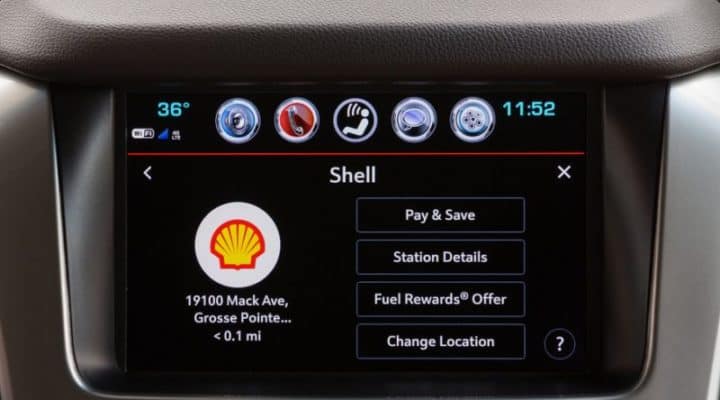
Refueling your Chevy car or truck is about to get a little easier with the launch of Chevy’s new in-dash payment system. The service, which is being beta tested in Detroit, Seattle and Houston, is part of General Motors’ (GM) Marketplace commerce platform and will allow drivers to pay for their gas from inside their vehicles via their infotainment systems.

The in-dash service will only be available at participating Shell (RDS-A, RDS-B) stations in the near term, but will reach all stations by the end of the year. Chevy says it’s also working with ExxonMobil to bring the service to that company’s gas stations, though no timeline has been announced.

To make in-car payments you’ll have to download and open the Shell app, which will then send your location (without any privately identifiable information) to Shell so it knows which station you’re at.

You then tap “Pay and Save” on your vehicle’s display. After choosing the payment method you want to use, you’ll receive a three-digit code for the pump at which you’ll refuel. Go to the pump, enter the code and you can start refueling. The feature even lets you use your Shell Fuel Rewards program.

The Chevy in-dash payment service in action.

Chevy says that the in-car payment service will use your vehicle’s built-in 4G LTE connection but won’t require you to sign up for any actual data plans, which is a plus.

The Marketplace in-vehicle app is available on all eligible 2017 and newer Chevy, Cadillac and GMC cars and trucks, and will reach about 4 million vehicles by the end of 2018.

Of course, as convenient as not having to walk into the gas station or pull out your credit card to pay for gas is, you still need to step out of your car to use the actual pump, so it’s not like you’re going to be able to stay in your vehicle the entire time. Unless you’re in New Jersey, that is.

What’s the big benefit? Well, you’ll be able to avoid credit card skimmers that can steal your card information at the pump, and even if you don’t have your card on you, you’ll still be able to pay for gas.

The main reason for the service, though, seems to be that it’s pretty darn cool. In order for it to take off, however, it’s going to need to be faster than just walking over to the pump and swiping or tapping your credit card. If it’s slower, don’t expect many people to use the in-car payment option.

Now if they could just find a way to automate changing my car’s oil, I’ll be set.