Archives for April 3, 2018

Why Alnylam Pharmaceuticals, Inc. Is Tanking Today

What happened

Shares of Alnylam Pharmaceuticals, Inc. (NASDAQ: ALNY), a precommercial pioneer of RNA-based therapies, continued a slide that began just ahead of the weekend. A clinical trial win that Pfizer Inc. (NYSE: PFE) announced on Thursday could mean potential competition for Alnylam’s lead candidate could be much worse than expected. In response, the stock is down 15.7% as of 11:30 a.m. EDT on Monday.

So what

Patisiran is one of several valuable candidates in Alnylam’s pipeline at the moment and furthest along the development timeline. The Food and Drug Administration is expected to hand down an approval decision this August that could make patisiran one of the first available treatments for the inherited form of a rare, life-threatening disease called transthyretin (TTR) amyloidosis.

Frustrated man with hands on head looking at a downward sloping chart.

Image source: Getty Images.

Ahead of Pfizer’s announcement, most had assumed a candidate from Ionis Pharmaceuticals (NASDAQ: IONS) called inotersen was the only serious contender for a very small population of TTR amyloidosis patients. The FDA rejected an application for Pfizer’s tafamidis years ago, citing lack of evidence proving efficacy. It took a long time, but Pfizer shot back on Thursday with long-term survival data that shows a significant benefit for patients taking tafamidis compared to placebo after 30 months.

Now what

Alnylam investors certainly have reasons to be nervous. However, there are still too many questions about tafamidis to assume a commercial launch is already doomed. Pfizer’s been marketing the oral treatment as Vyndaqel in the European Union for years, but sales figures have so far been too low to mention.

I’d call the recent plunge a bargain buying opportunity, despite Alnylam’s market cap still being up around $10 billion at the moment. Though the company has three other drugs in late-stage development, it still needs to score a string of victories to support its lofty valuation. Sanofi will fund late-stage development of a hemophilia candidate, and The Medicines Company has circled its wagons around a cholesterol candidate. While both have delivered excellent data, they also face increasingly fierce competition.


These 3 Stocks Doubled in 2017 — Are They Still Buys?

2017 was an absolutely banner year for the stock market. After historically rising by 7% a year, inclusive of dividend reinvestment and when adjusted for inflation, the broader market catapulted higher by nearly three times that amount last year. And with it, some of the hottest stocks logged triple-digit percentage gains. Payment processor Square (NYSE: SQ) gained 154%, online home-goods retailer Overstock.com (NASDAQ: OSTK) surged 265%, and Latin American e-commerce giant MercadoLibre (NASDAQ: MELI) vaulted higher by 102%.

But the big question is: Can these top performers continue pushing higher?

Dice that say buy or sell being rolled atop a digital chart.

Image source: Getty Images.

With this in mind, we asked three of our Foolish investors whether they believed Square, Overstock.com, and MercadoLibre were still buys today. Here’s what they had to say.

Mobile payments aren’t going anywhere

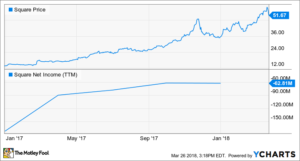
Travis Hoium (Square): Payment processing company Square has had an incredible run the past 15 months, nearly quadrupling in value for investors. The gains have been driven by Square’s revenue growth and an improving bottom line, which investors hope will continue. Square isn’t profitable yet, but if businesses continue to adopt the company’s platform it’s possible the company will be able to start reporting positive net income soon.

SQ data by YCharts

What Square has been able to leverage the last few years is its suite of products that surround its payment processor, including calendars, inventory management, an e-commerce platform, and more. If you’re starting a food truck, salon, or coffee shop, Square makes all the sense in the world. That’s the foundation of the company right now, but it’s just scratching the surface of its potential.

Where Square has struggled, and where it has a great opportunity, is in businesses with over $500,000 in annual payment volume. Square is an attractive point-of-sale system for businesses with very small transactions, because the 2.75% flat fee is less expensive than other options. But as transaction prices go up, the attractiveness of Square’s fees goes down. Visa’s interchange rates are 1.51% plus $0.10 for a credit card transaction and 0.8% plus $0.15 for a debit card transaction, and most processors charge a small fee on top of Visa’s fee. Square does custom rates for some larger customers, but it’s missing an opportunity to grow into higher-transaction businesses with its current fees and locking itself into money-losing low-volume transactions. Creating a fee structure that would increase profitability for low-revenue transactions while attracting more high-revenue transaction businesses could drive Square’s stock significantly higher. That’s where I see upside for the stock in the future.

Given its payment platform and services, Square has become a go-to for small businesses across the country, and I think the company can expand that to higher revenue businesses as well, driving growth for many years to come. That’s why I think Square is still a buy, despite the stock’s gains already seen in the past year.

Should you “Go for the O”? Well, no.

Sean Williams (Overstock.com): Few stocks were on fire in 2017 quite like online home-goods retailer and now blockchain developer Overstock.com. From start to finish, Overstock shares galloped higher by 265%.

Overstock has benefited from the emergence of blockchain technology — the digital, distributed, and decentralized ledger that’s often tethered to cryptocurrencies and is responsible for logging all transactions — which is being developed by a subsidiary. It also rose in step with cryptocurrencies as it’s been accepting bitcoin and a few dozen other virtual currencies as payment on its online website. Overstock has been hanging on to a growing percentage of its virtual currency holdings, rather than converting them immediately into cash, which has boosted its underlying valuation as the market value of digital currencies has soared.

The big question is, can this rally continue? Put plainly, this investor isn’t convinced.

A person holding a magnifying glass over a balance sheet.

If we look at Overstock’s core online home-goods business, it’s rather unexciting. Despite its niche focus and the convenience of online purchases, Overstock.com hasn’t been able to hold a candle to Amazon.com. Amazon has deeper pockets and a considerably more loyal customer base, leaving Overstock muddling along with a mid-single-digit growth rate and breakeven profitability. That’s hardly worth a 265% increase in share price.

What’s more, CEO Patrick Byrne is practically going all-in on blockchain development and has tinkered with the idea of selling Overstock.com’s online business to fund blockchain development at its subsidiary. Even if blockchain proves to be the game-changing technology that everyone believes it could be, the chance that will happen within the next few years is slim. We’re still trying to move beyond the proof-of-concept conundrum, which makes placing too much faith in blockchain a potential mistake.

Should investors be buying Overstock.com following its 265% rise in 2017? Heck, no!

This is just the beginning

Danny Vena (MercadoLibre): After years of being held back by fears involving political unrest, hyperinflation, and currency devaluation, Latin American e-commerce leader MercadoLibre roared ahead in 2017, gaining over 100% — five times the performance of the S&P 500. Improving economic and political conditions in the region spurred the company’s results to new heights. In light of the stock’s significant spike, however, investors will rightly be asking themselves if MercadoLibre is still a buy.

A look at what drove the company’s gains last year might give us insight into whether MercadoLibre still has gas in the tank.

Worldwide e-commerce is expected to grow to $4.88 trillion by 2021, more than double the $2.3 trillion achieved in 2017. MercadoLibre stands to benefit from the increasing adoption of online sales. Over the years, the company has worked to remove the friction points that kept consumers from joining the e-commerce revolution.

A woman holding a gold credit card, making an online purchase.

MercadoLibre created its own online payment service, MercadoPago, that has been a key to its success, as 70% of consumers in the region don’t have a bank account and only between 20% and 50% have a credit card, depending on the country. The company also created its own shipping solution, MercadoEnvios, and has been rolling out free shipping, to counter the coming encroachment of Amazon.com.

The company also helps solve issues for business owners in a variety of ways. MercadoLibre provides working capital loans to vendors in a region that has low penetration rate for typical banking services. The company has more than a decade of granular data for longtime merchants, allowing it to more accurately assess the likelihood of repayment. It also provides an easy-to-adopt platform vendors can use to set up online sales.

With a host of advantages and an improving business climate, MercadoLibre seems destined to continue the significant gains it achieved in 2017.

3 Top Value Stocks to Buy in April

Value stocks have become scarce thanks to the nine-year bull market, which has only recently started to show its age. Even a few months ago, it was tough to find anything that could legitimately be called a value stock.

The market is no longer moving in only one direction, and that means value investors should be on the lookout for opportunities. Where to start? How about Alphabet (NASDAQ: GOOG) (NASDAQ: GOOGL), Best Buy (NYSE: BBY), and Cypress Semiconductor (NASDAQ: CY)? Here’s what you need to know.

Puzzle pieces spelling VALUE

Image source: Getty Images.

A surprisingly inexpensive tech giant

Steve Symington (Alphabet): Alphabet stock is trading at around $1,035 per share as of this writing, but don’t let its four-figure price fool you into thinking it’s expensive. The parent company of Google is expected to increase revenue nearly 21% this year (to around $134 billion), while 2018 earnings should climb by an even more impressive 38% to roughly $42 per share. Assuming Alphabet lives up to those expectations — and it typically does, despite not offering quarterly financial guidance to Wall Street — that would mean the stock trades at below 25 times forward earnings, an attractive premium given its growth. And that’s not to mention the fact that Alphabet has nearly $101.9 billion in cash and marketable securities — or roughly $147 per share — on its balance sheet.

Of course, the vast majority of Alphabet’s sales and profits come from advertising and digital product sales from its incredible core Google business, which boasts seven products with at least one billion monthly users each: Search, Gmail, Chrome, Maps, YouTube, Google Play, and Android.

But Alphabet also enjoys the promise of substantial incremental growth from its “other bets” segment, which houses a group of mostly early-stage businesses with massive long-term promise. Even still, these other bets are seeing their collective top lines grow quickly; sales from the segment soared 49% last year to $1.2 billion — mostly from Nest connected home products, Fiber high-speed internet, and Verily life-sciences innovations. And while they simultaneously generated an operating loss of $3.4 billion last year (narrowed from $36 billion in 2016), if even one or two of these businesses can eventually grow to rival Google’s existing core operations, they will prove money well spent.

This retailer is killing it

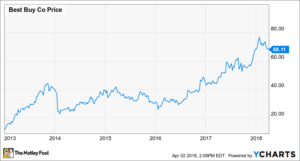
Tim Green (Best Buy): There are a lot of retail stocks trading at severely beaten-down valuations. Consumer electronics retailer Best Buy isn’t one of them. The stock has soared since the company embarked on its turnaround in late 2012. Over the past five years, shares of Best Buy have more than tripled:

BBY data by YCharts.

Best Buy has slashed unnecessary costs, removed layers of management, lowered prices, invested in its stores, and expanded its e-commerce operation. The company’s fourth-quarter results show the fruits of those labors: Comparable sales jumped 9% higher, online sales surged 17.9%, and adjusted earnings per share exploded 25%. On top of solid execution, the company’s results were aided by the decline of competitors like Sears Holdings and the bankruptcy of regional chain H.H. Gregg.

Best Buy produced adjusted earnings of $4.42 per share in 2017. Back out the $1.78 billion of net cash on the balance sheet, and the stock’s price-to-earnings ratio sits at 14. Use the $5.50 to $5.75 per share Best Buy expects to earn in fiscal 2021, and the ratio drops to 11 at the midpoint of that range.

Best Buy’s future growth will depend on its success expanding its services, e-commerce, and international businesses. The company doesn’t expect the blockbuster growth numbers it put up in the fourth quarter to repeat. But with a relatively low valuation, Best Buy doesn’t need to hit a home run every quarter for the stock to be a solid investment.

An overlooked niche chipmaker

Leo Sun (Cypress Semiconductor): Cypress Semiconductor is often overshadowed by larger chipmakers, but it’s the market leader in five high-growth niche categories — Wi-Fi/Bluetooth combo chips for Internet of Things (IoT) devices, automotive instrument cluster microcontrollers, automotive NOR flash memory chips, SRAM memory chips, and USB-C controllers.

The chipmaker’s core growth strategy, dubbed “Cypress 3.0,” aims to turn it into a “one-stop embedded solutions provider” for the IoT market. That strategy got a big boost from its acquisition of Broadcom’s wireless IoT business in 2016.

Cypress has a lot of irons in the fire. Its core growth comes from the automotive and industrial markets, where smarter machines now require more semiconductors, but it also has a major foothold in the consumer electronics market, where the USB-C standard is gaining traction.

Bears think its growth could be hurt by soft auto sales or an economic slowdown which hits industrial chips, but Cypress consistently gains content share in both the auto and industrial markets — which means that a large number of chips installed per machine could easily offset any cyclical declines. That’s why 80% of its revenues came from customers who bought “two or more” product families last quarter.

Analysts expect the company’s revenue and earnings to rise 7% and 37%, respectively, this year. Yet the stock trades at 14 times forward earnings and pays a forward dividend yield of 2.4%. Cypress already rallied 11% this year, versus the 6% gain of the PHLX Semiconductor Index, but I think that it’s still a great value play in a lofty sector.

Will Uber’s Driverless Accident Hurt These 3 Chipmakers?

One of Uber’s driverless SUVs was recently involved in an accident which killed a pedestrian on a dark road in Tempe, Arizona. Neither the car nor its backup driver spotted the woman, Elaine Herzberg, who was walking her bike across the road.

This was the first fatal accident directly caused by an autonomous vehicle. Uber halted all of its driverless vehicle tests across the US, while Arizona’s governor suspended all of Uber’s tests in the state.

A woman uses a smartphone while sitting in a driverless car.

Image source: Getty Images.

As a result, the industry’s autonomous efforts, which aimed to put driverless vehicles on public roads by 2020, could hit a lot more speed bumps this year. That’s a worrisome development for chipmakers that are dependent on the driverless market. Let’s examine three chipmakers in the blast zone: NVIDIA (NASDAQ: NVDA), Intel (NASDAQ: INTC), and Qualcomm (NASDAQ: QCOM).

NVIDIA

Uber’s driverless vehicles are powered by NVIDIA’s hardware (but not its Drive PX platform). Upon announcing that collaboration, Uber Advanced Technologies chief Eric Meyhofer stated that “NVIDIA is a key technology provider to Uber as we bring scalable self-driving cars and trucks to market.”

On March 27, Reuters reported that NVIDIA had suspended all its self-driving tests. The stock tumbled 8% after the news, although the decline was likely exacerbated by a broader sell-off across the markets.

This development could hurt NVIDIA, which saw its auto revenues — once a pillar of growth — fall 8% sequentially and rise just 3% annually last quarter. On the bright side, the business, which also includes its Tegra CPUs for infotainment and navigation systems, only accounted for 5% of its top line.

NVIDIA’s

NVIDIA’s weakness in autos was easily offset by its massive growth in gaming GPUs and data centers, which lifted its total revenues by 34% annually last quarter. Therefore, NVIDIA’s auto business could struggle, but that probably won’t throttle its top line growth.

Intel

Intel owns Mobileye, the largest provider of ADAS (advanced driver assistance systems) in the world. ADAS solutions use a combination of radars and cameras that help drivers spot hazards, park correctly, and remain in the right lanes.

Intel, Mobileye, BMW, and Fiat Chrysler are co-developing a driverless platform aimed at putting fully autonomous vehicles on the road by 2021. Intel also owns Movidius, a maker of computer vision chips that helps cars “see” and analyze their surroundings.

In a blog post, Mobileye CEO Amnon Shashua criticized “new entrants” which lacked the experience necessary to ensure the safety of driverless cars. Upon reviewing the police video of Uber’s crash, Shashua stated that Mobileye’s ADAS would have detected Herzberg “approximately one second before impact.”

Intel doesn’t report its automotive revenues separately. But we know Mobileye generated $358 million in revenues in fiscal 2016 (its last full year before being bought by Intel), which represented 49% growth from 2015. Assuming its revenue rose another 40% to $500 million in fiscal 2017, that would still equal less than 1% of Intel’s top line. Simply put, a slowdown in Intel’s fledgling driverless business won’t hurt its core business, which generates most of its revenue from x86 CPUs for PCs and data centers.

Qualcomm

Qualcomm narrowly escaped a hostile takeover by Broadcom, but the chipmaker still faces severe headwinds. Regulators and OEMs are still demanding that it lower its licensing fees, which account for the lion’s share of its profits.

Apple (NASDAQ: AAPL) is suing Qualcomm over unpaid exclusivity rebates and its licensing practices. Apple and another major OEM, widely believed to be Huawei, also suspended all their licensing payments to Qualcomm. Qualcomm’s chipmaking business, which generates most of its revenues, still faces tough competition from cheaper chipmakers like MediaTek and first-party chips from OEMs like Huawei.

Qualcomm’s Snapdragon Automotive chips.

Qualcomm’s escape plan was to buy NXP Semiconductors (NASDAQ: NXPI), the biggest automotive chipmaker in the world. NXP owns BlueBox, a driverless platform that competes against NVIDIA’s Drive PX.

However, that takeover remains in limbo. NXP’s shareholders still haven’t tendered enough shares, and China’s MOFCOM (Ministry of Commerce) hasn’t cleared the deal. The Broadcom battle also forced Qualcomm to raise its bid for NXP by 16% to $44 billion — so it could now be overpaying for a chipmaker in a slowing industry.

The bottom line

Driverless cars are a new technology, and tragic accidents were inevitable. Therefore, a slowdown is probably healthy for the industry — which should reevaluate its safety standards and testing practices.

Investors shouldn’t abandon NVIDIA and Intel over this news, since automotive chips are still mere slivers of their businesses. But they should take a more critical view of Qualcomm, and see if its original plans for NXP still hold up in this tougher market.

Mission Ctrl-P: HP Launches New Zero-G Printer for the Space Station

The astronauts on the International Space Station have access to a slew of state-of-the-art scientific instruments and cutting-edge technology, from hand-held DNA sequencers to robot assistants to even a 3D printer.

But when it comes to plain old 2D printing, the emphasis, as of late, has been on the “old.” [Space Station’s 3D Printer Makes Wrench From ‘Beamed Up’ Design]

“If you think about it in terms of its age, the printer can vote,” said Stephen Hunter, NASA’s manager for space station computer resources at Johnson Space Center in Houston, Texas. “And that is just the time we’ve had it on orbit. If you add in the years of development, it’s probably closer to 21, so the Epson printer can probably step up to any bar and order a drink.”

Since the first crew moved on board the orbiting laboratory in November 2000, the space station has been equipped with the same model of inkjet printer: the Epson 800. But after almost two decades, even with swapping out units every 18 months or so, keeping the printers up and running has become a real issue.

“I use that analogy because while the printers have worked well, the maintenance for them has just become too hard for us now,” said Hunter in an interview with collectSPACE. “So the decision became either we’re going to upgrade our printing capability or we just weren’t going to print anymore.”

Not printing was not an option.

Epson passed on NASA’s invitation to help develop a new printer, so NASA found a new commercial partner in HP.

All in one

The astronauts use the printers on the space station for the same reasons people on Earth use them in offices and at home. The crews print out work documents as well as personal files.

“Letters from home, photographs and training materials are the types of things the crews print,” said Hunter. “If you think about how much you print at home, or how much you print in your office environment, the same kind of thing applies in space, except that there are some critical things the crew has to print.”

While the astronauts have ample access to laptop and tablet computers, there are just some things they cannot keep in electronic format only. For example, were the space station to suddenly lose power or if the crew had to evacuate the outpost in an emergency, they could not rely on there being an available digital screen or the time needed to access their procedures. So hard copies are a must.

The rare contingency aside though, there is also the human factor.

“There’s something very human and psychological about the feel of paper,” Hunter explained. “You get things that are very personal to the crew — letters from home, pictures. There are some who have used the printers to make keepsakes to bring home. One crew member used the printers to print out their expedition patch on a special type of paper from their home country and used that as souvenirs.”

The space station’s printing needs put the orbiting outpost into a unique category, said Ronald Stephens, the R&D manager for HP Specialty Printing Systems.

“For the astronauts, the space station is really a combined environment,” he said. “It looks like an enterprise environment, where you have ‘corporate’ NASA on the ground changing procedures and sending up materials to be printed remotely, and we at HP work in those type of environments quite often.”

“It is also clearly an office and laboratory environment. You’ve got astronauts doing research, printing reports, graphs, other engineering and science documents.”

“And then it is also their home — their family sends an email or a photo,” added Stephens. “I think the challenge is that the space station is really a combination of all of the different types of segments that printers go into. It is that all in one.”

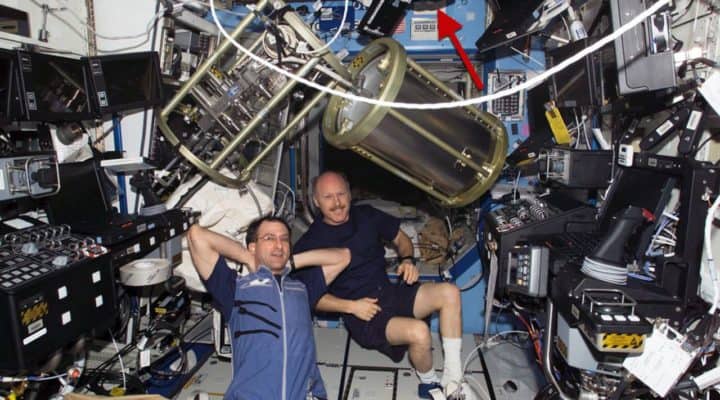
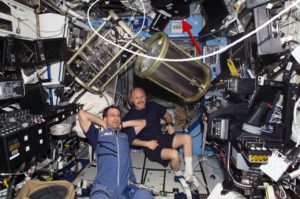
Spot the printer: An Epson 800 printer can be seen mounted on the ceiling of the space station’s Destiny lab amid other equipment and astronauts Don Pettit and Ken Bowersox in March 2003. NASA

Off the shelf

The astronauts’ printing needs may indeed be all in one, but the printer they use would be better if if it was not, said Hunter. When the Epson 800 first went into use aboard the space station, many commercial printers did just and only that, print.

“We wanted to stay with using a commercial off-the-shelf printer and then modify it for our needs,” said Hunter. “But as you can no longer find a printer that just prints, we had to take an all-in-one style printer and disable some of its functions.”

No one is sending faxes to the space station. And while it might be nice to be able to scan and copy documents in orbit, the printer parts needed to enable that are a problem for NASA.

“We needed to remove the glass out of the printer, because if that were to shatter or break we’d have a safety issue. It saves weight as well,” said Hunter.

After doing a market study of the available home and office printers, NASA found an HP model that could be modified to fit its needs.

“They were interested in our OfficeJet 5740 printer and working with us to figure out what would be the best way to replace the technology that they currently have on the space station,” Stephens told collectSPACE in an interview.

Out of the box, the OfficeJet 5740 could probably work if hung on a wall or even a ceiling here on Earth. But to print in microgravity, modifications were needed.

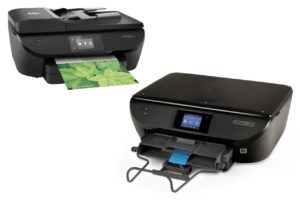
Before and after: At top, HP’s OfficeJet 5740 printer; at bottom, the HP ENVY ISS printer as developed for the space station. HP via collectSPACE.com

Off the planet

To figure out what worked and what did not in its printer, HP came up with test and mounting fixtures to mount the OfficeJet upside down, sideways and at 45-degree angles.

“At many of the orientations, yes, the standard OfficeJet is able to accommodate,” stated Stephens. “The biggest challenge from a zero-gravity standpoint was paper management.”

As it happens, the off-the-shelf 5740 comes standard with a small arm that lowers down on the paper entering the printer, and a roller that lifts the top sheet to feed it in “a perfect design for a zero-gravity paper pick,” said Stephens.

So going in, modifications were only needed to keep the paper stack in place. But what goes in must come out.

“You have to think about how you capture the paper in a microgravity environment. If you do not have some type of restraint, you end up with confetti shooting out of the printer,” Hunter said.

“Obviously that would be unacceptable,” said Stephens. “We used 3D printing and came up with an output tray design that uses some flexible fingers to help redirect the orientation of the paper as it’s coming out of the printer — basically to knock it down and simulate that action that gravity would pull the paper. And then we have got a unique bale arm that’s able to catch and stop the paper and keep it in place.”

There were other, more minor changes made as result of microgravity, which were also solved with printed parts. For example, the carriage that moves the printhead from side to side normally hangs on a rod.

“Here [on Earth], we count on gravity to rotate it so that it hangs down in its correct position. We realized that would be a challenge in zero gravity and so we used 3D printing to shim that down and force it into the needed orientation,” said Stephens. [How a Robot Arm in Space Inspired Tech for Surgery on Earth]

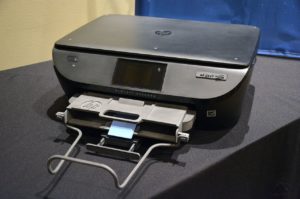
The new HP Envy ISS printer for the International Space Station is built from flame retardant materials and has 3D printed parts to direct paper flow. collectSPACE.com

Keeping ink in and fire out

NASA’s requirements for the modified printer weren’t only that it needed to work in microgravity. It also had to function safely aboard the space station.

For example, because the printers will be mounted in areas where astronauts and cosmonauts could bump into them accidentally while floating through the modules, there could not be any sharp edges.

And because fire precautions are paramount on orbit, NASA required that the new printer be made from fire-safe materials. So, HP re-molded all of its printer’s plastic parts from fire-retardant alternatives.

And then there was the ink.

Early on, NASA ruled out launching laser printers. The laser, itself, was considered a safety risk, the printers required too much power and the fine powder inside the drum of a laser jet would be a “huge contaminant” if it got out. So then it became a question of how to keep the ink from an inkjet printer contained.

HP’s OfficeJet cartridges do not rely on gravity to work. Unlike the example of the space pen, which required a pressurized ink cartridge to replace the pull of gravity, the HP printer cartridges use thermal forces to create a bubble inside of the nozzle, and that bubble is what ejects the ink out.

“And to prevent the ink from just drooling out of the printhead, this family of inkjet printers uses foam inside the print cartridge and the capillary force of the liquid in the foam is what gives us the back pressure in the ink cartridge so the ink doesn’t ooze out,” explained Stephens. “So, we were not required to make any changes to the ink or the ink cartridges for it to work.”

That does not mean, though, that droplets of ink do not sometimes pool inside the printer. On Earth, those drops fall and evaporate over time. But in space, where the droplets won’t ever drop, there is concern of ink escaping the printer.

“If the ink were to escape, it could contaminate science payloads or even be a risk to the crew with ingestion,” said Hunter.

That resulted in HP having to do “quite a bit” of work to redesign the interior of the printer, such as filling open areas with absorbent materials, Stephens said.

“We also used a special tape to cover all the seams of the case parts, so that if in the very unlikely event ink were to somehow get out of the inside of the printer, it will be unable to get out of the printer into the environment,” he said.

Mission ‘NV’

Taking all of the changes into account, the modified-for-orbit OfficeJet 5740 differs from an off-the-shelf printer by only about 10 percent. But, as it turns out, that was enough to warrant a new name.

Borrowing from another of its product lines, HP named its space station printer the “HP ENVY ISS” printer.

The first HP Envy ISS is launching on SpaceX’s CRS-14 Dragon cargo spacecraft and is expected to be installed by the station’s crew for a qualification run in May.

“We’re deploying this as a technology demonstration before we can do the full out replacement,” said Hunter. “I’m expecting, based on the amount of testing that we have done for this, that this printer will work flawlessly.”

Assuming everything does work, the Envy ISS will replace the two Epson printers — one in the U.S. and one in the Russian segment — on board the space station. NASA intends for the Envy ISS to be in use through the end of the space station, whenever that may be. (At present, the station’s partners have agreed to extend to at least 2024.)

“For the ground, we bought of the 50 of the unmodified, right-off-the-shelf printers to provide our training areas and have spares, and we purchased 50 printers to be modified for flight,” said Hunter, noting the quantities were based on HP production runs.

“We’re very excited about it because this is the first new printer for the ISS since its inception 20 years ago,” he said.

For its part, HP is prepared to support the Envy ISS printer on the space station, a project it has dubbed “Mission NV.”

“It’s been a blast to work with the NASA team very closely,” said Stephens. “It has certainly been the most exciting project I have worked on in my many years with HP.”

SpaceX nails another mission, sends a used Falcon 9 rocket to resupply the ISS

SpaceX has had a busy 2018. The company has been making history continuously over the course of the last several months, and now, Elon Musk’s space startup is looking to grab some headlines once again. SpaceX will be launching one of its Falcon 9 rockets to send 5,800 pounds worth of supplies and science experiments to the International Space Station. This precious cargo will be carried within a SpaceX Dragon capsule, which has also previously made a trip to the International Space Station.

SpaceX has quickly proven itself to be the private provider of choice for NASA, who seems to be making a habit of using the company’s rockets and capsules to bring various necessities into space. In fact, it’s the second time that NASA has used a Falcon 9 rocket to deliver equipment — the first mission took place in August 2017. It’s the third time that the Dragon cargo capsule will visit the ISS, making both SpaceX craft regular veterans of the station.

Unlike in previous missions, however, SpaceX will not attempt to land the Falcon 9 after its launch. Rather, it will seek to collect data as the rocket falls back down to Earth, landing somewhere in the ocean. “This one seemed like a really good opportunity to fly a trajectory a little bit out more towards the limits,” Jessica Jensen, director of Dragon mission management at SpaceX, said during a press briefing about the mission. “And that way, our engineers can collect additional data, not only during reentry but during landing that will be useful for the future.”

So what exactly is SpaceX carrying on behalf of NASA? As The Verge reports, onboard the Dragon are a few new technologies, like an instrument that will live outside the ISS and analyze thunderstorms on Earth. There will also be a research platform that examines the effects of artificial gravity on tissues and plants. The Dragon will remain attached to the ISS for about 30 days.

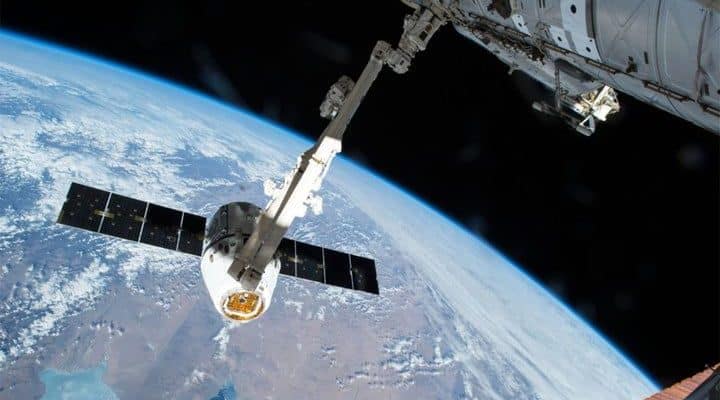
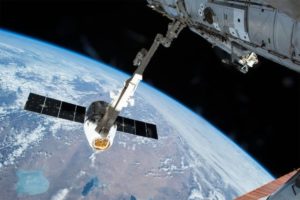
Dragon capsule at the ISS during a previous mission. NASA

On its way back, the capsule will also be carrying a few important items, including NASA’s old Robonaut 2, a humanoid bot that has lived on the ISS for the last seven years. It will get some serious attention from scientists back on Earth — the Robonaut 2, alas, has been non-functional since 2014.

You can check out the launch of the used Falcon 9 on Monday, April 2 at 4:30 p.m. ET (assuming no delays boggle the timing). Because the flight has what is called an instantaneous launch window, even the slightest delay will end up pushing the launch to tomorrow. There is currently a backup launch date on Tuesday, April 3 at 4:08 p.m.

NASA will begin its live coverage beginning around 4 p.m. ET, if you’re eager to watch every little aspect of today’s flight.