Archives for March 28, 2018

Here’s everything you need to know about the Huawei P20

Following in the footsteps of last year’s P10, the Huawei P20 brings a lot of exciting new features to the table. This year’s flagship comes in three flavors: The Huawei P20, Huawei P20 Pro, and Porshe Design Huawei Mate RS.

Here are all the details we have about the Huawei P20. If you want our first impressions on the Huawei P20 Pro, check out our hands-on review.

Camera

huawei p20 and pro news viewfinder

Huawei’s phone cameras have been great performers since it began its partnership with Leica. How will it improve on the P20? Well, it looks like Huawei added some pretty impressive new hardware and software features to make the camera on the P20 its best yet — and camera sensor testing company DxO Mark confirms that the goal has been met.

First things first: The Huawei P20 Pro and Porsche Design Mate RS are the first phones we’ve seen with a triple camera array. They’re equipped with a 40-megapixel main lens with A.I. Image Stabilization (AIS). The secondary camera comes in at 8 megapixels with Optical Image Stabilization, while the tertiary lens is a 20-megapixel mono lens. Each lens caries a different aperture from f/1.6 to to f/2.0, meaning you should be able to get good shots in just about any lighting condition.

The front-facing camera on the Huawei P20 Pro and Porsche Design Huawei Mate RS comes in at 24 megapixels and, like the other lenses, is Lecia branded, which bodes well for overall quality. It features an aperture of f/2.0, which is pretty good for a selfie cam, just don’t expect amazing shots in low light.

As for the Huawei P20, you’ll find a dual rear camera array with a 12-megapixel primary lens accompanied by a 20-megapixel monochromatic secondary lens. The primary lens features an aperture of f/1.8 while the mono lens comes in at f/1.6. Like other Huawei phones, the monochrome lens should help users get better shots in low light. You’ll also find the same 24-megapixel Lecia-branded camera on the P20 that appears on the P20 Pro.

In addition to hardware, Huawei has added some interesting software features to its newest flagships. The camera relies on A.I. to make image adjustments based on object recognition; while the P10 could discern between 13 different scene-recognition modes, the P20, P20 Pro, and Porsche Design Huawei Mate RS up the ante by identifying 19 different common scenes. A.I. also helps with composition by adding a horizontal line to the viewfinder to ensure the shot is level.

You’ll also find a super slow motion feature on these phones that’s similar to what you’d find on the Samsung Galaxy S9 Plus. With super slow motion, you can increase your camera’s frame rate to 960fps for 0.2 seconds to get a Matrix-like effect.

All that hardware has earned the P20 Pro the highest DxO Mark smartphone rating yet, with a score of 109. The plain P20 earns a still high, second-place 102. The DxO champions are continually getting shorter and shorter times on the throne — the P20 Pro replaces the previous top scorer, the Samsung Galaxy S9+, after less than a month. Before that, the Google Pixel 2 replaced the iPhone X as the top-scoring smartphone camera. DxO credits the P20 and P20 Pros’ larger-than-average sensor, monochrome camera, and triple lens setup for that high score. The difference is so significant that DxO Mark says it looks like “Huawei has skipped one or two generations.”

Specifications

huawei p20 and pro news back view

Along with the Mate Series of phones, Huawei’s P Series are the company’s flagship devices, and therefore are packed with the latest tech. All three models feature the company’s Kirin 970 processor. RAM varies depending on the exact model, with the P20 Pro and Porsche Design Huawei Mate RS packing 6GB of memory each, while the P20 comes in at 4GB. The Kirin processor features Huawei’s Neural Processing Unit (NPU), which does most of the heavy lifting in terms of A.I. tasks.

Both P20 models come with 128 GB of storage, while the Porsche Design Huawei Mate RS comes with a 256GB and 512GB storage option. None of the phones feature a Micro SD slot, so there’s no option for external storage. As for battery capacity, the P20 and Porsche Edition Mate RS feature a hefty 4,000mAh battery, while the P20 comes in at 3,400mAh.

There’s also a significant durability difference between the Huawei P20 and P20 Pro. The IP ratings are quite a bit different: The P20 has a shabby IP52 rating, meaning it will handle some dust and drops of water, while the Huawei P20 Pro has the more typical IP67 rating we’ve come to expect on phones. The IP rating was not disclosed for the Porsche Design Huawei Mate RS.

Design

huawei p20 and pro news size comparisons

The P-Series is usually Huawei’s “fashion-forward” smartphone, with an emphasis on design, and the Huawei P20 is no exception. It features an all-glass case that’s curved on all four sides. The phones have a bezel-less display with an aspect ratio of 18:9 . The P20 Pro and Porsche Edition Mate RS feature a triple camera array on the back, while the P20 has a dual-camera setup. All three phones feature a fingerprint sensor that sits at the bottom of the phone.

The P20 and P20 Pro ship in four colors: black, midnight blue, pink gold and twilight. While all of the colors are attractive, the twilight model is a showstopper, with a gradient pattern that shifts from purple to teal. The Porsche Edition Huawei Mate RS color options are more limited: black will be available in all markets while a limited-edition red case will be sold in China.

The Huawei P20 Pro features a 6.1-inch OLED display with a resolution of 2,240 x 1,080. The Huawei P20 has a 5.8-inch LCD screen with the same resolution. The Porsche Design Huawei Mate RS features a 6-inch OLED screen. And yes, Huawei did decide to go with a top notch on all three phones. It appears to be solely a design choice, as there is a setting that can make the notch disappear by dimming the display around it.

Face unlock

Several phones in 2017 featured face unlock, including the iPhone X and the OnePlus 5T, and Huawei added a similar feature to the new phones. The face unlock feature on the phones uses 2-D mapping to authenticate users in just half a secondd. Like the iPhone X, the feature will also work in the dark. Unlike the iPhone X, the feature is not secure enough to authorize payments.

Software

The Huawei P20, P20 Pro, and Porsche Edition Huawei Mate RS ship with Android 8.1 Oreo. You’ll find the latest version of EMUI, Huawei’s customer interface, on the phone as well. The EMUI update offers some minor improvements over its predecessor.

Release and pricing information

All three phones are available now. Pricing for the Huawei P20 comes in at 649 euros ($805), while the P20 Pro is available for 899 euros ($1,115). The 256GB version of the Porsche Edition Huawei Mate RS will sell for 1,695 euros ($2,103), while the 512GB varient will go for 2,095 euros ($2,600).


Tanks for the beer! Robotic vehicle follows you around, brings you a brewski

We’re lovers, not fighters here at Digital Trends — but for this awesome tank robot, we’re happy to make an exception. Created by maker Balázs Simon, the WalaBeer tank is a homemade Alexa-connected vehicle that treks around your apartment with the express goal of delivering you a beer. To do this, it uses Walabot, a do-it-yourself device that’s able to see through walls. You can keep your Roomba vacuum cleaner; this is the home robot for us!

“WalaBeer Tank is a voice-controlled, tracked vehicle that sees you with its special 3D sensor, Walabot,” Simon told Digital Trends. “It can do this by using microwaves; it doesn’t even need light to see. If you ask the tank to follow you, it will try to keep you in its target zone. If you leave the zone, the tank will move accordingly to keep you about 80 centimeter from its front. The fun part comes when you reach your destination and ask it to give you a beer. The top will open up and a crane will start to elevate with a beer.”

Balázs Simon

The tank’s electronics are built around an Arduino MKR1000 and Raspberry Pi 3 Model B. The Arduino interacts with the hardware, while the Raspberry Pi processes the data from the Walabot, handles the voice commands of the Amazon Echo, and controls the Arduino in the robot’s “follow me” mode. The tank itself was sourced from an existing kit, reinforced with some extra wood and plastic. The beer-lifting mechanism was created using Erector Set pieces and a slow servo motor.

“I wanted to build a robot car for years,” Simon says. “I’ve had some ideas on how to build one from scratch, but a couple of months ago I found a cheap tank chassis on a web shop that looked great. I bought it immediately. It wasn’t a car, but it was better. I planned to use it as an experimenting platform. The plan was to build an autonomous vehicle. However, I thought that roaming around the house aimlessly was not that fun. I wanted to give it a purpose — and beer transporting seemed an interesting and awesome goal.”

A bill of materials, along with build instructions, can be found at Hackster.io. If you don’t think you’ve got the necessary skills, though, Simon did mention that commercialization isn’t out of the question if the idea proves popular enough. We certainly hope so.

Province pledges $11M to reduce wait times for MRI scans

B.C. Health Minister Adrian Dix promises 20% increase in annual number of diagnostic exams

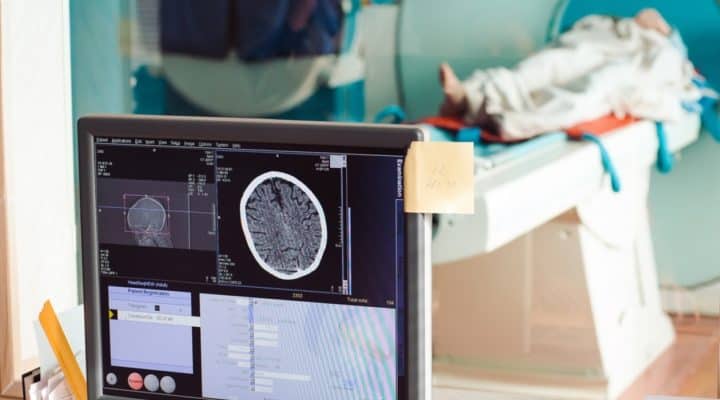
The B.C. government says 188,000 MRI exams are slated to be performed this year at hospitals and clinics in the public system. (Shutterstock)

British Columbia is increasing the number of MRI exams that will be done across the province.

Health Minister Adrian Dix says 37,000 more MRIs will have been performed by this time next year in the public health-care system.

The province says 188,000 of the exams — which use magnets and radio waves to make a detailed picture of specific parts of the body — are being scheduled this year at hospitals and clinics in the public system.

Dix says $11 million is being made available to add resources and capacity, allowing for the completion of 225,000 MRIs in 2018-19.

He says that is nearly a 20 per cent increase, which he describes as a “bold step” towards delivering on a NDP promise to restore health services and cut waiting lists.

The Health Ministry says overall wait times for the exams exceed 41 days for half of all patients, with 10 per cent waiting more than 199 days.

Canadian customs facilities in the U.S.? Americans say it could happen soon

Preclearance will not amount to much if governments cannot cut red tape: official

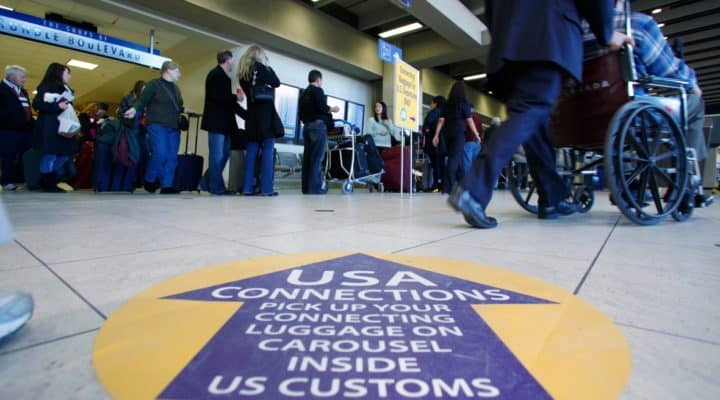
Passengers wait to check in and go through U.S. Customs at Calgary International Airport. While Canadians have been able to preclear U.S. customs in Canada for decades, the U.S. is still waiting for its first Canadian customs preclearance facility. (Todd Korol/Reuters)

Canada could soon have its first customs facilities inside the United States, says an American official who cites Florida and Arizona as potential sites for pilot projects in ongoing experiments to modernize the border.

This would come decades after American preclearance facilities were first placed at major Canadian airports, where travellers have long cleared customs before flying to the U.S., with the goal of reducing wait times at the back end.

Newer innovations involve train travel, with pilot projects to have rail passengers clear U.S. customs in Montreal and B.C., as the latest in ongoing efforts between the administrations of Stephen Harper, Justin Trudeau, Barack Obama, and Donald Trump.

Next, the project could spread south, an official said Monday.

“While Canada has not yet deployed inspection personnel to the United States to facilitate pre-clearance movement into Canada, we hope to see steps on this in the near-future. Perhaps in a pilot project in Scottsdale, or in Fort Lauderdale, Fla., for example,” said Kenneth Merten, a deputy assistant U.S. secretary of state.

“Such deployments can only make cross-border commerce and travel more efficient. … With the world growing smaller every day, we look to these and other programs to further facilitate trade and travel flows.”

He was among several speakers at a conference about the future of the Canada-U.S. border, hosted in Washington by the Wilson Center.

A Canadian official speaking at the conference says speeding up the border is an economic imperative. He said border wait times cost the Canadian economy somewhere between one per cent and 1.8 per cent of GDP in 2010.

“A more efficient, seamless border will make it easier for passengers,” said Vincent Rigby, associate deputy minister at Public Safety Canada.

“It’s also essential to our economies.”

Customs and policy

His boss, Public Safety Minister Ralph Goodale, has said his ultimate prize is introducing preclearance for cargo. In a recent interview with The Canadian Press, he described the goal this way: have customs officers inspect car parts at an auto-manufacturing plant, observe the sealing of cargo packages and send them on their way for speedy movement between the countries.

But one longtime trucking industry official raised a note of caution.

Jennifer Fox expressed her concern that all these big-picture modernization efforts will be for naught if the countries fail to improve the smaller details. She said she was speaking from experience, with frustrations about red tape.

One problem she cited: government departments not connected to customs systems.

She said a decade-old U.S. program aimed at automating customs barely does anything as a result of this. For example, she said a company importing tires still faces border delays — because the customs system has no idea if the tires meet standards set by the U.S. Environmental Protection Agency. And a company importing health products would face the same delays, because the customs system doesn’t communicate with the U.S. Food and Drug Administration.

“USDA, FDA, EPA. Whoever has a hand in those goods — they need to be talking,” said Fox, now with the North American Strategy for Competitiveness group.

She said these technical details need to be straightened out first, before the countries create new systems that don’t work. For example, even the payment systems for customs fees differ from one country to the other and are somewhat archaic.

“(Truckers) are still paying cash at the border (in the U.S.),” she said in an interview.

“You’ve got to have exact change… If you don’t have enough — say, you show up with a $10 bill and it’s $13.75 — they send you to secondary (inspection).”

NB Power settlement for Point Lepreau project could lead to lower rates: CEO

NB Power settlement for Point Lepreau project could lead to lower rates: CEO

FREDERICTON — New Brunswick’s Crown-owned utility has reached a settlement with insurers who underwrote an all-risk policy for refurbishment of the Point Lepreau nuclear generating station, which took three years longer than planned and cost a billion dollars more than budgeted.

NB Power CEO Gaetan Thomas did not disclose the terms of the settlement Monday, citing a confidentiality agreement.

However, he said the proceeds from settlement will allow the utility to seek a lower electricity rate increase “for all New Brunswickers.”

In a 2018-19 rate application, the utility had asked the province’s Energy and Utilities Board to raise rates by about two per cent.

NB Power wants to temporarily adjourn the rate hearings so it can assess the settlement.

In January 2015, the province’s auditor general uncovered problems with the $2.4-billion project, saying the cost was reasonable — but NB Power might have lost opportunities to save money by using sole-source exemptions rather than seeking competitive bids.

The utility later agreed with 10 recommendations from the auditor general, which included obtaining competitive bids for all significant engineering services.

The refurbishment was aimed at extending the plant’s lifespan by at least another 25 years.

The 660-megawatt station produces enough electricity to supply more than 333,000 homes.

“NB Power is pleased to have resolved this matter and to be in a position to share the benefits of this settlement with our ratepayers,” Thomas said in a statement.

The Canadian Press

Note to readers: This is a corrected story. A previous version put the cost at $2.4 million rather than billion.

Ontario Liberal budget to include free daycare for preschool children

The commitment is part of $2.2-billion investment in province’s daycare system

Studies have found that fewer than 25 per cent of Ontario families can afford full-day licensed care for one child. (CBC)

Ontario’s Liberals plan to make full-day daycare free for children aged 2-and-a-half until they are eligible for kindergarten should they form government after the June election, Premier Kathleen Wynne said on Tuesday.

The program would begin in 2020 and come at a cost of $930 million to the province. The move is part of a larger, “historic” $2.2-billion investment to expand access to licensed childcare for families.

“Not being able to find or afford child care is stressful. It is troubling, and it is holding families back at a time when it is already hard enough to get ahead,” said Wynne, who was joined by Finance Minister Charles Sousa and Indira Naidoo-Harris, minister responsible for early years and child care and minister of education.

“No more anxiety about costs … The freedom to choose when it’s time for mom or dad to go back to work. This is a big change,” Wynne said. “We’re playing the long game here, folks. This is the investment in the people of this province.”

Wynne made the announcement to a room of parents and children at Nelson Mandela Park Public School in Toronto, saying more details about the promise are coming in Wednesday’s pre-election budget.

According to Wynne, the plan would save the average family with one preschooler some $17,000. In Toronto, where the average cost of daycare is more expensive than any other Canadian city, families would benefit even more, she added.

Growing list of Liberal promises

The policy was largely devised by Gordon Cleveland, a University of Toronto economist, who called the current daycare regime a “punishing financial burden” for families. Cleveland said his research shows that yearly daycare fees for Ontario families, on average, range between $10,000 to $22,000 depending the age of children and where they live.

The typical family with one child between the age of two and four use more than 23 per cent of their after-tax income to pay for child care, Cleveland explained.

“Making child care free for preschool children will be transformative for Ontario’s families; it will help families balance the demands of work, education and family life, and will dramatically improve affordability, especially for children in low and middle income families,” Cleveland said in a statement issued to reporters.

The Liberals also committed $162.5-million over three years to boost access to licensed care, decrease fees and reduce wait list for parents applying for fee subsidies. Furthermore, a Liberal government would introduce a wage grid for early childhood educators to bring their compensation to the level of peers working in the school system.

Other elements of the plan include funding specifically for First Nations communities and $90-million to continue increasing the number of child care spaces in Ontario. In 2016, Wynne pledged to build 100,000 new spots for children under four by 2021.

Ontario’s Liberals have rolled out a number of costly commitments in the run-up to the release of the 2018 budget. Last week, Wynne revealed that OHIP+ will be expanded to include all Ontarians 65 and over, and promised extensive new funding for hospitals. Yesterday, she pledged $300-million for special needs education.

The provincial election is set for June 7.