Archives for March 28, 2018

1 High-Yield Stock I Wouldn’t Touch With a 10-Foot Pole

Martin Midstream Partners (NASDAQ: MMLP) is one of the highest-yielding MLPs around these days. With a current yield of 14.7%, it’s almost double the MLP average. While there are several above-average yielders worth considering these days, this isn’t one of them.

Drilling down into the numbers

Last year, Martin Midstream Partners managed to cover its high-yield payout with cash flow by 1.18 times. That’s a comfortable level for an MLP and an improvement over the slightly less than 1.0 times coverage it had in the previous three years. This year, however, will be a different story. While the company expects to generate about $156.1 million in adjusted EBITDA, nearly flat with 2017, cash flow will fall because the company plans to spend more money maintaining its assets. After spending just $18.1 million in maintenance capital last year, the company sees that number climbing to $29.3 million in 2018, due mainly to $10.5 million in one-time projects. As a result, the company only expects to generate enough cash to cover its current payout by a razor-thin 1.0 times. For comparison’s sake, stronger MLPs like Magellan Midstream Partners (NYSE: MMP) typically keep that level above 1.2 times.

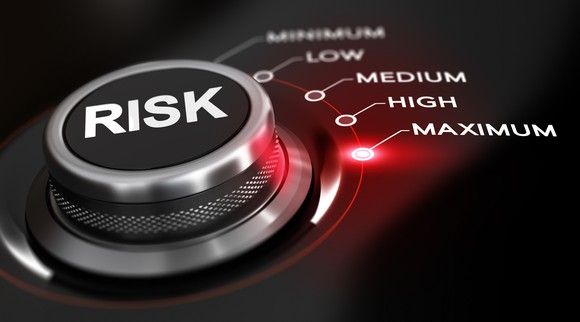
A risk dial set the the maximum level.

Martin Midstream’s coverage ratio wouldn’t be quite so concerning if the company generated rock-solid cash flow, had a strong balance sheet, and didn’t also have a hefty expansion program to finance. However, that’s not the case. While Martin Midstream operates several assets that generate stable fee-based cash flow, only 61% of its total comes from these steadier sources, with the rest earned from margin-based activities, which are less predictable. Most MLPs like to get 90% or more of their earnings from predictable sources like fee-based contracts — which was Magellan’s level last year — because it reduces cash flow volatility.

Martin Midstream’s balance sheet is also a concern after ending last year with a debt-to-adjusted EBITDA ratio of 5.11 times. For perspective, most MLPs like to keep that number around 4.0 times, though Magellan Midstream is one of the stronger ones considering its leverage ratio has averaged less than 3.5 times in recent years. Another of Martin Midstream’s concerns is that the company borrowed $445 million of the $664.4 million available to it under its revolving credit facility, leaving it with limited liquidity and causing its credit metrics to bump dangerously close to its financial covenants. Because of that, the company asked its banks to amend some of those covenants so that it could finance an upcoming growth project.
Scissors cutting a $100 bill in half.

Is there any hope for this payout?

Making Martin Midstream’s already tight financial situation even worse is that the company expects to spend roughly $50 million in expansion capital in 2018, which is about double last year’s level. Driving the increase is the expansion of West Texas LPG, which is a joint venture with ONEOK (NYSE: OKE). The companies expect to spend $200 million on the project, with ONEOK paying $160 million given its 80% stake in the venture, leaving Martin Midstream with having to fund $40 million of the project. ONEOK expects to finish this project in the third quarter, which should provide a noticeable boost to earnings on the system. In Martin Midstream’s case, its share of the profits will rise from $5.3 million last year to $8.5 million in 2018. Earnings on the system should head even higher next year as it benefits from a full year of operations as well as a continued volume ramp.

While those incremental earnings will help improve Martin Midstream’s coverage and leverage metrics, the company has a long way to go before its numbers rival those of Magellan or ONEOK, with the later also boasting 1.2 times dividend coverage and recently achieving its leverage target of about 4.0 times. Because of its much weaker metrics, there’s a high risk that Martin Midstream will eventually need to reduce its high-yield payout to get its numbers to a more sustainable level.

Not worth the risk

Martin Midstream’s near 15% yield might look tempting, but it likely won’t last since the company’s financial metrics can’t support a payout of that size. That’s why I wouldn’t touch it because there is a high probability that the company will need to significantly reduce the distribution to get its financial metrics back on solid ground. Instead, investors are much better off considering lower yielding, but much less risky options such as Magellan or ONEOK, which both still offer attractive payouts of more than 5% these days.
3 Stocks to Buy With Dividends Yielding More Than 3%

Dividend stocks yielding more than 3% are coveted among income investors. Why? Well, for starters, that easily beats the current 1.8% yield of the S&P 500. And although higher yields are often a hallmark of higher risk, there’s a sweet spot of dividend stocks yielding between about 2% and 5% that are among the most stable and mature businesses you can invest in.

If above-average dividend yields and stable payouts sound good to you, then you should consider taking a closer look at French energy giant Total SA (NYSE: TOT), North American pipeline leader Kinder Morgan (NYSE: KMI), and dividend champion ONEOK (NYSE: OKE). Here’s why they’re three dividend stocks to buy right now.

A chart showing growth with the trend line represented as a branch of a plant.

A forward-thinking oil supermajor

Total is one of the largest producers of crude oil and natural gas in the world, but it’s definitely tuned in to the possibility that fossil fuel consumption may soon peak. Coal is expected to be among the first casualties thanks to shifting demands in global electricity markets, while almost every supermajor concedes that crude oil consumption could peak in the next decade or two as electric vehicles encroach on the turf of the internal combustion engine. Natural gas may prove stickier, but also figures to play a central role in meeting climate goals.

The company is preparing by building profitable renewable energy companies (solar energy, energy storage, and the like) and investing generously in technologies that require more long-term thinking (next-gen biotech platforms for creating jet fuel).

Total is also betting big on the largest opportunity in natural gas: the quickly growing global market for liquefied natural gas (LNG). The company will be the second-largest LNG trader in the world by 2020. That alone is expected to generate $3 billion in operating cash flow per year.

Of course, while focusing on the future should be important for investors, it’s not as if Total wields a lackluster portfolio in more traditional energy markets — by far its bread and butter now and for years to come. Good stewardship of shareholder capital and a focus on safe and efficient operations over the years resulted in a solid 2017. It generated copious amounts of cash, sported the lowest debt-to-capital ratio of the supermajors, and pledged to increase its dividend 10% by 2020 while repurchasing $5 billion in shares.

Considering the current dividend yield is 5.1%, investors could feel almost spoiled over the next three years if dividends rise further.

A pipeline traversing through snowy terrain.

High expectations for 2018

Kinder Morgan is a large and mature business, but the stock hasn’t exactly been a poster child of stability in recent years. That’s because the company’s structure dictates that it maintain a relatively high level of debt, which got it into trouble when energy prices collapsed a few years ago. The fee-based business has proved resilient, although management was forced to redirect cash flow from the dividend to debt repayments.

In 2018, investors are looking to reap the rewards from difficult decisions made in the last three years. Compared to 2017, Kinder Morgan is increasing its per-share dividend 60% this year and 150% by 2020. In other words, the 3.2% yield is about to grow substantially, which makes it an attractive energy stock and dividend stock.

The massive dividend increase should be sustainable, too. Kinder Morgan is expecting to generate an additional $1.6 billion in earnings from growth projects coming online in the near future. Considering the company is the largest pipeline operator in North America — which is nearing energy independence — fee-based businesses that serve as the conduit for major energy producing and exporting regions figure to be pretty solid investments for investors over the long term.

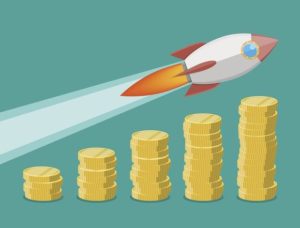
A rocket ship flying over successively taller columns of coins.

Dividend growth for years to come

ONEOK is another pipeline company, but one that has taken a slightly different route than Kinder Morgan in recent years. It merged with its former MLP to save money, maintains a relatively high coverage ratio, and still manages to pay out a 5.2% dividend yield. While that’s pretty impressive, management has plans to increase the payout 9% to 11% annually through 2021 while maintaining a coverage ratio of at least 1.2.

ONEOK has multiple expansion projects coming online by early 2020 that bode well for its ability to deliver on its targets. Meanwhile, management seems to be considering the potential to expand on or around those projects beyond 2021, which could come at a more capital-efficient price tag than greenfield construction — something that could greatly benefit shareholders.

So, although ONEOK has an aggressive plan in place to grow the business, increase the dividend, and continue deleveraging the balance sheet, it looks as if management is poised to deliver on its lofty goals.

Honda Goes Its Own Way With All-New 2019 Insight

On Monday, Honda (NYSE: HMC) revealed its all-new Insight, a hybrid sedan that will slot between the Civic and Accord in the company’s U.S. lineup.

Honda’s decision to roll out an all-new sedan at this moment is an interesting move, given that many of its global rivals will be rolling out new SUV models at this week’s auto show in New York City — and given that sedans have become something of a tough sell in recent years. It’s a throwback to a time when Honda found success by going in a different direction, something that’s becoming a hallmark of CEO Takahiro Hachigo’s management.

Here’s what we know about the all-new 2019 Honda Insight sedan.

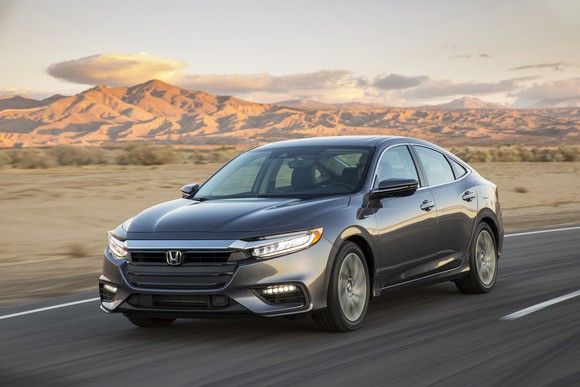
A dark gray 2019 Honda Insight compact sedan.

The all-new 2019 Honda Insight is a premium hybrid sedan that will slot between the Civic and the Accord in the automaker’s U.S. lineup. Image source: Honda Motor Co., Ltd.

What it is: A Prius-sized hybrid

Simply put, it’s a five-passenger sedan, somewhat smaller than an Accord, that shares some underpinnings with the Civic — and that will be offered only with a conventional gasoline-electric hybrid drivetrain.

Sound familiar? Like the last-generation Insight, which made its debut in 2009 as a 2010 model, the new Insight seems to be aimed directly at Toyota’s (NYSE: TM) huge-selling Prius hybrid. That 2010 model featured a flagrantly Prius-shaped body draped over mostly unimpressive underpinnings. It was panned by critics and sold poorly.

On paper at least, this new Insight appears to be a very different beast. Its exterior styling sits nicely between that of the handsome Accord and the edgy Civic, combining elements of both into a sporty and upscale-looking shape.

That upscale look should be backed by an upscale feel on-road. While it’s based on the Civic’s architecture and shares its 106.3-inch wheelbase, Honda said that the Insight received “numerous engineering enhancements to further improve ride quality, cabin quietness and efficiency” over the (very good) Civic, including suspension tweaks and added sound insulation to reduce road noise.

There’s only one powertrain on offer: It’s a conventional (non-plug-in) hybrid system that combines Honda’s super-efficient 1.5 liter Atkinson-cycle four-cylinder with two electric motors. The system’s total output is 151 horsepower and 197 pounds-feet of torque: That should be enough to give decent acceleration, but I suspect drivers won’t mistake the Insight for a sports sedan.

A view of the Insight’s back seat, showing a fair amount of legroom for a compact sedan.

Honda claims that the all-new Insight will have best-in-class rear-seat legroom. Image source: Honda Motor Co., Ltd.

Reinforcing the Insight’s upscale aspirations, there’s a fairly long list of high-tech standard equipment, including LED headlights, the Honda Sensing suite of advanced driver-assist systems, and an 8-inch touchscreen system with both Apple CarPlay and Android Auto.

Honda emphasized that the new Insight will be American-made. The battery pack and gasoline engine will be manufactured at separate Honda plants in Ohio and shipped to the company’s big factory in Greensburg, Indiana for final assembly.

The all-new 2019 Honda Insight will begin arriving at U.S. dealers in early summer.

Remember the old Honda Insights? This one is different

This is the third car to wear the Insight badge. The original Insight was one of the first gasoline-electric hybrids offered to the public. (Toyota’s original Prius was the first-ever hybrid vehicle offered to consumers, but the Insight beat the Prius to the U.S. market.) That insight, a tiny, lightweight two-seater optimized for fuel economy, didn’t exactly set the sales charts on fire — but it won Honda a loyal following among environmentally minded drivers and helped burnish the Honda brand’s green credibility.

A 2010 Honda Insight hatchback.

The last Honda Insight was a disappointing Prius-shaped entry. Image source: Honda Motor Co., Ltd.

The second Insight, which made its debut in 2009 as a 2010 model, looked a lot (a whole lot) like the then-current Prius. But Honda fans were disappointed: While the second Insight had good fuel-economy numbers, it didn’t have much else to offer. Consumer Reports, which had long held most Hondas in high regard, said it was “the most disappointing Honda tested by [the magazine] in a long time,” lambasting everything from its ride quality and acceleration to its uncomfortable back seat.

This new Insight looks to be a big improvement on its predecessor.

The new Insight builds on a positive trend at Honda

I’ll hold off on making a full judgment until I see the new Insight in person later this week. But two thoughts come to mind right now.

When Hachigo became CEO in 2015, he promised to create a “new Honda,” one that focused first and foremost on satisfying and delighting its customers. At the time, the sense I got from Honda executives was that Hachigo’s goal was to make Honda Honda again, in part by infusing the company’s upcoming products with the elegant simplicity and innovative touches that had won legions of loyal customers for the brand in the 1980s and 1990s.

In the last year or so, we’ve seen signs that he’s succeeding. Some of that old Honda magic is readily visible in the all-new 2018 Accord and its Urban EV Concept, a small electric car that riffs on the styling of the much-loved Civics of the 1970s.

My first thought is that it looks like the new Insight continues that happy trend: Yes, it’s aimed at the Prius, but this time around, Honda went its own way. While Honda hasn’t yet announced pricing, the new Insight seems aimed a little bit further upmarket than the Prius — and it looks like a Honda, not like a riff on a Toyota. For investors eyeing Honda’s stock, it’s another bullish sign.

My second thought is that even if the Insight turns out to be great, it may be a hard sell. The current Prius is well-regarded, but U.S. car-buyers haven’t been interested: U.S. sales of the Prius sedan were down 33% in 2017, and they’re down another 22% this year through February.

Will the Insight fare better? We’ll start to find out later this year.

Blackberry Turnaround Is Taking Hold

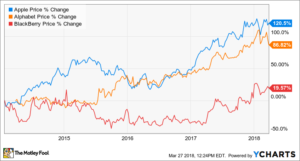
It’s been a solid year of returns for major smartphone companies. Apple’s stock has advanced by more than 20% over the past 12 months — pushing it ever closer to becoming the first $1 trillion publicly traded company — while Alphabet and its premier hardware partner, Samsung, have seen similar returns over the time period. However, forgotten smartphone maker Blackberry (NYSE: BB) has soundly outperformed these stocks with an 82% gain.

Of course, it’s no longer accurate to think of Blackberry as a smartphone company. In fact, it’s Blackberry’s retreat from the smartphone market that has recently propelled the stock price higher. After saying in 2014 that he was “abnormal” for taking the CEO role — “Any normal exec or CEO would have probably said ‘I want a safer, easier job.’ ” — John Chen’s first move was to limit the cash Blackberry was hemorrhaging from its smartphone business by shifting away from its own operating system and then by limiting its handset lineup to focus on security-centric models.

Artist’s rendering of a padlock in binary code, signifying digital security.

It’s been a slow turnaround

A brief scan of Blackberry’s website shows where the company is going. Gone are the vanity shots of smartphones, replaced by information on security-focused services and Blackberry’s QNX operating system. Although the company still has three smartphones, the company has shifted its smartphone strategy from hardware to deriving value from providing digital security for non-Blackberry units. Chen built upon Blackberry’s reputation for security by making a series of security-focused mobile solutions including AtHoc, Good Technology, SecuSmart, and WatchDox.

It certainly hasn’t been a quick turnaround for Chen and Blackberry. Despite its strong one-year returns, shares significantly lag Apple’s and Alphabet’s over the past five years. Still, Chen should be commended for bringing the company back from the brink of failure while transitioning its focus.

AAPL data by YCharts

For example, throughout the first nine months of fiscal year 2014 Blackberry (then Research in Motion) reported $3.4 billion in hardware sales with an additional $2.1 billion in service fees (the clear majority were smartphone-derived service access fees). Through the first nine months of fiscal year 2018, Blackberry recorded hardware sales of $62 million, a 98% decrease, and service access fee revenue of $102 million, respectively. While Blackberry’s lower revenue in hardware was mostly due to competitive forces, more recently this has been due to Chen’s pivot to enterprise software, services, and licensing. Those rose from an insignificant figure in 2014 to 84% of Blackberry’s total revenue haul in 2018.

Chen continues to cement his reputation as a turnaround specialist

Blackberry would not be the first time Chen’s faced long odds. In 1998, Chen took the reins of database management company Sybase when analysts at Gartner had assigned the company only a 30% chance of survival. Chen quickly returned the company to profitability and Sybase was sold to Germany’s SAP 12 years later for more than six times the value of when Chen took over.

While it’s too early to predict Blackberry will match Sybase’s success, it appears Chen’s vision is finally starting to take shape. Blackberry recently announced it will extend Chen’s contract until November 2023 as investors are becoming increasingly bullish on his vision.

Chen still has his work cut out for him. Revenue continues to drop on a year-over-year basis, although the shift to software changes the profit-margin profile. Additionally, the company still suffers from unreliable profitability, often due to below-the-line items not directly related to current operations, like a patent infringement payout to Nokia paid this quarter and fair value adjustments on debentures. That said, if you’re looking for a turnaround story with room to run, put Blackberry on your watchlist and watch Chen’s moves carefully.

NASA Delays Launch of James Webb Space Telescope Until 2020

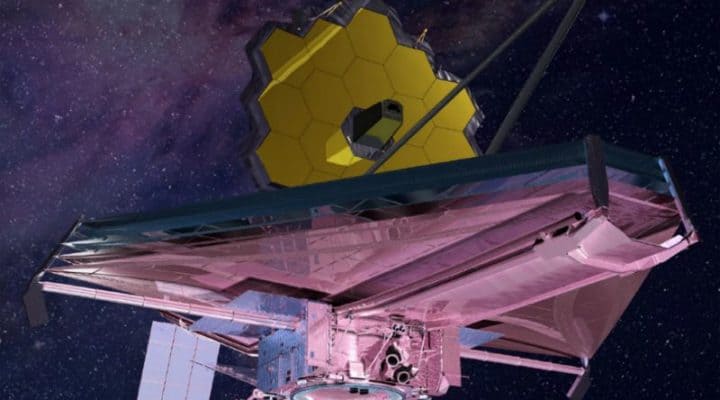
NASA has delayed the launch of its new James Webb Space Telescope until no earlier than May 2020 due to the need for more testing.

NASA has delayed the launch of its next great space observatory, the James Webb Space Telescope, until no earlier than May 2020 — nearly a year later than planned — due to the need for more testing of the telescope’s intricate systems and setbacks, including tears in the tennis-court-size sun shield, the space agency announced today (March 27).

Because of the launch delay, the telescope’s $8.8 billion price tag could rise, too, NASA officials told reporters today.

“All the observatory’s flight hardware is now complete; however, the issues brought to light with the spacecraft element are prompting us to take the necessary steps to refocus our efforts on the completion of this ambitious and complex observatory,” NASA Acting Administrator Robert Lightfoot said in a statement. [Building the James Webb Space Telescope: A Photo Tour]

Billed as the successor to the Hubble Space Telescope, the new space telescope is an infrared observatory designed to peer deep into the universe, study the earliest stars and galaxies, and seek out strange new planets around distant stars. NASA built the space telescope in two parts: the telescope itself and a huge, complicated sun shield that will protect the observatory’s sensitive instruments from the sun.

During a news conference today, Lightfoot was joined by Thomas Zurbuchen, associate administrator of NASA’s Science Mission Directorate, as well as Dennis Andrucyk, deputy associate administrator for the directorate, to describe the causes of the delay and the steps they’re taking to push the project forward.

While all flight hardware is complete, they said, testing of some parts of the hardware has taken longer than expected; for instance, rather than taking two weeks to deploy for the first time and a month to fold and stow, the sun shield took a month to deploy and two months to fold and stow.

There have also been schedule delays due to hardware mishaps: The cables that pull the sun shield into place had too much slack, leading to a snagging hazard and seven small tears forming within the shield’s five independent membranes; the largest two were 4 inches (10 centimeters) across, Andrucyk said.

In addition, “primarily in the propulsion system, we’ve had a schedule delay due to a transducer that was incorrectly powered; we needed to replace that. That resulted in a three-month hit,” he added. “An incorrect solvent was run through the prop[ulsion] system; as a result, we wound up having to replace valves in that system, and a catalyst bed heater was accidentally overstressed and needed to be replaced. Those [issues] are avoidable errors, but in developing very complex systems, those things do happen.”

NASA originally hoped to launch the James Webb Space Telescope in 2018 but delayed it until 2019 last September due to delays in the observatory’s assembly.

The potential for more issues arose in February, when a report from the U.S. Government Accountability Office warned that the telescope faced a high probability of more delays that could push the telescope beyond its budget cap. In 2001, Congress assigned the telescope a cost cap of $8 billion prior to launch.

“Following data from an independent assessment, NASA has determined that the Webb launch date milestone will be delayed from its baseline by more than six months, and its development cost estimate might exceed the 8 billion [dollar] development limit,” Lightfoot said at today’s news conference. “If we breach the 8 billion cost that was laid out in the congressional appropriations, the project will need to be reauthorized by Congress.” Officials are still reviewing the possible cost increase, but NASA will submit a detailed report to Congress this summer about the impacts to the cost and schedule.

When the James Webb Space Telescope finally flies, it will be the largest space observatory ever launched. The observatory has seven times the light-collecting power of Hubble. It will operate at ultracool temperatures and be able to detect infrared light from the universe’s earliest stars and galaxies, as well as analyze the atmospheres of distant planets as they pass in front of their stars.

The assembled instruments and mirrors recently completed testing in an enormous cryovacuum chamber at Johnson Space Center in Houston, and the telescope was transported to Northrop Grumman’s facility in California for final assembly with its tennis-court-size sun shield and spacecraft bus.

Going forward

The NASA officials specified organizational changes in work on the telescope, including implementing more NASA oversight of the project at Northrop Grumman. NASA will track daily and weekly test reports, and officials from NASA’s Goddard Space Flight Center in Maryland will rotate into the facility in California to help oversee integration and testing. The technical processes and procedures will also be reviewed, to ensure a high confidence level of the telescope’s success at launch. NASA is also establishing an independent review board to assess the deployment sequence and other aspects of the project’s launch.

In the meantime, engineers are implementing fixes to the specific hardware issues, such as adding springs to the sun shield’s cables to keep them from developing slack during the shield’s deployment.

“Webb will journey to an orbit about a million miles from the Earth — four times further than the moon,” Zurbuchen said at the news conference. “Simply put, we have one shot to get this right before going into space. You’ve heard this before, and it rings true for Webb: For us, really, failure is not an option … It needs even closer attention now as it nears the finish line.”

“This is the largest international space science project in U.S. history, and we need to take the time necessary to evaluate its data very closely to ensure that we get back on track and get it right on the ground,” Zurbuchen added. “We want to make sure that the launch is in 2020, and we have a path forward.”

The upcoming launch of NASA’s Transiting Exoplanet Survey Satellite, and possible collaboration between the Hubble Space Telescope and Webb for deep-space science, should not be affected by the delay, officials said.

Here is everything you need to know about Apple’s new education tools

On Tuesday, March 27, Apple held its education-focused event in Chicago at Lane Tech College Preparatory High School where the company unveiled a more affordable 9.7-inch iPad. To push for use of the iPad within the classroom, Apple also launched a wide variety of new educational resources.

From apps and updates to products, we rounded up all of Apple’s new education initiatives.

iWork with Apple Pencil

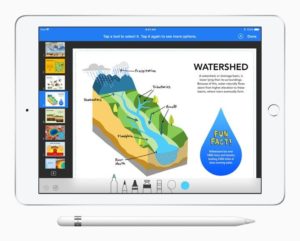
Since the new 9.7-inch iPad comes with support for Apple Pencil, Apple’s iWork suite — which includes Pages, Keynote, and Numbers — has been updated to include more features. You will be able to draw, write, or sketch with the Pencil within each of the productivity apps. Using both Pages and Keynote, users will be able to add drawings into their reports and can now write in Numbers when creating lab reports.

Currently in beta mode, Pages also includes a Smart Annotation feature allowing teachers to add comments within documents in real time — which will anchor to specific text. The app will also receive a book creation feature — available for both iOS and macOS — where users can create digital books like short stories or travel books. To create a book, you will be able to use different templates in addition to iWork’s new drawing tools or images and videos from the Photo library. Classmates can collaborate on books in real time using either the iPad, iPhone, Mac, or iCloud.com and the finished product can then be exported and shared in iBooks.

Another feature in Pages is Presenter Mode which allows you to use your iPad or iPhone as a virtual teleprompter. Not only can the text auto scroll at an adjustable speed, but you will be able to customize text size, spacing, font, or background color during playback.

Swift Playground adds augmented reality feature

swift-playgrounds-coding

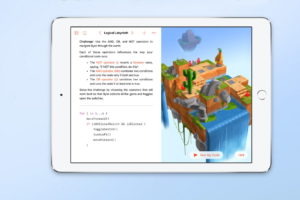
In 2016, Apple introduced its Everyone Can Code program which teaches kids how to code via its Swift Playgrounds app. The programming app now incorporates augmented reality using Apple’s ARKit technology. Students can now program an animated character into their game and place it within their physical space using the iPad’s camera.

Apple is incorporating AR into everyday lesson plans as well. For example, a new ARKit app called Froggipedia will allow students to dissect a virtual frog using the Apple Pencil stylus. Another app like Free Rivers by the World Wildlife Fund will help teach students about protecting rivers, as well as preserving communities and protecting habitats.

Everyone Can Create curriculum

Everyone Can Create is a free curriculum developed with the help of creative professionals and educators. The program offers a range of free learning resources and teaching guides that allows students to find different ways to express themselves and discover or develop new skills.

Using the program, teachers can find ways to integrate music, drawing, filmmaking, and photography into topics or assignments. Aside from lessons and student guides, the program also includes ideas and examples to help incorporate creativity into already existing core subjects like English, math, science, and history. Starting later this spring, Apple Stores will be teaching the curriculum as part of its regular Today sessions for educators.

New ClassKit framework and Schoolwork app integration

Integrated into Apple’s Classkit — its new developer framework meant specifically for creating educational apps on iOS — Schoolwork is a new app that makes it easier for teachers to complete tasks such as creating assignments. With a Handouts feature, the app allows teachers to create and send assignments to students that include anything from web links to documents and PDFs. Schoolwork can help to incorporate more apps into the curriculum as well. Teachers will be able to assign an activity within an app and then direct students to the specific point within that app.

As far as student progress, it also gives teachers the ability to check up on how a student is doing — they will be able to see a student’s overall class performance, check on students’ app activities, and progress on assignments. But Apple made it clear that all student data will be private, and that only teachers will have access to the information. Schoolwork will officially launch in June, giving educators plenty of time to get the hang of it before the new school year starts.

Logitech Crayon and Rugged Combo case

To accompany the new 9.7-inch iPad, Logitech announced the Logitech Crayon stylus and Logitech Rugged Combo 2 case. The Crayon — which is priced at $50 — is the first digital pencil designed for the new iPad — which includes low latency and support for tilt. It works with a large number of apps, including Apple’s newly updated Pages, Keynote, and Numbers apps along with Microsoft Office. Since it has an eight-day battery life, it should be able to last students throughout the entire school day on a single charge. It will also connect to the iPad automatically, so there is no need to go through the process of pairing it.

The Rugged Combo 2 case is designed to sustain daily wear and tear within the classroom. It can protect against drops from up to four feet, has a secure-sealed design that is spill-resistant, and includes a detachable keyboard that is pry-resistant with silent keys. It also has a kickstand that you can adjust to comfortably type or write notes, use apps, and watch videos. As for price, the case will run for $100.

Upgraded Apple School Manager Program

With the Apple School Manager program, administrative IT officials are able to create accounts for students and staff, manage devices, and buy content. Apple announced the program will now allow administrators to create profiles either individually or in bulk — with the ability to create up to 1,500 Apple IDs at once. It will also include 200GB of cloud storage, which is an upgrade from the 5GB available before.