Archives for February 24, 2018

Environmental groups pinning hopes on major spending for conservation in budget

Environmentalists are looking for up to $1.4 billion in new funding

An aerial view of the Gwaii Haanas National Park Reserve islands. The federal government is expected to earmark funding in the forthcoming budget to meet Canada’s international goal of protecting 17 per cent of its land and fresh water by 2020. (Andrew Wright/Parks Canada)

Environmental and conservation groups are convinced that there will be a significant amount of money — up to $1.4 billion dollars — in next week’s federal budget for conservation.

They say all signs point to a growing political commitment to meeting Canada’s international goal of protecting 17 per cent of its land and fresh water by 2020.

“There is a huge amount of support for that scale of investment and there is a lot of momentum building,” said Alison Woodley, national conservation director for the Canadian Parks and Wilderness Society, in an interview with CBC.

“This is the scale of investment we think is necessary.”

That figure — $1.4 billion — is being suggested by sources as the amount the government is most likely to earmark for conservation in Tuesday’s budget.

The sum was first proposed by the Green Budget Coalition, a group of 19 environmental and conservation groups, in its annual suggestions for federal environmental spending.

In January, more than 100 MPs and senators sent a letter to Finance Minister Bill Morneau asking him to allocate $1.4 billion over the next three years to protect land and fresh water so Canada can meet its commitments under the United Nations Convention on Biological Diversity.

Trudeau dropped hints about environmental spending

Prime Minister Justin Trudeau gave strong hints at recent town hall in Edmonton that his government is prepared to spend some money on conservation.

“We can’t talk about what’s in the budget concretely until actual budget day,” Trudeau told the audience. “But rest assured, we have heard the very clear calls, not just from MPs but from Canadians and our international partners, that we need to meet our targets on marine areas and on land protected areas.

“We will be significantly moving forward on protections for our land and for our waters.”

Sources say that the money could be used to establish more protected areas, help provinces and territories identify conservation regions, protect species at risk and set up Indigenous protected areas.

The funds also could be used as part of reconciliation efforts with Indigenous people.

Valerie Courtois is the executive director of the Indigenous Leadership Initiative, which helps foster nationhood by conserving and managing Indigenous lands. She’s watching the budget closely for funding to help Indigenous communities identify land they want to protect and manage.

“Many indigenous people are saying we want to be a part of the solution when it comes to conservation and dealing with environmental challenges like climate change,” said Courtois in an interview with CBC. “This budget and this kind of funding will help them do that.”

Gwaii Haanas National Park Reserve, on the Haida Gwaii archipelago, about 130 km off the coast of British Columbia. (Parks Canada/Instagram)

Courtois points to projects that are already working well — like B.C.’s Gwaii Haanas National Park Reserve, jointly managed by Parks Canada and the Haida Nation. Other similar conservation projects are being developed, like the proposed Thaidene Nene National Park Reserve on the East Arm of Great Slave Lake in the Northwest Territories. The nearby community of Lutsel K’e Dene First Nation is working with Parks Canada and the NWT government to create the park.

“People like what they are hearing from the federal government in terms of their commitments to a renewed nation-to-nation or Inuit to Crown relationship and to reconciliation, but the proof is in the pudding,” said Courtois. “And so, we are hoping that this budget will be part of that pudding.”

Last June, Environment Minister Catherine McKenna set up a National Advisory Panel and an Indigenous Circle of Experts to help figure out the best ways to go about protecting 17 per cent of the country’s land and fresh water.

The tricky part

Stephen Hazell, director of conservation for Nature Canada, said that could be the tricky part of the conservation plans the federal government is willing to fund.

“It takes a while to bring communities along,” said Hazell in an interview with CBC. “Not everyone wants a national park in their backyard.”

About 10 per cent of the country’s land has been protected so far, but adding the further seven per cent — approximately equal to the land mass of Manitoba — will take time and commitment from the federal, provincial and territorial governments and Indigenous groups. Hazell said they have to see money in this budget to make it happen by 2020.

“I think we’re getting a sense that it’s not just Minister McKenna that gets it but the prime minister gets it, and we’re kind of hoping that Minister Morneau gets it as well,” he said.


The Most Disappointing Number From Walmart’s Fourth Quarter

Shares of Walmart (NYSE: WMT) fell 10% on Feb. 20, after the retailer posted a mixed fourth quarter. Its revenue rose 4% annually to $136.3 billion, which beat estimates by $1.4 billion. But its adjusted EPS rose just 2% to $1.33, missing expectations by $0.04. The bottom line miss was surprising, since Walmart previously beat earnings expectations for nine straight quarters.

The company attributed the miss to restructuring and impairment expenses, which reduced its operating income by 11% annually. Excluding those one-time charges, its operating income would have fallen less than 1%. However, Walmart’s forecast for full-year earnings of $4.75 to $5.00 also missed the consensus estimate of $5.13.

Those numbers were disappointing, but the ugliest number from Walmart’s fourth quarter was its e-commerce growth.

How disappointing was Walmart’s e-commerce growth?

Walmart’s e-commerce revenues in the U.S. rose 23% annually, with a 24% increase in gross merchandise volume (GMV). Those figures might look solid, but they compare poorly to the company’s e-commerce growth in previous quarters.

Walmart stated that it had anticipated the slowdown, since it had “fully lapped” its acquisition of Jet.com, which closed in Sept. 2016 and gave the business a full-year boost.

During the conference call, CEO Doug McMillon blamed a “smaller portion” of that slowdown on “operational challenges that negatively impacted growth” — including its inability to juggle seasonal spikes in inventory at its fulfillment centers.

For the full year, Walmart’s e-commerce sales in the U.S. rose 44% to $11.5 billion, which accounted for just 2% of its top line. By comparison, Amazon.com’s (NASDAQ: AMZN) net sales in North America rose 33% to $106.1 billion in 2017. McMillon said he expects Walmart’s e-commerce growth “to increase from the fourth quarter level as we enter the New Year, with about 40% growth for the year” as the retailer learns how to handle higher shipment volumes.

Can Walmart really challenge Amazon?

Walmart’s consolidated gross margin fell 61 basis points annually during the quarter, partly due to its escalating price war with Amazon and higher investments in its e-commerce ecosystem.

Walmart has been expanding its e-commerce for years. In 2011, it acquired Kosmix, a social media firm that it rebranded as WalmartLabs. That unit developed an internal search engine called Polaris, then acquired over a dozen tech companies to improve the location, social, customer engagement, and price comparison features in its mobile app.

It also launched its own mobile payment platform, Walmart Pay, to track customer purchases and offer promotions. It’s aggressively matching Amazon’s prices, free delivery options, grocery services, and it’s using in-store pickup to win over customers who want a product right away.

A global surrounded by boxes on a computer keyboard.

Walmart’s acquisition of Jet.com expanded its online presence among younger and more upscale shoppers. It then acquired a long list of smaller fashion brands — including Bonobos, ModCloth, and Shoebuy — to counter Amazon’s moves into private-label apparel.

To match Amazon’s technical prowess, Walmart launched Store No. 8, a tech incubator that’s developing next-generation shopping solutions like a cashier-less store (similar to Amazon Go) and VR/AR apps. Walmart also recently partnered with Rakuten’s Kobo division to launch e-readers and e-books.

Missing a crucial piece of the e-commerce puzzle

Those are all smart moves, but Walmart still doesn’t have a meaningful way to counter Amazon’s greatest weapon in the U.S. market: Prime. Last October, research firm CIRP estimated that 90 million U.S. consumers, or 63% of Amazon’s user base, were Prime members.

The firm also noted that Prime members spent nearly $1,300 per year on Amazon, compared to just $700 for non-members. The reason is simple: Prime’s perks — which include discounts, free delivery options, free video and audio streams, free e-books from the lending library, and free cloud storage — are too lucrative to pass up.

Amazon also locks users into that ecosystem with hardware products like Echo speakers, Kindle tablets, Dash buttons, and Dash-enabled appliances. Unless Walmart figures out a way to pry users away from that growing ecosystem, it will continue to struggle against Amazon.

The key takeaway

Walmart’s e-commerce slowdown isn’t as nasty as it looks, due to the year-over-year distortion caused by Jet.com. But its inventory and fulfillment issues were disappointing, and the e-commerce business still accounts for a tiny slice of its total revenues.

Investors should see if Walmart’s e-commerce growth will accelerate again in the first quarter, and if it can do so while keeping its expenses under control. If it can achieve those two things, it might still stand a chance against Amazon.

3 Stocks That Feel Like Netflix in 2002

A bank-vault door that’s slightly open.

Investing in disruptive companies that are about to ride a wave of growth because of emerging trends can be a great way to juice up investment returns. However, identifying those stocks isn’t easy. Fortunately, our Motley Fool investors have a few ideas to share. According to them, buying BofI Holdings (NASDAQ: BOFI), Activision Blizzard (NASDAQ: ATVI), and Canopy Growth (NASDAQOTH: TWMJF) now could be like picking up shares in Netflix way back in 2002 when it was just getting going.

A potential game changer in its industry

Matt Frankel (BofI Holding): Online-only bank BofI Holding is one of the stocks I have high hopes for over the coming years. With roughly $9 billion in total assets, the bank is still relatively small and has lots of room to grow.

The basic idea is that, since BofI — which stands for “Bank of Internet” — doesn’t have to cover the costs associated with operating physical branches, it can afford to pay higher interest rates on deposits than its brick-and-mortar competitors, while still producing excellent profitability. As of mid-February, BofI is advertising checking accounts with 1.25% APY (annual percentage yield) and CDs (certificates of deposit) that pay up to 2.25%. Compare that with the major brick-and-mortar banks.

For the most recent quarter, the bank generated a return on equity (ROE) of 18.54% and a return on assets (ROA) of 1.87%, far beyond the industry benchmarks of 10% and 1%, respectively. The company doesn’t expect this to change anytime soon.

Growth has been impressive, as well, with 19% year-over-year growth in the bank’s loan portfolio and 22% earnings growth. BofI also has some high-potential growth catalysts going forward, such as its recently introduced personal-lending business, auto lending, and its now-exclusive partnership with H&R Block to provide the company’s refund-anticipation loans.

A boy sitting on a couch next to a soccer ball and a bowl of popcorn, and holding a video game controller, smiling with his arm reaching up into the air.

Content, content, content

Travis Hoium (Activision Blizzard): In 2002, Netflix was just starting to think about upending media as we know it and had a core business (renting DVDs) with a number of growth options up its sleeve. I see a similar strategy playing out at Activision Blizzard, which is a dominant player in the PC and console video game market, but could move well beyond both markets to grow in the future.

It may seem crazy to the casual observer, but esports is one area where a company like Activision could see a tremendous amount of growth. In the first week of the Overwatch League, 10 million people tuned in, and at any given moment, there was an average of 280,000 people watching league play. That’s an incredible turnout for any sporting event, but when you consider that the Overwatch League was created out of thin air this year, it’s all the more impressive.

Looking down the road further, Activision Blizzard will likely be a big player in virtual reality content and could fold that into new services. Imagine a VR esports league with thousands of players around the world competing for a prize. If the VR installed base grows big enough to attract investment, Activision Blizzard will be at the center of innovation in the industry.

As consumers look for more interactive content on platforms from the home to mobile devices to arenas, Activision Blizzard will play an increasing role in our lives. This is a company that’s just getting started with its growth story.

A person’s hand holds a marijuana leaf up in the sky in a field of marijuana.

A budding business

Todd Campbell (Canopy Growth): 2002 was early in the growth of Netflix; similarly, 2018 is early in the growth of Canadian marijuana company Canopy Growth. This may be a young company, but it’s already generating impressive revenue growth. Recently, it reported revenue that jumped 123% year over year, to $21.7 million Canadian dollars. The company’s CA$88 million in annualized sales could only be the tip of the iceberg.

Currently, the company makes its money by being Canada’s market-share-leading medical marijuana company. However, Canada’s recreational market is expected to open for business later this year and could be significantly larger. Health Canada estimates Canada’s medical marijuana market will reach CA$1.3 billion in 2024, but CIBC World Markets estimates Canada’s recreational market could exceed CA$5 billion annually.

In anticipation of a spike in demand, Canopy Growth’s investing heavily to increase production. Yet despite its investments, it still turned a small operating profit last quarter. Given that the company’s weighted average cost per gram before shipping and fulfillment has fallen to CA$1.03 from CA$1.41 per gram in the past year, and recreational users could cause sales to swell in the second half of this year, Canopy Growth is only at the beginning of tapping into its market opportunity.

Garmin Gets a Boost From Wells Fargo

Garmin family of watches and trackers

For serious athletes looking for a fitness tracker, Garmin (NASDAQ: GRMN) is a go-to device maker. The vivoactive 3 tracker released last year has just become immeasurably more vital with the addition of Wells Fargo (NYSE: WFC) to the lineup of contactless payment partners that Garmin Pay utilizes.

“Wells Fargo’s more than 21 million mobile banking customers expect to make payments when and where they want, and wearables like vívoactive 3 with Garmin Pay technology help enable their active lifestyles,” Jim Smith, head of virtual channels at Wells Fargo, was quoted as saying in a press release.

The wearable device market continues to grow, with the researchers at IDC forecasting wearable shipments almost doubling by 2021, growing from 113.2 million devices to 222.3 million. It also expects smartwatches like the vivoactive 3 and Apple’s (NASDAQ: AAPL) latest Watch iteration to far surpass the basic wristbands that dominate today. Watches (basic and smart) are on track to grow from 61.5 million units today to 149.5 million in 2021, while basic wristbands will only increase to 47.7 million from 45 million, according to IDC.

But where wearables have enjoyed considerable growth, the same can’t be said of mobile payments. Even Apple CEO Tim Cook had to admit he wasn’t able to “kill cash” quite as readily as he thought when Apple Pay was introduced. At Apple’s annual shareholder meeting this month, he was sounding less confident about the prospects for cash’s demise, even as the company introduced Apple Pay Cash, person-to-person money payment option.

No doubt the trend toward multipurpose wearables will benefit Apple, but it also ought to help others like Garmin, particularly as it increases the functionality of its devices.

All the payments fit to make

The vivoactive 3 made a big splash when it was released last year, as it featured contactless payments through Garmin Pay for Mastercard and Visa cardholders. Garmin Pay is powered byFitPay, the wearables payment technology subsidiary of Nxt-ID, which uses tokenization technology that replaces cardholders’ account information with a unique digital identifier.

Garmin Pay using FitPay enables consumers to simply tap and pay at NFC-enabled point-of-sale terminals or ATMs using an existing credit, debit, or prepaid card account.

The addition of Wells Fargo adds another layer of usefulness. First, the bank is the third-largest bank in the U.S., making the payment feature available to lots more people. Wells Fargo has more than 21 million mobile banking customers, and if they make a payment with Garmin Pay using their Wells Fargo cards, their transactions will be monitored with the bank’s risk and fraud detection systems.

Watch Garmin grow

The growing availability of payment options open to wearables users means now could be the time contactless payments take off, since the process is much faster than with EMV chip cards, which have never really been popular with consumers. An EMV transaction takes approximately 30 seconds to complete — an eternity when you’re standing at the register — while a contactless payment takes about 13 to 15 seconds, according to creditcards.com.

Although Garmin is the fifth-most-popular manufacturer of wearables, according to IDC, its market share in the space had slipped to 4.9% in the third quarter of 2017, from 5.4% in the previous year as shipments declined by more than 3%. The companies with top market share were Fitbit and Xiaomi, both at 13.7%.

However, with the vivoactive 3 out and a growing list of partners that athletes can use to make mobile payments, Garmin could see its payment service become an integral part of its business.

Is Caterpillar Inc. (CAT) a Buy?

An excavator in a stone quarry at sunset.

Around this time two years ago, Caterpillar Inc. (NYSE: CAT) was trading at roughly $65. The stock has since stunned the market, more than doubling in value.

The rally appears to have left some investors worried, though, which is why the stock has shed nearly 8% in the past month, as of this writing, mainly on profit booking. You might, however, want to consider this drop an opportunity once you look at Caterpillar’s growth prospects and the stock’s current valuation.

What fueled Caterpillar stock’s rally

Caterpillar stock ended 2017 with a whopping 70% gain, fueled largely by earnings beats from the company quarter after quarter, to give investors an inkling that they might be underestimating the bellwether’s turnaround prospects.

Caterpillar recently reported strong numbers for fiscal year 2017 and topped it up with an encouraging outlook for 2018.

One number that stands out in the above table is Caterpillar’s operating margin. If you were to dissect the growth in its operating profit last year, nearly 65% of the increase came from higher sales volumes, which confirms an up cycle. Management’s aggressive restructuring efforts further helped lower costs and boost margins.

What matters most is that Caterpillar is experiencing a broad-based recovery in sales across all of its businesses: construction industries, resource industries (primarily mining equipment), and energy and transportation. That should make Caterpillar’s recovery sustainable. There are two other important points worth noting here:

  • Caterpillar relies heavily on its dealership network for sales. Dealer inventory increased by $100 million in FY 2017, compared with a decrease of $1.6 billion in 2016. Simply put, dealers are buying fresh equipment from the company in anticipation of strong demand.
  • Caterpillar’s backlog value at the end of the fourth quarter surged $3.7 billion, year over year, to $15.8 billion, with construction and resource industries being the largest contributors.

In short, the recovery in Caterpillar shares reflects growth in the company’s sales and profits, and it could be wrong to assume that the stock has run its course. Let me tell you why.

2018: Another strong year in the making

Caterpillar foresees growth in “many end markets” this year and expects to earn $7.75-$8.75 per share in fiscal 2018, backed by higher sales volumes, favorable price realization, and lower restructuring costs, among other things.

That would be a massive jump over Caterpillar’s 2017 EPS, but it’s important to understand that the growth in the company’s profits look exceptionally good right now as it’s coming off a very low base, thanks to a severely challenging few years. Growth will gradually taper with every passing year.

Nonetheless, 2018 will likely go down in Caterpillar’s history as one of its best years ever in terms of profitability. Let’s also not forget that the company’s outlook does not include any impact from a potential infrastructure bill. As the world’s leading construction equipment manufacturer with a solid brand power, Caterpillar could be one of the biggest beneficiaries when infrastructure spending in the U.S. kicks off.

More importantly, Caterpillar’s cash flows should also grow as its profits climb, which is where the stock starts looking like a buy right now.

Caterpillar stock has upside left

A rigorous focus on maintaining its cash flows even during the most challenging times is one of the biggest reasons why Caterpillar could avoid a dividend cut and is so well positioned to ride a recovery.

In each of the past five years, Caterpillar converted more than 100% of its net income into FCF, thanks to efficient working capital (especially inventory) management and prioritization of capital expenditures, in line with the end-market conditions. Compare that with rival Deere (NYSE: DE), for instance, which was FCF-negative in 2017 and whose FCF conversion rate has been below 50% in each of the past five years.

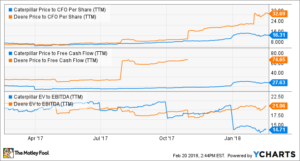
Interestingly, Caterpillar is trading significantly cheaper than Deere on cash flow metrics, as well as the enterprise value to earnings before interest, tax, depreciation, and amortization ratio (EV/EBITDA), which is a useful metric to value and compare capital-intensive companies.

CAT price to CFO per share (TTM) data by YCharts.

When you combine the potential uptick in Caterpillar’s end markets such as mining, oil and gas, and infrastructure, its strong FCF trend, and a dividend yield of 2%, it looks like the stock should offer long-term investors good upside even at current prices.