Archives for February 11, 2018

Old Edmonton YMCA building to be reborn as mixed-use development

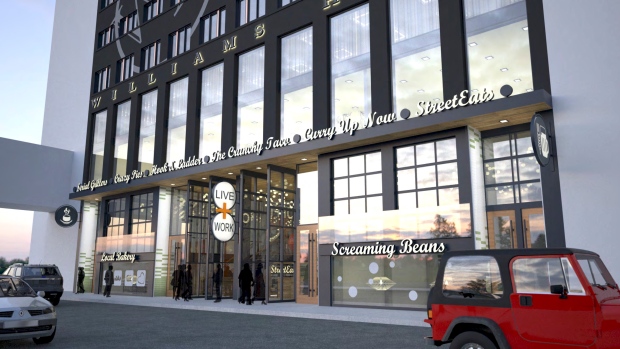
Beljan Developments hopes to refurbish the 1950s-era building into a commercial, residential and office hub

The old YMCA building in downtown Edmonton will be getting a complete makeover, as this mock-up image shows. (Beljan Developments/Supplied)

Three months after Edmonton’s downtown YMCA centre closed its doors, a developer has released plans to revitalize the building into a multipurpose office, retail and apartment space.

Beljan Developments purchased the building next to the Sutton Place Hotel on 102A Avenue with plans to gut its insides and replace them with food and retail options on the first and second floors, office space on the third floor and 85 to 90 small apartments in the remainder.

The apartments are expected to be between 225 and 400 square feet, and furnished with small, moveable furniture. Rent is expected to cost around $1,000 a month.

Ivan Beljan, owner of Beljan Developments, said that while many companies may knock down old buildings to start fresh, he didn’t want to with this project.

“Sometimes we’re just too quick to start fresh because it’s easier. But to me, easier isn’t always the right path,” Beljan told CBC’s Edmonton AM. “When you can carry a story forward … I just think people love that.”

Saving old buildings

Beljan was born and raised in Edmonton and has made it a personal goal to maintain and refurbish as many of the old buildings as he can.

His company is working on designs for other older buildings in the city, like the Metals Building on 101st Avenue and 104th Street, as well as the Dominion Hotel on Whyte Avenue.

He said the city has lost too many buildings with character over the past 40 years and preserving what’s left to make the city more walkable in some areas is his goal.

“We have such [few character buildings] in Edmonton that it’s a real purpose and passion of ours to save these buildings and the stories that are associated with them,” he said.

Beljan hopes to make the area around the YMCA building more inviting to pedestrians.

“I’d say [it’s] one of the worst streets of downtown in the sense of architecture and walkability and being inviting for people to walk down,” Beljan said.

“The building itself does a really poor job of connecting to the street.”

The YMCA building was built in the 1950s, with additions in the 1960s that made it into the multipurpose building it was before it closed last October. “It’s a real dog’s breakfast of uses and areas,” Beljan said.

The building had pools, a gymnasium, fitness areas, administration offices and affordable housing in it. But the YMCA had to close it after years of running deficits — coupled with the amount of money it’d cost for repairs.

But Beljan sees potential. “As long as the bones are good, it already gives you a head start,” he said.

Beljan said he recognizes the need for less expensive housing options in the downtown core.

“Our goal would be, let’s say, a person who just recently graduated from MacEwan [University] and have their first job out of school, working for TD Financial,” he said.

But most of all, he recognizes the increased desire for walkable parts of the city.

“We have an endless amount of work here to help improve the city to make it more walkable,” he said. “There’s a whole movement now of changing Edmonton and the attitude and being proud of Edmonton.”


Code suggests Google Assistant will come to all Chromebooks

If you want Google Assistant on a Chromebook, you currently have exactly one option: Google’s own $1,700 Pixelbook.

If you want Google Assistant on a Chromebook, you currently have exactly one option: Google’s own $1,700 Pixelbook. It looks like Google’s about to unleash its voice helper on any ChromeOS device, however, if code spotted by XDA Developers is implemented. In a recent ChromeOS built, there’s a new feature that will let manufacturers enable Google Assistant (by default, it’s off). According to another part of the code, OEMs will be able to decide whether it listens for a keywords or is activated simply by a button press.

Google Assistant code for ChromeOS has been spotted before, but this is the first time we’ve seen a reference to a code commit. While the Pixelbook is a stunning device, many folks choose Chromebooks as an inexpensive web and email machine or basic PC for family members. Having the Assistant, then, will make them a lot more useful for that crowd.

It’s hard to say when the feature will arrive, as the time between a committed feature and wide release can vary drastically. On top of that, it could take manufacturers like ASUS and HP awhile to implement it. On the other hand, it’s a pretty strong selling point, so that could motivate Google and sellers to get it ready as soon as possible.

Finally, an A.I. voice assistant that doesn’t collect and monetize your data

Science fiction is full of sinister sentient computers. The most famous is, of course, HAL 9000, the artificially intelligent ship’s computer from 2001: A Space Odyssey, which gains self awareness and sets about murdering its crew. But HAL’s got some equally villainous pals — such as the Ultimate Computer from Superman III, Proteus IV from Demon Seed, Colossus from The Forbin Project, and, of course, Skynet from Terminator.

However, while silver screen A.I. is almost always evil, science fiction does have at least one sentient computer that isn’t so sinister. Mike (an abbreviation of Mycroft, the name of Sherlock Holmes’ brother) is a fun-loving supercomputer from Robert Heinlein’s classic sci-fi novel, The Moon is a Harsh Mistress. A character as far removed from the cold, austere as HAL as is possible, Mike becomes the best friend of the book’s narrator, and a key driver in the fight for freedom in the novel’s lunar society. He is a sentient supercomputer on humanity’s side.

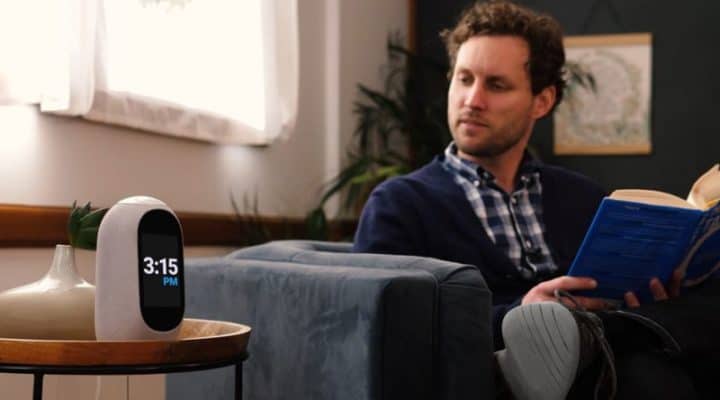
Here in reality, we don’t have a sentient computer that’s truly on our side — but we might, soon. The Mycroft Mark II, as it’s called, is a new smart speaker that recently landed on Kickstarter, and, unlike the more familiar models such as the Amazon Echo and Google Home, this one has our best interests in mind. Or so its creator, Kansas-based creator Joshua Montgomery is keen to stress.

Montgomery’s goal with Mycroft is to build an open source alternative to the big tech giants’ A.I. assistants, and one that promises to protect your privacy in the process. “[Companies like Google and Amazon want to] wall you into an ecosystem that they control, and then monetize you,” he told Digital Trends. “Our goal is to provide you with the best experience possible. We want to build a technology that represents you.”

A big challenge

Montgomery got into the AI assistant space a few years ago. Running a “makerspace” in Kansas City, he says his team was working on a project and wanted to add a voice-controlled smart assistant. Unfortunately, they couldn’t find an option which gave them the level of freedom that they wanted. “At that point, the average user might give up and say, ‘Okay, I’ll put an Echo in,’” he said. “In our case, we decided to see if we could build our own.”

Needless to say, that’s not an easy task. The companies which have broken through into the smart speaker A.I. assistant space — mainly Amazon and Google — also happen to be two of the tech giants vying to become the world’s first $1 trillion company. They have seemingly limitless resources and, for a variety of reasons, can undercut rivals at every turn. But, hey, aren’t underdog stories what tech and its love of asymmetrical little-guy-against-the-giants warfare is made of?

The result of Montgomery’s work was a successful 2015 campaign for the original Mycroft assistant. Now he’s back with a sequel and a product that looks far more polished than its predcessor. The original Mycroft, Montgomery said, was more of a hacker’s device than anything; an Arduino-powered tool for those whose idea of a Saturday well spent is sitting in a Makerspace, soldering iron in hand, surrounded by tiny tech components.

The Mark II looks like an Apple HomePod with the screen of an Amazon Echo Show. “Not only can it speak, but it can also display graphics and widgets so the user can better interpret what the device is trying to say,” Montgomery said. “A picture’s worth a thousand words.”

Under the hood, the Mycroft II boasts a six microphone array, instead of the single condenser microphone used for the original model. That means that, like its big budget counterparts, it should be able to hear you from across the room, even when you’ve got your music blaring.

The big differentiator, though, is the privacy. While the device can answer questions, much as with all smart assistants, that data won’t then be sold to advertisers, and fed back back to you in the form of ads. In an ideal world, this means that the information you’re getting is objectively the best information for you; not information from the advertiser who paid more money to have their results show up higher in a list.

Mycroft promises not to store any of your voice data on its servers, unless you explicitly agree to allow it to do so in order to improve its speech recognition efforts. If you do agree, you can change your mind at any time. The aim is to be more transparent than companies like Google and Amazon which, at least as of now, make bulk deletion of your voice files difficult — and warn that it can hurt the usability of your devices.

“You want an agent that has the mandate to work on my behalf, not on behalf of some company that, frankly, probably doesn’t have my best interests at heart,” Montgomery said.

The open source revolution

The idea of developing an open source A.I. assistant is an intriguing one. Montgomery rightly points out that other areas of tech all have open source standards — whether it’s the Linux operating system or tools like Red Hat, Ubuntu, WordPress, Mongo, or MySQL. “There absolutely will be an open player in the assistant space,” he said. “Someone’s going to build it. Why not me?”

Open source means that Mycroft isn’t walled into an ecosystem, so it’s compatible with whatever email, social stream, streaming music subscription service you want. If you’re someone with an iPhone, an iPad, a Mac and an Apple TV, you may be better off sticking with HomePod — but if you want a bit more flexibility, this could be the answer for you.

Building an AI assistant in this way opens up some fascinating possibilities. For example, it’s possible to help shape Mycroft’s personality — and the answers it will give; the AI equivalent of the mantra that it takes a village to raise a child. “Initially [we’re letting people contribute to] subjective questions, but eventually it’ll be objective questions,” Montgomery said. “If someone says, ‘Hey, Mycroft, what’s your favorite color? It doesn’t really have an answer for that,’ so it gets fed into the Persona engine and the community comes up with a response, which then gets re-ingested. The next time someone asks that same question, it’s got an answer.”

Eventually, though, questions might get trickier — “Tell me about Jesus Christ.” Montgomery said he looks to the Wikipedia editing community to see how it uses debate to establish answers that are generally agreeable to the crowd.

So far, Mycroft’s Kickstarter campaign has raised around three times its original funding goal, with more than 20 days remaining on the clock. That’s good, but it’s still early days for this alternative to the established smart speakers. While all the usual suggestions about pledging Kickstarter campaigns stand, if you are interested in joining the Mycroft revolution you can pledge your support here.

Shipping is set to take place in December 2018. Prices start at $99 for a DIY kit or $129 for a completed unit.

Utter cuteness! Down syndrome boy steals Gerber execs’ hearts in photo contest

The winning smile goes to 18-month-old Lucas Warren, the first baby with Down syndrome to be awarded first place for the Gerber baby contest in its 91-year history. Out of 140,000 photo submissions, the adorable boy was chosen to be this year’s spokesbaby.

“Lucas’ winning smile and joyful expression won our hearts this year, and we are all thrilled to name him our 2018 Spokesbaby,” said Bill Partyka, President and CEO, Gerber in a corporate statement.

According to PR Newswire, Partyka said, “Every year, we choose the baby who best exemplifies Gerber’s longstanding heritage of recognizing that every baby is a Gerber baby, and this year, Lucas is the perfect fit.”

The 18-month-old’s mother, Cortney Warren, says she hopes this opportunity will help increase the acceptance of special needs kids.

“This is such a proud moment for us as parents knowing that Lucas has a platform to spread joy, not only to those he interacts with every day, but to people all over the country.”

The Georgia mother said, “We hope this opportunity sheds light on the special needs community and educates people that with acceptance and support, individuals with special needs have the potential to change the world – just like our Lucas!”

Lucas’ family will receive $50,000 as the Grand Prize Winner of the Gerber Baby Photo Search and we will be seing the adorable little guy in all of the company’s social media platforms in the near future.

Yelp Is Investing in Its Future — and the Market Isn’t Happy

Yelp logo with various animated goods below it, including shoes, foot, shopping bags

Yelp Inc. (NYSE: YELP) announced better-than-expected fourth-quarter 2017 results on Wednesday after the market closed, detailing continued healthy growth in traffic and advertising for its core business-review platform. But after Yelp followed with a warning on its near-term profitability, the market punished its stock with a 14% plunge.

Now that the dust has settled, let’s take a closer look at what Yelp accomplished over the past few months, as well as why its guidance left investors wanting more.

What happened with Yelp this quarter?

  • Note Yelp’s GAAP net income included a $164.8 million pre-tax gain on the sale of Eat24.
  • Adjusted for one-time items, Yelp’s net income was $16.8 million, or $0.19 per share. That’s down from $0.27 per share in the same year-ago period, but arrived well above investors’ expectations for adjusted earnings of $0.05 per share.
  • Revenue was above the high end of guidance provided last quarter, which called for a range of $211 million to $216 million.
  • Adjusted earnings before interest, taxes, depreciation, and amortization (EBITDA) declined 8.2% year over year, to $41.6 million, but arrived near the high end of guidance for $39 million to $42 million.
  • By segment:

Advertising revenue increased 18% year over year, to $208.4 million.
Transactions revenue fell 68%, to $5.2 million, primarily due to Yelp’s sale of Eat24 to Grubhub in October.
Other services revenue more than doubled, to $4.6 million, driven by higher sales from Nowait and Yelp WiFi.

  • Cumulative reviews grew 23% year over year, to 148 million.
  • App unique devices climbed 20%, to $29 million, on a monthly average basis.
  • Paying advertising accounts rose 21%, to roughly 163,000.

What management had to say

“We finished 2017 strong with rising growth in new advertiser acquisition and continued improvements in revenue retention from the prior year,” stated Yelp co-founder and CEO, Jeremy Stoppelman. “In 2018, we are focused on increasing consumer usage through deepening our product experience in the Restaurants category and attracting advertisers through expanding sales channels and increased ad product flexibility.”

To that end, Yelp CFO Lanny Baker noted that Yelp plans to give businesses “greater control over their advertising messages and increased flexibility in contract term lengths.”

What’s more, Baker added that Yelp plans to increase investments aimed at growing its burgeoning Nowait, Yelp Reservations, and Yelp WiFi products. But those investments will come at a cost: Yelp expects to incur collective operating losses in the range of $20 million to $25 million from the three platforms in 2018.

Looking forward

In the meantime, Yelp expects revenue in the first quarter in the range of $218 million to $221 million — the midpoint of which is slightly above consensus estimates — which should result in adjusted EBITDA of $29 million to $32 million. That’s good for adjusted EBITDA margin of just 14%, marking a steep drop from 19% in the fourth quarter.

That said, Yelp also told investors to expect full-year 2018 revenue of $935 million to $965 million, in line with expectations and good for 12.2% growth at the midpoint. That should result in adjusted EBITDA for the year ranging from $175 million to $187 million, representing healthier adjusted EBITDA margin of 19.1%.

In the end, our short-sighted market certainly isn’t happy about Yelp’s underwhelming EBITDA guidance to start the year — even though it resulted from Yelp’s astute decision to forsake near-term profits in favor of focusing on long-term growth. Contrary to what the market’s negative reaction might indicate, this was an admirable end-of-year performance from Yelp that should leave patient investors pleased with its position.

Why Did Wal-Mart Buy a Virtual Reality Startup?

A woman wears a VR headset.

Wal-Mart’s (NYSE: WMT) tech incubator, Store No. 8, recently acquired virtual reality start-up Spatialand, which will develop new virtual reality (VR) products for the retailer’s stores and websites. Spatialand, which collaborated with Store No. 8 on another VR project last year, makes software tools that help creators turn existing content into VR experiences.

The terms of the deal and details about upcoming projects weren’t disclosed. Katie Finnegan, who has been overseeing Store No. 8, will serve as Spatialand’s interim CEO as about ten of its employees join Wal-Mart.

Wal-Mart launched Store No. 8 last year to expand its tech capabilities against online behemoths like Amazon.com (NASDAQ: AMZN), so investing in the VR market wasn’t surprising. However, some evidence suggests that consumers aren’t quite ready for VR shopping experiences yet.

Alibaba and Amazon have been down this path before

Two of Wal-Mart’s biggest e-commerce rivals, Alibaba (NYSE: BABA) and Amazon, have dabbled with VR shopping. In late 2016, Alibaba launched a VR shopping app called Buy+, which let headset-wearing shoppers purchase products by gazing at them on store shelves.

About 8 million people downloaded Buy+ in the week after Singles’ Day (Nov. 11) that year, China’s equivalent of Black Friday. That wasn’t a bad start, but it still represented a tiny percentage of the 488 million active consumers who use Alibaba’s e-commerce sites. Most consumers likely found it easier to simply buy products through Alibaba’s websites and apps.

Last year, Amazon put out a job listing for a senior software development manager who could “lead the development of a completely new VR shopping experience at Amazon.”

But instead of launching something similar to Alibaba’s Buy+, Amazon pivoted toward augmented reality (AR) instead. It joined the list of retailers using Apple’s ARKit software development kit for AR apps, added a new AR feature for its iOS app that virtually places objects in a shopper’s home, and bought Body Labs, which develops a 3D body-scanning technology that could eventually allow users to try on virtual clothes.

Amazon’s decision to pivot from VR to AR was likely caused by the tepid market response to VR headsets, which remain niche gadgets for gamers and tech enthusiasts. Mainstream consumers also seem dismissive of VR shopping apps — in Walker Sands’ 2017 Future of Retail study, only 13% of consumers stated that VR experiences would make them shop more in physical stores.

What’s Walmart’s play?

It’s unclear what Wal-Mart will do with Spatialand. It might make a VR shopping app like Alibaba’s Buy+, but it probably won’t reach enough shoppers to make a meaningful impact. It might collaborate with Facebook Spaces, which lets users visit each other in virtual reality to develop “social shopping” experiences.

Wal-Mart could also pivot from VR to AR to add features similar to Amazon, or work with Microsoft to produce AR shopping experiences for its Hololens AR headset.

Store No. 8’s other projects include a personal shopping service and the development of a cashierless store similar to Amazon Go, which is being led by Jet.com co-founder Mike Hanrahan. Wal-Mart bought Jet.com for $3.3 billion back in 2016 to bolster its online presence against Amazon.

Whatever Wal-Mart plans to do with Spatialand, investors probably won’t see the results until years later. Store No. 8’s Finnegan previously stated that her group focuses on retail experiences that might not go mainstream for another five to ten years.

What should investors focus on?

Store No. 8 isn’t Wal-Mart’s first effort to expand its tech ecosystem. Back in 2011, Wal-Mart bought Kosmix, a social media firm focused on e-commerce, and renamed it @WalmartLabs.

@WalmartLabs developed an internal search engine called Polaris, which optimized product searches across its sites, and acquired over a dozen smaller tech companies to improve the location, social recommendation, customer engagement, and price comparison features in its mobile app.

Wal-Mart also launched its own mobile payment platform, Walmart Pay, to keep tabs on customer purchases. The company is also aggressively matching Amazon’s prices and free delivery options, while using its massive network of brick-and-mortar stores as fulfillment centers for online orders.

While Wal-Mart’s purchase of Spatialand is noteworthy, it’s just another piece of its tech defense against Amazon, Alibaba, and other e-commerce challengers. Investors should focus on this bigger picture instead of expecting to shop in virtual Walmart stores in the near future.