
Archives for January 18, 2018

This Couple Retired in Their 30s, And They Shared How They Did It

Everyday is a vacation for Jeremy Jacobson and Winnie Tseng. The couple, who retired in their 30s, travel 52 weeks a year to destinations like Belize, Taiwan, Mexico and Guatemala. Envy their dreamy lifestyle? Jacobson and Tseng say way more people could do it than you probably think. Um, we’re listening.

13 years ago the couple drastically changed their lifestyle. They decided their goal was to save 70% of their combined $135,000 yearly income, which meant doing things like getting rid of their car, cooking every meal at home, and relying on nature as their main sources of entertainment.

The couple, who now have a young daughter, currently lives on an income of $4,000 a month. On their money/lifestyle strategy blog “Go Curry Cracker” they explain that this lifestyle is actually feasible for many people. Both Jacobson and Tseng came from low-income homes and spent about six years paying off student loans before the saving process really began.

“Many assume that you have to work more than 40 years to retire, or that long-term international travel is only for college dropouts and dirty hippies living on rice and beans,” said the husband-and-wife team. “It doesn’t require winning the lottery, inheriting a windfall, or getting lucky on some penny stocks. There is really one thing that determines how quickly you could join us on the road: savings rate.”

Hmmm…time to whip out the piggy bank.
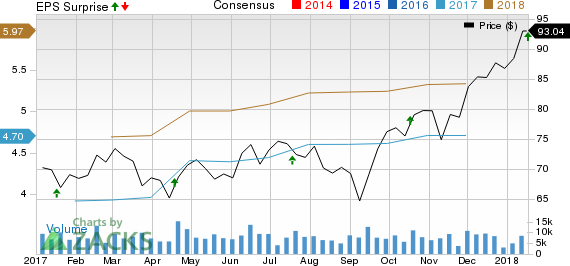
Comerica’s (CMA) Q4 Earnings, Revenues Beat Estimates

Comerica Incorporated Price, Consensus and EPS Surprise

Comerica Inc. CMA pulled off a positive earnings surprise of 5.8% in fourth-quarter 2017. Adjusted earnings per share of $1.28 surpassed the Zacks Consensus Estimate of $1.21. Also, the bottom line compares favorably with the prior-year quarter figure of 99 cents.

Results reflected an increase in revenues supported by easing margin pressure and higher fee income. Strong capital position and improving credit quality were the positives. However, higher expenses and a fall in loans balance remained major headwinds.

After considering the charges from tax legislation of $107 million and other adjustments, the company reported net income of $112 million in the fourth quarter.

For full-year 2017, adjusted earnings per share were $4.73 per share, surpassing the Zacks Consensus Estimate of $4.70. Also, earnings compared favorably with the prior-year figure of $3.02. For 2017, net income of $743 million was reported, up 55.8% year over year.

Segment wise, on a year-over-year basis, its Retail Bank performed well. It reported net income of $21 million against net loss of $4 million in the prior-year quarter. Also, net income increased 9.1% at Wealth Management while it declined 14.1% at Business Bank. The Finance segment incurred a net loss of $2 million compared with net loss of $60 million in the prior-year quarter.

Increase in Revenues Partly Offset by Higher Expenses

For 2017, the company reported revenues of $3.17 billion, up 11.2% on a year-over-year basis. Results surpassed the Zacks Consensus Estimate of $3.16 billion.

Comerica’s revenues for the quarter were $830 million, up 15% year over year. Also, the figure surpassed the Zacks Consensus Estimate of $819.6 million. The increase in revenues was supported by expanded net interest margin and higher fee income.

Net interest income increased 19.8% on a year-over-year basis to $545 million. Moreover, net interest margin expanded 63 basis points (bps) to 3.28%.

Total non-interest income came in at $285 million, up 6.7% year over year. Increased card fees, fiduciary income and service charges on deposit accounts primarily led to the rise.

Further, non-interest expenses totaled $483 million, up 4.8% year over year. The rise was chiefly due to higher salaries, advertising and software expenses, partly offset by lower restructuring expenses.

Loans Decline, Deposits Increase

As of Dec 31, 2017, total assets and common shareholders’ equity were $71.6 billion and $8 billion, respectively, compared with $73 billion and $7.8 billion as of Dec 31, 2016.

Total loans were down slightly on a sequential basis, to $49.2 billion. However, total deposits increased marginally from the previous quarter to $57.9 billion.

Credit Quality Improves

Total non-performing assets decreased 31.6% year over year to $415 million. Also, allowance for loan losses was $712 million, down 2.5% from the prior-year period. Additionally, allowance for loan losses to total loans ratio was 1.45% as of Dec 31, 2017, down 4 bps year over year.

Moreover, net loan charge-offs decreased 55.6% on a year-over-year basis to $16 million. In addition, provision for credit losses declined 51.4% to $17 million.

Capital Position Strengthens

The company’s tangible common equity ratio improved 43 bps year over year to 10.32% as of Dec 31, 2017. Further, common equity Tier 1 and tier 1 risk-based capital ratio was 11.55%, up from 11.09% in the prior-year quarter. Total risk-based capital ratio was 13.71%, up 44 bps from the prior-year quarter.

Capital Deployment Update

Notably, during the reported quarter, Comerica repurchased 1.9 million shares under its existing equity repurchase program. This, combined with dividends, resulted in a total payout of $200 million to shareholders.

For 2017, the company repurchased 7.3 million shares under its existing equity repurchase program. It returned a total of $724 million to its shareholders in the year.

Impressive Outlook for Full-Year 2018

Comerica provided guidance for full-year 2018 assuming continuation of the current economic environment and low rates, along with $270 million of benefits from the GEAR Up initiative.

The company anticipates net interest income to benefit from loan growth and increase in interest rates. Full-year benefit from the rate hikes in 2017 is expected to be $110-$125 million (assuming a 20-40% deposit beta for the December rate increase). Notably, elevated interest recoveries of $28 million in 2017 are not expected in 2018.

Non-interest income is expected to increase 4%, benefitting from GEAR Up opportunities, which will drive modest growth in treasury management, card fees, brokerage fees and fiduciary income. This expectation excludes deferred compensation of $8 million in 2017.

Non-interest expenses are predicted to be up 1%, affected by restructuring expenses of about $47-$57 million and an additional $50 million benefit from the GEAR Up initiatives. Also, expenses related to revenue growth such as outside processing expenses are likely to increase. Pressure will also be created from higher technology expenses and inflationary conditions.

Provision for credit losses is expected to reflect continued solid performance in its overall portfolio. Notably, net charge-offs are expected to remain low while provisions are expected to be in the range of 20-25 bps.

Income tax expenses are anticipated to be approximately 23% of pre-tax income on the assumption of no tax impact from employee stock transactions.

Comerica expects average loans to increase in line with the gross domestic product, reflecting rise in most lines of business while remaining stable in Energy and Corporate Banking.

Our Viewpoint

Comerica reported another strong quarter. The company remains well poised to benefit from its ongoing strategic initiatives. Additionally, its strong capital position continues to lend support. Further, the top line continues to benefit from easing pressure on margins. Lower tax rates and improving economic conditions are likely to continue supporting its financials going forward.

Comerica Incorporated Price, Consensus and EPS Surprise

Wells Fargo & Company’s WFC fourth-quarter 2017 adjusted earnings of 97 cents per share improved from the prior-year quarter earnings of 96 cents. The Zacks Consensus Estimate was $1.04.

Amid an expected trading weakness, strong investment banking results and higher rates drove JPMorgan Chase’s JPM fourth-quarter 2017 earnings of $1.76 per share, which handily surpassed the Zacks Consensus Estimate of $1.69. Results exclude one-time tax related charge of $2.4 billion or 69 cents per share.

Riding on higher revenues, The PNC Financial Services Group PNC delivered a positive earnings surprise of 4.1% in fourth-quarter 2017. Adjusted earnings per share of $2.29 beat the Zacks Consensus Estimate of $2.20. Moreover, the bottom line reflected a 16.2% increase from the prior-year quarter.

Nature, industry and art inspire conceptual Green Line station designs

New LRT stations will feature transit plazas, which can be customized

Conceptual drawings show a preliminary station design for the Green Line LRT.

Stations for the Green Line LRT will feature “transit plazas” that can be customized for the different communities they will serve, according to an architectural concept video posted Tuesday to the City of Calgary’s Youtube channel.

“It was very important that they have the potential for a variety of uses, so maybe Monday to Friday they’re primarily directed to transit users and people passing through them, but on a Saturday or Sunday, is there space available for a farmers market or even pop-up food trucks,” said Lesley Beale of Sturgess Architecture during the 6½-minute video.

“Or are there other uses the community would like for these stations?”

Architect Jeremy Sturgess says the design team used three main images as inspiration for the project — a train, a chinook and a piece of art.

“The responsibility we were charged with was to ensure that the LRT coming through the city would have a meaningful relationship with every community that it goes through,” he said.

“The first image we looked at was the historic railroad, and Calgary was built because of the railroad. The image of the railroad engine coming across the prairie inspired me to think of not only the connection to Calgary’s origins, but also to the plume of the engine itself and the energy that represents.”

The second image, a chinook cloud, “compresses the sunlight and forces it into very dramatic shadows on the landscape,” said Sturgess.

Another conceptual drawing of an outdoor station along the Green Line LRT.

“So that affects our architecture and how we make buildings, but it also affects your sense of place because of the way the sun works with the light.”

The third inspirational image was Running Fence, created in 1974 in California by the artists Christo and Jeanne-Claude.

“My goal is that we can create a consistent pattern of building that starts from one end of Calgary, in the southeast, and moves all the way up, ultimately to the very north end of the city,” said Sturgess.

“What’s important to me is that we have used these parts to inform every station, and each one is different.”

A conceptual drawing of the 26th Avenue S.E. station on the Green Line LRT route.

The transit plazas will serve as threshold between station and the community, he added.

“So the transit plaza will be something that each community can shape into their own expression within the context of the larger expression of this consistent architecture,” he said.

“Some neighbourhoods will be more historic, some neighbourhoods will be more contemporary, and everything in between, but the transit plaza will be the device communities can embrace to make the station their own.”

Current plans for the Green Line LRT call for 28 stations to eventually be built along the 46-kilometre route between 160th Avenue in the north and Seton in the southeast.

The first stage of construction will run from 16th Avenue N. to 126 Avenue S.E. Work is slated to begin in 2020 and finish in 2026 with an estimated cost $4.65 billion.

All three levels of government have committed funding toward the project, with $1.53 billion coming from the feds, $1.53 billion from the province and $1.56 billion from the city.

Scientists Seek Super-Shot for Flu 100 Years After Pandemic

Scientists seek super-shot for flu 100 years after pandemic

WASHINGTON — The descriptions are haunting.

Some victims felt fine in the morning and were dead by night. Faces turned blue as patients coughed up blood. Stacked bodies outnumbered coffins.

A century after one of history’s most catastrophic disease outbreaks, scientists are rethinking how to guard against another super-flu like the 1918 influenza that killed tens of millions as it swept the globe.

There’s no way to predict what strain of the shape-shifting flu virus could trigger another pandemic or, given modern medical tools, how bad it might be.

But researchers hope they’re finally closing in on stronger flu shots, ways to boost much-needed protection against ordinary winter influenza and guard against future pandemics at the same time.

“We have to do better and by better, we mean a universal flu vaccine. A vaccine that is going to protect you against essentially all, or most, strains of flu,” said Dr. Anthony Fauci of the National Institutes of Health.

Labs around the country are hunting for a super-shot that could eliminate the annual fall vaccination in favour of one every five years or 10 years, or maybe, eventually, a childhood immunization that could last for life.

Fauci is designating a universal flu vaccine a top priority for NIH’s National Institute of Allergy and Infectious Diseases. Last summer, he brought together more than 150 leading researchers to map a path. A few attempts are entering first-stage human safety testing.

Still, it’s a tall order. Despite 100 years of science, the flu virus too often beats our best defences because it constantly mutates.

Among the new strategies: Researchers are dissecting the cloak that disguises influenza as it sneaks past the immune system, and finding some rare targets that stay the same from strain to strain, year to year.

“We’ve made some serious inroads into understanding how we can better protect ourselves. Now we have to put that into fruition,” said well-known flu biologist Ian Wilson of The Scripps Research Institute in La Jolla, California.

The sombre centennial highlights the need.

Back then, there was no flu vaccine — it wouldn’t arrive for decades. Today vaccination is the best protection, and Fauci never skips his. But at best, the seasonal vaccine is 60 per cent effective. Protection dropped to 19 per cent a few years ago when the vaccine didn’t match an evolving virus.

If a never-before-seen flu strain erupts, it takes months to brew a new vaccine. Doses arrived too late for the last, fortunately mild, pandemic in 2009.

Lacking a better option, Fauci said the nation is “chasing” animal flu strains that might become the next human threat. Today’s top concern is a lethal bird flu that jumped from poultry to more than 1,500 people in China since 2013. Last year it mutated, meaning millions of just-in-case vaccine doses in a U.S. stockpile no longer match.

The NIH’s Dr. Jeffery Taubenberger calls the 1918 flu the mother of all pandemics.

He should know.

While working as a pathologist for the military, he led the team that identified and reconstructed the extinct 1918 virus, using traces unearthed in autopsy samples from World War I soldiers and from a victim buried in the Alaskan permafrost.

That misnamed Spanish flu “made all the world a killing zone,” wrote John M. Barry in “The Great Influenza: The Story of the Deadliest Pandemic in History.”

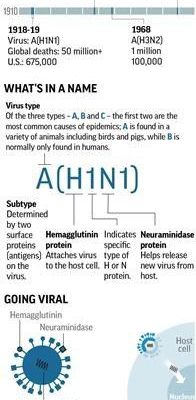
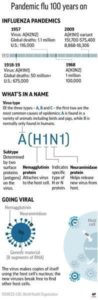
Historians think it started in Kansas in early 1918. By winter 1919, the virus had infected one-third of the global population and killed at least 50 million people, including 675,000 Americans. By comparison, the AIDS virus has claimed 35 million lives over four decades.

Three more flu pandemics have struck since, in 1957, 1968 and 2009, spreading widely but nowhere near as deadly. Taubenberger’s research shows the family tree, each subsequent pandemic a result of flu viruses carried by birds or pigs mixing with 1918 flu genes.

“This 100-year timeline of information about how the virus adapted to us and how we adapt to the new viruses, it teaches us that we can’t keep designing vaccines based on the past,” said Dr. Barney Graham, deputy director of NIH’s Vaccine Research Center.

The new vaccine quest starts with two proteins, hemagglutinin and neuraminidase, that coat flu’s surface. The “H” allows flu to latch onto respiratory cells and infect them. Afterward, the “N” helps the virus spread.

They also form the names of influenza A viruses, the most dangerous flu family. With 18 hemagglutinin varieties and 11 types of neuraminidase — most carried by birds — there are lots of potential combinations. That virulent 1918 virus was the H1N1 subtype; milder H1N1 strains still circulate. This winter H3N2, a descendent of the 1968 pandemic, is causing most of the misery.

Think of hemagglutinin as a miniature broccoli stalk. Its flower-like head attracts the immune system, which produces infection-blocking antibodies if the top is similar enough to a previous infection or that year’s vaccination.

But that head also is where mutations pile up.

A turning point toward better vaccines was a 2009 discovery that, sometimes, people make a small number of antibodies that instead target spots on the hemagglutinin stem that don’t mutate. Even better, “these antibodies were much broader than anything we’ve seen,” capable of blocking multiple subtypes of flu, said Scripps’ Wilson.

Scientists are trying different tricks to spur production of those antibodies.

In a lab at NIH’s Vaccine Research Center, “we think taking the head off will solve the problem,” Graham said. His team brews vaccine from the stems and attaches them to ball-shaped nanoparticles easily spotted by the immune system.

In New York, pioneering flu microbiologist Peter Palese at Mount Sinai’s Icahn School of Medicine uses “chimeric” viruses — the hemagglutinin head comes from bird flu, the stem from common human flu viruses — to redirect the immune system.

“We have made the head so that the immune system really doesn’t recognize it,” Palese explained. GlaxoSmithKline and the Gates Foundation are funding initial safety tests.

In addition to working with Janssen Pharmaceuticals on a stem vaccine, Wilson’s team also is exploring how to turn flu-fighting antibodies into an oral drug. “Say a pandemic came along and you didn’t have time to make vaccine. You’d want something to block infection if possible,” he said.

NIH’s Taubenberger is taking a completely different approach. He’s brewing a vaccine cocktail that combines particles of four different hemagglutinins that in turn trigger protection against other related strains.

Yet lingering mysteries hamper the research.

Scientists now think people respond differently to vaccination based on their flu history. “Perhaps we recognize best the first flu we ever see,” said NIH immunologist Adrian McDermott.

The idea is that your immune system is imprinted with that first strain and may not respond as well to a vaccine against another.

“The vision of the field is that ultimately if you get the really good universal flu vaccine, it’s going to work best when you give it to a child,” Fauci said.

Still, no one knows the ultimate origin of that terrifying 1918 flu. But key to its lethality was bird-like hemagglutinin.

That Chinese H7N9 bird flu “worries me a lot,” Taubenberger said. “For a virus like influenza that is a master at adapting and mutating and evolving to meet new circumstances, it’s crucially important to understand how these processes occur in nature. How does an avian virus become adapted to a mammal?”

While scientists hunt those answers, “it’s folly to predict” what a next pandemic might bring, Fauci said. “We just need to be prepared.”

Volkswagen Sells Record 10.74 Million Vehicles in 2017

FRANKFURT — German automaker Volkswagen had record sales of 10.74 million vehicles last year, but its bid to remain the world’s largest carmaker was disputed by rival Renault-Nissan-Mitsubishi.

Volkswagen’s sales rose 4.3 per cent from 10.30 million in 2016, when the company passed Japan’s Toyota to become the globe’s largest auto producer for that year.

The figures show the Wolfsburg-based company continuing its effort to move past a scandal that broke in September 2015 over cars it had rigged to cheat on diesel emissions tests. Sales last year were boosted by a strong December, when sales rose 8.5 per cent . For the year, the company saw big jumps in Russia and Brazil, and significant gains in China and the United States.

“We are thankful for the trust of our customers,” CEO Matthias Mueller said in a statement.

Carlos Ghosn, chairman and CEO of the Renault-Nissan-Mitsubishi alliance, told a committee of the French National Assembly that his group was the world’s biggest with 10.6 million vehicles last year, the French business publication Les Echos reported. Ghosn said that 200,000 of Volkswagen’s vehicles were trucks that should not count.

Toyota estimated in December that it sold 10.35 million vehicles last year. Final figures are expected around the end of January or the beginning of February.

None of the companies sets as a goal to be the world’s largest auto maker, though Ghosn was quoted as saying it was “a satisfaction.”

3 of the World’s Hottest Chilies to Heat Up Your Winter

Ghost chilies, an ’11 out of 10′ shouldn’t be handled with your bare hands, warns spice expert

Jayson Thomson, sales associate at the Silk Road Spice Merchant in Calgary’s Inglewood neighbourhood, says it’s ‘exciting that people are willing to explore different types of chilis, or hot cuisines.’

Today is International Hot and Spicy Food Day, a celebration of ingredients that range from fragrant to piquant and occasionally even painful, depending on whom you ask.

“If I’m not sweating when I’m eating something spicy, then it’s not hot enough,” laughed Jayson Thomson, sales associate at Silk Road Spice Merchant in Calgary.

Whether you’re a heat-seeking daredevil or a cautious explorer in the vast and colourful world of spice, there’s a spice out there to suit your appetite.

If you’re looking to push your boundaries, here are three of the hottest chilies available in Calgary, as recommended by Thomson, and one more moderate chili for those with a milder heat preference.

1. Ghost chili

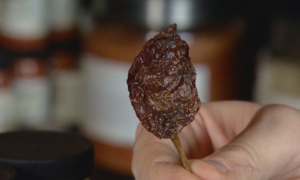
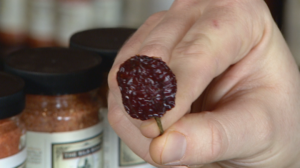
The ghost chili earned the Guinness World Record as the world’s hottest pepper in 2007, but was superseded in 2011 by the infinity chili.

The bhut jolokia, more commonly known as the ghost chili, is one that strikes fear and admiration into the hearts of even the most enthusiastic spice aficionados.
An “11 out of 10” on the spice scale, it’s not for the faint of heart, said Thomson.

If you feel up to the challenge, he suggests experimenting with a small amount of the chili pepper in a pineapple or mango chutney sauce, which will highlight the chili’s natural burnt mango flavour.

2. Habanero

Ringing in at a solid 10 out of 10 in terms of heat, habanero chilies are among the hottest on the planet.
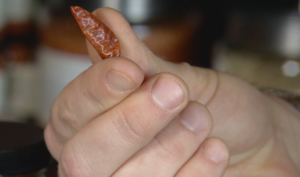
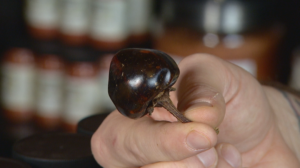
With a tropical, fruity flavour, these lantern-shaped chilies pack a mean punch, Thomson said.

“It looks basically just like a cherry, but I wouldn’t eat it,” he cautioned.

In fact, his shop advises customers to wear gloves when handling these especially hot chilies, as the spicy surface oils can penetrate human skin, causing irritation.

Obvious problems will arise if people then rub their eyes or nose with their hands after handling a chili this hot.

3. Bird’s eye chili

The bird’s eye chili is from the same species as the African Bird Chili, also known as peri peri, and is similar in appearance, flavour and heat.

The bird’s eye chili, grown in India and southeast Asia, is a widely used hot pepper in that region of the world.

Thomson characterizes this one as a 9 out of 10 on the spice scale.
It’s known to have a delayed potency, meaning heat will gradually build the more you eat.

4. Cascabel

Dried cascabels can also be soaked in hot water to soften their hard, outer skin, making them easier to incorporate in some dishes.

For those who are looking for a more gentle introduction to the world of spice, Thomson suggests the cascabel.

Spanish for “rattle,” these chilies earned their name from the sound they make. When dried, the brownish-red chilies retain their shape, and the seeds inside bounce against the crispy outer shell.

Cascabels carry a moderate heat and a deep, nutty flavour. Measuring a 4 or 5 out of 10 in terms of heat, they can be ground up and incorporated into mild salsas and stews.