Archives for October 16, 2017

Why you should buy a TV antenna. Yes, really.

When I was a kid, I had a 13-inch TV with old-school rabbit ear antennae sticking out the back. When my family finally got cable, my brother and I promptly broke the antennae off and used them to hit each other.

More than 20 years later, I’m ordering an HDTV antenna on Amazon to connect to my new 55-inch 4K HDR TV.

It might sound silly to strap an antiquated piece of technology like an antenna to a high-end television, but if you’re a cord cutter who also wants to watch your local broadcast channels in HD for free, it makes perfect sense.

Cutting the cord can cut out broadcast channels

If you’ve ditched your cable subscription for the likes of Netflix (NFLX), Hulu and other services, you likely still get access to many of the major broadcaster channels’ biggest shows on-demand. We’re talking about things shown on ABC, CBS, Fox, NBC and the CW.

Okay, you don’t need old-school rabbit ears, but an HDTV antenna could be a the key to free broadcast TV in your home. (image: Flikr/ dailyinvention)


But if you want to watch something as it happens live, well, you’re out of luck. You can see broadcast channel shows like Dancing with the Stars or, ugh, Big Bang Theory, on Netflix or YouTube, but you can’t see them live. And if you’re a football fan, you can forget about seeing the week’s games. Even if you’ve got an over-the-top streaming subscription service like Sling or Hulu Live, you might not get all of the local broadcasters.

Sure, the major broadcast companies also have apps for Apple’s (AAPL) iOS and Google’s (GOOGGOOGL) Android, but you can only use those if you have a cable or satellite subscription. Which, you know, doesn’t make much sense if you’re trying to cut the cord.

Antennae are easy to purchase and install

It’s probably safe to say most of you reading this don’t know the first thing about buying an antenna. Neither did I before I started looking into it. But it turns out, it’s relatively easy.

First off, no, you’re not going to have to attach a giant metal monstrosity to your roof. Modern antennae are actually pretty compact compared to their predecessors. Heck, you can connect one to your TV and slap it on your wall if you want.

But before you purchase an antenna, you’ll need to make sure that it is able to pull in the broadcasts you want. To do that, you can go to websites like Nocable.org or FCC.gov., which will tell you exactly what stations you’ll get based on the how far you are from each tower.

I live in Queens, NY, so I’ve got access to a number of towers, but if you live in a more sparsely populated region of the country, you might only have one or two towers within 60 miles of your home. It all depends on where you happen to live.

Once you’ve got an idea how many towers are in a certain number of miles from your home, you can go online or to your nearest brick-and-mortar electronics retailer and purchase an antenna with the range you want. Again, checking Nocable or the FCC is the best way to see the kind of antenna you’ll need to buy if you want to get specific channels.

I found an antenna with a range of 75 miles for $25 on Amazon (AMZN), so don’t expect to pay too much for your own.

It’s going to get better

Getting free HD content over the air is a pretty great deal, but that’s not the end of the line for antenna broadcasts. A new over-the-air standard is coming this year that promises to allow broadcasters to send out internet protocol–based content that viewers can watch on their connected devices.

The new standard, called ATSC 3.0, will also allow for 4K and HDR over-the-air broadcasts.

In other words, what’s old is new again. Hopefully in the next few years, we’ll be talking about the return of the classic flip phone. Because there was nothing cooler than finishing a call and aggressively flipping your phone shut.
A flawed argument used by Warren Buffett could be setting stocks up for ‘one of the worst disasters in history’

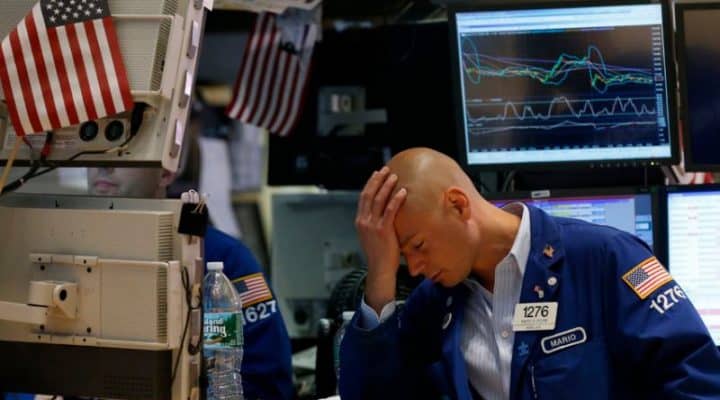
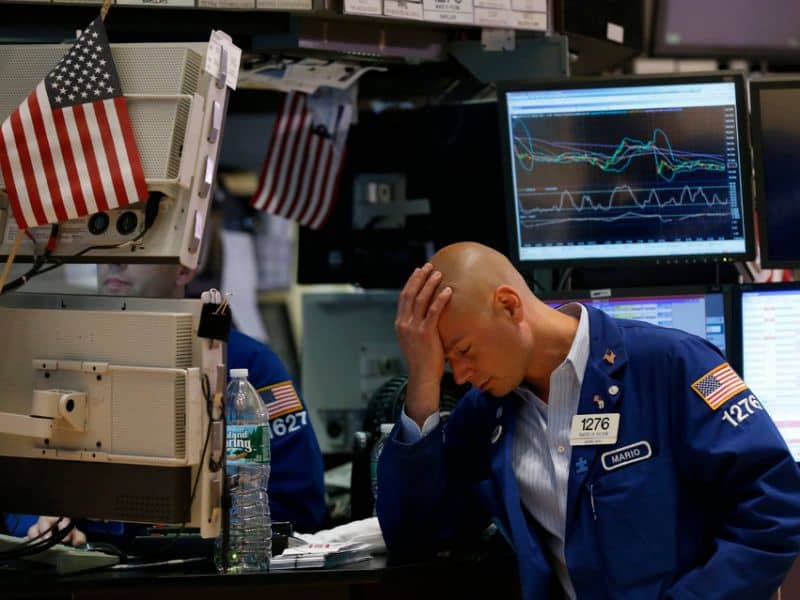
sad NYSE trader


REUTERS/Brendan McDermid

Billionaire investor Warren Buffett made a lot of people feel better about historically stretched stock prices earlier this month.

Speaking in an interview with CNBC on October 3, the chairman and CEO of Berkshire Hathaway said, “Valuations make sense with interest rates where they are.”

The investment community breathed a sigh of relief. After all, Buffett is arguably the most successful stock investor in world history. An all-clear from him surely gives a green light for adding more equity exposure, right?

Wrong, says John Hussman, the president of the Hussman Investment Trust and a former economics professor.

In his mind, Buffett only gets half of the equation right. While Hussman acknowledges that low lending rates do, by nature, improve future cash flows, he argues that they must also be accompanied by strong growth — something that he notes the US is not currently enjoying.

To Hussman, the simple idea that “lower interest rates justify higher valuations” is one that gives people false confidence.

“It’s an incomplete sentence,” Hussman wrote in a recent blog post. “Unfortunately, the convenience of investing-by-slogan, rather than carefully thinking about finance and examining evidence, is currently leading investors into what is likely to be one of the worst disasters in the history of the U.S. stock market.”

Hussman calculates that stock valuations are stretched 175% above their historic norms, and predicts the S&P 500 will see negative total returns over the next 10 to 12 years. Along the way, the benchmark index will experience an interim loss of more than 60%, he estimates.

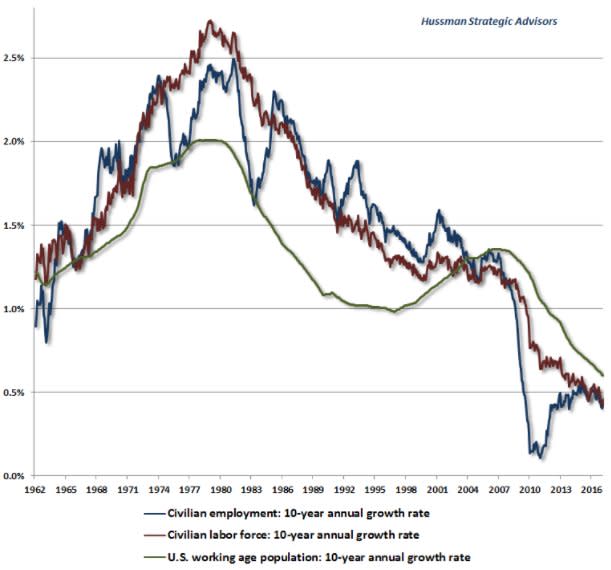
As touched on above, at the core of Hussman’s bearish argument is a lack of economic growth. He specifically points to slowing expansion in the US labor force, as shown by this chart:

Screen Shot 2017 10 13 at 3.11.15 PM

Hussman Strategic Advisors

“Put simply, if interest rates are low because growth rates are also low, no valuation premium is ‘justified,'” Hussman wrote. “The long-term rate of return on the security will be low anywaywithout any valuation premium at all. This observation has enormous implications for current U.S. stock market prospects.”

So where does that leave the market at this very moment? In the very near term, Hussman’s neutral, citing the continued speculative impulses of investors. Still, he stresses that traders should be hedging and using other safety nets to protect against potential downside, which he says could materialize quickly.

To say he’s less than warm and fuzzy about the stock market is an understatement. And when discussing price levels, he doesn’t exactly pull any punches, saying US equities are now “at the most offensive level of overvaluation in history” — even worse than in 1929 and 2000.

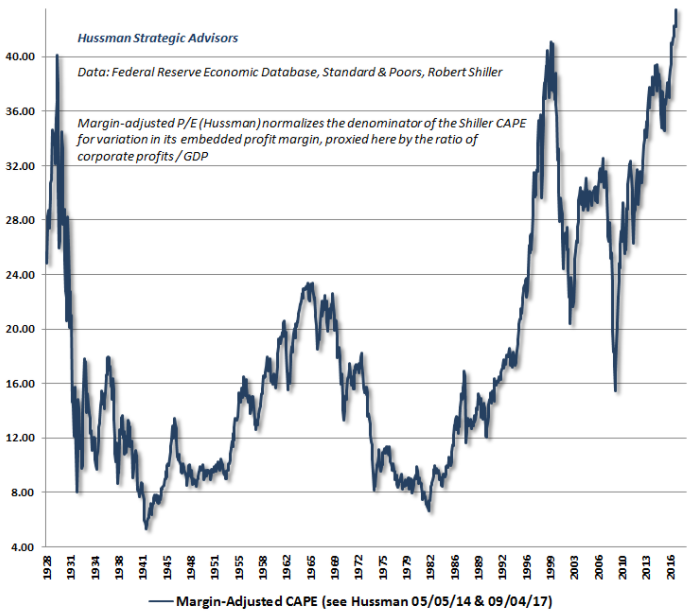
We leave you with the chart supporting Hussman’s bearish claims, which shows the margin-adjusted price-earnings ratio for the US stock market at a record high:

Screen Shot 2017 10 13 at 3.30.38 PM

Hussman Strategic Advisors

In the NFL, owners hold the power — might one challenge Trump?

Two weeks after an initial “show of unity,” when NFL players and, in many cases, their team owners, linked arms on Sept. 24 after President Donald Trump slammed the NFL the night before, Dallas Cowboys owner Jerry Jones flipped the script.

At a press conference on Sunday after the Cowboys lost to the Green Bay Packers, Jones suggested the Cowboys will bench players who don’t stand during the national anthem. “We cannot in the NFL, in any way, give the implication that we tolerate disrespecting the flag,” Jones said. “We cannot do that… The Dallas Cowboys are going to stand up for the flag. Just so we’re clear.”

While a wide range of team owners issued statements two weeks ago criticizing Trump’s divisive comments about NFL players, Jones has performed a 180. He is the first owner to publicly say that his team will bar its players from kneeling.

And now the NFL appears to be at least considering following suit.

Will NFL ban players from kneeling?

NFL owners will meet next week to discuss a potential rule change to explicitly prohibit players from kneeling during the anthem. (To be clear: the existing policy, which is not in the NFL rulebook but is in a “game operations manual” handed out to teams and not players, states that players “should stand at attention, face the flag, hold helmets in their left hand, and refrain from talking.” But the NFL last season said it would not punish any player that does not do so.

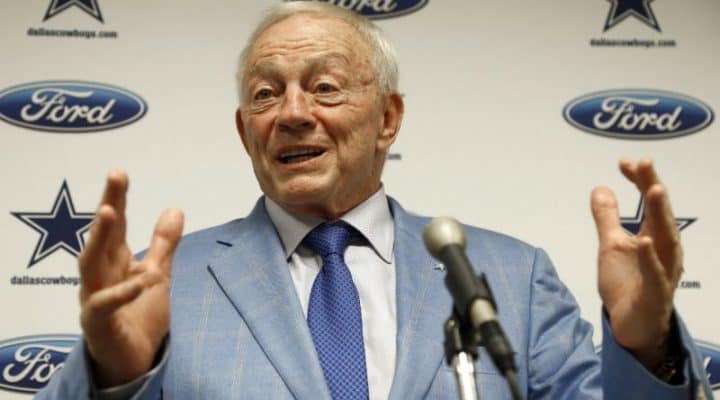
Dallas Cowboys owner Jerry Jones talks about players kneeling. (AP)

Jones’s comments caught at least some Cowboys players by surprise. And many media outlets have interpreted this as the NFL caving to President Trump, who has tirelessly trashed the NFL for the past month. Politico wrote that the NFL has “lost to Trump” while Slate wrote that the NFL is likely to “give Donald Trump exactly what he wants.”

Trump was quick to praise Jones for his comments.

In the NFL, it’s the 32 team owners that pull the strings. Many football fans forget that Goodell, as commissioner, works for the owners. He serves at their pleasure, and his continued employment is up to them.

Among the 32 owners, Jones is thought to be the very most influential. Besides Jones, the bigger power brokers include New England Patriots owner Bob Kraft, Carolina Panthers owner Jerry Richardson, the Maras (New York Giants) and the Rooneys (Pittsburgh Steelers).

So, what can the team owners do to minimize the political firestorm Trump is pushing about the NFL? That was the subject of Episode 6 of our ongoing Sportsbook podcast on the business of football. You can listen on iTunes or scroll to the bottom of this post.

The guests on Episode 5 of our podcast were Yahoo Finance writers Rick Newman (who happens to be a Steelers fan) and Myles Udland (Giants fan), and the debate got spirited.

Might owners stand up to Trump? Might players strike?

Newman asked: What’s to stop an owner from publicly coming out against Trump’s demands? One owner could conceivably ask Trump, free of politics, to just stay out of it.

“What we don’t have in the NFL yet is a Bob Corker, someone who flat-out stands up to Trumpand says, ‘Get out of our business. Get out of football, man. You have no place here.’ Now, I’m not sure anybody like that will materialize,” said Newman. “It would be quite refreshing if somebody said, ‘We got it. We know this is a little bit messy, but it’s okay, we’ve been through things like this before, and we know how to run our business. Back off.’”

But is that scenario plausible?

Even though there is vocal rejection of Trump’s crusade against the NFLeven from conservative radio host Rush Limbaugh (who said, “We don’t want the president being able to demand anybody that he’s unhappy with behave in a way he requires”), many of the NFL team owners were Trump supporters. 25% of the owners donated money to Trump’s campaign: Jones; Kraft; Ed Glazer (Buccaneers); Stan Kroenke (Rams); Woody Johnson (Jets); Shad Khan (Jaguars); Bob McNair (Texans); and Dan Snyder (Redskins).

Colin Kaepernick provided a similar opportunity this season for the owners to take a stand, and none signed him (even when multiple teams needed to sign a quarterback due to an injury), and it’s looking almost certain none will. Signing Kaepernick, as Newman argues in the podcast, became a “litmus test” for an owner supporting the player protests, and thus appearing to go against Trump. Even if a team truly needed Kaepernick for his skill, signing him would now be taken as a political statement.

Udland raised another possibility: Would the players try to strike? (Recall that there was an NFL lockout in 2011, though it was initiated by the owners.)

“It shouldn’t take, in my estimation, that many players saying, ‘You know what? We’re done with this. We’re done being bullied by our owners, who are being bullied by the president. We’re members of a union, we’ll go to our union rep and say, ’30 of us are sitting. You want to cancel the game, cancel the game,’” said Udland. “I’m not saying this will definitely happen, I just don’t see why it would be such an outside possibility. All these things are in place for the league’s current power structure to sort of erode.”

This is what Trump’s war of words has done to the NFL: backed team owners into a corner where they must choose whether to stand by their players’ right to free speech or side with the president. And it just might lead to a shift in power in the league.

Millennial homebuyers struggle the most, according to new data

If you’re a millennial looking to buy a home, put on your boxing gloves: The market is competitive. August housing sales fell to a 2017 low, dropping 3.4% from July’s numbers, according to the US Census Bureau.

But while there are fewer homes on the market, there are more people looking to buy. This means the market is competitive, and affordable homes harder to come by.

Millennials are affected the most, because they make up 42% of first-time homebuyers, the largest group of any generation. According to a report by Apartmentlist, 80% of millennialssaid they would like to buy a home one day, but just 55% think they can actually afford to buy one.

Coming up with money for the recommended 20% downpayment is a huge obstacle for all homebuyers, but millennials fare slightly worse, according to a new report by Zillow. More than one-third of millennial buyers could not afford a 20% down payment, and put down an average of 11% instead, according to the report. But 68% of millennials reported having less than $1,000 saved for a down payment, and 44% said they have not saved anything.

For those who did sign on the dotted line, 37% of those millennials went over budget, compared with 29% of all home buyers, according to Zillow.

The problem with the market is a lack of affordable homes, according to the Zillow report. The average price of a new home was $300,200, down from July’s average of $320,100. These prices are out of reach for many potential young home buyers.

The options to rent are also pushing potential home buyers away from owning. Sixty-two percent of millennials were also looking into rental properties while searching for homes. The Zillow report says this suggests millennials don’t view home buying as “a sure thing.”

The solution? Build more affordable homes, according to Zillow. As more millennials look for housing outside of the rental market, they will need more options in their price range.

7 ways to make extra holiday cash

Ready to start tackling your holiday gift list? Join the shopping frenzy—this year, holiday retail sales are expected to top $1 trillion, according to estimates by Deloitte.

“People are feeling pretty good about things, incomes are rising, people have jobs, they’re in the spirit to spend and they’re going to spend,” said Vera Gibbons, a personal finance expert and the founder of nonpoliticalnews.com.

According to the American Research Group, the average American planned to spend an average of $929 on holiday shopping last year. Want to put away some extra cash? Gibbons shares her seven ways to save.

TIP 1: Go on a financial fast

Gibbons recommends going on a financial fast for several weeks to curb your spending habits.

“You see how much money you’ve been spending when you actually set yourself up and go on a financial fast,” she says.

Gibbons says during the fast, you don’t make any unnecessary purchases or credit card purchases. You should also challenge yourself to make no purchases whatsoever one day per week during the fast.

“I think it’s a great way for you to reset and see just how much you are spending, and get a grip on the spending,” Gibbons says.

TIP 2: Create an automatic holiday savings account  

“One of the easiest ways to actually stash away your money is to go automatic — automatically have a certain amount of money taken out of your paycheck and deposit it into a savings account,” Gibbons says.

She recommends giving it a name, and not touching it until you’re ready to shop.

“This is a really easy strategy, and the point is to get into a habit of automatically having a certain percentage taken out of your paycheck,” she says.

TIP 3: Get a side gig

For people who want to pick up an extra job, the gig economy is one of the easiest and most accessible ways to do it, Gibbons says.

“The gig economy is now 34% of the workforce, and it’s projected to grow to 40% by 2020,” Gibbons says, citing statistics from Intuit, the owner of TurboTax.

Startups like Uber, Airbnb and TaskRabbit have made making extra cash easier than ever. Plus, gigging can add flexibility and supplemental income.

“It’s a great way to get out there and earn a little extra holiday cash. People like the flexibility, you can make your own hours, and the money is decent,” Gibbons says.

TIP 4: Get a seasonal job

Picking up a seasonal job is another way to save some holiday cash, and retailers are preparing for the season in a big way.

“In the last couple of weeks retailers have rolled out literally hundreds of thousands of seasonal jobs,” Gibbons says.

Target plans to hire 100,000 seasonal workers this year, and many other retailers are looking to hire. Gibbons says the pay and benefits can be good, as retailers anticipate a busy season.

“As the season gets underway and they see the business of it all they’re offering all sorts of perks to try to draw on good talent,” Gibbons says.

TIP 5: Avoid impulse buys

It’s become easier than ever to shop, and that’s led to more impulse purchases, which means more money out of your pocket on things you might regret.

Impulse buys are “problematic because each impulse buy can easily be $50-$100 and you’re out,” Gibbons says.

And the feeling after you make that impulse purchase?

“Generally after you make an impulse buy, you have sort of the high that comes after the fact, but soon after, it’s regret,” Gibbons says.

Gibbons recommends waiting 24 hours before making your purchase. Think it through, and decide if you still want it the next day.

TIP 6: Abstain from “self-gifting”

It’s nice to treat yourself once in awhile, but “self-gifting” has become a buzzword — and a pricey one for shoppers.

“You’re going to see more self-gifting offers to actually get consumers to spend more than they actually anticipated and to buy exclusively for themselves.”

Gibbons says remembering that you’ll also be receiving, and not just buying, holiday gifts this year, can help curb your spending.

“Maybe then you won’t jump in and buy something for yourself,” she says.

TIP 7: Keep your emotions in check

When you are ready to hit the mall (or your web browser…), prepare yourself, Gibbons says. Have a shopping list and a budget to avoid any emotional spending that can add to your holiday bill.

“You have to get a grip on your emotions because when you’re feeling emotionally able to make a financial commitment to buy something, you’re probably going to go for it,” Gibbons says. “If you let your emotions go wild, that leads to a lot of unintended purchases.”

How to meet your money goals by the end of the year

You may have made a financial resolution for 2017—but did you keep it? Thirty-six percent of Americans made a financial resolution this year, according to Fidelity. The most popular resolutions? Save more, pay off debt and spend less overall.

As the year comes to a close, it’s common for our resolutions to fall by the wayside. But there’s still time to tackle your financial resolutions. Here’s what top financial professionals have to say about the importance of setting goals, and how you can still accomplish your 2017 resolutions by the end of the year.

The importance of making a financial resolution

“It’s important to have financial goals because you need to have an idea of what you’re looking to accomplish. With no clear purpose, it’s easy to meander aimlessly and not make any progress.” —Dawn-Marie Joseph, founder of Estate Planning & Preservation

“Setting a goal, especially with finances, helps you break down what changes you have to make.” —Kim Palmer, credit card expert at Nerdwallet.com

“Setting financial goals is important because it gives you a target to strive for and holds you accountable.” —Joe Sterf, CPA and founder of Average Joe Finance

The easiest ways to reach your goals  

“First, you need to pick a goal that is meaningful to you and that you will be willing to ‘sacrifice’ for when other temptations and needs arise. Second, you need to put that goal in writing and revisit frequently so that you can stay focused on meeting your goal.” —Joe Berry, investment adviser, Semmax Financial Group

“It’s really all about turning your big resolutions into small steps so you can feel encouraged and celebrate small victories. All of those little things add up over time so by the end of the year you can really see a big difference.” —Kim Palmer, Nerdwallet.com

“Meet with a financial advisor. So many people think you need a certain amount of money, but that’s just not the case. The advisor can help you make a plan and stick with it. They can make sure you don’t bite off more than you can chew.” —Colleen Carcone, director of wealth planning strategies, TIAA

“Keep the goal in front of you. Too often we start a year with great goals, only to completely forget what they are by March, let alone October! I write out my goals on a sticky note and put it on my bathroom mirror so that every morning and every night as I’m brushing my teeth I look at it and it stays fresh in my mind.” —Jeremy Walter, CFP, founder of Fident Financial

Making a dent in your debt by December

“Don’t wait any longer to start paying off your loan! From credit cards or student loans, pay off the debt that has the highest interest rate first and then work your way through debt with lower interest rates.” —Deborah Sweeney, CEO of MyCorporation.com

“Even this far into the year, yes, you can make a difference in paying off debt. You can start cutting back on some of your expenses, or if you get a holiday bonus or year-end bonus, you can put that towards your debt.” —Colleen Carcone, TIAA

“Don’t add more debt! Before this holiday season starts, set a budget that doesn’t require any new debt. Keep your credit cards out of reach and your goals in sight.” —Ian Atkins, head financial analyst, FitSmallBusiness.com

“Look at what you are spending now per month. Look at the dinners, take-out, magazine subscriptions, monthly charges for apps or computer games/services you don’t need. Take the savings from these and put it toward your debt.” —Al Zdenek, founder of Traust Sollus Wealth Management

How to add to your savings ASAP

“Having a budget and sticking to it is critical. Meeting a financial goal for year-end will require saying ‘No’ to expenditures that are not necessary. Get lean and mean! Cut out the fluff.” —Joe Berry, Semmax

“Set up automatic payments into a savings vehicle. If you want to put more into your 401(k), 403(b) or a retirement savings that you have at work, call your HR department immediately. You can reach your goals, but it takes planning on your part.” —Dawn-Marie Joseph, Estate Planning & Preservation

“If your employer provides end-of-the-year bonuses or holiday bonuses, that’s a great opportunity to contribute to your savings. Set your bonus aside to further a financial goal.” —Ian Atkins, FitSmallBusiness.com

How to avoid getting discouraged and stick to your goals

“At times, you are going to have a few slip-ups with your goals. Don’t beat yourself up too bad. Give yourself 15 minutes of disappointment and then move on.” —Dawn-Marie Joseph, Estate Planning & Preservation

“Skip the pity party when you fall short. Don’t set yourself up for failure by insisting on an all-or-nothing change. Instead keep your focus on where you are going and your long-term savings goals.” —Pamela Yellen, financial expert, author of Bank on Yourself

“Don’t wait until the milestone date you have set yourself to find out that you haven’t met your goal. Review progress regularly and adjust your goal to be more realistic if it looks like you won’t hit your target. Keep goals realistic and you shouldn’t get discouraged.” —Amanda Gillam, personal finance professional, Solution Loans