Uncategorized

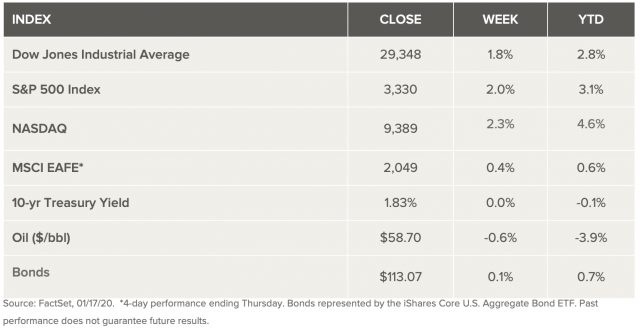
Weekly Market Review – January 18, 2020

Stock Markets

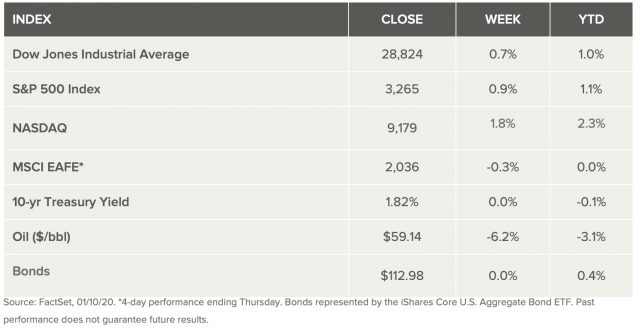
What analysts call better-than-expected economic data, encouraging corporate earnings from U.S. banks, and the signing of the “phase-one” trade agreement helped raise U.S. stocks to fresh record highs last week. A surge in housing starts bolstered by strong retail sales point to a resilient consumer that is supported by a continued strong labor market. The “phase-one” trade agreement between the U.S. and China was formally signed last week, fulfilling expectations for a deal that was already done. Important terms of the deal included commitments from China to increase purchases by $200 billion over the next two years ($78 billion of manufactured goods, $52 billion in energy, $32 billion of agricultural products, and $38 billion in services). Analysts agree that the agreement removes significant uncertainty, however, they say trade issues will likely continue as a source of volatility through 2020.

U.S. Economy

The closing of stocks at record highs last week was driven by the U.S. and China reaching the “phase-one” trade agreement. Analysts believe the recent trade agreement is a significant step in the de-escalation of the trade tensions between the two superpowers. It takes away much of the threat that new tariffs create and creates confidence that a more comprehensive deal is achievable. Still, tariffs remain in place on two-thirds of U.S. imports from China. So, attention now shifts to implementation and enforcement. Potential failure to meet the terms of the deal could create temporary setbacks which could stretch as far as additional new tariffs. Further tariff relief and more complete trade cohesiveness that would include including structural fundamentals, like industrial subsidies, is likely to be in place by the time we reach the U.S. election. The current agreement gets rid of significant uncertainty, but all agree that trade issues will likely create some volatility in the coming year. Analysts expect stocks to continue to rise but at a slower pace than they have over the past decade. This is widely supported by ongoing economic growth, modest earnings growth, and accommodative central banks.

Metals and Mining

The precious metals sector was two sided this week, with gold and silver remaining in a channel, while both platinum and palladium climbed. Platinum was up 4.4 percent from last week, exceeding US$1,000 per ounce for the first time in two years. The precious metal had been sidelined for much of the growth that palladium and gold experienced in 2019. Now it’s starting to see a benefit from the same motivators that drove those metals. Rallying from US$976 (January 10) to US$1,037 (January 16), Platinum exhibited its best performance year-to-date. It is on track to surge to highs not experienced since 2015. The phase one trade deal between China and the US countered some of the volatility that entered the market earlier in this month. The exchange traded-funds sector (ETF) may help motivate the platinum’s price too, since last year, platinum ETFs grew by 12 percent with investors purchasing 90,000 ounces or 11 percent of global supply. Easing geopolitical tensions moved against gold’s momentum, putting it on course to record its weakest performance in nearly two months. News of the phase one deal pushed gold below US$1,550 only to rebound supported from a weaker equity market and lower US dollar. Another round of increased buying from central banks and monetary policy are also projected to impact the value of gold in 2020. Palladium continued its upward trend this week. The precious metal star climbed 14 percent to trade at an all-time high of US$2,429 on January 17. Palladium’s hyperbolic performance has now moved the industrial metal beyond platinum and gold’s record highs, making it the most valuable of the four exchange-traded precious metals. The German bank pointed to the prolonged supply deficit as the current catalyst behind palladium’s best historic performance. Like gold, silver remained locked in a range staying below US$18 an ounce for much of the week. Silver has exhibited the poorest price growth of all four precious metals. It ended the week without any gains.

Energy and Oil

As expected, China has been the key oil price driver this week. The phase one trade deal drove prices higher before worrying economic data from the country dragged prices lower. Oil prices regained a bit of ground by week’s end. That was based on optimism surrounding the Phase 1 U.S.-China trade deal only. The global oil market managed to dodge a bullet after the U.S. and Iran backed away from war talk and eased tensions. But the geopolitical risk has not disappeared. In any case, non-OPEC oil supply is expected to continue to grow faster than demand this year. Once again that leaves the market with a persistent supply surplus, according to the IEA. The result is tremendous pressure on OPEC+, which may find that it needs to cut even further than current levels. In the U.S. Permian basin, the industry is suffering through bankruptcies, slower growth and investor scrutiny. Many analysts suggest that production should grow this year, however skeptical investors are starting to see a potential for peak in supply over the near-term period. Natural gas spot price movements were mixed this week. The Henry Hub spot price fell from $2.08 per million British thermal units (MMBtu) last week to $1.98/MMBtu this week. At the New York Mercantile Exchange (Nymex), the price of the February 2020 contract decreased 2¢, from $2.141/MMBtu last week to $2.120/MMBtu this week. The price of the 12-month strip averaging February 2020 through January 2021 futures contracts declined 3¢/MMBtu to $2.290/MMBtu.

World Markets

Stock in Europe rose this week as trade tensions eased, and investors welcomed strong Chinese economic data. The pan-European STOXX Europe 600 Index ended the week 1.33% higher, and the UK’s FTSE 100 Index gained 1.30%. Germany’s DAX Index advanced 0.3%. For the UK, poor economic data, combined with recent dovish speeches and comments by Bank of England (BoE) Monetary Policy Committee (MPC) members, set speculation in motion that an interest rate cut is in the cards at the January 30 policy meeting. What was suggested as a quarter-point reduction in the benchmark Bank Rate, from 0.75% to 0.50%, just rose to 80% on expectations.  Analysts see rate cut as a form of insurance given the sharp slowdown at the end of the year. This move that probably should have occurred at the end of 2019 but was weigh laid by the general election. Analysts also expect data to begin improving as uncertainty has receded since the Conservative Party election victory, so purchasing managers’ surveys of the construction, manufacturing, and services sectors, will still be key to policymakers’ voting intentions.

China’s stock market moved slowly ahead of the signing of the phase one trade deal with the U.S. and did not rebound after the announcement. The Shanghai Composite lost 0.8% during the week while the CSI 300 large-cap index edged down 1.2%. The trade deal was already baked into the market came largely as expected. Many observers in the region viewed the deal as driven primarily by U.S. election politics and as a band-aid rather than a solution. For its part, China has pledged to import much more from the U.S.  There are worries that the target of a USD 200 billion increase in imports of goods and services from the U.S. over the next two years may be very difficult to achieve and could fall short. Regional skeptics also doubt China’s claim that other countries will not suffer as it redirects purchases back to the U.S.

The Week Ahead

U.S. markets will be closed on Monday to observe Martin Luther King Jr. day. Important economic data being released include pending home sales, the leading index on, and the Markit Purchasing Managers’ Index on Friday. This is an important week in the corporate earnings season as another 43 companies of the S&P 500 will be reporting fourth-quarter earnings.

Key Topics to Watch

  • Chicago Fed national index
  • Existing home sales
  • Weekly jobless claims
  • Leading economic indicators
  • Markit manufacturing PMI (flash)
  • Markit services PMI (flash)

Markets Index Wrap Up
Weekly Market Review – January 11, 2020

Stock Markets

Stock markets closed at near new all-time highs last week after the U.S. and Iran recoiled and avoided expected escalation in geopolitical tensions. Iran took retaliatory steps for the death of its general with missile strikes against U.S. military bases in Iraq. There were no casualties, whether on purpose or not, but President Trump eased tensions by offering an olive branch. As a result, oil declined 6% on the week, recording its worst weekly performance since July of 2019. Where the economy is concerned, December jobs reports showed a slowdown in the overall job gains, but that was to be expected since it followed what was a very over performing November. And while wage growth was not quite as strong, the data shows wages are still growing faster than consumer prices. That’s adding a big boost to consumer confidence and spending, both big drivers of the current market.

U.S. Economy

The US economy remains surprisingly robust. An escalation in military tensions and the strong employment report combined to send the Dow briefly above the 29,000-mark last week for the first time in history. It appears that the stock market has picked up in 2020 right where it finished 2019. Even the combination of political uncertainties and widely positive economic conditions have not really changed. Analysts expect three things will dominate the investment perspective this year; 1. policy/political risks, 2. Domestic and global economic trends, and 3. The potential for this market rally to based on what takes place in numbers 1 and 2. These are the narratives to follow closely and mine for information that will dominate the economy this year.

Metals and Mining

Precious metals benefited greatly from growing geopolitical uncertainty in the Middle East following last week’s attack on an Iranian military personnel. Both gold and palladium started the week with highs for the year. Gold then reached a seven-year peak at US$1,578.80 an ounce. Palladium raced above US$2,000 an ounce to US$2,023. Not to be outdone, silver, was also pushed higher by the uncertainty, and reached a year-to-date high of US$18.55 an ounce on Tuesday. Platinum followed the trend on the week and moved to US$989 an ounce on Sunday before dipping lower and staying steady. The aerial assault carried out by Iran on Iraqi targets late Tuesday sent ripples through the market. A rush to safe haven assets pushed gold as high as US$1,610. Once the evaluations came in only to find there were no reported casualties, all metals prices began to retreat back to their pre-attack levels. Gold was trading for US$1,556.77 as of 10:53 a.m. EST on Friday (January 10). Palladium was the one metal that retained this week’s gains and has even creeped up. The metal, which is used in catalytic converters for gasoline-powered cars, is still vital for reducing emissions from vehicles. It continues to break records as it hit another all-time high selling for US$2,122 Thursday. The driving factors continue to be mine supply concerns from South Africa related to energy generation and load shedding. Continued tightening emissions standards in China are also playing a big part. Platinum has not been able to match gold and palladium, but it did record gains this week. It has risen less than 1 percent year-to-date after reaching a decade low last year. Analysts contend that gold will motivate the platinum price over the coming year. Silver could also benefit from gold’s strength and the increase in investor appetites for the whole field of save haven assets.

Energy and Oil

Oil prices are down sharply for the week, lower than where they were before the Soleimani killing. WTI chimed in at a one-month low. With de-escalation on the rise, it appears the geopolitical risk premium has evaporated for the moment. Crude stocks increased marginally over the past week, but gasoline stocks took a quick rise. Gasoline stocks have increased by more than 22 million barrels over the week. EIA data released after President Trump spoke about Iran led the market to interpret the news as an immediate de-escalation. The combination quickly sent oil prices falling. Following the de-escalation, Iran declared that it wants U.S. out of the Middle East. “It is in their interest that they pack and leave voluntarily, not only Iraq but Afghanistan and the Arabic countries,” Brig. Gen. Amir Ali Hajizadeh said on Thursday. The U.S. is considering its position in Iraq as the country’s parliament and Prime Minister continue to voice open support for expelling American forces from the country. In more domestic news, the EPA has tightened pollution on trucks initiating a process to limit emissions of nitrogen dioxide from heavy trucks. The industry supports it, as analysts say the move could head off stricter state-level standards in California. Natural gas spot prices rose at most locations this week. The Henry Hub spot price rose from $2.05 per million British thermal units (MMBtu) last week to $2.08/MMBtu this week. At the New York Mercantile Exchange (Nymex), the price of the February 2020 contract increased 2¢, from $2.122/MMBtu last week to $2.141/MMBtu to this week. The price of the 12-month strip averaging February 2020 through January 2021 futures contracts climbed 3¢/MMBtu to $2.319/MMBtu.

World Markets

Stocks in Europe were up as Middle East tensions faded and traders focused on the fact that that the U.S. and China are expected to sign a phase-one trade deal. The pan-European STOXX Europe 600 Index ended the week 0.39% higher, and Germany’s DAX index gained 2.38%, while the UK’s FTSE 100 Index slipped 0.76%. Business activity in the eurozone strengthened more than expected for December. Gains in the service sector partially offset a decline in manufacturing as indicated in an IHS Markit purchasing managers’ survey out this week. The eurozone consumer price index rose 1.3% in December from a year earlier, a six-month high, due to strong consumer spending in the runup to Christmas. In Europe’s largest economy, German exports fell by a more-than-expected 2.3% in November and outpaced the decline in imports. The trade resulting surplus narrowed to EUR €18.2 billion from EUR €21.3 billion in October. German industrial production rebounded in November, snapping two months of declines.

China’s markets managed to rise for the sixth week in a row. The benchmark Shanghai Composite Index added 0.28%, and the large-cap CSI 300 Index, which tracks blue chips listed on the Shanghai and Shenzhen exchanges, rose 0.44% for the week. Analysts note that the Shanghai Composite and CSI 300 large-cap indices traded in a range that was extremely narrow in light of the geopolitical news taking place the Middle East and involving the US. Chinese equities also appeared to get a boost from the seasonal strength associated with the Lunar New Year holiday. That falls early this year from January 24 and last for one week.

The Week Ahead

It is the unofficial beginning of the earnings season this week starting with major U.S. banks who will be reporting fourth-quarter results. It is also expected that the U.S./China “phase one” trade deal will be signed this week. The key economic data being reported this week includes inflation, consumer price index, retail sales, housing starts industrial production, and job openings.

Key Topics to Watch

  • Federal budget
  • NFIB small business index
  • Consumer price index
  • Core CPI                      
  • Producer price index
  • Empire state index       
  • Weekly jobless claims
  • Retail sales
  • Retail sales ex-autos
  • Philly Fed
  • Import price index
  • Business inventories
  • NAHB home builders’ index
  • Housing starts
  • Building permits
  • Patrick Harker speaks                                     
  • Industrial production
  • Capacity utilization
  • Consumer sentiment index
  • Job openings               

Markets Index Wrap Up

Weekly Market Review – January 4, 2020

Stock Markets

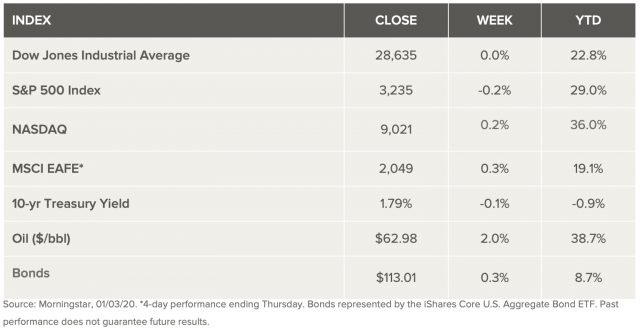
Following a sharp rally at year-end and a new record high on the first trading day of the year, U.S. stocks declined modestly on the week, which many expected. New concerns over tensions between the U.S. and Iran popped up on Friday after a U.S. airstrike in Iraq killed an Iranian general who is believed to have been planning US attacks. The rise in geopolitical risk in the Middle East pushed crude oil prices up by 3% on the news. Analysts were quick to react that a combination of some complacency in the market and rising geopolitical uncertainties could drive volatility and a short-term pullback. They contend that economic fundamentals and monetary policy still support a bull market to continue well into in 2020 without abatement.

U.S. Economy

Early trading in the 2020 year showcased what we can likely expect over the coming year. The first trading day of the year saw all three major indexes – Dow, NASDAQ and the S&P 500, closing at record highs – which is not new. Again, bonds also rallied, along with gold and that helped to support similar moves in international indexes. On the second day, markets opened to news of the U.S. airstrike in Iraq which upped tensions throughout the Middle East. It also placed market attention on geopolitical uncertainty in the Middle East and around the world once again. Analysts 2020 outlook calls for equities to outperform bonds again this year, supported by solid economic and corporate fundamentals. They also anticipate a return to normal levels of market volatility in the later stages of the bull market, making the gains for equities bit of a tough ride.

Metals and Mining

The heightened tensions between the US and Iran sent gold close to its highest price in nearly six years, as well as silver moving above the important US$18 per ounce level.  President Donald Trump ordered an airstrike that killed Qassem Soleimani, leader of the Quds Force, a unit of Iran’s Revolutionary Guards. The Pentagon called the airstrike a “decisive defensive” action designed to protect Americans in Iraq. The gold price opened the new year at US$1,516.80 per ounce, but the news sent it to nearly $1,550 and reaching US$1,549.90, its highest point of the day. Gold is now close to its highest point since April 2013. In comparison, last year as it reached that point gold had been on a run and was up substantially from its mid-May price of US$1,275. Silver also peaked high on Friday at US$18.23 in the early hours of trading. It then fell off slightly, but was still above US$18 later in the day. Unlike gold, silver is not yet close to its highest point of 2019, which was US$19.57 in the first week of September. Certain well-known analysts suggested that while concerns about retaliation from Iran may keep the price of gold high initially, it will likely fall back if no events take place. Platinum and palladium also recorded small gains this week. Platinum was trading at US$982 per ounce as of 1:39 p.m. EST on Friday, while palladium, last year’s metals favorite was at US$1,954 per ounce at 1:40 p.m. EST.

Energy and Oil

As expected, oil prices spiked immediately after the U.S. strike on Iraq resulted in the death of Iranian General Qassem Soleimani on Thursday. Soleimani, as head of the Quds force of the Revolutionary Guard, was powerful Iranian official. Iran promised “severe retaliation,” which had many analysts forecasting a broader regional war. Attacks on U.S. military installations in the Middle East are anticipated. Brent prices spiked by more than 3 percent. The fallout has begun as dozens of workers in the southern oil fields in Iraq began leaving the country. The American embassy urged all U.S. citizens to leave the country immediately. According to the Iraqi officials, production would not be affected by this incident. However, the question at this point remains as to just how Iran might respond. Energy companies in the region said that vessels and oil facilities are both at risk, giving it a 50% chance of retaliation. The equity markets fell after the attack on Soleimani, interrupting the bullish mood for stocks. It’s expected that a conflict could “dash market hopes for a rebound of the global economy that is still to emerge from under the cloud of the U.S.-China trade war,” said Valentin Marinov, head of G-10 currency research at Credit Agricole SA. “Risk sentiment should remain fragile also because central banks may be slow to respond or simply no longer have the arsenal to respond in an adequate way.” Natural gas spot prices rose at most locations this week. The Henry Hub spot price fell from $2.26 per million British thermal units (MMBtu) last week to $2.24/MMBtu this week.  At the New York Mercantile Exchange (Nymex), the price of the January 2020 contract increased 4¢, from $2.243/MMBtu last week to $2.286/MMBtu this week. The price of the 12-month strip averaging January 2020 through December 2020 futures contracts climbed 2¢/MMBtu to $2.294/MMBtu.

World Markets

European markets fell slightly this week. The pan-European STOXX Europe 600 Index fell for the week after the U.S. airstrike that killed an Iranian general raised geopolitical fears. Germany’s DAX index, France’s CAC 40, and the UK’s FTSE 100 Index all were in decline. Overall, the trading remained light due to the fact that most European markets closed early on Tuesday and remained closed on Wednesday for New Year’s. The STOXX 600 ended 2019 up 24.5%. That is its best calendar year result since just after the economic crash of 2008 and ending 2009. A purchasing managers’ survey showed that the downturn in eurozone manufacturing deepened in December, especially in Germany. The index data of 46.3 was slightly better than the preliminary 45.9 figure. However, expectations about output strengthened to a six-month high in December. The UK manufacturing sector declined in 2019. The IHS Markit/CIPS Manufacturing Purchasing Managers’ Index landed at 47.5 in December from 48.9 in November. That was slightly higher than the initial expectation.

The Chinese stock exchanges recorded their fifth weekly gain following the central bank lowing the amount of cash that lenders must hold in reserve. That gave reassurance to investors that Beijing was taking steps to ensure liquidity even as the country has a wider slowdown. For the week, the benchmark Shanghai Composite Index added 2.6%, while the large-cap CSI 300 Index rose 3.1%. The People’s Bank of China (PBOC) said that it would cut the reserve requirement ratio (RRR) for financial institutions by a half-point, effective January 6. The reduction in the RRR would release roughly 800 billion yuan ($115 billion) into the financial system. The bank claims that the reserve requirement cut was a hedge against higher demand for cash ahead of the upcoming Lunar New Year holidays, not a stimulus measure. The move marked the eighth time that the PBOC has cut the RRR since early 2018 China’s official manufacturing PMI data held steady in. December and marked a second month of expansion.

The Week Ahead

Important economic data being released include the ISM non-manufacturing PMI on Tuesday and the December jobs report on Friday.

Key Topics to Watch

  • Markit services PMI
  • Trade deficit
  • ISM nonmanufacturing index
  • Factory orders Nov.
  • ADP employment
  • Consumer credit
  • Weekly jobless claims
  • Philly Fed annual revision                                                                   
  • Nonfarm payrolls
  • Unemployment rate
  • Average hourly earnings
  • Wholesale inventories

Markets Index Wrap Up

Weekly Market Review – December 28, 2019

Stock Markets

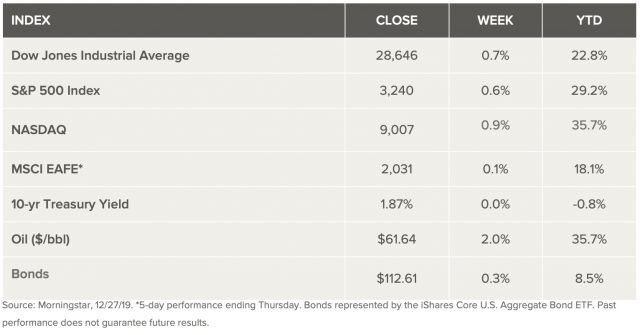
In the final week of 2019, stocks rose yet again as several major indexes hit fresh record highs. Volatility remained under control and stocks continued upward as we moved to year-end. There are, at present, no major catalysts or economic issues to disrupt the market rally. The S&P 500 is on track to match the 2013 29.6% return that keeps pace with the best of the 2010 decade. In most cases, stocks have risen by an average of 7.0% the following year when the stock market rose by more than 25%. That assures us that that good returns don’t have to be followed by bad ones. Given the extent of valuations, analysts suggest that investors need to incorporate lower expected long-term rates of return into their overall investment view.

U.S. Economy

It’s not a given that Investment goals and market cycles reset every calendar year, but the end of a year creates an opportunity for review and planning. Most investors agree that there is never a lackluster moment when it comes to investing and financial markets. That fact proved out this year as stocks managed to crash through a spate of worries and concerns on a global scale only to finish the year and the decade on a high note. While there are always events and factors that drive the market narrative and what kind of performance takes place in the near term, two stand out this year for certain: 1) the Federal Reserve moves, and 2) ups and downs concerning the U.S. / China trade deal. As the year draws to a close, analysts seem convinced that economic data will be more balanced and stock-market gains will moderate into the coming year and over the next decade. Most contend that with limited opportunities for further multiple expansion, the pace of market gains will continue to match the pace of earnings growth, which they think will rise modestly at more of a mid-single-digit rate than the wild growth of the past decade.

Metals and Mining

Gold prices steadied on the week after experiencing their biggest gain in nearly two months earlier in Friday’s trading session. The metal leveled out as investors became more cautious over lower year-end trading and adjusted their positions on the precious metal. During 2019, gold has been largely supported by the trade war, which has helped it gain over 17 percent. The dispute between two superpowers has caused turmoil in the markets and had investors concerned over a global economic slowdown. 2020 is expected to produce more uncertainty in the markets with unresolved US-China trade issues, Brexit and upcoming US presidential elections. Also, giving gold a boost is talk that Russia could consider a partial investment in gold via its National Wealth Fund. Silver dipped slightly on Friday but is on track for its best week since the end of August. Despite a slightly uneven month, the secondary metal remains stronger in 2019, as it is close to 10 percent higher on a year-to-date basis. As of 9:27 a.m. EST on Friday, silver was trading at US$17.86. In other precious metal news, platinum was up slightly on Friday, and had gained US$20 from this time last week. The tracking firm FocusEconomics believes that prices are likely to pick up slightly on the back of a fall in global supply. Despite this, weak automotive demand from result of a shift away from diesel vehicles in the European Union, is seen limiting the metal’s gains. Investors have focused heavily on platinum’s paired metal palladium.  Palladium has slipped from the US$1,900 level that it broke records with two weeks ago, but it is still managing to trade far higher than gold. It pushed past US$1,900 on December 10 following a power outage in South Africa that stopped production at several mines and raised concerns over a supply shortage. Since the outage, the metal has continued to climb and is headed for on a fifth straight week of gains.

Energy and Oil

It appears that oil will close out the year on a high note. Oil prices are roughly 30 percent higher than they were at the start of the year. 12 months ago, there was a sudden and steep downturn. Still, WTI rose above $61 in recent days, and investors are more bullish than in any recent period. That doesn’t remove the downside risks– the IEA is still calling for a supply surplus in the first quarter – however, there is now a feeling that the market is closer to balance than it has been in some time. On the shale side, the U.S. shale industry closes the door on what was an unpredictable decade that included record production levels paired with widespread financial wreckage in the business. The “growth-at-all-costs” business model that led the period is not going to cut it in the 2020s according to leading analysts. The market approach to this remains to play out. Natural gas spot prices rose at most locations this week. The Henry Hub spot price fell from $2.26 per million British thermal units (MMBtu) last week to $2.24/MMBtu this week. At the New York Mercantile Exchange (Nymex), the price of the January 2020 contract increased 4¢, from $2.243/MMBtu last week to $2.286/MMBtu this week. The price of the 12-month strip averaging January 2020 through December 2020 futures contracts climbed 2¢/MMBtu to $2.294/MMBtu.

World Markets

European stocks reached a new high this week. The pan-European STOXX Europe 600 Index recorded a small gain for the week and reached another record high in light trading. The UK’s FTSE 100 Index and Germany’s DAX index also advanced. Most European markets were closed Wednesday and Thursday for Christmas and Boxing Day, respectively. Europe-specific news flow was light, however traders noted that European markets benefited from the positive sentiment created by the rally in U.S. stocks and progress toward the completion of a phase one trade deal between the U.S. and China. The STOXX 600 index broke a 5-year-old record earlier in December, and holiday-week gains set a new mark. The index ended the week up about 24% for the year-to-date period and was on track for its best calendar year result since 2009. In one of the week’s few headlines, Italy’s parliament passed its 2020 budget, a week ahead of the year-end deadline. Italy’s governing coalition canceled a sales tax hike amid concerns about weak household spending and kept the fiscal deficit target at 2.2% of gross domestic product for the third consecutive year.

In China, stocks posted their fourth consecutive weekly gain based on investors’ anticipation of a partial U.S-China trade deal coming shortly. Both the benchmark Shanghai Composite Index and large-cap CSI 300 Index edged slightly higher for the week. Optimism over improved trade relations came after the U.S. and China announced December 13 that they had reached a so-called phase one trade deal. Data pointing to surprisingly strong growth in China’s industrial sector also supported investor sentiment. Profits at industrial companies rose 5.4% in November from a year ago, their fastest pace in eight months, China’s statistics bureau reported Friday.

The Week Ahead

Although we are headed into the last week of the year, there’s still a few Important economic data being released including advance trade goods, the consumer confidence on New Year’s Eve, pending home sales, the manufacturing purchasing managers index (PMI), and on Friday the Federal Reserve’s December meeting minutes.

Key Topics to Watch

  • Advance trade in goods
  • Chicago PMI
  • Pending home sales
  • Case-Shllier home price index                        
  • Consumer confidence index
  • Weekly jobless claims
  • Markit manufacturing PMI
  • ISM manufacturing index
  • Construction spending
  • Motor vehicle sales

Markets Index Wrap Up

Weekly Market Review – December 21, 2019

Stock Markets

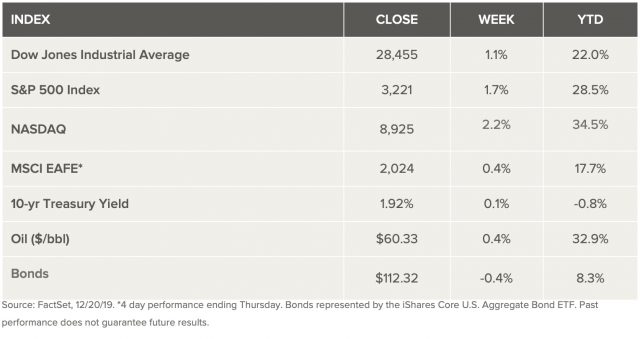
Heading into the Christmas-holiday shortened trading week, stocks are set to finish the year strong. The S&P 500 has now posted 31 all-time highs in 2019, driven by sizable gains in the technology sector, progress on Brexit, the U.S./China trade front, and continued strength in the U.S. jobs market. Despite an impeachment vote in the House of Representatives, the S&P 500 finished 1.7% up on the week, a reminder that the political drama isn’t the primary driver of market performance over time. Positive economic and corporate performance news has been the driving force behind this year’s sizable gains.

U.S. Economy

When it comes to the market, swings are a normal part of the investment landscape. But the pendulum has swung in particularly notable fashion over the past year. Investors digested a full plate of data and news last week, including an impeachment vote and the passing of USMCA (NAFTA 2.0) in the House, an updated reading of third-quarter U.S. GDP (2.1%) that included upwardly revised consumer-spending growth, and housing-market readings that showed a modest uptick in activity. And with all of that, the stock market moved higher again on the week, reaching yet another record high.

But it was just one year ago that conditions were seemingly on a polar-opposite path. The S&P 500 was down sharply, and headlines were filled with projections of impending economic doom. That was then (December 2018), and this is now.

Metals and Mining

The gold price was relatively flat on Friday (December 20) after US Treasury Secretary Steven Mnuchin said that the US and China would sign phase one of the trade pact at the beginning of the new year, which sent investors away from the yellow metal to riskier assets. As part of an alleged first phase deal, Washington has agreed to offer Beijing some tariff relief as well as a pause on a tranche of new tariffs. Mnuchin added that the pact will not be subject to any renegotiations. In addition to the announcement from Washington, China’s finance ministry revealed a new list of import tariff exemptions for a duration of one year — which will start next Thursday (December 26) — for six chemical and oil products from the US. Over the course of the year, gold has been largely supported by the trade war, which has helped it gain over 15 percent. The dispute between two of the world’s largest economies has caused turmoil in the markets and has had investors concerned over a global economic slowdown.

Gold was also weighed down this week by the better-than-expected US economic data, as that gave a boost to the greenback, setting it up to make gains for the first time in four weeks. Silver was up slightly on Friday, not falling under the same pressure that the yellow metal faced throughout the week. Despite a slightly shaky month, silver remains stronger in 2019, as it is 9.7 percent higher on a year-to-date basis. As of 10:02 a.m. EST on Friday, silver was changing hands at US$17.17 per ounce. Platinum was down on Friday, but still managed to stay above the US$900 per ounce level. Going forward, FocusEconomics believes that prices are likely to pick up slightly on the back of a fall in global supply. Despite this, weak automotive demand — the result of a shift away from diesel vehicles in the European Union — is seen capping the metal’s gains. Palladium continued its climb on Friday, staying above the US$1,900 per ounce level that it broke records with last week. The metal pushed past the US$1,900 level last Tuesday (December 10) following a power outage in South Africa that stopped production at several mines and exacerbated concerns over a supply shortage. Since the outage, the metal has continued to climbed and is headed for its fifth straight week of gains. Since the beginning of the year, the metal has risen over 40 percent, with its large gains being attributed to stricter environmental regulations around car emissions. As demand increases from the automotive sector, supply shortfalls are beginning to emerge, giving the spot price a boost on the market.

Energy and Oil

Oil didn’t move a lot this week, but it may have consolidated gains achieved earlier this month. The trade talks continue on a positive trajectory, and economic sentiment is slightly upbeat. The U.S. reported a drawdown in crude inventories, although there was a surprising jump in refined product stocks. “A sense of cautious bullishness is developing as we head into 2020,” Stephen Brennock, an analyst at PVM Oil Associates Ltd. in London, told Bloomberg. “Supply-side and demand-side factors are singing from the same supportive hymn sheet. Natural gas prices remain depressed. Natural gas prices could fall even further unless there is a serious cold snap in the U.S. this winter. Investors have staked out the most net-bearish position on gas futures in a decade. Natural gas spot prices rose at most locations this report week (Wednesday, December 11 to Wednesday, December 18). The Henry Hub spot price fell from $2.26 per million British thermal units (MMBtu) last Wednesday to $2.24/MMBtu yesterday.  At the New York Mercantile Exchange (Nymex), the price of the January 2020 contract increased 4¢, from $2.243/MMBtu last Wednesday to $2.286/MMBtu yesterday. The price of the 12-month strip averaging January 2020 through December 2020 futures contracts climbed 2¢/MMBtu to $2.294/MMBtu.

World Markets

European stocks rose after UK Prime Minister Boris Johnson’s emphatic general election victory and the U.S. and China agreed to an interim limited trade deal. The pan-European STOXX Europe 600 Index ended the week 1.55% higher, and the UK’s FTSE 100 Index climbed 3.11%. Germany’s exporter-heavy DAX index gained 0.27%. The UK pound gave up its postelection gains against the euro and the U.S. dollar after Johnson revived fears of a no-deal Brexit. Johnson signaled that he would amend the Brexit bill to prevent any extension of the transition period for a new trading relationship with the European Union beyond the end of 2020, the current deadline. A failure of the negotiations would mean the economic relationship would default to World Trade Organization terms, with the likelihood of tariffs on imports and exports. (Click here for a more detailed perspective on the implications of the Conservative election victory for Brexit.)

Chinese stocks rose for the third straight week, as a partial trade deal between the U.S. and China offered a temporary respite in trade tensions. For the week, the benchmark Shanghai Composite Index rose 1.23%, and the large-cap CSI 300 Index, which tracks blue chips listed on the Shanghai and Shenzhen exchanges, added 1.2%. The weekly gains came one week after the U.S. and China announced that they had reached an agreement on a “phase one” trade deal that would lower some U.S. tariffs levied during the dispute and suspend planned duties that were scheduled to kick in on December 15.

The Week Ahead

Economic data will be light this week, with building permits, continuing jobless claims, and the Chicago Fed National Activity Index a few of the measures being released.

Key Topics to Watch

  • Chicago Fed national index
  • New home sales
  • Durable goods orders
  • Core capex orders
  • Weekly jobless claims

Markets Index Wrap Up

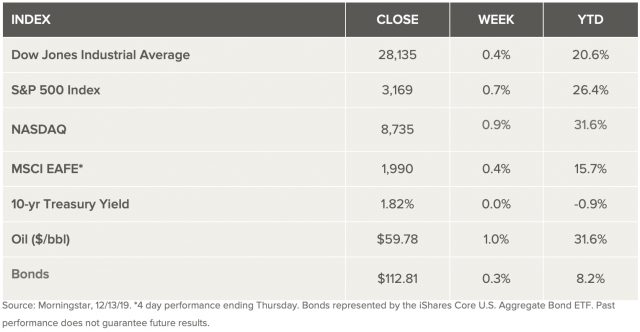
Weekly Market Review – December 14, 2019

Stock Markets

As expected, U.S. stocks rallied to fresh record highs after the three main issues that have created most of the uncertainty this year came to a positive close. The trade deal, Brexit and the Fed policy all moved to new positive levels. The U.S. and China reached a “phase one” trade deal which eased fears of further trade issues and offers positive sentiment on the “Phase Two” talks. The agreement includes important items focused on agricultural purchases and offers significant relief from certain tariffs. For the on again off again Brexit, U.K. prime minister Boris Johnson got a positive mandate when his party won a majority in the general election held this week. That will serve to reduce a lot of lingering political uncertainty now that the country plans to negotiate its exit from the European Union. Importantly, the Federal Reserve (Fed) went with its better judgement last week and left interest rates unchanged. That also sent signs of a pause through the coming year for Fed rates. Low inflation gives the Fed flexibility, analysts say, to remain accommodative for the foreseeable future without having to raise interest rates.

U.S. Economy

The immediate enthusiasm over the “phase one” trade deal might have been dampened a bit by some negative economic data released late in the week. The Commerce Department announced Friday that retail sales excluding the auto sector rose only about 0.1% in November. That’s well below the expectations of most analysts. At the same time spending at restaurants, bars, and clothing stores dropped which indicated that consumers may be getting more cautious about discretionary spending. The weekly jobless claims also moved to the highest level in over two years. However, some seasonal adjustments as a result of the really late Thanksgiving holiday may have been the main contributor.

The reports of a preliminary trade agreement resulted created a bounce in Treasury yields on Thursday. Those yields then fell back Friday and ended the week lower as investors seemed to react to the weaker than expected retail sales data. Many traders reported that it was a fairly quiet week in the investment-grade corporate bond market, as investors’ focus on trade talks and somewhat limited year-end liquidity led to subdued risk appetite.

Metals and Mining

Word of a US-China trade deal left the gold price relatively flat on Friday. The relief from uncertainty and avoiding a new round of US tariffs sent investors mostly away gold opting instead for riskier assets. The first phase of a deal between the US and China was set to be completed in November but was given a new deadline of December 15 when it the two powers realized that they would not be reaching on an agreement that would mutually benefit both sides. Gold has been largely supported by the trade war that helped the metal gain over 15 percent in 2019 to date. The dispute between two of the world’s largest economies has caused turmoil in the markets and had investors concerned over a global economic slowdown. Gold was given a small lift when the US Federal Reserve decided to hold steady on the interest rate of 1.5 to 1.75 percent. Silver was also held tight on Friday but managed to make gains over the week. Its safe haven appeal declined, but even so, it landed its best week since late October with a gain just over 2 percent. In terms of the other precious metals, platinum was flat on Friday, but also had what amounted to its best week since late August. The metal rose over 5 percent. FocusEconomics believes that prices are likely to pick up slightly on the back of a fall in global supply. Weak automotive demand resulting from a shift away from diesel vehicles in the European Union is being blamed for capping Platinum’s gains. Palladium was once again the only precious metal to make gains on Friday. Its gain was large enough to push the metal over US$1,900 per ounce for the first time. That took place on Tuesday when a major power outage in South Africa stopped production at several mines increasing concerns over supplies. Palladium metal has risen over 40 percent since the beginning of 2019 with its large gains based on stricter environmental regulations around car emissions.

Energy and Oil

The big energy news this week surrounded the state-controlled Saudi Arabian Oil Company, commonly known as Aramco. The company raised $25.6 billion this week in the world’s largest initial public offering (IPO). Local demand for shares appeared to be strong, however international investors seemed a bit skeptical of the lofty price that the company set for the offering relative to peers in the oil patch. The size of the IPO, which is meant to represent 1.5% of Aramco’s shares, broke the record set by Chinese internet company Alibaba in 2014. The offering puts the value of the internationally integrated oil and gas company at $1.7 trillion. That makes Aramco worth more than either tech giant Apple or Microsoft. Natural gas spot price movements were mixed this week). The Henry Hub spot price fell from $2.37 per million British thermal units (MMBtu) last week to $2.26/MMBtu this week. At the New York Mercantile Exchange (Nymex), the price of the January 2020 contract decreased 16¢, from $2.399/MMBtu last week to $2.243/MMBtu this week. The price of the 12-month strip averaging January 2020 through December 2020 futures contracts declined 6¢/MMBtu to $2.274/MMBtu.

World Markets

Stocks in Europe rose as the U.S. and China drew closer to a limited trade deal, and fears of a disorderly Brexit waned after a crushing general election victory for Prime Minister Boris Johnson and his Conservative Party. The pan-European STOXX Europe 600 Index ended the week 1.05% higher, Germany’s DAX index gained 0.73%, and the UK’s FTSE 100 Index rose 2.11%. The news that the ruling Conservatives won a landslide general election victory was well received. The Tories won 364 of the 650 seats, achieving a majority of 79 seats which is the party’s largest majority since 1987. The pound sterling soared to more than USD $1.35. That’s its highest level since May 2018. Brussels expressed relief over Johnson’s win, but UK traders were skeptical that an accord would be struck by the end of 2020. Others fully expect Parliament to approve the timetable for the Withdrawal Agreement Bill.

In China, stocks surged for the second straight week based on momentum from the “phase one” trade deal, staving off the imposition of fresh U.S. tariffs on nearly $160 billion of Chinese goods that were set to kick in over the weekend. The benchmark Shanghai Composite Index was up 1.91%, and the large-cap CSI 300 Index grew 1.69%. China’s yuan hit its highest level against the U.S. dollar in nearly four-and-a half months. Clearly traders anticipated that the latest agreement would start a softening in a trade war that has constantly weighed on public sentiment this year.

The Week Ahead

In the run up to the Christmas holiday week, there are a number of important economic indicators scheduled for release this week, including industrial production, housing starts, job openings, leading indicators, and on Friday the key numbers for consumer sentiment.

Key Topics to Watch

  • Empire state index
  • Markit manufacturing PMI (flash)
  • Markit services PMI (flash)
  • Homebuilders index
  • Housing starts Nov.
  • Building permits
  • Industrial production
  • Capacity utilization
  • Job openings
  • Weekly jobless claims
  • Philly Fed                                
  • Existing home sales
  • Leading economic indicators
  • GDP revision
  • Personal income
  • Consumer spending
  • Core inflation
  • Consumer sentiment index

Markets Index Wrap Up