Staff Editor

Study finds you tend to break your old iPhone when a new one comes out

Ah, it’s that time of year again! Carols ring, holly glistens, and Apple (AAPL) comes out with a new iPhone model.

And we conveniently start losing or breaking our existing phones.

That’s not just clumsiness at work. According to a study from the University of Michigan, it’s your psychology at work, attempting to help you justify the purchase of a faster, better phone model. (The study’s title is, “’Be Careless With That!’: Availability of Product Upgrades Increases Cavalier Behavior Toward Possessions.” It was published in the October 2017 Journal of Marketing Research.)

Ordinarily, associate professor of psychology Josh Ackerman says, when we lose or break a phone, we file a report. We ask our insurance to cover it, we cash in on our AppleCare coverage—we somehow report it. But when he studied the numbers over time, he discovered something bizarre: every time Apple or Samsung comes out with a new smartphone model, the number of broken phone/lost phone claims go down.

Josh Ackerman, associate professor of psychology at the University of Michigan, Skyped in to explain his study.

“And our interpretation of that was, once people wanted to start upgrading, they just cared less about the product that they currently had,” Ackerman says. “They’re causing damage to them, losing them, and so on, despite the fact that that is costly to them.”

It’s our subconscious at work, he says. “People have this very strong desire to justify why they’re going to get a new product. If you already own a phone and it works just fine, but a new one comes out that seems really, really appealing, what do you tell yourself in order to convince yourself to get that new phone? Maybe you tell yourself, ‘Well, maybe my phone’s not working quite as well as I thought.’ Or maybe, ‘Oops, I dropped it on the ground and the screen cracked!’ Or, ‘Maybe I happened to leave it in a taxi.’ Those kinds of justifications might mean, ‘Oh, now I get to tell myself that I can really buy that new product.’”

And yet if you ask people if they think they could be susceptible to this kind of mental psyche-out, they’ll deny it. “When we ask people in our studies, ‘Would you go out and intentionally lose your phone?,’ people are like, ‘No, that’s crazy—I would never do this!’”

To test his theory, Ackerman’s team reproduced the psychological setup with less pricey belongings.

“We looked at eyeglasses, sunglasses, coffee mugs. For example, that we gave people coffee mugs—just regular, everyday, kind of boring mugs. And we told some people that they could have the opportunity to get a much better mug, a much nicer mug,” Ackerman says. “And we put them in a position where they could potentially take risks with the mug that they had. And it turns out that people who were wanting to get that better mug took more risks. In fact, they dropped their mug more frequently. And oh, suddenly—“My mug is broken! I better get that new one.!”

There are two takeaways, Ackerman says. First, just be aware that your psychology may be playing these games with you.

Second, if you admit that you want the new model phone, take active steps to do something useful with your old one. “We also found in our research that if you give people another type of justification—not one where they’re damaging their product, but one where you donate or trade it in—that works just as well to motivate people to get these new products. You’ll feel a lot better about yourself.”

GM will soon let you order Starbucks while driving

General Motors (GM) wants to help you get your favorite cup of coffee faster with its new Marketplace platform. Available for eligible Cadillac, Chevy, Buick and GMC vehicles, Marketplace lets you order your venti mocha latte with a double shot of espresso right from your car’s touchscreen.

Marketplace, which GM says will roll out alongside a host of other interface updates for its vehicles throughout the next 12 to 18 months, will use your vehicle’s built-in 4G LTE connection to connect to different retailers and purchase items ranging from a cup of joe to gas to your favorite food at Applebee’s.

Interestingly, GM says Marketplace will let you make purchases while driving using your car’s touchscreen. Most automakers seemingly prevent you from doing most anything having to do with apps while behind the wheel.

Marketplace doesn’t offer voice support yet, so you can’t order your coffee by telling your car to get you a large with cream and five Splenda packets just yet.

A GM representative said Marketplace was tested and validated by GM to be safe to use while driving.

If you’ve got a Cadillac, Chevy, Buick or GM, you might soon be able to order food from behind the wheel while driving.

The automaker has released a list of 12 different retailers that will offer some form of compatibility with Marketplace. Starbucks (SBUX) and Dunkin’ Donuts (DNKN) integration will allow you to order your favorite drink or “food item” from your car and then pick it up in the store or at the drive-through.

Applebee’s and IHOP (DIN) will let you search for their nearest locations and reserve tables. TGI Fridays will also let you reserve tables for your group, while Wingstop will let you reorder your favorite foods from your car.

ExxonMobil (XOM) and Shell (RDS-A) integration will help you find nearby gas stations. In fact, Shell’s service will let you pay for fuel from within your vehicle.

A GM-specific offering, meanwhile, will let you do things like top off your 4G LTE data pool from your car. It’s important to note that Marketplace doesn’t require you to sign up for a separate LTE plan.

Outside of simply being able to order drinks or food directly, Marketplace learns your habits and preferences, so eventually it will be able to suggest that you visit certain stores based on the hour of the day and where you’re driving.

That’s a convenient feature, but it’s sure to raise concerns from privacy advocates.

Either way, it will be interesting to see if more retailers jump on board with Marketplace. Something about demanding that my car buy me a Dairy Queen (BRKA) Blizzard without having to wait in line sounds irresistible.

RFG Rejects Allegations It Runs ‘Brutal Business’; Shares Slump 22%

Retail Food Group (RFG.AU) has denied media reports it is running its franchisees into the ground with a brutal business model.

A Fairfax Media investigation alleges that RFG, Australia’s biggest food franchise operator, is charging crippling franchise fees and other costs in its search for fatter profits, driving some operators into bankruptcy and has led to systemic staff underpayment.

Shares in RFG plunged 22% in Monday morning trading on the news. However,  the owner of Brumby’s, Donut King and Gloria Jean’s brands rejected the allegations in a company statement:

Recently, Fairfax Media has published coverage alleging RFG is not supporting its Franchise Partners.

We reject this assertion and reiterate the fact that our success depends on the success of our Franchise Partners. If they thrive, so do we, and we are committed to finding ways to better support them, their staff and customers.

What the coverage failed to acknowledge properly are the steps we have been taking over the past year under the leadership of RFG’s new MD and his executive team:

  •  We’ve comprehensively engaged with our Franchisee Partners and asked them to work with us on improving the support we provide them;
  • We’ve implemented numerous measures to improve store performance and enhance outcomes for our Franchisee Partners, whilst also bolstering the resources which support our brands;
  • We’ve implemented a new strategy focused on better assuring the long term sustainability and profitability of not just our own business, but those of our Franchise Partners and other customers; and
  • We’ve appointed Deloitte to support us in conducting a whole of business review, a key aspect of which is ensuring our franchise model remains appropriate for a retail market which remains challenging.

In relation to wage compliance, we take our responsibilities very seriously.

For a long time now we’ve been taking proactive steps to better inform, support and educate our Franchise Partners in relation to their employer obligations, whilst also providing their team members with avenues to raise any concerns they may have with us. These measures are supported by our monitoring and supervisory framework, which we’ve also asked Deloitte to review.

We remain committed to helping our Franchise Partners succeed, despite the tough retail market they face every day. We applaud each and every one of them, and their teams, for the great service and products they strive to deliver to all Australians, and ask that you, our valued customers, continue to support them.

Amazon’s apparel business could grow to as much as $85 billion in sales by 2020

Amazon.com Inc. may already be the largest apparel retailer and could still grow to sales between $45 billion and $85 billion by fiscal 2020, according to Instinet analysts.

Instinet analysts led by Simeon Siegel estimate overall apparel and accessories sales at above $1 trillion with “above average” online penetration and “leading gross margin” compared with other categories.

“We believe Amazon AMZN, +0.19%   has the largest [total available market] TAM (ever), doesn’t carry socio-economic retailing stigmas, can stock a limitless number of goods on its virtual shelf and knows customers better than they do,” Instinet wrote. “Amazon’s path to book dominance provides a potential road map for apparel success, with its fiscal 2007 media progress sharing similarities to its fiscal 2017 apparel achievements,” the note said.

Instinet says Wal-Mart Stores Inc.’s WMT, -0.24%   apparel sales are about 8% of total U.S. sales, and about 10.5% of U.S. nongrocery sales. Target Corp.’sTGT, +0.46%   apparel sales amount to about 20% of net sales. Amazon’s fiscal 2016 global apparel gross merchandise volume was in the 10% to 20% range, or $18 billion to $36 billion, “enveloping Walmart US and Macy’s apparel sales of $25 billion and $22 billion.”

Right now, Amazon is “best with basics,” but is trying a number of strategies to see what sticks, including a push into private labels, which analysts estimate could drive $1.6 billion in gross profit, and Prime Wardrobe, which lets shoppers try on clothes before committing to the purchase. And Amazon has, increasingly, a universal appeal, Instinet said.

Amazon is also becoming more important to brands, with powerhouse athletic company Nike Inc. NKE, +1.16%   entering into a partnership with the e-commerce giant.

“The fact that Nike, one of the most valuable brands in the world, was the most recent to announce a partnership, shows the want, need or somewhere in between to see through Amazon, as the sneaker behemoth implicitly acknowledges they’d be better off being a part of the Amazon machine than simply watching others sell their goods for them in an uncontrolled manner,” the note said.

Instinet rates Amazon shares buy with a $1,360 price target.

For 2017, Wells Fargo analysts estimate that Amazon’s gross merchandise volume in the U.S. apparel/footwear category will approach $18.5 billion, more than T.J. Maxx parent TJX Cos. TJX, +0.05%   and Macy’s Inc. M, +2.06%  , making Amazon the number two player in the market. Analysts also estimate that Amazon accounted for 35% of retail growth in the third quarter.

While analysts note that many brands, including Nike, are turning to direct-to-consumer channels in order to compete while maintaining brand equity, what Amazon has to offer is compelling.

“As mall traffic continues to decline and department stores are falling out of favor, vendors need to look elsewhere for growth and Amazon is the most compelling and obvious vehicle for this,” Wells Fargo wrote.

Wells Fargo rates Amazon shares outperform with a $1,525 price target.

Amazon shares are up 53.7% for the year so far while the S&P 500 indexSPX, +0.55%   is up 17.4% for the period.

Size Matters With Smart Beta

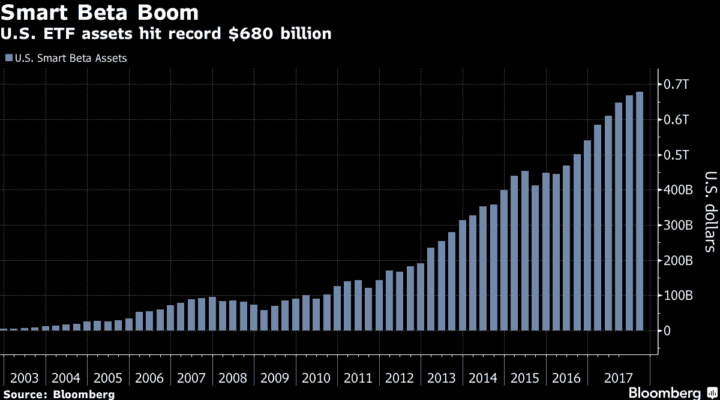
The size factor is widely cited as one of the primary reasons why some smart beta strategies offer out-performance potential over traditional cap-weighted indexes. However, simply allocating larger portions of an equity portfolio to small-caps over large-caps is not always a winning strategy.

While smaller stocks may outperform their large counterparts over the long-term, small-caps are historically more volatile and there are no guarantees that smaller companies will deliver better risk-adjusted returns than large-caps. The good news is, when applied to smaller stocks, some investment factors can help enhance the returns of small-caps while potentially lowering volatility. Some exchange traded funds (ETFs) can help investors access a multi-factor approach to small-caps.

“Other factors, like value, momentum, and low volatility, have tended to work better among smaller stocks,” said Morningstar. “Deliberately targeting small-cap stocks with these characteristics will likely be more fruitful than a broad-based approach to investing in a broader cross section of smaller firms.”

The JPMorgan Diversified Return U.S. Small Cap Equity ETF (JPSE

) is a multi-factor small-cap ETF idea to consider. JPSE, which is just over a year old, tracks the Russell 2000 Diversified Factor Index, a factor-based answer to the widely followed Russell 2000 Index.

That index uses “a rules-based approach that combines risk-based portfolio construction with multi-factor security selection, including value, quality and momentum factors,” according to JPMorgan Asset Management. “It Aims to diversify risk at the sector and stock levels while providing exposure to factors that have the potential to enhance returns.”

“Value stocks are thought to outperform either because they are riskier than their more-expensive counterparts and offer higher expected returns to compensate investors for that risk, or because they are mispriced,” according to Morningstar. “The risk-based explanation is plausible. Value stocks tend to have less-attractive business prospects than more richly valued stocks.”

Small-cap growth stocks, while potentially exciting, is usually among the more volatile smaller stocks. Conversely, small-cap value is historically one of the best factor combinations. By providing investors with exposure to the value and growth factors, JPSE ensures investors do not need to isolate those factors via individual stocks or funds.

The quality factor is also important as it pertains to smaller stocks. Many small-cap companies may offer compelling growth prospects, but that does not guarantee profitability or financial strength. By definition, a quality stock is likely to be backed by a sound balance sheet and a solid management team, traits that can reduce volatility, even with small-caps.

“Highly profitable stocks tend to be less volatile and hold up better during market downturns than their less-profitable counterparts,” said Morningstar.

JPSE is up 13.3% year-to-date, an advantage of 100 basis points over the Russell 2000 Index.

Read more: Size Matters With Smart Beta | Investopedia https://www.investopedia.com/news/size-matters-smart-beta/#ixzz50w0jHdUm
Follow us: Investopedia on Facebook