Archives for January 19, 2020

Weekly Market Review – January 18, 2020

Stock Markets

What analysts call better-than-expected economic data, encouraging corporate earnings from U.S. banks, and the signing of the “phase-one” trade agreement helped raise U.S. stocks to fresh record highs last week. A surge in housing starts bolstered by strong retail sales point to a resilient consumer that is supported by a continued strong labor market. The “phase-one” trade agreement between the U.S. and China was formally signed last week, fulfilling expectations for a deal that was already done. Important terms of the deal included commitments from China to increase purchases by $200 billion over the next two years ($78 billion of manufactured goods, $52 billion in energy, $32 billion of agricultural products, and $38 billion in services). Analysts agree that the agreement removes significant uncertainty, however, they say trade issues will likely continue as a source of volatility through 2020.

U.S. Economy

The closing of stocks at record highs last week was driven by the U.S. and China reaching the “phase-one” trade agreement. Analysts believe the recent trade agreement is a significant step in the de-escalation of the trade tensions between the two superpowers. It takes away much of the threat that new tariffs create and creates confidence that a more comprehensive deal is achievable. Still, tariffs remain in place on two-thirds of U.S. imports from China. So, attention now shifts to implementation and enforcement. Potential failure to meet the terms of the deal could create temporary setbacks which could stretch as far as additional new tariffs. Further tariff relief and more complete trade cohesiveness that would include including structural fundamentals, like industrial subsidies, is likely to be in place by the time we reach the U.S. election. The current agreement gets rid of significant uncertainty, but all agree that trade issues will likely create some volatility in the coming year. Analysts expect stocks to continue to rise but at a slower pace than they have over the past decade. This is widely supported by ongoing economic growth, modest earnings growth, and accommodative central banks.

Metals and Mining

The precious metals sector was two sided this week, with gold and silver remaining in a channel, while both platinum and palladium climbed. Platinum was up 4.4 percent from last week, exceeding US$1,000 per ounce for the first time in two years. The precious metal had been sidelined for much of the growth that palladium and gold experienced in 2019. Now it’s starting to see a benefit from the same motivators that drove those metals. Rallying from US$976 (January 10) to US$1,037 (January 16), Platinum exhibited its best performance year-to-date. It is on track to surge to highs not experienced since 2015. The phase one trade deal between China and the US countered some of the volatility that entered the market earlier in this month. The exchange traded-funds sector (ETF) may help motivate the platinum’s price too, since last year, platinum ETFs grew by 12 percent with investors purchasing 90,000 ounces or 11 percent of global supply. Easing geopolitical tensions moved against gold’s momentum, putting it on course to record its weakest performance in nearly two months. News of the phase one deal pushed gold below US$1,550 only to rebound supported from a weaker equity market and lower US dollar. Another round of increased buying from central banks and monetary policy are also projected to impact the value of gold in 2020. Palladium continued its upward trend this week. The precious metal star climbed 14 percent to trade at an all-time high of US$2,429 on January 17. Palladium’s hyperbolic performance has now moved the industrial metal beyond platinum and gold’s record highs, making it the most valuable of the four exchange-traded precious metals. The German bank pointed to the prolonged supply deficit as the current catalyst behind palladium’s best historic performance. Like gold, silver remained locked in a range staying below US$18 an ounce for much of the week. Silver has exhibited the poorest price growth of all four precious metals. It ended the week without any gains.

Energy and Oil

As expected, China has been the key oil price driver this week. The phase one trade deal drove prices higher before worrying economic data from the country dragged prices lower. Oil prices regained a bit of ground by week’s end. That was based on optimism surrounding the Phase 1 U.S.-China trade deal only. The global oil market managed to dodge a bullet after the U.S. and Iran backed away from war talk and eased tensions. But the geopolitical risk has not disappeared. In any case, non-OPEC oil supply is expected to continue to grow faster than demand this year. Once again that leaves the market with a persistent supply surplus, according to the IEA. The result is tremendous pressure on OPEC+, which may find that it needs to cut even further than current levels. In the U.S. Permian basin, the industry is suffering through bankruptcies, slower growth and investor scrutiny. Many analysts suggest that production should grow this year, however skeptical investors are starting to see a potential for peak in supply over the near-term period. Natural gas spot price movements were mixed this week. The Henry Hub spot price fell from $2.08 per million British thermal units (MMBtu) last week to $1.98/MMBtu this week. At the New York Mercantile Exchange (Nymex), the price of the February 2020 contract decreased 2¢, from $2.141/MMBtu last week to $2.120/MMBtu this week. The price of the 12-month strip averaging February 2020 through January 2021 futures contracts declined 3¢/MMBtu to $2.290/MMBtu.

World Markets

Stock in Europe rose this week as trade tensions eased, and investors welcomed strong Chinese economic data. The pan-European STOXX Europe 600 Index ended the week 1.33% higher, and the UK’s FTSE 100 Index gained 1.30%. Germany’s DAX Index advanced 0.3%. For the UK, poor economic data, combined with recent dovish speeches and comments by Bank of England (BoE) Monetary Policy Committee (MPC) members, set speculation in motion that an interest rate cut is in the cards at the January 30 policy meeting. What was suggested as a quarter-point reduction in the benchmark Bank Rate, from 0.75% to 0.50%, just rose to 80% on expectations.  Analysts see rate cut as a form of insurance given the sharp slowdown at the end of the year. This move that probably should have occurred at the end of 2019 but was weigh laid by the general election. Analysts also expect data to begin improving as uncertainty has receded since the Conservative Party election victory, so purchasing managers’ surveys of the construction, manufacturing, and services sectors, will still be key to policymakers’ voting intentions.

China’s stock market moved slowly ahead of the signing of the phase one trade deal with the U.S. and did not rebound after the announcement. The Shanghai Composite lost 0.8% during the week while the CSI 300 large-cap index edged down 1.2%. The trade deal was already baked into the market came largely as expected. Many observers in the region viewed the deal as driven primarily by U.S. election politics and as a band-aid rather than a solution. For its part, China has pledged to import much more from the U.S.  There are worries that the target of a USD 200 billion increase in imports of goods and services from the U.S. over the next two years may be very difficult to achieve and could fall short. Regional skeptics also doubt China’s claim that other countries will not suffer as it redirects purchases back to the U.S.

The Week Ahead

U.S. markets will be closed on Monday to observe Martin Luther King Jr. day. Important economic data being released include pending home sales, the leading index on, and the Markit Purchasing Managers’ Index on Friday. This is an important week in the corporate earnings season as another 43 companies of the S&P 500 will be reporting fourth-quarter earnings.

Key Topics to Watch

  • Chicago Fed national index
  • Existing home sales
  • Weekly jobless claims
  • Leading economic indicators
  • Markit manufacturing PMI (flash)
  • Markit services PMI (flash)

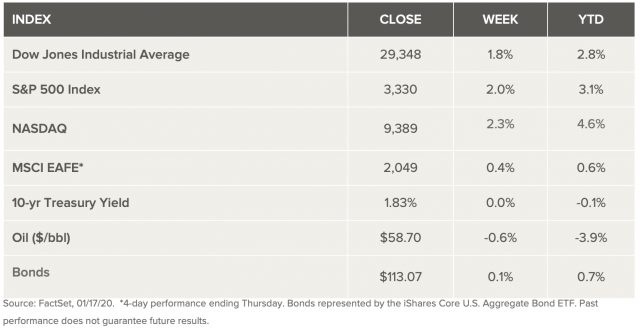
Markets Index Wrap Up
Only 12% of Older Americans Have Achieved This Impressive Retirement Savings Goal

If you don’t believe you’ll need savings of your own going into retirement, consider this: Social Security pays the average recipient today $1,503 a month, or $18,036 per year. Chances are, that’s not enough for you to live on, which is why you need savings of your own — and the more you have, the better.

In fact, you’ll often hear $1 million thrown around as an ideal target. You don’t necessarily need a full million to retire comfortably — but having that much on hand certainly can’t hurt, either.

Still, it’s a feat most savers struggle to achieve. In fact, only 12% of Americans in their 60s and 70s have $1 million or more in their nest eggs, according to a new survey from TD Ameritrade. But if you’re serious about accumulating a cool $1 million by the end of your career, here’s how to do it.

1. Start early

The more time you give yourself to save, the more likely you’ll be to accumulate a bundle. You won’t have to part with as large a sum each month as savers who start later in life, so funding your nest egg becomes fairly easy. In fact, if you begin setting money aside as soon as you get your first job out of college, you could conceivably have a 45-year savings window to work with.

2. Invest in stocks

The money in your IRA or 401(k) needs to grow, and stocks are generally your best bet in this regard. If you play it too safe with your investments by sticking largely to bonds, you’ll limit your nest egg’s growth, and as such, you’ll need to set aside even more of your hard-earned money each month to see solid results over time.

How well will your savings efforts pay off?

Let’s imagine you do, in fact, give yourself a 45-year savings window for retirement. And assume that you load up on stocks, at which point there’s a good chance your investments will generate an average annual 7% return, since that’s a few percentage points below the stock market’s average. In that case, here’s what your savings balance could amount to, depending on how much you sock away monthly:

Monthly Savings Total Over 45 Years (at a 7% Average Annual Return)
$200$686,000
$300$1.03 million
$400$1.37 million
$500$1.71 million
$600$2.06 million

Not only are these some pretty impressive numbers, but they’re also quite attainable given the modest monthly contributions they require.

If you don’t have 45 years of work ahead of you, you may need to put away more each month to achieve similar results. But even if you’re limited to a 30-year savings window, you can get to $1 million in a 401(k) by contributing $900 a month to that plan, which is just a bit more than half of what you’re allowed to put in if you’re under 50. And if you only have 20 years to save, you can get to $1 million by saving $2,100 a month, which isn’t easy, but it falls within the $26,000 annual 401(k) contribution limit for workers 50 and over. All of this assumes you snag the 7% average annual return we used earlier. But again, if you go heavy on stocks, that’s a reasonable assumption.

You don’t have to end up with $1 million to enjoy retirement to the fullest. With a more modest lifestyle, you may do just fine with half that amount, or even less. The point is that saving $1 million is more doable than you might think, provided you start early enough or otherwise make some sacrifices later in life.

Don’t Save for Retirement Until You’ve Hit This Key Milestone

Search the internet, and you’ll see tons of advice highlighting the importance of retirement savings. And it’s all valid. Without savings, you’ll risk struggling financially during your senior years.

Social Security pays the average senior today only about $18,000 a year. That’s hardly enough to live comfortably. In fact, those benefits will generally replace around 40% of the typical worker’s pre-retirement earnings, and most seniors need about twice that much income to maintain a decent lifestyle.

So it pays to contribute to an IRA or 401(k) from as early an age as possible. The more time you give yourself to grow wealth in one of these accounts, the more successful you’re likely to be.

But believe it or not, there’s one financial circumstance under which saving in a retirement plan is not the right move: when you don’t have emergency savings.

An estimated 39% of Americans don’t have the funds on hand to cover an unplanned $400 expense, says the Federal Reserve Board, when in reality, we’re all supposed to have enough money in cash to pay for three to six months of essential living expenses. If your emergency fund isn’t complete, then that’s the first place you should divert your extra money — even if that means putting retirement savings on hold.

Why emergency savings trump retirement savings

Having money in an IRA or 401(k) will help you cover your bills when you’re older, but it won’t help you in the near term when an unplanned expense pops up. If you take an early withdrawal from a retirement account, you’ll face a 10% penalty on the withdrawal, a pretty substantial loss.

But money in a savings account can be accessed at any time and for any reason, without losing a portion of it in the process. And you can generally withdraw funds from savings on the spot; with a retirement plan, it could take time for that money to make its way to you.

And without emergency savings, you’ll risk racking up credit card debt when unexpected expenses rear their ugly heads. Not only can this cost you money in interest, but it can also hurt your credit score, making it difficult to borrow affordably in the future.

That’s why you should aim to save enough money to cover three to six months of essential bills before focusing on retirement savings. Though it’s noble to want to fund your nest egg, and it’s smart to take advantage of the tax savings associated with retirement accounts, if you don’t have emergency savings, you’ll risk a host of unhealthy financial consequences.

So cut back on spending, get a second job, or do whatever else it takes to build some cash reserves. Once you’re done, you can begin contributing regularly to an IRA or 401(k) to secure your financial future.

3 Reasons to Retire Early, and 3 Reasons Not to

Some see early retirement as a wildly irresponsible gamble, while others see it as essential to living life to the fullest. Both sides make good points, but ultimately, we must all decide for ourselves if it’s right for us based on our own goals and financial security. Here are a few arguments from each camp that might help you make up your mind.

3 reasons to retire early

Here are three of the most common reasons people think about retiring early.

1. You’ll have more time for the things you love

The most obvious argument in favor of retiring early is that it will give you more chances to travel, spend time with family, fish, or curl up with a good book at home. This can be a powerful motivator that persuades some people to save a lot of money while they’re young.

2. You have plenty of savings

Those who saved a substantial amount from their early 20s onward may be financially ready to retire in their 50s or possibly even sooner. In that case, there’s no reason to keep working unless you want to or you’re worried that you might grow bored if you don’t have structure to your day. 

Before you retire, it’s a good idea to run the numbers one last time to make sure that you’re prepared for even worst-case scenarios like losing money on your investments, living decades longer than expected, or developing a serious medical condition. Keep saving a little longer if you’re not sure.

3. Your job is ruining your health

Some jobs cause a lot of stress or encourage sitting all day. These can harm your health and result in costly medical bills down the road. Getting out of that unhealthy environment and spending more time on things you enjoy could improve your well being and save on healthcare. 

If you don’t think you can afford to exit the workforce quite yet, see if you can switch employers or work part time. This may relieve your stress while still letting you cover your expenses so you don’t have to draw upon your retirement savings quite yet.

3 reasons not to retire early

Ready for the bad news? Here are three reasons you might want to keep working.

1. You’re nowhere near financially ready

Those who start late on saving probably won’t be able to afford to retire early. While the thought might still be tempting, it’s important for these individuals to keep working and saving as long as possible to afford their basic living expenses. 

Create a retirement plan, if you haven’t already, to estimate how much money you’ll need. Start by subtracting your estimated life expectancy from your preferred retirement age to determine the length of your retirement. Multiply your annual estimated retirement expenses by the number of years of your retirement, adding 3% annually for inflation. Use a calculator to do this and to factor in your investment rate of return. Stick to 5% or 6% for this to be conservative. Once you have your total, subtract any money you expect from Social Security, a pension, or a 401(k) match to figure out how much you need to save on your own. Try to delay retirement until you’ve hit this amount.

2. You expect to live a long time

If you’re healthy and people in your family tend to live a long time, you could be looking at 30-plus years of retirement even if you don’t quit work early. So retiring early could push this up to 40 or even 50 years. That means you’ll need money to cover even more years of living expenses, so what seemed like plenty of money before might not be.

To reduce your risk of running out of money prematurely, plan for a long retirement from the start. Expect to live to at least 90 unless you have a medical condition or another reason to believe you won’t. Save until you feel pretty confident that you have enough to last your entire life.

3. You could cost yourself Social Security benefits

Retiring early could cut your Social Security benefits in two ways. First, working less could reduce your average benefit check because it’s based on your average monthly earnings during your 35 highest-earning years adjusted for inflation. If you work less than 35 years, you’ll have zeros included in your calculation, which will bring down your average. Working longer than 35 years is best because your lower-earning years will be replaced by higher-earning years.

If retiring early also means starting Social Security early to help you get by, you could cost yourself even more. You’re entitled to your full Social Security benefit at your full retirement age (FRA) — 66 to 67, depending on your birth year. Starting early reduces your benefits, while delaying past your FRA increases them. You’ll only get 70% of your scheduled benefit per check if your FRA is 67 and you begin benefits at 62 or 75% if your FRA is 66. Conversely, if you wait until 70 to claim benefits, you could get 124% of your scheduled benefit per check if your FRA is 67 or 132% if your FRA is 66. These larger checks could reduce your reliance on your personal savings, helping them stretch further.

There’s no clear-cut answer to whether you should retire early or not. It’s best to err on the side of working longer to avoid running out of money. But if you understand the risks involved, early retirement could be worth it.

Getting to retirement can be just as hard as retirement

A list of things people universally dislike includes stop-and-go traffic, getting hit with bird poo, and budgeting. And, while budgeting isn’t as messy as a bird incident, it might raise your blood pressure like a bad traffic jam would. Why? Budgets force us to look at our income and the choices we make, and that can be unpleasant.

A 2019 Debt.com survey of 1,042 adults captures this attitude. One-third of respondents said they didn’t follow a budget at all, citing insufficient income, lack of time, and previous failed attempts at budgeting. Those complaints are understandable, but also solvable.

And it pays to rise above those negative attitudes. Every personal finance expert you meet will tell you the same thing: budgeting, done right, helps you reach financial goals and build wealth. If you like the sound of that, read on for four solutions to get past the most annoying aspects of the budgeting process.

1. Budgeting is restrictive

Creating a budget initially might feel like you’re trying to make 14 sandwiches with one teaspoon of peanut butter. Hard as you try, you can’t spread it thin enough. And as you pore over the numbers, you imagine yourself never shopping again, missing out on fun, and forever eating plain peanut butter sandwiches.

Know that this is part of the process. If your income simply won’t cover your expenses, accept that big lifestyle changes are in order because how you are managing money today isn’t sustainable. The solution is to reset your living expenses to make room for discretionary spending.

Be open to moving, selling assets, canceling subscriptions and services, and generally downsizing your life. A good goal is to get your required, non-negotiable expenses down to 50% of your take-home pay. If you can do that, you’ll have enough left to pay down debt, save in your retirement accounts, and have a little fun. 

2. Budgeting is tedious

Budgeting is not a one-time effort. Once you establish your spending limits, you have to track your progress against them. This can be tedious if you rely on spreadsheets or paper to add up your five monthly grocery store runs and seven trips to the gas station.

Try automating your spend tracking instead. Apps like Mint and Clarity Money pull in transactions from your bank accounts, so you can easily categorize those purchases. Set up your spending limits, and the app will notify you when you’re over budget. Put in the time to get the app set up, and it’ll only take a few minutes daily to track your spending.

3. Budgeting is confusing

You sit down to figure out where all your money went last month, and your eyes immediately glaze over. There are too many transactions. You can’t remember what you bought. And you’re not sure how much to send to your credit card or what the right contribution rate is for your 401(k).

When the budget creation process leads you down a rabbit hole of questions and self-doubt, it’s time to learn a system. The 50/20/30 budget, for example, provides recommended spending limits for your required expenses (50%), debt repayment and savings (20%), and discretionary spending (30%).

You could combine the 50/20/30 system with envelope budgeting to streamline your banking transactions and keep your spending on track. Envelope budgeting is a cash system. Once you set limits for your spending categories, you withdraw those amounts in cash and put them in labeled envelopes. Say you set your two-week grocery budget at $300. On payday, you withdraw $300 from the bank in cash and use that to buy your groceries. When the envelope is empty, you stop spending.

4. Sticking to a budget is hard

Finally, you might hate budgeting because it’s hard to keep your spending in line. If your motivation wanes, you lose interest and give up. Or, you stray once, feel guilty, and decide budgeting isn’t for you.

That’s when it’s time to get back in touch with your longer-term financial goals. Where do you see yourself in five years? Debt-free, with money in the bank? Working your way toward early retirement? Visualize your future self for a few minutes and remember that budgeting is a critical part of realizing that future. Get excited about the direction you’re heading in.

Stay the course

One splurge-y purchase won’t ruin your financial future, but giving up on your budget entirely might.

Stay the course, even when it’s hard. The challenges that come along with budgeting are a bit like traffic jams. They seem terrible in the moment, but are quickly forgotten. And despite them, you will still get to your destination.

Microsoft will fix an Internet Explorer security flaw under active attack

Homeland Security has even warned about the vulnerability.

Mozilla isn’t the only one grappling with a serious web browser security flaw. Microsoft has confirmed to TechCrunch that it will fix an Internet Explorer security exploit already being used for “limited targeted attacks.” The vulnerability lets attackers corrupt memory used for the scripting engine in IE9, IE10 and IE11 in a way that would let the intruder run arbitrary code with the same permissions as the user, letting them hijack a PC. It’s believed to be similar to the Firefox issue disclosed a week earlier.

The issue is significant enough that Homeland Security issued an advisory encouraging people to both be aware of the flaw and consider implementing workarounds, including temporarily restricting access to jscript.dll.

Unlike the Firefox bug, though, you’ll have to wait a while for a patch. Microsoft said it wasn’t likely to provide its fix until its next monthly security release, slated for February 11th. Until then, you’ll either have to consider workarounds or be cautious about clicking links to visit unfamiliar sites.

The risks might not be extremely high given the modern browser market. Microsoft has largely showed Internet Explorer to the side in favor of Edge, which just got a major Chromium-based revamp on January 15th, and you’re statistically more likely to use a third-party browser like Chrome. Nonetheless, it’s a headache — Microsoft’s past is coming back to haunt its present.