
Archives for November 4, 2019

Analysts Cut Earnings Estimates for Church & Dwight Co., Inc. (NYSE:CHD)

Church & Dwight Co., Inc. (NYSE:CHD) – Investment analysts at William Blair cut their Q4 2019 earnings estimates for shares of Church & Dwight in a research report issued on Thursday, October 31st. William Blair analyst J. Andersen now forecasts that the company will post earnings per share of $0.54 for the quarter, down from their previous forecast of $0.61.

Church & Dwight (NYSE:CHD) last announced its quarterly earnings data on Thursday, October 31st. The company reported $0.66 EPS for the quarter, topping the Zacks’ consensus estimate of $0.61 by $0.05. Church & Dwight had a return on equity of 24.91% and a net margin of 14.33%. The firm had revenue of $1.09 billion for the quarter, compared to the consensus estimate of $1.10 billion. During the same quarter last year, the business posted $0.58 earnings per share. The firm’s revenue was up 5.0% compared to the same quarter last year.

A number of other equities analysts also recently commented on CHD. Jefferies Financial Group set a $86.00 price objective on Church & Dwight and gave the stock a “buy” rating in a research report on Friday, September 13th. Oppenheimer set a $85.00 price objective on Church & Dwight and gave the stock a “buy” rating in a research report on Friday. Stifel Nicolaus set a $70.00 price objective on Church & Dwight and gave the stock a “hold” rating in a research report on Friday. Citigroup upgraded Church & Dwight from a “sell” rating to a “neutral” rating and set a $71.00 price objective on the stock in a research report on Friday. Finally, Morgan Stanley set a $70.00 price objective on Church & Dwight and gave the stock a “hold” rating in a research report on Friday. One investment analyst has rated the stock with a sell rating, eleven have assigned a hold rating and five have given a buy rating to the stock. The company presently has an average rating of “Hold” and an average price target of $73.47.

Shares of Church & Dwight stock opened at $68.78 on Monday. Church & Dwight has a one year low of $58.59 and a one year high of $80.99. The company has a market cap of $17.28 billion, a price-to-earnings ratio of 30.30, a PEG ratio of 3.21 and a beta of 0.12. The company has a debt-to-equity ratio of 0.71, a quick ratio of 0.44 and a current ratio of 0.80. The business’s 50 day moving average price is $74.05 and its 200 day moving average price is $75.18.

The firm also recently announced a quarterly dividend, which will be paid on Monday, December 2nd. Shareholders of record on Friday, November 15th will be paid a dividend of $0.2275 per share. The ex-dividend date of this dividend is Thursday, November 14th. This represents a $0.91 annualized dividend and a yield of 1.32%. Church & Dwight’s dividend payout ratio (DPR) is 40.09%.

In other news, VP Rick Spann acquired 1,000 shares of the company’s stock in a transaction dated Monday, September 16th. The stock was acquired at an average cost of $72.07 per share, with a total value of $72,070.00. Following the completion of the purchase, the vice president now owns 4,973 shares of the company’s stock, valued at approximately $358,404.11. The acquisition was disclosed in a legal filing with the SEC, which is accessible through the SEC website. Also, Director Robert D. Leblanc sold 10,000 shares of Church & Dwight stock in a transaction on Tuesday, August 13th. The shares were sold at an average price of $78.34, for a total value of $783,400.00. Following the completion of the sale, the director now directly owns 49,702 shares of the company’s stock, valued at $3,893,654.68. The disclosure for this sale can be found here. In the last three months, insiders have acquired 8,704 shares of company stock valued at $621,301 and have sold 90,418 shares valued at $7,198,251. 2.00% of the stock is owned by company insiders.

Several hedge funds and other institutional investors have recently modified their holdings of CHD. Invesco Ltd. grew its stake in shares of Church & Dwight by 116.9% in the second quarter. Invesco Ltd. now owns 5,393,316 shares of the company’s stock valued at $394,035,000 after buying an additional 2,906,844 shares in the last quarter. BlackRock Inc. grew its stake in shares of Church & Dwight by 5.9% in the second quarter. BlackRock Inc. now owns 20,701,434 shares of the company’s stock valued at $1,512,447,000 after buying an additional 1,151,283 shares in the last quarter. Thoroughbred Financial Services LLC grew its stake in shares of Church & Dwight by 7,373.9% in the second quarter. Thoroughbred Financial Services LLC now owns 1,044,333 shares of the company’s stock valued at $104,433,000 after buying an additional 1,030,360 shares in the last quarter. Nuveen Asset Management LLC grew its stake in shares of Church & Dwight by 15,518.4% in the second quarter. Nuveen Asset Management LLC now owns 869,631 shares of the company’s stock valued at $63,535,000 after buying an additional 864,063 shares in the last quarter. Finally, Morgan Stanley grew its stake in shares of Church & Dwight by 10.2% in the second quarter. Morgan Stanley now owns 5,981,868 shares of the company’s stock valued at $437,037,000 after buying an additional 556,109 shares in the last quarter. 81.14% of the stock is owned by institutional investors and hedge funds.

About Church & Dwight

Church & Dwight Co, Inc engages in the development, manufacture, and market of household, personal care, and specialty products. It operates through the following segments: Consumer Domestic, Consumer International, and Specialty Products. The Consumer Domestic segment offers household products, such as laundry detergents, fabric softener sheets, cat litter, and household cleaning products; and personal care products including antiperspirants, oral care products, depilatories, reproductive health products, oral analgesics, nasal saline moisturizers, and dietary supplements.

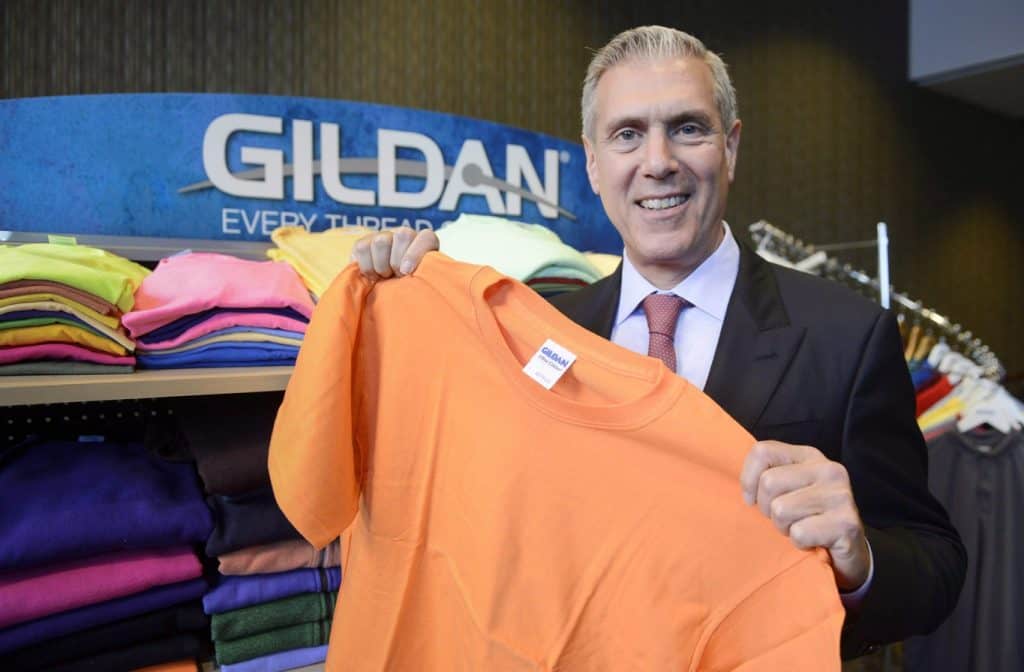
Analysts Issue Forecasts for Gildan Activewear Inc’s FY2019 Earnings (NYSE:GIL)

Gildan Activewear Inc (NYSE:GIL) (TSE:GIL) – Equities research analysts at National Bank Financial lowered their FY2019 earnings per share (EPS) estimates for shares of Gildan Activewear in a research note issued to investors on Thursday, October 31st. National Bank Financial analyst V. Shreedhar now anticipates that the textile maker will post earnings per share of $1.65 for the year, down from their prior forecast of $1.69. National Bank Financial has a “Sector Perform” rating and a $40.00 price objective on the stock. National Bank Financial also issued estimates for Gildan Activewear’s Q4 2019 earnings at $0.40 EPS, Q1 2020 earnings at $0.31 EPS and Q4 2020 earnings at $0.52 EPS.

Several other research analysts also recently issued reports on the company. Bank of America downgraded Gildan Activewear from a “buy” rating to an “underperform” rating and set a $23.00 price target for the company. in a research note on Friday, October 18th. Royal Bank of Canada cut their price target on Gildan Activewear from $36.00 to $30.00 and set a “sector perform” rating for the company in a research note on Friday, October 18th. Desjardins raised Gildan Activewear to a “hold” rating and set a $40.00 price target for the company in a research note on Monday, October 21st. TD Securities cut their price target on Gildan Activewear from $38.00 to $36.00 and set a “buy” rating for the company in a research note on Friday. Finally, Edward Jones downgraded Gildan Activewear from a “buy” rating to a “hold” rating in a research note on Monday, October 21st. Two analysts have rated the stock with a sell rating, nine have issued a hold rating, one has assigned a buy rating and one has issued a strong buy rating to the stock. Gildan Activewear currently has a consensus rating of “Hold” and a consensus target price of $30.55.

NYSE:GIL opened at $25.87 on Monday. The company has a market capitalization of $5.20 billion, a PE ratio of 13.91, a price-to-earnings-growth ratio of 2.20 and a beta of 0.79. The company has a quick ratio of 1.68, a current ratio of 4.33 and a debt-to-equity ratio of 0.55. Gildan Activewear has a 52-week low of $23.45 and a 52-week high of $40.40. The stock has a fifty day simple moving average of $32.72 and a 200-day simple moving average of $36.48.

Gildan Activewear (NYSE:GIL) (TSE:GIL) last issued its earnings results on Thursday, October 31st. The textile maker reported $0.53 EPS for the quarter, hitting the consensus estimate of $0.53. The company had revenue of $739.70 million for the quarter, compared to analyst estimates of $739.86 million. Gildan Activewear had a net margin of 9.87% and a return on equity of 18.06%. The business’s revenue was down 1.9% on a year-over-year basis. During the same period in the previous year, the firm earned $0.57 EPS.

Large investors have recently added to or reduced their stakes in the company. Commonwealth Bank of Australia raised its stake in Gildan Activewear by 28.1% in the 2nd quarter. Commonwealth Bank of Australia now owns 2,595 shares of the textile maker’s stock valued at $99,000 after purchasing an additional 569 shares during the last quarter. Quest Capital Management Inc. ADV acquired a new position in Gildan Activewear in the 3rd quarter valued at about $98,000. Tower Research Capital LLC TRC raised its stake in Gildan Activewear by 997.0% in the 2nd quarter. Tower Research Capital LLC TRC now owns 3,598 shares of the textile maker’s stock valued at $140,000 after purchasing an additional 3,270 shares during the last quarter. Neuburgh Advisers LLC raised its stake in Gildan Activewear by 11.4% in the 2nd quarter. Neuburgh Advisers LLC now owns 3,744 shares of the textile maker’s stock valued at $139,000 after purchasing an additional 384 shares during the last quarter. Finally, Atlas Capital Advisors LLC acquired a new position in Gildan Activewear in the 3rd quarter valued at about $171,000. 67.07% of the stock is owned by institutional investors and hedge funds.

About Gildan Activewear

Gildan Activewear Inc manufactures and sells a range of apparel products in North America, Europe, the Asia-Pacific, and Latin America. The company manufactures and markets active wear products, including T-shirts, fleece tops and bottoms, and sport shirts under Gildan, Gildan Performance, Gildan Platinum, Gildan Hammer, Comfort Colors, American Apparel, Anvil, Alstyle, and Gold Toe brands.

Alberta separation wouldn’t solve problem of landlocked oil: expert

It would be difficult to get products to market if western provinces split from Canada, experts say

International trade experts say it’s a pipe dream to think the landlocked oil-producing western provinces would have an easier time getting their product to international markets if they were to split from Canada.

“Wexit” — an apparent play on the word “Brexit” used to describe the United Kingdom’s planned departure from the European Union — was trending on social media after the Liberals secured a minority government in last week’s federal election, but were shut out of Alberta and Saskatchewan.

Peter Downing, a founder of the western separatist movement that wants a referendum on separation, has said an independent country in the middle of the Prairies could leverage the United Nations Convention on the Law of the Sea to gain coastal pipeline access.

“We have more freedom as an independent country to get our resources to the coast than as part of Canada,” he said the day after the election.

“We’ll have the best of both worlds: We’ll keep our money and we’ll have access to the coast.”

The UN convention, adopted in 1982, does say that “landlocked states shall enjoy freedom of transit through the territory of transit states by all means of transport.”

However, it goes on to say that terms “shall be agreed between the landlocked states and transit states concerned through bilateral, subregional or regional agreements,” and that transit states have the right to ensure their “legitimate interests” aren’t infringed upon.

“It’s not an unqualified right. They can’t just say, ‘OK, we need to get through here,”‘ said Silvia Maciunas, a fellow at the Centre for International Governance Innovation in Waterloo, Ont.

“They have to talk to the other state, which would be Canada.”

Peter Downing, a founder of the western separatist movement that wants a referendum on separation, has said an independent country in the middle of the Prairies could leverage the United Nations Convention on the Law of the Sea to gain coastal pipeline access. 

The “means of transport” in the convention refers to railways, waterways, roads and even porters and pack animals, but the treaty specifies that landlocked and transit states would have to agree to add pipelines to the list.

Landlocked countries such as Ethiopia and Switzerland have long had agreements to use ports in other countries.

Bolivia, on the other hand, lost its ocean access in a war with Chile in the 1800s and has been fighting to regain it ever since. The International Court of Justice in The Hague ruled last year that Chile has no obligation to engage in talks with Bolivia.

“Had the court ruled in the favour of Bolivia, Chile would have theoretically been obligated to enter into ‘good faith’ negotiations, whatever the heck that means,” said Carlo Dade, director of the Trade and Investment Centre at the Canada West Foundation.

“You can imagine how that would play out up here if Alberta, Saskatchewan leave … We’ve seen enough out of B.C. to know how that would play out,” said Dade.

The British Columbia government has resisted, primarily through court actions, the Trans Mountain pipeline expansion that would triple the amount of crude shipped between Alberta and the Lower Mainland.

Add to that there is no real enforcement mechanism through the international court, Dade said.

“The only thing the ICJ gives you is the ability to go from saying, ‘Please give us access’ to ‘Pretty please give us access.”‘

Mayne Island’s sole garbage service packing up amid land-use dispute

The privately-run company has been collecting trash on the small island for years

Trash may soon be piling up on Mayne Island, one of B.C.’s southern Gulf Islands, with the announced end of the island’s only garbage-disposal service. 

Mayne Island Garbage Services said this week it will cease operations starting on Jan. 1, 2020 because of a land-use dispute.  

The privately-run company, which has been operating on the island for the past five years, parks its commercial trucks on private land in a residential area — which is against Mayne Island’s zoning bylaws. 

“They [the Islands Trust] say we’ve been running it illegally because of where we park,” said Mikael Sauvageau, who runs the company. 

“So, I guess we’re going to sell everything.”

The island doesn’t have any municipal waste removal services. Instead, the roughly 1,000 residents rely on the privately run company to pick up garbage and other items, from fridges to old car parts, for a fee. 

The announcement of the company’s closure on Facebook generated dozens of comments, with many expressing concern that trash will ended up being burned or dumped with the lack of a disposal service. 

“We just need to hang tight and not speculate and assume anything at this point,” said Raven Mayne, who’s been living on the island for two years. 

“As a community and as a village, we’re going to just have faith and see what happens.”

‘A lot of misunderstanding’

On social media, much of the blame has been directed toward the Islands Trust, a federation of local governments that operates under the provincial government to oversee conservation and preservation for islands in southern B.C. 

About a month before announcing the closure, Mayne Island Garbage Services posted on social media that “recently, the Islands Trust has reinitiated efforts to close down our service.”

Dan Rogers, chair of the local trust committee for Mayne Island, says it’s not a blame-game. 

“There’s a lot of misunderstanding about our role and what our intentions are in this matter,” Rogers said. 

“We have no motivation to shut down this business.”

The trust, which is tasked with land use zoning and planning, received multiple complaints about the bylaw infraction, he said, and were obligated to investigate.

“Once it’s decided that it’s a valid complaint, we have to do something,” he said. 

“We’re trying to work with the land owner but so far we’ve been unsuccessful.” 

David Maude, who owns the private land where the garbage company runs its operations, declined to comment. 

He’s also a Mayne Island trustee with the Island Trust but wasn’t part of any meetings about the issue, according to Rogers. 

“We are trying to resolve things as a community and not in the media,” Maude wrote in an email to CBC News. 

Fishing gear killed whale

Necropsy indicates fishing gear likely caused death of right whale

Necropsy results indicate a North Atlantic right whale found in waters off the eastern U.S. in September died after being entangled in Canadian fishing gear.

The 40-year-old male known as Snake Eyes was last seen entangled in the Gulf of St. Lawrence on Aug. 6 off the Magdalen Islands. Its badly decomposed carcass was discovered off Long Island, N.Y., on Sept. 16.

The Atlantic Marine Conservation Society did the necropsy a few days after the whale was found.

“They (scientists) determined that the likeliest cause of death was entanglement,” said Jennifer Goebel, a spokeswoman for the fisheries arm of the National Oceanic and Atmospheric Administration.

Goebel said the necropsy found no evidence of blunt force from hitting a vessel. While the internal organs were “significantly decomposed,” no signs of disease indicated death from natural causes.

No gear was found on its body but Goebel said scientists found wrap marks on the whale that matched what had been observed when the animal was last seen entangled.

“They were able to find linear wounds that were wrapping the rostrum and pectoral flippers as well as wounds to the fluke, which is the tail,” Goebel said. “Those were consistent with what was documented while the animal was alive, as were the head wounds.”

Death from entanglements, she said, can be “rather gruesome” for marine animals.

“Animals can get severe cuts from the entanglements, it can limit their ability to forage, they can get infections from the cuts — it’s a very painful way to die.”

So far this year, eight right whale are known to have died in Canadian waters out of an endangered population numbering about 400 animals. Twenty-nine right whales have died in North American waters since 2017.

It’s believed the death of Snake Eyes is the first this year as a result of entanglement. Three other whales were also sighted entangled in the Gulf this year.

Goebel said it’s not certain the fishing gear spotted on the whale last summer was Canadian but the evidence points that way.

“What we do know is that it was seen in the Gulf of St. Lawrence in July without any gear and then the next sighting was in August with a severe entanglement in the Gulf of St. Lawrence,” she said.

Give inmates clean needles?

Barring inmates access to clean needles unconstitutional: activists

Barring drug-using federal prisoners from access to clean syringes puts them at risk for serious diseases and violates their rights, an Ontario court is set to hear.

For two days starting Monday, prison and other activists are expected to make the case that Ottawa’s rules and policies around needles in prisons are unconstitutional.

“The absolute prohibition on sterile injection equipment is arbitrary, overbroad and grossly disproportionate,” the applicants say in their filings in Superior Court.

“Prisoners are particularly vulnerable to infringement of their (constitutional) rights because the government has total control over every aspect of their daily lives, including their access to health care.”

The case was initially launched in 2012 by Steven Simons, who was imprisoned from 1998 to 2010. Court documents show Simons became infected with the hepatitis C virus and was potentially exposed to HIV, the virus that can lead to AIDS, while behind bars. He says another prisoner used his injection materials, and that they had no access to sterile equipment.

The problem, the applicants say, is that prison authorities regard syringes as contraband, making inmates found with them subject to punishment. The tough approach comes despite mounting evidence that in-prison access to sterile needles helps prevent the spread of serious illnesses.

“The sharing of drug-injection equipment poses a high risk for transmitting blood-borne infections,” the applicants state.

“The prevalence of HIV and (hepatitis C) among Canadian prisoners, including those in federal penitentiaries, is significantly higher than among the population as a whole.”

Activists note that more than 90 per cent of prisoners are eventually released. Like Simons, some will have become infected with serious illnesses from sharing needles and syringes behind bars.

“Correctional authorities’ refusal to ensure access to sterile injection equipment inside prisons not only jeopardizes the health and lives of prisoners, it also contributes to a public health problem beyond prisons.”

In recognition of the problem, the federal government recently began a pilot needle-exchange program in which inmates are given access to sterile equipment. However, The pilot has only been implemented in half a dozen of Canada’s 43 federal prisons, according to court filings.