
Archives for November 4, 2019

Microsoft’s new Office app for mobile combines Word, Excel and Powerpoint

Making and signing PDFs on-the-go should also be easier.

Microsoft’s having a busy Monday morning, and for anyone that uses Office on the go, its new app might be the major gamechanger.

The company’s newly unveiled Office app is an attempt to put everything you might need in one place. Instead of grabbing separate apps for Word, Excel and Powerpoint (aka the Office Triforce), today’s public preview puts them all together.

The app also includes a new Actions pane that should be especially effective for document editing on-the-go. Microsoft says you’ll be able to create and sign PDFs with ease from your tinier smartphone screens, and sharing files has also been simplified and streamlined. The Office app also makes better use of your phone’s talents, with the ability to take a photo of a document and turn it into an editable Word file on the fly, or even do the same with printed-out tables in Excel. Details ahead of today’s launch was otherwise a little scarce — but nevermind, you can test them out for yourself starting this morning. The Office app preview is available on Google Play now, and for iOS users that are using Testflight. There’s no date yet for when the app will launch outside of preview.

Google’s Assistant-friendly Nest WiFi router is available now

Extend your network and fill your home with voice controls.

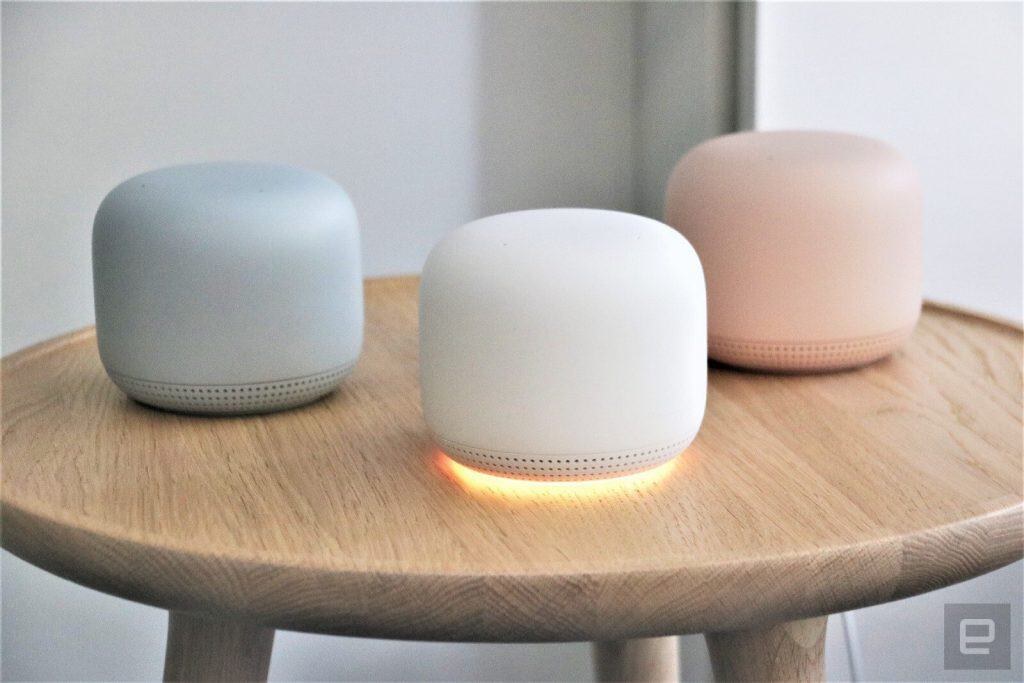
You now have your chance to try Google’s latest, Assistant-fueled take on home networking. As promised, Nest WiFi is now available through Google’s store and other channels. You can buy the core router by itself for $169, but the system only really comes alive when you buy Points that both extend the mesh network and double as Google Assistant smart speakers. A standard pack with a router and one Point will cost you $269, while a three-pack will serve large homes for $349. You can buy further points for $149 online.

Nest WiFi has its share of limitations. You won’t find a wide array of Ethernet ports (there are just two) or USB (none). It’s not going to deliver WiFi 6 speeds. And of course, you’re making a deep investment in Google’s ecosystem — you’d be better off with Eero hardware if you’re an Alexa fan. If you’re building a smart home system from scratch, though, this could give you the foundations you need without having to buy separate networking gear and speakers.

Microsoft’s Chromium Edge browser arrives January 15th

You can test out the release candidate now.

After launching a beta test for the new Chromium Edge in September, Microsoft is now gearing up to officially launch the browser on January 15th, 2020. Over the weekend, the company also revealed a new pinwheel-like Edge logo, which looks like an offshoot of Chrome’s logo. You can test out the near-final Release Candidate version today, which should be stable enough for anyone to use, but also serves to let IT administrators to prepare for the new Edge. And speaking of IT folks, Microsoft is also debuting new Bing features for businesses, which gives the search engine the ability to index intranet files and corporate data.

As I covered in my last preview, you can expect the new Edge to be much faster than the last version, thanks to the Chromium engine that’s also used in Chrome. While Microsoft made a decent effort building up its own browser engine over the last few years, it could never really compete with the Google’s might when it came to speed and website compatibility.

By switching browser engines, the company can work on delivering new experiences on top of a solid framework. The Collections feature, for example, lets you gather websites, jot down notes and share that info with anyone, giving you a simple way to collaborate on things like vacation activities. And the new Legacy Internet Explorer mode gives you a secure way to use aging web apps that still rely on that old browser.

The Chromium Edge browser will also be much more secure than before. In its default “Balanced” mode, it’ll block trackers from sites you haven’t visited, as well as known harmful trackers. And while you’ll lose a bit of personalization from some sites and ads, Microsoft says sites should work as you’d expect. A stronger “Strict” mode blocks even more trackers and might stop some sites from working, but it’s all in the name of keeping you more secure. The “Basic” security mode will also block harmful trackers, but give full access to everything else. (My recommendation? Just keep it on the default balanced security mode.)

Chromium Edge and Bing

Microsoft says the new Edge and Bing search will also be more secure while using InPrivate tabs. Typically, you’d expect those to be secure, but it turns out most browsers still track bits of data in private browser tabs. Moving forward, Microsoft is working to make sure searches and browsing aren’t tied to you at all while using InPrivate Mode.

While it might sound a bit strange to see Bing start handling internal corporate data, the move makes a lot of sense. That’s something Google has been offering for a while, most recently with Cloud Search, but there are also plenty of other intranet solutions that aren’t nearly as robust. The updated Bing makes Microsoft 365 an even more compelling option for businesses, since they’ll have faster access to corporate content.

Microsoft

The Edge home screen can automatically highlight shared documents you might need. You’ll also be able to use natural language queries to look up information about specific colleagues, like their exact desk location and title. Similarly, you can search for information about confusing acronyms used by your company.

There really aren’t any downsides with the Edge Chromium release. It’ll be a faster, more secure and offer more website compatibility than before. Microsoft won’t be removing the classic Internet Explorer app from current Windows 10 systems, but the company says moving forward, it won’t be installed on new PCs. (That sound is every IT admin on the planet breathing a huge sigh of relief.)

Garmin’s Venu is a great fitness wearable pretending to be a smartwatch

A gorgeous screen, paired with frustrating software.

There’s a big difference between smartwatches made by consumer technology companies and those made by fitness companies, and that’s ‘friction’. The friction that you have to deal with on a regular basis to make use of your watch. It’s the one thing that dogs Garmin’s Venu, a watch that’s just a little bit too annoying for me to recommend it.

The Venu is a 43mm-wide crossover watch, designed to sit in the grey area between fitness watches, where Garmin is strong, and smartwatches, where it isn’t. It’s a Vivoactive 4 with a nicer-looking body and a higher-res display, which is the main selling point. Where the Vivoactive 4 has a 260 x 260 low-power display, the Venu has a 390 x 390 AMOLED touchscreen.

It’s a gorgeous screen, and the live faces are especially pretty. Each pane you swipe through have been given a polish. But the watch doesn’t make the most of it, because the Venu is running Garmin’s stock OS, which is designed for watches with lower-resolution displays. Garmin hasn’t sought to take advantage of the better display to make the information denser, or more useful.

So, like a regular running watch, you have to cycle through any number of cards to get to the stat you need. And, because it’s a fitness watch first, you can get plenty of fine-grain data about your body and your day. Including heart rate, stress, steps, stairs, calories, breaths per minute, pulse oximetry, weather, calendar, phone notifications and hydration levels.

If all of these are added to the carousel, then finding a specific card, like the hydration tracker, is a nightmare. I tried to keep tabs on how much water I’d drank but gave up after half a day, in frustration. If Garmin had compressed some of this data on to a couple of screens and used the touchscreen more, this wouldn’t have happened.

Garmin Venu

The further you push into smartwatch territory, the more the Venu falls short of what you would expect, especially at this price. Paired with an iOS device, the most you’ll get are notification previews of what’s on-screen, same as with most other wearables. And, if you try and install third-party apps onto the system, you’d better buckle in and hope for good weather and plenty of luck.

I tried to install Spotify onto the watch in order to use offline music and, well, I haven’t been able to yet. There’s a default app you can install, but it doesn’t work, so you have to visit the Garmin Connect store and download one there. Installing and deleting both, twice over, and a couple of restarts, and I finally got access to my playlists via the watch. But actually playing them, or downloading them to my watch, hasn’t happened — something that other users are struggling with. I’ve spoken to Garmin about this, and am waiting for a response.

But I don’t just come here to bury the Venu, I come to praise it as well. When you steer clear from the smartwatch elements, it’s a great device. The GPS is whip-fast to find a signal and, because it’s Garmin, the activity tracking is spot on. Due to the time of year, I’ve been using my rowing machine a lot, and love the amount of data you get from the Venu.

And I can’t speak highly enough about the Venu’s battery life, which is staggering. It has managed to last six full days on a single charge. You’ll burn through the battery faster with an always-on display mode, but it’s not really designed for that. Personally, I don’t want a watch that I need to recharge on a daily basis, and so the Venu’s longevity is an asset.

Fundamentally, the Garmin Venu is a fitness watch that’s playing at being a smartwatch, and so fails to stand equal to devices from rivals. For its $399 asking price, you can get a number of other wearables that have better integrations with app ecosystems, music players and mobile payments. If, however, you treat it as a prettier version of the Vivoactive 4, then it stands a little stronger on its own merits. Just don’t go in expecting a credible alternative to smartwatches from Apple or Samsung.

Analysts Offer Predictions for Callaway Golf Co’s Q4 2019 Earnings (NYSE:ELY)

Callaway Golf Co (NYSE:ELY) – Analysts at Jefferies Financial Group lowered their Q4 2019 earnings per share (EPS) estimates for Callaway Golf in a research report issued to clients and investors on Thursday, October 31st. Jefferies Financial Group analyst R. Konik now forecasts that the company will post earnings per share of ($0.22) for the quarter, down from their previous forecast of ($0.12).

Callaway Golf (NYSE:ELY) last posted its quarterly earnings results on Wednesday, October 30th. The company reported $0.36 EPS for the quarter, topping the Zacks’ consensus estimate of $0.23 by $0.13. The business had revenue of $426.00 million during the quarter, compared to the consensus estimate of $420.43 million. Callaway Golf had a return on equity of 13.17% and a net margin of 5.10%. The company’s revenue for the quarter was up 62.2% compared to the same quarter last year. During the same period last year, the firm earned $0.10 earnings per share.

A number of other equities analysts also recently commented on the company. B. Riley set a $30.00 target price on Callaway Golf and gave the company a “buy” rating in a research note on Wednesday, October 9th. Zacks Investment Research downgraded Callaway Golf from a “buy” rating to a “hold” rating in a research note on Friday, October 18th. Raymond James upgraded Callaway Golf from a “market perform” rating to an “outperform” rating and set a $21.00 target price for the company in a research note on Wednesday, September 11th. ValuEngine downgraded Callaway Golf from a “buy” rating to a “hold” rating in a research report on Tuesday, October 1st. Finally, Compass Point set a $21.50 price objective on Callaway Golf and gave the stock a “buy” rating in a research report on Friday. Four analysts have rated the stock with a hold rating and five have assigned a buy rating to the stock. The stock currently has an average rating of “Buy” and an average target price of $22.78.

Shares of ELY stock opened at $19.78 on Monday. The company has a quick ratio of 0.92, a current ratio of 1.79 and a debt-to-equity ratio of 0.74. The business has a 50 day moving average of $19.81 and a two-hundred day moving average of $17.84. Callaway Golf has a 52 week low of $14.44 and a 52 week high of $22.69. The company has a market cap of $1.90 billion, a P/E ratio of 18.49, a PEG ratio of 0.73 and a beta of 1.25.

Several hedge funds and other institutional investors have recently modified their holdings of ELY. We Are One Seven LLC grew its holdings in Callaway Golf by 2.8% during the 3rd quarter. We Are One Seven LLC now owns 19,451 shares of the company’s stock worth $378,000 after acquiring an additional 523 shares during the last quarter. Oregon Public Employees Retirement Fund raised its position in shares of Callaway Golf by 1.7% in the 2nd quarter. Oregon Public Employees Retirement Fund now owns 35,004 shares of the company’s stock worth $601,000 after buying an additional 600 shares during the period. Meadow Creek Investment Management LLC raised its position in shares of Callaway Golf by 8.7% in the 2nd quarter. Meadow Creek Investment Management LLC now owns 9,968 shares of the company’s stock worth $171,000 after buying an additional 800 shares during the period. First Mercantile Trust Co. raised its position in shares of Callaway Golf by 13.9% in the 3rd quarter. First Mercantile Trust Co. now owns 6,835 shares of the company’s stock worth $133,000 after buying an additional 833 shares during the period. Finally, Augustine Asset Management Inc. raised its position in shares of Callaway Golf by 0.9% in the 2nd quarter. Augustine Asset Management Inc. now owns 100,126 shares of the company’s stock worth $1,718,000 after buying an additional 916 shares during the period. Institutional investors and hedge funds own 94.57% of the company’s stock.

In other news, EVP Richard H. Arnett sold 13,137 shares of the business’s stock in a transaction that occurred on Friday, August 9th. The stock was sold at an average price of $20.00, for a total transaction of $262,740.00. Following the completion of the transaction, the executive vice president now directly owns 31,276 shares in the company, valued at $625,520. The sale was disclosed in a legal filing with the SEC, which is accessible through this link. Insiders own 1.97% of the company’s stock.

Callaway Golf declared that its Board of Directors has authorized a stock repurchase program on Thursday, August 8th that permits the company to repurchase $100.00 million in outstanding shares. This repurchase authorization permits the company to purchase up to 5.9% of its shares through open market purchases. Shares repurchase programs are often a sign that the company’s management believes its stock is undervalued.

About Callaway Golf

Callaway Golf Company, together with its subsidiaries, designs, manufactures, and sells golf clubs, golf balls, golf bags, and other golf-related accessories. The company operates through three segments: Golf Clubs; Golf Balls; and Gear, Accessories and Other. The Golf Clubs segment provides golf drivers and fairway woods, hybrids, irons and wedges, putters, packaged sets, and pre-owned golf clubs.

Analysts Boost Earnings Estimates for S&P Global Inc (NYSE:SPGI)

S&P Global Inc (NYSE:SPGI) – Equities research analysts at Cantor Fitzgerald increased their FY2019 EPS estimates for S&P Global in a research report issued on Wednesday, October 30th. Cantor Fitzgerald analyst J. Foresi now expects that the business services provider will earn $9.36 per share for the year, up from their prior estimate of $9.18. Cantor Fitzgerald currently has a “Overweight” rating and a $294.00 target price on the stock. Cantor Fitzgerald also issued estimates for S&P Global’s FY2020 earnings at $10.32 EPS.

S&P Global (NYSE:SPGI) last posted its quarterly earnings data on Tuesday, October 29th. The business services provider reported $2.46 earnings per share (EPS) for the quarter, beating the Zacks’ consensus estimate of $2.34 by $0.12. S&P Global had a net margin of 32.22% and a return on equity of 448.14%. The firm had revenue of $1.69 billion during the quarter, compared to the consensus estimate of $1.65 billion. During the same quarter in the previous year, the firm posted $2.11 EPS. The business’s revenue for the quarter was up 9.2% compared to the same quarter last year.

Several other equities analysts also recently commented on the stock. William Blair reissued an “outperform” rating on shares of S&P Global in a research note on Wednesday, October 30th. UBS Group increased their price objective on shares of S&P Global from $301.00 to $314.00 and gave the company a “buy” rating in a research note on Wednesday, October 30th. JPMorgan Chase & Co. began coverage on shares of S&P Global in a research note on Wednesday, July 10th. They issued an “overweight” rating and a $260.00 price objective for the company. ValuEngine downgraded shares of S&P Global from a “buy” rating to a “hold” rating in a research note on Friday, September 27th. Finally, Edward Jones began coverage on shares of S&P Global in a research note on Wednesday, September 11th. They issued a “buy” rating for the company. Six research analysts have rated the stock with a hold rating and ten have given a buy rating to the company’s stock. The company has an average rating of “Buy” and a consensus target price of $264.42.

Shares of S&P Global stock opened at $258.80 on Monday. The company has a 50 day moving average of $249.92 and a 200-day moving average of $238.12. S&P Global has a 1-year low of $156.68 and a 1-year high of $269.57. The company has a current ratio of 1.10, a quick ratio of 1.37 and a debt-to-equity ratio of 8.91. The company has a market cap of $63.05 billion, a PE ratio of 30.45, a price-to-earnings-growth ratio of 2.76 and a beta of 1.07.

In other S&P Global news, insider Nicholas Cafferillo sold 9,911 shares of the company’s stock in a transaction that occurred on Thursday, August 8th. The shares were sold at an average price of $252.95, for a total value of $2,506,987.45. Following the completion of the transaction, the insider now directly owns 7,454 shares in the company, valued at approximately $1,885,489.30. The sale was disclosed in a filing with the SEC, which is available at this hyperlink. Also, CEO Alexander Matturri, Jr. sold 1,007 shares of the company’s stock in a transaction that occurred on Wednesday, August 14th. The shares were sold at an average price of $254.46, for a total transaction of $256,241.22. The disclosure for this sale can be found here. In the last three months, insiders sold 16,918 shares of company stock valued at $4,292,209. 0.20% of the stock is owned by insiders.

A number of hedge funds and other institutional investors have recently made changes to their positions in the business. Van ECK Associates Corp increased its position in shares of S&P Global by 91.1% during the second quarter. Van ECK Associates Corp now owns 5,996 shares of the business services provider’s stock worth $1,366,000 after buying an additional 2,859 shares during the period. Greenleaf Trust increased its position in shares of S&P Global by 3.9% during the second quarter. Greenleaf Trust now owns 2,823 shares of the business services provider’s stock worth $643,000 after buying an additional 106 shares during the period. Contravisory Investment Management Inc. increased its position in shares of S&P Global by 24.0% during the second quarter. Contravisory Investment Management Inc. now owns 305 shares of the business services provider’s stock worth $69,000 after buying an additional 59 shares during the period. BlackRock Inc. increased its position in shares of S&P Global by 2.1% during the second quarter. BlackRock Inc. now owns 16,706,719 shares of the business services provider’s stock worth $3,805,622,000 after buying an additional 339,310 shares during the period. Finally, AustralianSuper Pty Ltd increased its position in shares of S&P Global by 160.9% during the second quarter. AustralianSuper Pty Ltd now owns 272,426 shares of the business services provider’s stock worth $62,056,000 after buying an additional 168,027 shares during the period. Hedge funds and other institutional investors own 82.63% of the company’s stock.

About S&P Global

S&P Global Inc, together with its subsidiaries, provides ratings, benchmarks, analytics, and data to the capital and commodity markets worldwide. The company operates through four segments: S&P Global Ratings (Ratings), S&P Global Market Intelligence (Market Intelligence), S&P Global Platts (Platts), and S&P Dow Jones Indices (Indices).