
Archives for September 26, 2019

Amazon Sidewalk aims to connect outdoor tech beyond your WiFi range

It can ping you when the mail comes or your dog leaves the yard.

As IoT technology spreads across our homes, keeping devices on our WiFi networks becomes more of an issue. Amazon thinks it has a solution with Sidewalk, which aims to keep low-power, low-bandwidth devices connected despite being far away from your router using, a 900 MHz spectrum.

This network will enable developers to build new products that can be placed farther than the reach of your wireless signal. Amazon cites water sensors to keep the plants in your garden quenched, or a mailbox device to let you know when you’ve got mail as examples. The company will also be introducing the Ring Fetch, which is a dog tracker that will alert you if your good boy leaves a designated perimeter.

There aren’t many details on how Amazon Sidewalk will work just yet, but the popularity of IoT devices could make it a worthwhile addition to smart home ecosystems, especially for homes with limited WiFi range.


Facebook lays out its vision of our communal VR future

The holodeck future is coming.

After all the new products were announced and surprise features revealed at Oculus Connect 6 on Wednesday, Facebook Reality Lab (FRL) lead Michael Abrash took to the stage to discuss the future of VR, AR, and the company’s leading role in their continuing development.

“VR certainly has the same long term potential as the personal computer,” Abrash told the audience. “In fact, I believe that it will ultimately become the most powerful creative and collaborative environment that has ever existed.”

But for that to happen, Abrash admits that there is much work yet to be done. The Reality Lab aims to create a genuine sense of “social presence” — the feeling that you’re physically sharing the same space with another person — within the virtual space. To do that, Facebook is currently developing full-body avatars that look and move exactly like the human they represent. The company can’t generate these “Codec Avatars” in real-time currently, but Abrash is confident that they will in the coming years.

Abrash also spoke to the importance of conveying emotion in creating social presence and, to that end, his lab is working on making photo-realistic virtual faces for their Codec Avatars. As you can see in the video below, as two members of Abrash’s team speak to each other, their headsets track their facial expressions and are “translated in real-time into audio and visual signals they perceive as a picture-perfect representation of the other person’s likeness,” according to a Facebook release.

But what good are full-body avatars and photo-realistic faces if you’ve got nowhere to go in VR space? That’s why the FRL has developed a prototype system capable of capturing high-fidelity 3D scans of interior environments.

“Through a combination of a high-accuracy depth capture system, state-of-the-art simultaneous localization and mapping (SLAM) technology, a cutting-edge camera rig, and a dense reconstruction system, we’re able to achieve a level of fidelity that’s unprecedented in VR,” per a Facebook release. Not only will this technology allow users to hang out virtually in familiar, real-world spaces, it will also serve as “the core infrastructure that will underpin tomorrow’s AR experiences,” what the FRL has dubbed, Live Maps.

These two aspects — photo-realistic avatars and virtual spaces — will eventually combine to create an entirely new form of social interaction. The ability to project your presence anywhere on the globe is nothing short of transformative. But don’t get too excited just yet. “Realizing the full potential of VR will take decades,” Abrash warned. “Just as it did with personal computers.”

But progress is being made. The Half dome prototype headset shown off at last year’s event has already been surpassed by the smaller and 200-gram lighter Half Dome 2. The field of view is a bit more narrow than the original Half Dome, but that’s still 20 percent wider than what Oculus Quest users see. The Half Dome 2 also boasts an improved mechanical varifocal lens that reduces noise and vibration. Both of these headsets, however, are eclipsed by the Half Dome 3, which uses an electronic varifocal lens, which eliminates virtually all of the moving parts of the assembly with a stack of six thin liquid crystal displays.

No one advancement will bring us to the next generation of VR headset, Abrash argued. “VR technologies will need to be woven together into a complete, tightly integrated platform in order to make that quantum leap,” he said. “It’s the sum of those parts that will lead to that breakthrough experience, not technologies in isolation.”

Where to Find a Personal Finance Community Online

We might talk about money in this corner of Lifehacker all day every day, but outside the warm confines of Two Cents, discussing money is still generally frowned upon. In fact, people are so hush-hush about their finances that they would rather talk about their sex life than their credit card debt at a dinner party, according to a report from Motley Fool’s The Ascent. That survey found that almost 57% of respondents think it’s taboo to discuss personal finances regardless of time and place. And that stigma may leave you feeling lost when you want to discuss your financial goals, understand your setbacks, or celebrate your achievements.

Sometimes, it’s easier to talk about money with strangers, especially those who are in a similar financial situation to yours. Or those strangers may have been in your shoes before and can offer advice without criticizing the actions that led to your current circumstances, whether it’s good or bad.

That’s where the power of the internet comes in handy. When you need a jolt of motivation or a place to commiserate about how bored you are already with the lunches you meal-prepped for the week, you can turn to these supportive online groups. Best of all: They’re free.

Facebook communities

You’re logged into Facebook already, so why not use that convenience to find a new personal finance community or two?

Spending Fasters (Get Out of Debt, Save Money, and Be Inspired)

This group, a companion to the blog And Then We Saved, focuses on using spending fasts (which you might know as no-spend challenges) to pay off debt faster. If you’re laser-focused on getting out of debt, this is the group for you.

Frugal Friends Podcast Community

The Frugal Friends podcast emphasizes that you don’t have to take extreme steps to improve your finances. The show’s Facebook group with about 1,100 participants is welcoming to newbies and frugal pros alike.

Your Money and Your Life

This group run by NPR, is gigantic, with more than 51,000 members. But with a focus on saving and investing, you’re sure to learn a few new strategies to apply to your finances.

Dough Rollers

This group from the Dough Roller blog keeps it broad, inviting conversations about money and investing, but with a more manageable group size—about 7,500 participants.

Subreddits

The amount of activity on Reddit can be overwhelming, so here are two subreddits I enjoy perusing that can help you dip into money topics.

r/personalfinance

This is the catch-all for budgeting, saving, getting out of debt, investing and everything in between. If there’s a more specific forum that suits your inquiry (like using credit cards to earn travel rewards, for example), other users will point the way.

r/frugal

Want to save more and spend smarter? This subreddit will teach you how to coupon, work the circular, and make the most of your pantry. You can also read some “frugal fails,” which will make you feel better when your attempts to save money go horribly wrong.

Traditional forums

Do you miss the olden days of the internet? Lucky for you, forums still exist. Start with one of these:

Oh My Dollar

Fans of the robust comments section at now-closed site The Billfold (which Lifehacker writer Nicole Dieker used to run) can find that community in the forums for personal finance education site Oh My Dollar. Topics range from budgeting to parenting, and there’s even a thread for sharing your financial victories with the group.

BiggerPockets

The BiggerPockets forums, like the site of the same name, is focused on real estate investing. But there’s also discussion around financial independence, goal-setting, and taxes.

Hashtags

Sure, performative social media can make you feel bad about your money (or lack of it). But if you follow a few select hashtags, you can find motivational posts with lots of tips and strategies for reaching your financial goals.

On Instagram, try #debtfreecommunity and #debtfreejourney to connect with users who are paying off debt or have already achieved it.

If you prefer Twitter, WiseBread hosts a weekly chat, #WBChat, on Thursdays to discuss personal finance. There’s a different topic each week.

Recession or not … many Americans already ‘living on edge’ financially: Survey

More than a decade into the longest economic expansion on record, almost two-fifths of people said in a new Bankrate poll that their main financial priority was just keeping their heads above water on living expenses rather than saving money.

Nearly as many of those surveyed said that they’re not following financial budgets, according to Bankrate’s September Financial Security Poll.

The lack of financial preparedness highlighted by the survey could spell trouble for many households, whether concerns about a global economic slowdown manifest or not. Financial advisers say people without a budget and savings are often less equipped to handle financial emergencies in their own lives.

“Every household that doesn’t have sufficient savings will be living on the edge when a recession arises, and in a sense, they’re living on the edge even before a recession arises,” says Mark Hamrick, senior economic analyst at Bankrate.

Keeping your head above water

Economists increasingly believe the U.S. will experience a recession within the next year to year and a half.

A downturn could mean many companies will cut jobs as lenders become more reluctant to approve loans and new lines of credit. The combination could leave unprepared families scrambling to make ends meet during income interruptions.

But Hamrick points out that families who aren’t financially prepared could be left struggling even in good economic times because they’re not ready to handle emergencies such as an unexpected medical bill or major home repair.

Among survey respondents in the nationally representative poll, 38 percent said their top financial priority is “just staying current on living expenses or getting caught up on all the bills.” Almost 3 in 10 respondents (29 percent) said their chief priority was “saving more money,” and 19 percent indicated they were mainly working on paying down debt from products like credit cards and student loans.

Bankrate conducted the survey released Wednesday via telephone by SSRS on its Omnibus survey platform. Interviews were conducted from Sept. 3-8 among a sample of 1,017 respondents.

“For people who have a sense that they are current on their bills, the logical next step would be to save more money,” Hamrick says. “Some individuals are spending more money on things than they ought to be. Other individuals are essentially trapped because their incomes aren’t higher or their living expenses are high.”

Difficulty of saving at lower incomes

The percentage of people who say their top priority is saving money steadily increases as income brackets go up. For example, 19 percent of people who make less than $30,000 say their top priority is saving, while 39 percent of those who make $75,000 or more say the same.

“Those with really low incomes or really limited resources don’t have many options,” says Sara Croymans, an educator specializing in family resiliency with University of Minnesota Extension.

She suggests those who need help creating a budget or understanding how to get out of a paycheck-to-paycheck cycle seek financial assistance through an extension program in their area, their financial institution, state agencies or certified professionals.

“Everyone’s situation is really unique,” Croymans says. “We ask them what are their priorities, what’s most important to them and what they’re willing to sacrifice to get what’s most important.”

How to increase your financial literacy

Millennials who graduated during the last recession and its aftermath may be the most in need of basic financial planning help. More than half (51 percent) of adults between 23 and 38 said they were not using a budget, Bankrate’s survey finds.

Paradoxically, millennials were also the most likely to say their top priority is saving money. Thirty-five percent of young adults were focusing on saving versus 30 percent of Generation X, 20 percent of baby boomers and 27 percent of the silent generation.

As of 2016, only 17 states required students to take a personal finance course in high school. And only 20 states required an economic class, according to the Council for Economic Education.

“I’m concerned about the lack of economic knowledge and financial literacy putting people at a disadvantage even without a recession,” says Anna Lusardi, chair professor at the George Washington University School of Business.

Lusardi’s research shows wealth inequality between individuals can partly be explained by the different levels of financial knowledge. Knowing how to create and maintain a budget is a starting point, she said, but people need much more skills and information to successfully manage their money on a day-to-day basis and the long term.

The financial world from understanding our student loans, to taking out a mortgage to buying a home and even funding our retirement can be complex.

“If we don’t teach these concepts, people have to learn them by themselves,” Lusardi says. “You’re at a disadvantage if you don’t have this knowledge because you’re making financial decisions every day.”

Create a budget, live below your means and save more

You can create a budget yourself by sitting down and looking at where your money goes every month. It’s best to look at about six months to a year of expenses captured by receipts, credit statements and bank accounts to get an idea of where your money is going. This process can help you see areas where you can cut back as well as plan how much money you’ll need each month for necessities. It’s crucial to develop a plan to live below your means rather than above them, which creates a constant cycle of borrowing and stinting on or avoiding savings.

If you are able to set some money aside, many experts suggest automatically diverting a portion of your paycheck to a high-yield savings account through direct deposits. This pool of money which will accrue over time and earn interest will serve as your emergency fund. Experts recommend you have six months to a year of your expenses set aside in this fund.

5 Reasons to Retire as Early as You Can

An early retirement isn’t for everyone. You may not have much socked away, for example, which would make retiring early a bit difficult. But if you have some savings, an early retirement may be more achievable than you think.

Here’s a look at five reasons why you might want to retire as early as you can. See if they’re enough to change your retirement goals and plans.

No. 1: Putting off retirement can be risky

The first reason to consider retiring early is because you don’t know how long you’ll live or how long you’ll remain relatively healthy and active. Many people actually end up retiring early not because they want to but because they have to — due to a job loss or a health problem or because they had to care for others. For this reason alone, it’s worth being more aggressive in saving for retirement, in order to build a fat nest egg sooner rather than later.

No. 2: You hate your job

If you hate your job, it can be well worth retiring from it earlier than planned. That’s because hating your job is a far-reaching problem, even affecting your physical and mental health.

Somewhere between 20% and 40% of workers are very unhappy at their jobs, according to various studies. Here are some of the consequences that have been found to result from hating one’s job:

  • Depression
  • Stress
  • Weight gain
  • Sleep problems

Note that these health problems have corresponding additional problems, such as fatigue and irritability. The National Institute of Mental Health has noted that:

Health problems can occur if the stress response goes on for too long or becomes chronic, such as when the source of stress is constant, or if the response continues after the danger has subsided. With chronic stress, those same life-saving responses in your body can suppress immune, digestive, sleep, and reproductive systems, which may cause them to stop working normally.

People under chronic stress are prone to more frequent and severe viral infections, such as the flu or common cold.

On top of all that, unhappiness at work can lead to unhappiness at home, a less happy marriage, and a dysfunctional family life.

It’s also worth remembering that retiring from a job you hate doesn’t necessarily have to mean retiring from work altogether. It might just mean looking for, finding, and switching to a different job — perhaps in a field that you’ve always wanted to try.

No. 3: You can be very productive in your retirement years

If you’re not too interested in retirement because you’re imagining being bored and unproductive, know that you can still be very productive while retired. A close look at your savings and retirement goals might make it clear that you can’t quit working completely any time soon. But you might be able to retire earlier than you originally planned to if you keep working — on a part-time basis.

Look for a job that’s less stressful and, ideally, more enjoyable. Generating some extra dollars that way can help your nest egg last longer. You might be able to stay at your current job for a while (assuming you like it there), working part-time for a few years. Wherever you work, if you work, say, 10 hours per week and earn $12 per hour, you can generate about $500 per month, and that additional income could cover some major expenses, such as food and/or utilities.

It’s actually good for many people to work a bit and make money in retirement, as jobs offer structure and socializing — things that many people miss in retirement. 

There are other ways to be productive in retirement, too. If you’re financially secure, you can volunteer for causes or organizations close to your heart, perhaps tutoring kids or leading museum tours. You might also make money by giving music or language lessons, selling crafts or baked goods you make, or doing freelance writing or editing.

You can use your more plentiful free time in retirement to work on improving your health, too. You’ll have more time to prepare nutritious meals and go for long walks or bike rides or visit the gym regularly. If you can lose any excess weight, you may reduce your odds of developing diabetes or high blood pressure — or if you already have various conditions, you may reduce their severity.

You may start sleeping better, too, as you won’t have the stress of your old job and may no longer have to wake up early for anything. Here’s a bonus: If you’re healthier, you may live longer!

No. 4: You can avoid running out of money with annuities

Many people avoid retiring early because they think they should keep stockpiling money lest they run out of it too soon in retirement. One way to prevent that is to spend a chunk of your retirement funds on one or more fixed annuities. Doing so is kind of like buying yourself some dependable pension income, as you can set yourself up to receive monthly checks and even ones that are adjusted for inflation over time.

The table below offers an idea of how much you might get from a fixed annuity in today’s economic environment, based on some recent quotes:

PurchaserCostMonthly IncomeAnnual Income Equivalent
65-year-old man$100,000$540$6,480
65-year-old woman$100,000$517$6,204
70-year-old man$100,000$618$7,416
70-year-old woman$100,000$593$7,116
65-year-old couple$200,000$923$11,076
70-year-old couple$200,000$1,032$12,384
75-year-old couple$200,000$1,188$14,256

No. 5: It’s not worth delaying Social Security

Finally, you may be putting off retirement because you know that for every year beyond your full retirement age — which is 66 or 67 for most of us — that you delay starting to collect your benefits, they’ll increase by about 8%. And you may know that starting to collect early — you can start as early as age 62 — means your checks will be smaller.

But you may not realize that delaying isn’t such a no-brainer decision. As the Social Security Administration has explained, “If you live to the average life expectancy for someone your age, you will receive about the same amount in lifetime benefits no matter whether you choose to start receiving benefits at age 62, full retirement age, age 70 or any age in between.” After all, starting to collect early means smaller checks but many more of them.

It can still be smart to delay, but that’s not the best move for everyone, and for some, starting to collect early may enable them to retire early. For one thing, it might allow them to keep some significant funds invested in stocks for the long run, aiming for growth.

An early retirement may be more within your grasp than you thought. At the very least, you may be able to retire a year or three sooner than you’d planned — if you take some smart steps now.

The No. 1 reason millennials are struggling to save for retirement—and it’s not debt

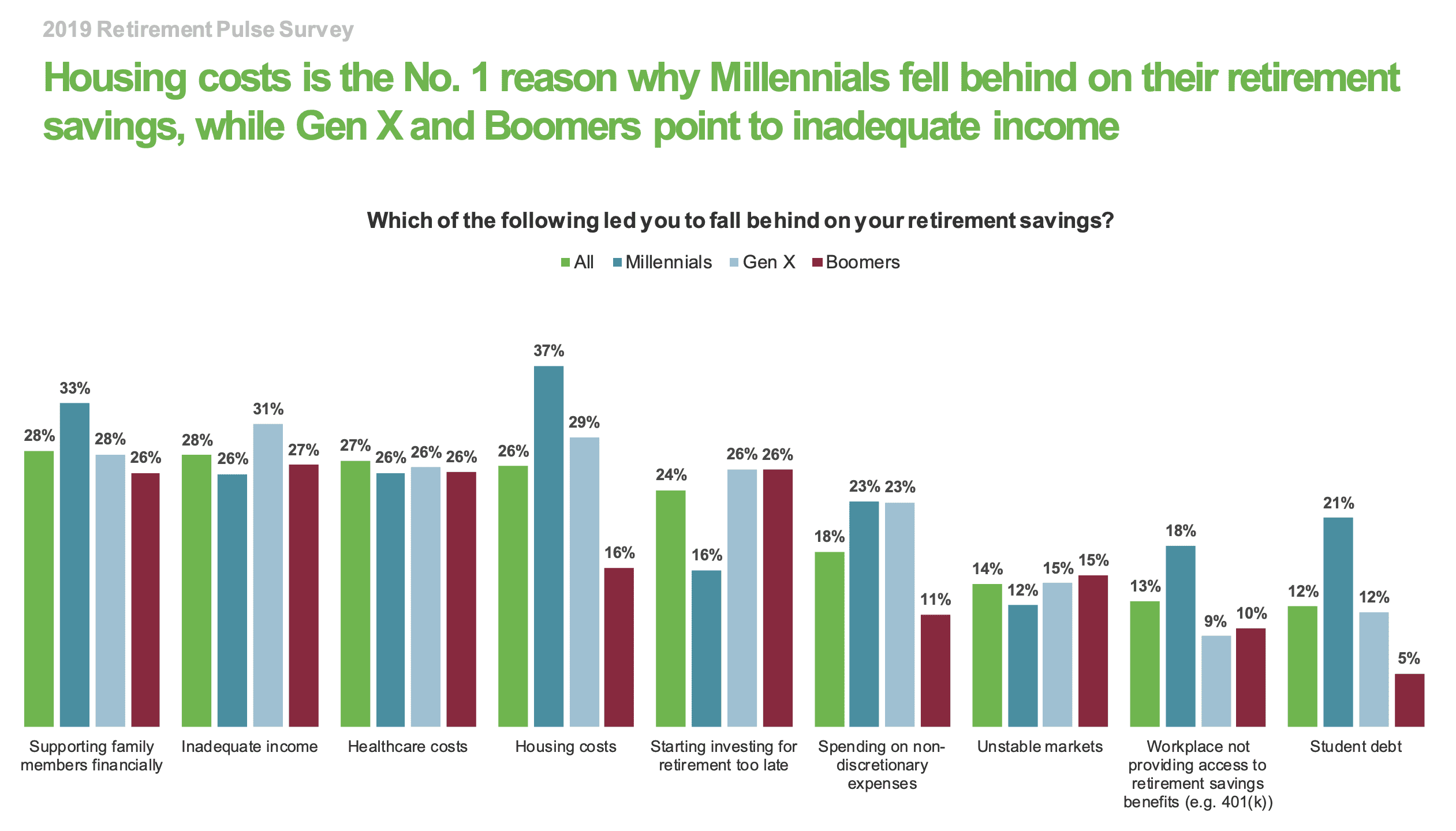
Most millennials, 66%, don’t feel on track when it comes to saving for retirement. That’s according to a 2019 TD Ameritrade report, which surveyed 1,015 U.S. adults aged 23 and older with at least $10,000 in investable assets.

When asked why they’ve fallen behind on their retirement savings, the No. 1 response for millennials (ages 23 to 38), was housing costs: 37% cited it.

Partly because of rising rental prices, young people are spending big chunks of their income on housing. That’s especially true for families: 1 in 5 millennial parents reported spending 50-59% of their income on housing, according to a 2016 report from the National Endowment for Financial Education and Parents magazine. And 8% said they’re paying 60-74%.

It doesn’t leave much room for savings. As a rule of thumb, money experts recommend putting half of your take-home pay toward necessities, which includes things like housing, transportation, food, insurance and childcare. About 30% of your income can go toward “fun” and the remaining 20% should go toward savings for your future self.

Besides housing, 33% of millennials say that “supporting family members financially” has prevented them from saving enough for retirement. And 26% cite “inadequate income” for causing them to fall behind.

About one-fifth (21%) of millennials say that student debt is holding them back from saving for their future. This is a much more common answer among young people: Only 12% of Gen Xers and 5% of boomers feel this way.

td ameritrade report

The good news is, there are ways to save on housing and free up more room in your budget for retirement savings. Here are three strategies:

1. Split rent with roommates

Living with other people might not be your ideal scenario, but it can save you thousands of dollars, real estate website StreetEasy finds.

To stack on even more savings, you can double up in shared rooms, which is what more and more young people are opting to do in pricey cities like San Francisco or New York.

2. Stick to what you need

When shopping for a place, make sure you’re not getting more than what you need, recommends one millennial who saves more than 60% of his income by focusing on cutting back on “the big three” expenses: housing, transportation and food.

“If you’re renting, ask yourself whether stainless steel appliances will actually improve your life in any meaningful way,” says the Minneapolis-based millennial, who goes by the pen name Sean. “If you’re buying, take a long hard look at how much space you really need, and whether a mega huge yard with its mega huge maintenance is really something you want in your life.”

It’s important to be open-minded in general. If your dream neighborhood is going to break your budget, for example, consider other areas. The biggest mistake first-time home buyers make is not keeping an open mind, CPA Cathy Derus tells CNBC Make It.

3. Move to a different city

Another way to save on housing, which may not be feasible for everyone, is to move to a cheaper city. That’s what Sean did after living in Denver, Colorado, for two years: “Denver’s out-of-control home prices were certainly something I considered when I decided to pack up shop and head north to Minneapolis.”

Check out the most affordable cities for business professionals to live and work in 2019.

If you can’t leave your current city, consider living outside the city center. In general, the farther out you go, the cheaper the housing.