Archives for September 22, 2019

Weekly Market Review – September 21, 2019

Stock Markets

After three straight weeks of gains, stocks ended lower overall last week. Several events engaged investors including a spike in oil prices and the Federal Reserve’s second rate cut this year. An unprovoked attack on key Saudi oil placements set off the worst oil supply disruption on record. Estimates suggest 6% of the world’s production was impacted in the event. In response, oil prices jumped 15% but later gave back gains, ending the week 6% higher after officials confirmed that global oil production will be pretty well back to normal by the end of the month. The Federal Reserve lowered its rate by a quarter point as a measure against risks from slowing global growth and the ever-present trade tensions. Analysts expect that accommodative Fed measures can help extend the current expansion, but they also say that aggressive market expectations for the Fed to continue cutting rates could promote volatility over the near term.

U.S. Economy

The Fed rate cuts that we have seen this year are clearly more a choice of wanting to have to offset potential slowing rather than aiding a failing economy. There’s plenty of evidence to support this:

  • Unemployment remains at 3.7%, one-tenth of a percent from the lowest level in 50 years. There have now been 107 consecutive months of job growth, the longest streak on record. Wages are rising at an average of 3.2% making it the strongest year in over a decade.
  • U.S. GDP growth has averaged 2.7% over the past two years.
  • With the economy in pretty decent shape and likely to get ongoing support from household spending, we don’t expect the Fed to aggressively cut rates further from here.
  • Core inflation has averaged 2.1% thus far in 2019, below the Fed’s intended longer-term 2% target.
  • The slowdown in the manufacturing sector is at least partly a result of the tariff uncertainty.

The bottom line is that the Fed’s preemptive actions could provide the momentum to extend the current economic expansion, or at the very least, prevent monetary conditions from becoming too restrictive, which could serve as a catalyst for a recession.

Metals and Mining

Gold ended steady this week after losing some momentum in mid-week following the US Federal Reserve’s decision to cut interest rates by 25 points to a new target range of 1.75 percent to 2 percent.

The Fed also has taken quite a quite dovish outlook for future possible decreases. Fed Chair, Jerome Powell said the Fed would be keeping an eye on geopolitical concerns and has not ruled out further cuts in the future. Even as gold weakened over the last few weeks, market watchers are expecting that ongoing geopolitical concerns continue to support gold. Also adding to gold’s safe haven investment appeal was an announcement from the US that it was building a coalition to shield itself from Iranian threats following last week’s attack on Saudi oil infrastructure. Silver rebounded Friday to get even closer of the US$18 per ounce level. Silver is being supported by the recent interest rate cut and ongoing geopolitical issues. In other precious metals, platinum was up close to 1 percent Friday, and continues to trade above the US$900 per ounce level. Analysts see the price of the metal rising slightly from its current level as they believe it will continue to trail behind its sister metal palladium. Palladium made solid gains once again, climbing over 1 percent this week.

Energy and Oil

It was what many say was the wildest week for oil in recent history. Prices first spiked, then fell back again, and then gained slowly on Thursday and Friday. There are still some large unanswered questions over Saudi Arabia’s ability to repair its infrastructure damaged by a drone strike as quickly as it claims. The U.S and Saudis are measuring next steps following the attack. Nothing has been left off the table, even more military action is possible.

Analysts suggest that if oil prices move higher because of the outage in Saudi Arabia, it could generate higher U.S. shale drilling rates. But an increase in associated natural gas output would be bearish for gas, they say. “Appalachia producers in particular need to show restraint in order to keep the market balanced into 2020,” Goldman Sachs said in a research note. The events of this week have certainly changed the landscape from both a fundamental and technical viewpoint.

Unless we move back below the 50-day average, an unlikely thing given the renewed focus on geopolitical risk, oil will, likely settle into a new, higher range as the year comes to an end. If that’s true, we are potentially at the bottom. So, setting positions for a move higher could be positive.

Natural gas spot prices fell at most locations this week. Henry Hub spot prices rose from $2.59 per million British thermal units (MMBtu) last week to $2.68/MMBtu this week. At the New York Mercantile Exchange (Nymex), the price of the October 2019 contract rose 9¢, from $2.552/MMBtu last week to $2.637/MMBtu this week. The price of the 12-month strip averaging October 2019 through September 2020 futures contracts rose by 3¢/MMBtu to $2.587/MMBtu.

World Markets

European stock markets were mostly stuck in a range this week. That was set against trade negotiations between the U.S. and China resuming after nearly two months, as well as hopes for a Brexit deal on the rise. The pan-European STOXX Europe 600 Index gained 0.4%, while the German DAX and the UK’s FTSE 100 Index both declined slightly.  The British pound traded in a narrow range this week, held steady by hopes for a Brexit deal. Pressure increased on the likelihood that the Bank of England (BoE) will cut short-term rates. European Commission President Jean-Claude Juncker seemed to raise the prospect of a Brexit deal. In his comments, he suggested he was ready to scrap the Irish backstop if UK Prime Minister Boris Johnson could come up with a potential alternative to consider.

Chinese stocks moved down over the week as a whole group of indicators reiterated the continued toll the U.S. trade war is taking on the country’s economy. The benchmark Shanghai Composite Index lost 0.8% and the large-cap CSI 300 Index fell 0.9%. The declines fell on the heels of a trio of indicators released last weekend that showed key drivers of China’s economy slowing. The growth in both industrial output and retail sales in August missed expectations. Meanwhile industrial output had its lowest monthly gain since 2002. In a final note, fixed-asset investment slowed to 5.5% in the first eight months of the year. That was also below expectations.

The Week Ahead

Reporting is relatively light this week with some key economic data being released including the preliminary September Purchasing Manager’s Index, consumer confidence, Case-Shiller home price index, final second-quarter GDP, and likely most important, personal income and spending released on Friday.

Key Topics to Watch

  • Chicago Fed national activity
  • Markit manufacturing PMI
  • Markit services PMI (flash)
  • Case-Shiller home price index
  • Consumer confidence index
  • Weekly jobless claims
  • GDP revision
  • Advance trade in goods
  • Pending home sales index
  • Durable goods orders
  • Core capex orders
  • Personal income
  • Consumer spending
  • Core inflation
  • Consumer sentiment index

Markets Index Wrap Up

Samsung asks users to be extra careful with the Galaxy Fold

It has released a video with care instructions for the device.

Samsung postponed Galaxy Fold’s release to fix its issues after an early rollout put damaged units in the hands of reviewers. The redesigned Fold felt sturdier than before when we tried it at IFA, but it sounds like the tech giant still wants you to take extra good care of the device if you buy it. Samsung has published a new care guide video showing the model’s features with instructions on what and what not to do when handling it.

It starts with a reminder that the Fold’s display comes protected and needs no extra film — one of the reasons why early units got damaged was because reviewers peeled that layer off. However, the video also advises potential buyers to “use a light touch.”

Next, the video explains that the Fold was designed with an articulated spine “inspired by the precision of watch mechanics” and that you should keep it free of water and dust. When Samsung redesigned the device, it added caps to the top and bottom edges of the hinge, because dust was getting into the older hinge design and jamming the mechanism. It’s not quite clear why the company still wants you to protect it from dust and how it expects you to accomplish that.

Finally, the company explains that the device uses strategically placed magnets to keep it secure when folded. That’s why, according to Samsung, it shouldn’t be placed near keys or coins that could damage it. The device also shouldn’t be kept near debit or credit cards, which means you can’t just dump it into your bag/purse with everything else. Samsung even warns that you may want to consult your doctor before use if you have an implantable medical device.

The video ends with a note that Samsung created the Galaxy Fold Premier Service to help you care for the foldable phone-slash-tablet. You can watch the whole thing below, but here’s a one-line summary for you: you may want to think twice about buying the $2,000 device if you’re clumsy.

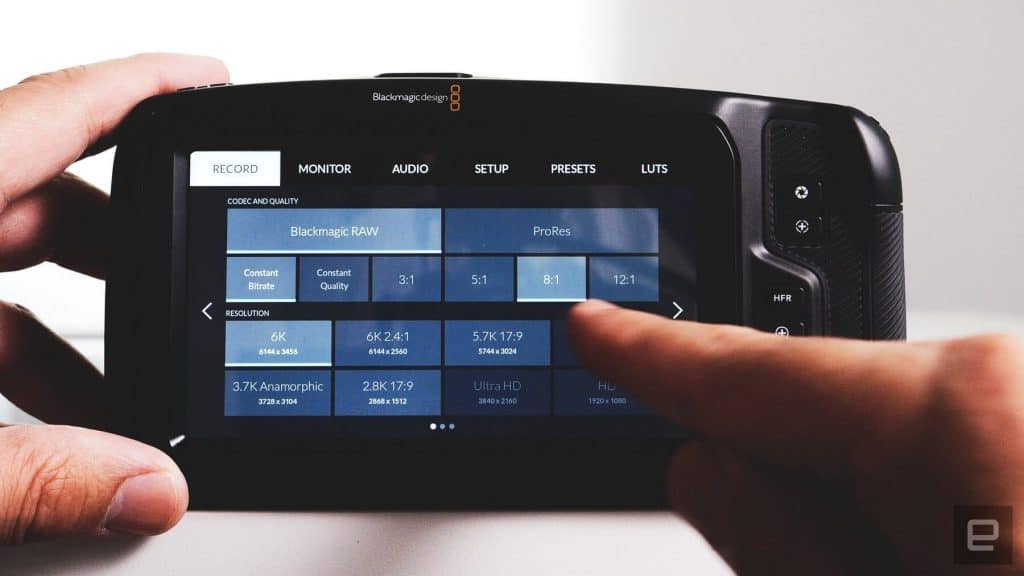
Tilta mods Blackmagic’s Pocket Cinema Camera with a tilt screen and SSD

The mod kit lets you keep your existing screen while adding full articulation.

With their sharp picture, super efficient and flexible RAW format and SSD compatibility, the Blackmagic Pocket Cinema Cameras are fantastic choices for videographers on a budget or anyone in need of a solid B-camera that doesn’t break the bank. But one nagging problem is the camera’s fixed 5-inch LCD, which can make it difficult to keep an eye on the action when positioning the camera at certain angles. Accessory maker Tilta is correcting that with an aftermarket modification kit that adds the ability to pull and tilt the screen to suit your viewing angle.

You won’t be replacing the camera’s screen with this mod, just adding some hardware to allow it to twist and turn. Tilta says that it only takes an hour to complete the modification and that the kit includes all the tools you’ll need. The company will also provide tutorials so you can follow along and hopefully not brick your pricey camera. Oh, and performing this mod will definitely void your warranty.

The kit will also come with carbon fiber replacements for the BMPCCs’ flimsy port plugs, as well as a kit that allows you to mount an M.2 SSD in the cavity formerly occupied by the screen. A stock Blackmagic Pocket Cinema Camera takes SD, UHS-II and CFast cards natively, and can also write to a tiny USB SSD, like the Samsung T5, via a USB port. So while there’s no lack of connectivity, having an SSD tucked inside the camera is a nice bonus. Tilta hasn’t published a product page yet, but the mod kit will ship in November and cost $329.

Fitbit is reportedly in the early stages of exploring a sale

It’s sandwiched between its rivals in smartwatches and fitness trackers.

Fitbit might be ready to cede some control of its destiny. Reuters sources said the company is talking to investment bank Qatalyst Partners about the possibility of shopping itself around to would-be acquirers. Qatalyst has reportedly been pressing Fitbit to consider the option for weeks, suggesting that Alphabet and private equity outfits might be interested if it did. A move is far from certain, but it’s notable that a selloff is even on the table.

Fitbit and Alphabet have both declined to comment.

There might be good reasons for Fitbit to consider a sale. While it has enjoyed some success transitioning to smartwatches and services, it’s still struggling to return to profit. There have been missteps such as the poorly received Versa Lite. Fitbit isn’t in imminent danger if it continues to operate on its own, but a purchase could give it a lifeline and help it compete against rivals with vast resources.

Microsoft invites more people to test very rough Xbox features

You can join the Alpha Skip Ahead ring to live life on the edge.

You’ve had to be part of a very exclusive club to try Xbox One features in their rawest form — so exclusive the criteria has been “closely guarded,” Microsoft said. Now, though, the company is loosening its restrictions ever so slightly. The Xbox Insider unit is inviting more people to join the Alpha Skip Ahead ring so that it can expand testing for key updates. If you see this before September 23rd at 2:59AM Eastern (11:59PM on September 22nd), you can use the “report a problem” feature in the power menu, choose “add new problem,” pick “future build” and then make a case for why you should be included in the Alpha Skip Ahead program.

You’ll know if you get in through an Xbox Live message formally inviting you to the test ring.

This isn’t for the faint of heart. Alphas are rough by their very nature, and Microsoft warned that the current Alpha Skip Ahead build has bugs that can prevent the home dashboard from loading or prompt you for a passcode even if the feature is turned off. You may only want to sign up if you’re determined to try new features and feel that even beta tests are too slow.

Stocks to Watch: Analyst Target Watch for Royal Dutch Shell PLC (:RDS.A)

Investors may be tracking sell-side analyst opinions on shares of Royal Dutch Shell PLC (:RDS.A). According to analysts polled by Zacks Research, the current consensus target price is $72.62. Analysts and financial institutions may use different methods to value a particular stock. Because of the use of alternate methods, individual price targets may be widely varied. Viewing the consensus target price can help provide a general sense of where the sell-side sees the stock heading in the future. Investors can take a look at the target projections and decide for themselves if they agree with the Street. Investors tend to take a closer look at shares when analysts provide update to price targets.

Some traders may be using technical analysis to try and beat the stock market. There are many different indicators that traders have at their disposal. The sheer amount of indicators may leave the trader wondering which ones to use. Studying different technical indicators and signals may be worthwhile and educational, but the average investor may only end up focusing on a couple different indicators that actually work. Finding which indicators to follow and trade on may take some time and effort. Scoping out the proper signals and figuring out which ones tend to work the best may be on the minds of many traders. Trying to follow too many technical indicators might not be the best idea, and it may even cause more confusion. Once the signals have been chosen, traders may spend a lot of time back testing strategies before diving into the market.

Street analysts often provide stock recommendations for companies that they track. According to analysts polled by Zacks Research, the current average rating on shares of Royal Dutch Shell PLC (:RDS.A) is 1.8. This average rating includes analysts who have given Buy, Sell and Hold ratings on the name. This rating uses a numerical scale from 1 to 5. A 1 would indicate a Buy recommendation, and a score of 5 would point to a Sell recommendation. Out of all the analysts offering recommendations, 6 have rated the stock a Strong Buy or Buy.

Covering analysts are looking for Royal Dutch Shell PLC (:RDS.A) to report a current quarter EPS of 1.09 when the company issues their next earnings report. This is the consensus estimate using analysts taken into consideration by Zacks Research. This estimate includes 2 sell-side analysts. For the previous reporting period, the company posted a quarterly EPS of 0.86. Investors will be closely tracking how close the actual comes to the consensus estimate after the next report. Analysts covering the stock are usually very busy during earnings periods. Before the release, they might be revising estimates. After the earnings release, they will closely review the information and update accordingly.

Looking at some recent stock price activity for Royal Dutch Shell PLC (:RDS.A), we have spotted shares trading near the $58.31 level. Looking at some popular historical levels, we note that the 52-week high is presently $69.6, and the 52-week low is currently $54.95. When the stock is trading close to the 52-week high or 52-week low, investors may pay extra attention to see if there will be a move through that level. Looking back over the last 12 weeks, the stock has moved -10.42%. Heading back to the start of the year, we can see that shares have moved 0.07%. Over the past 4 weeks, shares have seen a change of 4.33%. Over the last 5 trading sessions, the stock has moved 3.11%.

Stock market investors may be well aware of how turbulent the investing climate can be. Markets might be surging to new highs leaving the average investor to wonder what will happen next. When everything is going higher in the stock market, it may seem as though every pick is going to be a winner. Conversely, when things are going down, investors may be cursing the day they ever entered the markets. These ups and downs are a normal part of investing in the stock market. Having a well thought out investing plan may help ease the burden of day to day volatility. Many successful investors and traders will preach the wonders of sticking to an outlined plan. It may take some time to actually realize how well the plan is working. If after some time the results continue to be sub-par, then it may be time to devise a different plan.