
Archives for September 6, 2019

Didn’t anyone tell you investing rules change in retirement?

If you’re close to retirement or already retired, merely reacting to the latest bout of market volatility, viewing it as a warning, may not be enough. It’s time to sit up and take notice, understanding what a larger potential correction could do to your financial situation.

Could a market correction, like the one we experienced a decade ago, sink your retirement plans? For those near retirement, a 15% to 20% market decline likely wouldn’t make a big change in retirement lifestyle. However, a downturn of 30% to 40% could be catastrophic.

Instead of hiding and doing nothing (which could be a big mistake) or panicking and abandoning your plan altogether (which could be an even bigger mistake), why not consider taking some defensive measures? If you’re counting on your investments for income, you may not be able to just hold on and wait out another rough market cycle. Your savings will now be subject to “sequence of return risk.” That means, if the market is down and you need the income, or if you are 70½ and taking RMDs you may have to take the money while you accounts are down! The markets will typically bounce back, but your accounts may not.

Now may be a great time to make the shift from a portfolio built for growth and accumulation to one that’s about income, wealth preservation and tax advantages. Two questions to ask yourself:

  1. If you’re close to retirement or already retired, and the market goes up 20%, will it change the way you retire?
  2. If the market goes down 40%, will that change the way you retire?

If you answered NO and then YES , here are some steps to take to help safeguard your retirement future:

Take a fresh look at your goals as you transition from working to retirement.

The clearer you are when envisioning and defining your goals, the easier it should be to reshape your financial plan to achieve them. Think about it: If you’re going to bake a pie, you begin with the end in mind. You choose the ingredients, purchase them at a good price and prepare them in a certain order to make the best pie you can.

Creating a wealth-preservation plan should work the same way. Up until now, you may have had a hodgepodge of investments amassed with one goal: accumulation. But in retirement, your portfolio could benefit by being more specific. What investments, products and strategies will get you where you want to go?

Build an income plan that can help keep you afloat if the market crashes.

What type of guaranteed or reliable income sources will you be living on? Social Security, a pension, real estate, annuities, bonds? These retirement “paychecks” can help serve as your lifeboat: If they provide enough money to cover your basic living expenses, or close, you won’t feel the need to jump out of the market should your investments flounder a bit.

In the current interest rate environment, bonds have become a more challenging place to get income, so you may want to consider indexing products as an alternative. Insurance companies now offer indexed annuities and life insurance, which are fixed products that allow you to participate in a percentage of the market’s upside while protecting you from a loss. (Like everything else, no one product can fit everyone’s needs, so find a fiduciary who will recommend the ones that best fit your needs.)

Consider a more conservative investment plan.

The risks you’re willing to take in your working years can be more dangerous in retirement, when you’re pulling from your nest egg rather than contributing to it. That doesn’t mean you should eliminate all risk. You’ll need to hold inflation at bay if you want to be able to afford a long life in retirement. But you should consider minimizing the impact a market downturn can have on your portfolio. Investments that fluctuate with the market, such as stocks and bonds, need proper diversification to reduce volatility risk.

Mutual funds and ETFs have become popular because they’re an easy way to diversify, but they’re still subject to the market’s whims, and it’s easy to duplicate holdings. Take the time on your own or with your adviser to go through the positions you hold and make sure they match up with your objectives.

Don’t overlook the importance of tax efficiency.

When you were working, you probably asked your tax preparer to save you as much money as possible on your return each year. Retirement planning, though, is all about the long journey. If you have all your money in a 401(k) or some other pretax account, you could end up running into a wave of taxes in retirement. It’s crucial to have a plan for when and how much you’ll pull from your retirement accounts and how those withdrawals will work with your other income sources.

You may also want to convert some money to a Roth account or find another strategy to reduce the tax hit you could take in retirement. Due to the deficit, some feel taxes are going up in the future and that the tax brackets today may be the lowest we’re are ever going to see in our lifetimes.

Work out the basics of your legacy plan sooner rather than later.

Of course, your primary retirement planning objective is to be sure you don’t run out of money during your lifetime. That can make legacy planning a challenge, especially when you’re concerned about market volatility. But if you plan now, it could save you and your loved ones money later. Talk to an experienced professional about life insurance, trusts and other strategies that will ensure your loved ones get what you wanted them to have. Don’t wait until your health or mind is failing to put this part of your plan in place.

If the latest ups and downs in the market made you a little queasy, don’t fret. Maybe you didn’t make the changes you wanted at the top of the market, but you may be close enough. There’s no time like the present to right your ship and sail forward with confidence.

52% of Americans have raided their retirement savings early—here’s why that’s a mistake

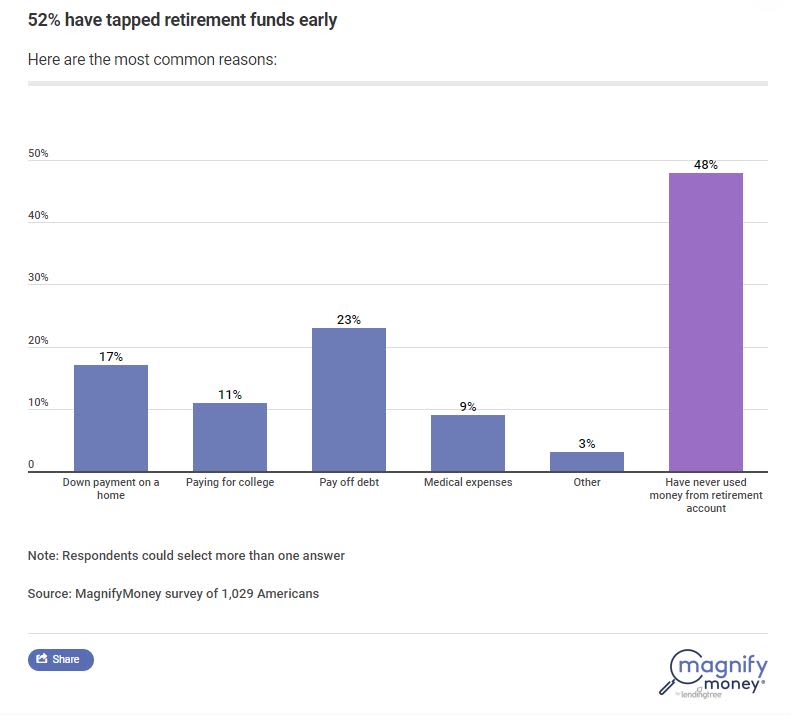
More than half (52%) of Americans have tapped into their retirement savings early, according to a recent survey from Magnify Money, and 23% did so in order to pay off debt.

Survey respondents also dipped into their savings to cover a down payment on a home (17%), paying for college (11%) and medical expenses (9%).

Magnify Money Retirement Savings Chart

Millennials (ages 22 to 37) in particular are more likely than Gen X (ages 38 to 53) and baby boomers (ages 54 to 72) to pull from their savings early, the survey found. Education is a priority: 59% of well-off millennials say they would take money from their retirement savings in order to fund their kids’ college so that they can avoid student loan debt, a similar survey from investment company Ameriprise found.

While they may have good intentions, many financial experts warn against this line of thinking. “You don’t want to derail your retirement for your child’s college education when they can get a loan or scholarships,” certified financial planner Carrie Schwab-Pomerantz tells CNBC Make It.

It’s best to avoid taking from your retirement early if at all possible, regardless of the reason, Ryan J. Marshall, a New Jersey-based certified financial planner, tells CNBC Make It.

“One of the worst things we see is when people try to play catch up with their retirement later on,” Marshall says.

Here are three major reasons to forgo pulling money from your retirement ahead of schedule.

1. Borrowing early could result in penalties and fees

Not only will taking money out early leave you with less in retirement, but you could also be hit with early withdrawal penalties.

With a 401(k) plan, taking money out before turning 59½ can result in a 10% penalty. And if you take out a significant amount of money at once, those withdrawals could push you into a higher tax bracket since you’ll have to include withdrawals as income on your tax return.

If you have a Roth IRA, the rules for withdrawal are more flexible than those of a 401(k) plan. But, typically, the same 10% penalty applies to any interest accrued on your contributions if you are younger than 59½. Plus, you may also be required to pay taxes on the withdrawal.

There are sometimes ways around these penalties, but it’s important to be aware that they exist.

2. You’ll lose out on compound interest

The longer your money is invested in the market, the more you’ll have in the end. That’s thanks to compound interest, in which any interest earned then accrues interest on itself.

“Compound interest is huge and is something you really can’t get back once you take a withdrawal,” Marshall says. “There isn’t a compound interest fountain of youth and we can’t go back in time. Once you miss out on the compounding interest effect, it’s lost.”

If you started investing $250 a month at 25, you’d accumulate around $879,000 by 65, assuming an 8% return on investment. But if you start at 35, you’ll have just over $375,000.

If you start saving early for retirement, do so consistently throughout your career and leave the money where it is for as long as possible, you’ll have a far healthier retirement account than someone who borrows from their retirement fund early. If you need cash, try to tap into other sources before dipping into your 401(k) or IRA.

3. Retirement funds are legally protected

Should you get behind on your bills or experience financial troubles, creditors can take you to court and go after your assets. However, most employer-sponsored retirement funds, such as 401(k) plans, are protected by the Employee Retirement Income Security Act (ERISA).

That means that in most situations it won’t be possible for others to gain access to your retirement account. But that money is no longer protected if you withdraw it early. Instead, it’s best to keep your savings safely stored within your 401(k).

Tennis legend Andy Roddick wants you to save your money. Here’s how he did it

For tennis great Andy Roddick, there’s one important rule that works both on the court and in the world of investing.

“Even if you’re intimidated by words like ‘volatility’ and you think the world’s going mad … be disciplined with what you put away monthly,” the one-time U.S. Open champ told CNBC’s “Fast Money: Halftime Report” Thursday.

“That shouldn’t change regardless of what you think is the best avenue to grow money.”

It was that discipline that propelled Roddick into the world of professional tennis in 2000 at the age of 17. It also led him to start the Andy Roddick Foundation, which works on expanding educational opportunities for kids, when he was 18 years old.

A few years later, just after he turned 21, Roddick won the U.S. Open and briefly held the title of No. 1 ranked player in the world.

While his career was skyrocketing, Roddick made sure he started saving his money and investing wisely.

“The goal was that when I stopped playing, whatever I made on the court would be replaced by whatever I built while I was still playing,” he said.

“I don’t know that a lot of athletes … think that way,” he added. “There’s such an opportunity at a young age to get your money to work for you.”

For Roddick, his big opportunity came during the 2008 financial crisis. When a lot of people were trying to liquidate their holdings, he snapped up some real estate — specifically, bank buildings — and locked down 15- and 20-year leases.

“With real estate, if you wait long enough, you look smarter 10 or 12 years later,” said Roddick, who retired from the game in 2012.

He now has about 70 properties and isn’t buying as aggressively as he once was.

Roddick, who earned $20.6 million in prize money during his tennis career, knows he’s been fortunate. However, he stresses that the same basic principles apply, no matter your salary.

He said hears things like, ”‘I only have so much, so what’s the point of investing?’”

“Start it, because 10, 12 years later, you’re going to be happy you did,” Roddick said.

5 Tips to a Quicker Retirement

Remember the Seven Dwarfs song, “Heigh-Ho, Heigh-Ho (It’s Home From Work We Go)”? How about the 1988 variant by David Chamberlain, “I Owe, I Owe (It’s Off to Work I Go)”?

You might be singing the latter tune for longer than you’d like as you try to reduce your debt and expenses while you work to increase your retirement income. Here are five tips that might help you to reach your retirement nest egg goal a little more quickly:

Decrease your taxes to allow you to save more money for retirement. Consider using a high deductible health plan with a health savings account for tax-free savings to cover health care expenses. Use a flexible spending account to pay for out of pocket health care costs and dependent care expenses up to an annual limit. Increase your contributions to the traditional Thrift Savings Plan, where you save using pre-tax dollars. (On the other hand, if you save after-tax dollars now in the Roth TSP option, you’ll reduce your taxable income in retirement. It’s a case of pay the IRS now or pay it later.) 

If you’re under the Federal Employees Retirement System, keep working. At least until you qualify for Social Security retirement, the 1.1 percent FERS annuity calculation factor and cost of living adjustments to your benefit. In other words, work until you’re at least 62 years old with at least 20 years of service. 

Increase your savings, in the TSP and elsewhere. The Securities and Exchange Commission’s Compound Interest Calculator allows you to quickly and easily project the growth of your current account balances and future contributions. (For the TSP monthly savings, be sure to include not only your contributions, but agency automatic and matching contributions.) The TSP’s own How Much Will My Savings Grow calculator can be used to run a variety of interest rate scenarios. You can then convert the balance you have projected into retirement income by using the TSP’s Retirement Income Calculator.

Make sure you’re getting credit for all of your past federal and military service. One of the main factors in determining the value of your retirement benefit is your years and months of creditable service. Every month of service is worth 1/12 of a percentage of your high-three average salary. The percentage varies from 1 percent to 1.1 percent for FERS and 2 percent for Civil Service Retirement System employees. Is all of your past employment properly documented showing the beginning and ending dates of each appointment along with your retirement coverage and work schedule? Records of your past federal service should be filed in your electronic official personnel folder. Locate these records and make a copy to keep in your files. 

Pay any applicable deposits into the retirement system. In the course of making sure your service is properly documented, you might discover that you may have to pay a deposit to the retirement fund in order to get full credit for this service in your annuity. The rules are different for civilian and military service credit and also vary for CSRS and FERS. Deciding whether or not to pay a deposit is a personal choice, based on how much you have to pay and the effect it would have on your benefit. A retirement specialist in your human resources office should be able to help you sort things out.