
Archives for September 5, 2019

Stock markets trade higher

Canada’s main stock index headed higher in late-morning trading, helped by the energy sector as the price of oil gained ground.

The S&P/TSX composite index was up 64.76 points at 16,463.99.

In New York, the Dow Jones industrial average was up 177.99 points at 26,296.01. The S&P 500 index was up 21.18 points at 2,927.45, while the Nasdaq composite was up 67.81 points at 7,941.97.

The Canadian dollar traded for 75.35 cents US compared with an average of 74.95 cents US on Tuesday.

The October crude contract was up US$2.03 at US$55.97 per barrel and the October natural gas contract was up 3.5 cents at US$2.393 per mmBTU.

The December gold contract was down US$1.50 at US$1,554.40 an ounce and the December copper contract was up 5.75 cents at US$2.5855 a pound.


Banks warn of slowdown

The top executives of Canada’s biggest banks are signalling slower growth ahead amid looming trade tensions and America’s falling interest rates, but the lenders remain confident they’ll be able to adapt to the changing environment.

CIBC chief executive Victor Dodig told an industry conference Wednesday that the prospect of more countries moving to negative interest rates is an issue and questions loom over whether trade wars can worsen.

He added that “you can’t keep your blinders on” but CIBC will manage by adjusting its business and investment spending accordingly.

“That’s going to be the plan going forward,” Dodig told the Scotiabank Financials Summit. “We are living in very unprecedented times. Political leadership tends to be on the angrier side, the more aggressive side. Negative rates, trade wars. These aren’t good trends.”

The executives’ comments came days after Canada’s biggest banks reported their financial third-quarter results, with a mix of beats and misses, as tensions between the U.S. and China weighed on business sentiment.

As well, concerns of a potential recession and a recent interest rate cut by the U.S. Federal Reserve cast a shadow over the lenders’ earnings prospects. On Wednesday, the Bank of Canada stayed put on interest rates as other central banks have been signalling or taking policy action in response to expanding trade risks. Analysts have predicted that Canada’s central bank will lower rates at its next announcement in October.

The Canadian banks’ U.S. businesses have benefited in recent years from economic stimulus and rising interest rates, which helped fuel robust earnings growth and spurred several lenders to expand their footprints south of the border.

And as rising interest rates had padded banks net interest margins — the difference between the money banks earn on the loans they make and the interest they pay out to savers — the recent rate cut puts pressure on them.

Dodig said Wednesday a 25 basis point rate cut translates to between $10 million and $20 million of revenues for CIBC’s U.S. business, which is “a manageable amount.”

BMO Financial Group chief executive Darryl White on Wednesday said with declining rates, the growth will be slower. Still, lower rates may stimulate consumer behaviour and unemployment remains quite low, he added.

“If the last two or three (years) were a tailwind, is this a gale-force headwind?… I think it feels like a breeze in the face,” White told the conference. “And that’s really important, because it doesn’t mean that we put the brakes on investment and offence, but it does mean that you start to shift the way you think about benefiting from investments you’ve made over the last three years.”

RBC chief executive Dave McKay agreed there are headwinds but the outlook is “not as dark,” adding that if there is a lower growth, lower rate environment the bank will shift gears.

“If there is less growth opportunity, you have less deployment of sales capacity, you have less advertising… we’re still focusing on economic opportunity, but if that doesn’t present itself, we’ll pull back.”

Scotiabank chief financial officer Raj Viswanathan said the lender’s biggest tool to help navigate the changing landscape is its diversification, such as its international footprint.

TD Bank chief executive Bharat Masrani told the summit that while lower rates are not helpful, he would also expect business activity to pick up as a result.

“The part that we should keep in mind is, as quickly as things appear to have turned, it could turn the other way as well,” he said. “And we have to just be mindful of operating the bank as thoughtfully as we can through this turmoil and through this volatility.”

Home prices fall, sales up

The number of homes sold in the Greater Vancouver area was up in August compared with a year ago, but benchmark prices for the major categories of housing was down, the region’s real estate board says.

The Real Estate Board of Greater Vancouver says there were 2,231 home sales last month, up 15.7 per cent from 1,929 in August 2018.

However, it says the benchmark price for 706 detached homes sold in August was $1.4 million, down 9.8 per cent from the same month last year.

Sales of apartment homes reached 1,116 in August — 8.9 per cent more than the same month last year — but the benchmark price for the category fell 7.4 per cent from August 2018 to $771,000.

For the 409 attached homes sold in August, the benchmark price was $654,000 — down 7.8 per cent from a year earlier.

The price declines came as the total number of homes listed for sale in August rose 13.3 per cent from a year earlier, to 13,396.

Billion dollar trade deficit

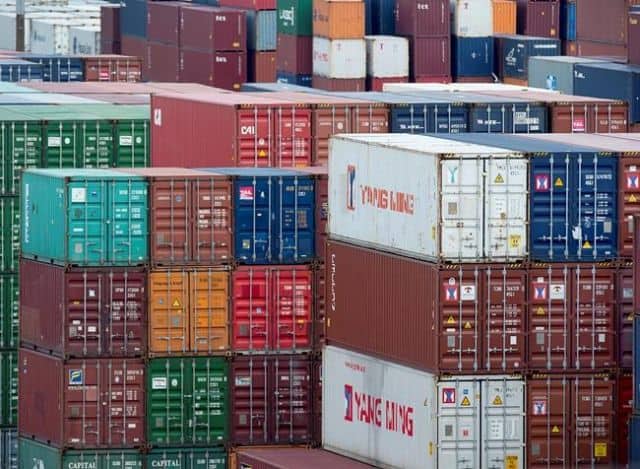
Statistics Canada says the country posted a merchandise trade deficit of $1.1 billion in July compared with a revised deficit of $55 million June.

Economists had expected a deficit of $400 million, according to financial markets data firm Refinitiv.

The result for June was updated from what was originally reported as a $136-million surplus.

Statistics Canada says imports rose 1.2 per cent to $50.9 billion in July, with gains in six of 11 sectors.

Imports of consumer goods were up 2.4 per cent, while aircraft and other transportation equipment and parts rose 10.2 per cent.

Total exports fell 0.9 per cent to $49.8 billion in July as energy product exports fell 6.7 per cent in July due to a 7.7 per cent drop in crude oil exports.