Archives for September 2, 2019

Weekly Market Review – August 31, 2019

Stock Markets

U.S. stocks managed to eek out another gain, ending the week in and the month of August on positive note. The rally was fueled by optimism about the possible reduction of trade clashes between the U.S. and China based on conciliatory talk emerging from both countries. The economic data that showed consumer spending rose by 4.7% over the second quarter also helped. Remember that consumer spending accounts for for 70% of all economic growth. A change in Britain’s Brexit situation reared its head once again as the odds of the U.K. leaving the European Union without an agreement were bolstered by the new prime minister announcing he would be suspending Parliament before October 31 – the Brexit deadline. So even with the spate of geopolitical uncertainties, the solid consumer fundamentals, rise in corporate profits continuing, and generous monetary policies are likely to extend the current economic expansion – one of the longest in recent history.

U.S. Economy

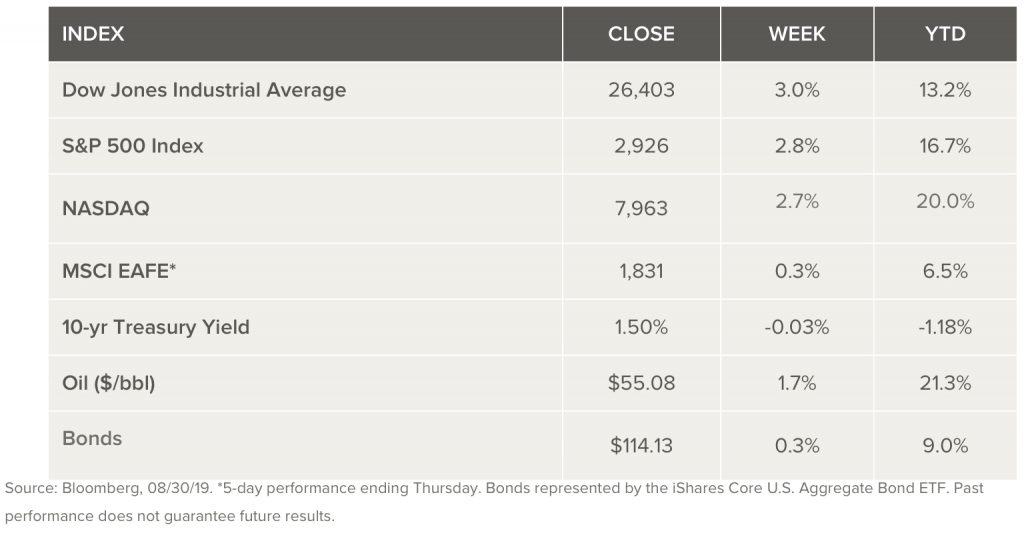
The end of August was the period on a volatile month during where stocks swung on frequent changing trade news between China and the U.S. Sometimes they rebounded off progress on negotiations and then escalated based on news of tariffs. Overall, the S&P 500 is up a strong 17% in 2019. It is down 3.5% from the recent high and at about the same level as it was this time last year. The sell-off last December was followed by a strong rally to new highs through much of 2019. It lost some traction over the past month. But as impressive as this bull market has been over the last 10 years, it is certainly not smooth, with several significant periods of market volatility. And while stocks finished August on a high note, recession fears are still hanging on. So there are several cautionary signals that give pause to the bull market’s longevity.

Metals and Mining

Gold was softer on Friday as both the US dollar and equities moved up. Despite the slight slide in the market, concerns about the economy trade war battles kept the gold on track for its fourth consecutive monthly rise. Gold surged through a more than six year peak earlier in the week, climbing over US$1,550 per ounce as investors sought safe haven refuge. The situation between the US and China has been grabbing the attention of market participants for over a year now, and fueling concerns around a global slowdown. Silver managed to continue its rally on Friday, holding strong. Like gold, it is being supported by interest from investors thanks to concerns surrounding the state of the economy and geopolitical issues. In terms of where the silver price may go from here, markets watchers say that investors won’t have to wait long for it to hit US$20. As for the other precious metals, platinum made gains, finally breaking through the US$900 per ounce level. That’s over a more than one-year high and heading for its best month since January of last year. Palladium made huge gains this week, ticking up over 5 percent as it went head-to-head with gold on Friday for the highest trading precious metal title.
After a relatively lackluster August, it got momentum at the end of the trading week as it hit a one month high. Palladium was trading at US$1,526 per ounce as of 11:00 a.m. EDT, Friday.

Energy and Oil

It looked like oil prices were set for their biggest weekly increase since July until demand fears caused by Hurricane Dorian hitting Florida sent prices crashing on Friday morning. Oil prices were initially pushed up by cautious language from the U.S. and China, falling oil inventories, and also by the major Hurricane heading for the southeastern U.S. Despite the apparent easing in the trade war, tariffs are set to jump on Sunday. Analysts state that upside momentum should not be taken for granted and that recession fears are casting a shadow on sentiment and oil prices should keep dancing to the tune of the U.S.-China trade saga.

Natural gas spot prices fell at most locations this week. Henry Hub spot prices dropped slightly from $2.25 per million British thermal units (MMBtu) last Wednesday to $2.24/MMBtu this week. At the New York Mercantile Exchange, the September 2019 contract expired yesterday at $2.251/MMBtu, up 8¢/MMBtu from last week. The October 2019 contract increased to $2.222/MMBtu, up 4¢/MMBtu from last week. The price of the 12-month strip averaging October 2019 through September 2020 futures contracts climbed 3¢/MMBtu to $2.373/MMBtu.

World Markets

European markets rose this week lifted slightly by improvements in U.S.-China trade talks and a new agreement forwarded by Italian political parties to join together for a new government. The pan-European STOXX Europe 600 Index rose over 2%, while the German DAX advanced 2.5%, and Italy’s FTSE MIB Index made serious headway and gained almost 4%.The FTSE 100 Index rose after Prime Minister Boris Johnson suspended Parliament from mid-September until October 14 in an attempt to push through Brexit. The idea behind the move shortens the time period when opponents of Brexit will have to prevent a disorderly Brexit. It was endorsed by by Queen Elizabeth II. Unfortunately it could end up triggering a possible election based on non-confidence.

Chinese investors were not as pleased by the latest trade developments and seemed to be preparing for a new wave of U.S. tariffs. The benchmark Shanghai Composite Index declined 0.4% and the large-cap CSI 300 Index dropped 0.6%. Both indices fell in August, with the Shanghai composite falling 1.6% and the CSI 300 giving up 0.9%.

The Week Ahead

The coming week is shortened by the Labor Day holiday, and holds light reporting including the Manufacturing Purchasing Managers’ Index on, auto sales, foreign trade deficit numbers, non-farm payrolls and August’s jobs report on Friday.

Key Topics to Watch

  • Markit manufacturing PMI
  • ISM manufacturing index
  • Foreign trade deficit
  • Motor vehicle sales
  • Weekly jobless claims
  • Markit services PMI
  • Non-farm payrolls
  • Unemployment rate
  • Average hourly earnings

Markets Index Wrap Up
How Millennials Are Revolutionizing The Home Buying Process

There is a seismic shift in the real estate market and it’s all due to the Millennial generation.

“Millennials have represented the largest share of the home buying market for the past five years in a row with the 2018 share at 36%,” says Anna DeSimone, author of Housing Finance 2020 and a housing advocate.

It’s no secret that, compared to previous generations, Millennials are late to the home buying game. Both their parents and the press lament that many Millennials either live at home or are simply more content to be renters. As a result, there is a perception that owning a home was not a priority of this generation. But the real answer might be simpler.

“Affording a home, one could argue, was relatively easier for the previous generation,” says Farnoosh Torabi, Personal Finance Expert and Host of the highly rated SoMoney Podcast which focuses on Millennial money issues.

Even though Millennials have been adults in a consistently low interest rate environment, the barrier to entry to the real estate market has been high for this generation.

Torabi explains it quite simply as a perfect storm. “While research suggests Millennials are even more interested in buying homes than their parents, they are slower to buy due to a set of financial challenges, which include student loans and credit card debt, as well as an inability to save up for a down payment,” she says. “Wages have been pretty stagnant, on average, over the last 15 years, all while the cost of living, education and housing has skyrocketed.”

Yet like everything that Millennials have faced, they are about to revolutionize home buying and put their own personal stamp on it. And in some instances, they may be rewarded for their patience by some unique partners.

More Personalized, More Service

Previous generations were buying homes in an entirely different world. Buyers found their realtors through personal referrals, the Yellow Pages or by simply walking into an open house. If the right chemistry was there, it was often a stroke of luck.

But from dating apps to subscriptions, the Millennial generation is both captive to and captivated by technology, which has found its way into the home buying process. The National Association of Realtors reports in Homebuyer & Seller Generational Trends in 2019 that 81% of older Millennials found their home through a mobile app. Given this, the real estate world is recognizing that leveraging technology will enable it to capture the generation focused on ‘swiping right’.

Realogy, which owns some of the top national real estate firms including Coldwell Banker and Century 21, is using technology to create a unique Millennial home buying experience. It has partnered with Amazon to offer the TurnKey Home Purchase Service. By answering a few questions online, the potential home buyer is matched with an agent who is best suited to find them their home. For older generations, this may seem like an odd choice, but it works well for the needs and habits of Millennial buyers.

“People are seeking slightly smaller homes, and want properties that suit their lifestyle, such as larger yards for pets, or organic gardens. Location preferences have changed and many Millennials want to live in a walkable city or near public transportation,“ points out DeSimone.

Treating the real estate agent relationship like a successful Bumble connection will likely result in a more satisfying experience for the Millennial home buyer.

Rewards for Technology

But the technology doesn’t stop there. In fact, in the real estate transaction, the technology is beginning to dictate lifestyle.

When previous generations purchased their first homes, they were on their own once the sale closed. Gen Xers and Boomers counted on hand-me-down furniture and housewarming gifts from family and friends to make their new house a home.

But in catering to the Millennial homeowner-to-be, real estate companies realize that this generation, having waited to purchase a home, want to make it their own quickly. When a home is purchased through a TurnKey agent, the homeowner receives for free smart home products worth from $1,000 to $5,000 based on the home purchase price. Further Amazon will even include in the offer free in-home services like hanging TVs or cleaning.

Torabi agrees that this type of service really appeals to Millennial home buyers. “One trend that we’re seeing across new home buyers is the desire for ‘optimized’ homes that cater to one’s well-being. such as spaces for meditating, workout areas, expansive kitchens, and an eco-friendly environment,” she says. “They want to make sure their house accommodates their lifestyle and values.”

For thirtysomethings who just spent years saving for a down payment, getting their house made ready for move in will save on their monthly budget.

Technological Changes for a Changing World

While these shifts in the home buying market might seem like marketing, it is actually foreshadowing an evolution in home ownership.

“The home buying behavior of Millennials continues to change,” points out DeSimone. “Millennials are environmentally conscious, and are seeking energy conservation, open spaces, walking trails and sustainability in their home choices.”

Further, as they have struggled under the pressures of debt and stagnant wages to finally buy a home, perhaps gaining goods and services in the home purchase process is a fair outcome. But it also shows that as Millennials continue to be the largest segment of home buyers, they are going to demand that the market caters to them.

3 Retirement Planning Mistakes You Might Not Even Realize You’re Making

Retirement planning takes decades of hard work, and it can sometimes be confusing and overwhelming. Fifty-six percent of Americans don’t have a clue how much they should be saving for retirement, a survey from Northwestern Mutual found, and roughly 1 in 5 have no retirement savings whatsoever.

Even if you are trying to save for the future, you’ll likely make some mistakes along the way, and that’s OK — as long as you correct them. Some errors are subtle enough you may not even realize you’re making them. However, they can throw your entire retirement plan off track.

1. Underestimating your expenses in retirement

Calculating how much you’ll likely spend each year once you retire is the foundation of retirement preparation. If you underestimate how much you’ll spend each year, you may not save enough by the time you retire and risk running out of money too soon.

Even slight miscalculations can result in major financial problems, too. Spending even a few thousand dollars more than you’d planned each year adds up when you’re spending decades in retirement, and depending on how much you’re spending each year, that could mean outliving your savings by several years.

Of course, you can’t predict exactly how much you’ll need each year in retirement, and unexpected expenses — particularly healthcare expenses — will inevitably pop up. But the more accurate your estimate is, the better chance you’ll have at saving enough.

To figure out how much you’ll be spending in retirement, it’s a good idea to create a retirement budget and map out all your expected costs. Even though you won’t be able to predict all your costs, getting a relatively accurate estimate will help ensure you don’t underestimate your basic living expenses.

2. Assuming Social Security will cover most (or all) of your expenses

Roughly half of recent retirees say Social Security benefits are their primary source of income, according to a survey from Nationwide. However, nearly a quarter say they’re receiving less in benefits than they expected.

The average Social Security check amounts to just $1,471 per month, which is hardly enough for most Americans to live on — especially as you age and healthcare expenses start creeping up. Social Security benefits are only designed to replace around 40% of your preretirement income, so if you’re expecting them to cover the majority of your retirement expenses, you could be in for a rude awakening.

In addition, there is the possibility that benefits could be cut in the future. Because there’s more money flowing out of the program than coming in, the Social Security program is facing a cash shortage and is expected to deplete its financial reserves by 2035. Although that doesn’t mean the program will fall apart completely (as long as workers continue paying their taxes, there will always be at least some money to distribute in benefits), it does mean benefits could be reduced in the future. Now, that’s assuming Congress doesn’t come up with a solution before 2035. But it’s a good idea to have a backup plan so you’re not placing your financial future entirely in the hands of the government.

3. Not having a withdrawal strategy for your retirement savings

You could save for decades, working diligently to build a strong and healthy nest egg. But if you withdraw too much too soon once you retire, it could undo all your hard work.

There’s no simple answer for how to plan your retirement savings withdrawals. Some financial experts recommend following the 4% rule, which states that you can withdraw 4% of your total savings during the first year of retirement, then adjust your withdrawals each year after that to account for inflation. That’s a good way to keep your spending in check, ensuring your savings have a good shot at lasting the rest of your life.

But the 4% rule isn’t perfect, and it assumes you’ll be spending the same amount (adjusted for inflation) every year in retirement — which isn’t always realistic. For example, you may spend more during your initial years of retirement as you travel and check off other bucket-list activities, lower your spending mid-retirement, and eventually spend more as you age due to health issues. In that case, it might be a good idea to discuss your plan with a financial advisor to figure out what type of withdrawal strategy fits your specific needs.

Making mistakes while planning for retirement is par for the course. Correcting them early ensures you’re on track to enjoy a financially secure retirement.

Here’s how your money could grow if contribute $10, $100, or $1,000 a month to a high-yield savings account at Betterment

The best high-yield savings accounts live up to all the hype. After all, what more could you need in a savings account than no fees, zero risk, full liquidity, and excellent earning potential?

Whether you’re building up an emergency fund, saving for a down payment, or preparing for your next Euro trip, it’s hard to go wrong with a high-yield savings account.

Currently, online investing platform Betterment offers an industry-leading annual percentage yield (APY) of up to 2.39% on its high-yield savings account if you join the waitlist for its checking account. Otherwise, the interest rate is 2.14%.

Betterment debuted its Everyday Savings account this summer with an eye-popping 2.69% APY, though it didn’t last long. Less than two weeks later, the Federal Reserve announced an interest rate cut of a quarter-percentage point and Betterment slashed its rates too — a good reminder to choose a savings account for all its features, not just the APY.

Despite the rate drop, Betterment’s high-yield savings account still earns up to 25 times more than a typical savings account. You need an initial deposit of $10 to open the account, but it’s fee-free, allows unlimited transfers, and is FDIC-insured up to $1 million.

To see how an initial balance of $10 plus additional monthly contributions of $10, $100, or $1,000 would grow at the highest interest rate Betterment currently offers, we plugged the numbers into the compound interest calculator on Investor.gov.

Below, you’ll see the total balance (your contributions plus your interest payments) at the end of one year and at the end of three years. Note that the interest on this account is compounded monthly.

Also note that the calculation assumes a constant APY of 2.39%, though it’s unlikely this would remain the same for up to three years since interest rates are variable.

The takeaway: The more you save, the more you earn. While there are rules of thumb for how much you should be saving in retirement accounts and in your emergency fund, financial planners recommend starting wherever you can. No amount is too small, and once you start, it’s easier to keep going.

To make saving feel effortless, consider setting up automatic transfers from a checking account or even directly through your payroll provider. When you save off the top, you quickly adapt to living on less.

The Betterment Everyday Checking account is set to become available later in 2019 and will have no maintenance or overdraft fees and no minimum balance. The account comes with a Visa debit card, and Betterment will reimburse all ATM fees for accountholders.

3 Simple Tricks for Saving More Money

The data is clear: Almost every American needs to save more money.

Average retirement savings are too low, around 4-in-10 Americans can’t cover a $400 emergency, and average credit card debt tops $6,000. But knowing about the need to save and actually doing it are two different things. Saving can be hard, especially when there are lots of pressing expenses, and income doesn’t quite stretch far enough to cover them all.

But you can make saving simpler — you just need to know the secrets to doing it. To get you started, here are three easy steps to take now to boost your savings rate and hopefully improve your financial security.

1. Target the biggest expenses first

To find ways to cut spending and increase savings, most people start by picking through their budget with a fine-tooth comb looking for areas where they’re spending a bit too much — whether that’s on groceries, dining out, or entertainment.

But you’re only going to be able to cut these small everyday expenses by so much unless you’re really being excessive. And you can end up stripping all the fun out of life by trying to save $5 here and $10 there through taking away that morning latte or your weekly meal out with your spouse.

Instead of nickel-and-diming yourself, look at the big stuff first and see if you can change one or two major expenses that are actually costing you a lot. If you can switch to a cheaper car and cut your payment by $200 a month, that’s going to be a whole lot easier to stick with than cutting out $200 worth of small expenses from every other area of your budget.

2. Get a cash-back credit card and save your rewards

There are almost countless credit cards available today that offer rewards for everyday spending. Why not turn your rewards into more savings?

You can do this if you pick a cash-back card that lets you deposit your money into a bank or brokerage account so you can effortlessly save with every dollar that you spend.

When you save your credit card cash refunds — instead of getting a credit on your statement or opting for a card that provides travel rewards — you can ensure you’re putting away at least some money for the future. Obviously, this can’t be your sole means of saving — but if you charge all your expenses on your cards and end up automatically saving 1% or 2% of your annual spending, this can add up to a surprisingly big chunk of change by the end of the year.

3. Engage a friend in a savings challenge

Saving money can be more fun if you do it with a friend — especially if you make a game of it. So enlist your partner or someone else in your life in a different savings contest every month. You could challenge each other to see who can:

  • Go longer without making a purchase.
  • Have more no-spend days during the month.
  • Make cheaper, healthy meals for dinner.
  • Spend less on gas over the month.
  • Get your electrical bill lower.
  • Deposit more cash in a savings account.
  • Find more free activities during the month.
  • Go longer without dining out.
  • Make more extra income from a monthlong side hustle.

By trying out some different challenges each month, you can cut spending in different areas and find new ways to solve problems. And no matter who “wins” the challenge, you’ll both be better off because of all the cash you’re not spending.

You really can save more

As you can see, there are things you can do that should hopefully help make saving a whole lot easier. Try at least one of these to see if you can increase the amount you’re putting aside for the future. Accomplishing financial goals such as saving for retirement or an emergency fund won’t be possible without getting good at putting away spare cash, so it can really pay to find an approach that works for you.