Archives for July 24, 2019

Canada to invest in satellite technology to connect rural, remote areas Social Sharing

The launch of Telesat’s Telstar 18 Vantage communications satellite on a SpaceX Falcon 9 rocket, launched from Launch Complex 40 at Cape Canaveral Air Force Station, last year. Telesat has been developing a satellite constellation — a group of co-ordinated satellites it says will provide high-speed connectivity in rural and remote communities around the globe.

Satellites will provide high-speed connectivity in rural, remote communities around the globe

The federal government is making a big funding announcement Wednesday alongside a Canadian company that’s developing satellite technology to expand high-speed Internet access in rural and remote regions.

The head of Ottawa-based Telesat will join Economic Development Minister Navdeep Bains for an event that appears to be part of the government’s commitment to invest $100 million over five years into a technology known as low-Earth-orbit satellites.

In its spring budget, the Liberal government said low-Earth-orbit satellite capacity would be part of its $1.7-billion vow to help rural and remote areas gain access to reliable, high-speed Internet.

Telesat has been developing a satellite constellation — a group of co-ordinated satellites it says will provide high-speed connectivity in rural and remote communities around the globe.

Company CEO David Goldberg will hold a news conference with Bains at the Canada Aviation and Space Museum following the announcement.

On its website, Telesat says its state-of-the-art satellite constellation will involve launching highly advanced satellites into low Earth orbit, which is about 1,000 km from the surface of the planet — much closer than traditional satellites.

The satellites will “seamlessly integrate with terrestrial networks,” the company says.

100 per cent connectivity
In March, the federal government earmarked between $5 billion and $6 billion in new investments over the next decade for a plan to make sure 95 per cent of Canadian homes and businesses will have access to high-speed Internet by 2016.

It also set a target of 100 per cent connectivity throughout the country by 2030.

In addition to the development of low-orbit satellite technology, the government plan also includes investments aimed at encouraging more private-sector spending on rural high-speed Internet and better co-ordination among provinces and territories.

The budget also announced the federal infrastructure bank would seek to invest $1 billion over the next decade as a way to attract $2 billion in additional private investments towards expanding connectivity.


Toxic food, toxic water: What’s killing B.C.’s killer whales?

A southern resident killer whale eats salmon in the Salish Sea. Orcas sit at the top of a fragile food chain that is threatened by pollutants and warming ocean temperatures.

Poisoned bodies, dangerous blobs and dissolving snail shells: the threats facing the killer whale family J pod read like a horror film.

The resident orcas of British Columbia’s South Coast have no natural enemies, but the toxins in their environment are creating unnatural threats that could wipe out the entire population of the Salish Sea’s top predator, scientists say.

J pod is one of three orca families that belong to the endangered southern resident group. They are among the most-studied whales in the world and scientists say pollutants in the ocean, and the water itself, could be what’s killing them.

A CBC podcast, Killers: J pod on the brink, hosted by Gloria Macarenko, examines the range of threats facing B.C.’s southern resident killer whales.

Peter Ross, vice-president of research at Ocean Wise and a marine mammal toxicologist, says the southern residents are the marine mammals most contaminated by polychlorinated biphenyls (PCB) on the planet.

Research suggests global killer whale populations could collapse in as little as 30 to 50 years because of exposure to PCBs.

The carcinogens are banned in Canada, but PCBs linger in the ocean for a long time and whales accumulate the toxin in their body tissue. A female killer whale can live up to 70 years — and the longer a whale lives, and the more contaminated salmon they feast on, the more PCBs they store in their bodies.

“They affect normal development, the immune system, reproductive health and brain development,” says Ross, who said the dangerous chemicals can also be passed on to calves through their mothers’ milk.

Ross says PCB levels in southern residents are likely causing hormonal and reproductive problems — and for the endangered orcas, every birth, and death, matters.

The southern resident population is reported to be at a 30-year low and their mortality rate is high — around 50 per cent of babies die in their first year.

Attack of the killer blob
The fragile food chain is also threatened by temperature changes in the ocean.

In 2015 and 2016 a large mass of water at least 2 C warmer than normal, nicknamed “the blob,” loitered in the Pacific Ocean and wreaked havoc on the ecosystem.

According to Brian Hunt, biological oceanographer at the University of British Columbia, in 2016 B.C. had the warmest surface waters on record, and there were “substantially reduced growth rates of juvenile salmon during that year.”

Scientists also noticed large numbers of zookplanton in the blob that are normally found off northern California, not Canada. Salmon rely on zooplankton for food, but the ones found in the warmer waters have much less nutrition.

“Changing ocean conditions are impacting the foundations of the ocean ecosystems and the plankton communities that support the food webs,” explained Hunt.

Souring seas and sea butterflies
The ocean isn’t just getting warmer, it’s also getting increasingly acidic.

The oceans absorb about 30 per cent of carbon dioxide produced by humans, the United Nations says.

Since 1997, the oceans have absorbed man-made heat energy equivalent to a Hiroshima-style bomb being exploded every second for 75 straight years, according to a 2016 study published in Nature Climate Change.

This CO2 intake is changing the chemistry of the water and this is having a ripple-effect on the food chain.

Salmon off the South Coast munch on pteropods, which are swimming sea snails that live at the surface of the ocean and float freely on the current in a fashion that has earned them the name sea butterflies.

These salmon snacks have shells made of calcium carbonate and the acidity of the ocean is now dissolving those shells, endangering this integral food source.

The snails can repair their shells, but the energy they use to do so exhausts them and can lead to premature death.

Iria Gimenez, researcher at the Hakai Institute, studies the impact of ocean acidification in the Salish Sea. At her lab on Quadra Island, she tests a sample of water that measures 428.2 for CO2.

“That’s basically 400 parts per million,’ said Giminez, who explained the number would have been closer to 270 before the Industrial Revolution.

Those numbers will keep rising as more carbon is pumped into the atmosphere, risking more changes to the ecosystem.

Ottawa formally asks companies to make their pitches to replace CF-18 jets

A pilot positions a CF-18 Hornet at CFB Cold Lake in Alberta on October 21, 2014.

A decision on the winning bid is not expected until 2022

The federal government formally submitted requests for proposals (RFP) today to procure fighter jets to replace the decades-old CF-18s.

Four companies are in the running to supply Canada with roughly 80 new jets: Saab of Sweden, Airbus Defence and Space out of Britain, and the American firms Boeing and Lockheed Martin.

Those companies have until spring of 2020 to submit their initial proposals to the $19-billion competition. A decision on the winning bid is not expected until 2022 — the military procurement process can take years — with delivery of the first jets expected by 2025.

That means the first phase of delivery is slated to occur more than 15 years after the former Conservative government began the process of buying new jets to replace the CF-18s, which were first flown by the Canadian Armed Forces (CAF) in 1983.

“The procurement of a fleet of 88 future fighter aircraft is an essential step forward that our government committed to. This investment will mean that the Royal Canadian Air Force has what it needs to protect Canadians. It is essential that we get the right equipment that will serve our women and men in uniform for decades to come,” Defence Minister Harjit Sajjan said in a statement.

Speaking to CBC News Tuesday, procurement officials from the Department of National Defence (DND), Innovation, Science and Economic Development Canada (ISED) and Public Services and Procurement Canada (PSPC) said the project has now reached a “major milestone” after months of intensive engagement with eligible suppliers, which resulted in thousands of tweaks to Canada’s initial draft for eligible bids.

André Fillion, the assistant deputy minister of defence and marine procurement, said the 2025 delivery date will give Canada the capacity to meet its commitments to the North Atlantic Treaty Organization (NATO) and North American Aerospace Defense Command (NORAD).

Fillion said Tuesday the military is prepared to keep the existing CF-18s flying for at least another 10 years — until 2032 — as it awaits the new jets. It also previously agreed to purchase 18 used Australian F-18 jets for $500 million to ensure operational readiness.

Mitch Davies, a senior assistant deputy minister at ISED, said Canada has addressed concerns initially voiced by one bidder, Lockheed Martin, which said it would be unfairly disadvantaged in the procurement process because of how the industrial technical benefits (ITBs) portion of the deal had been structured.

The ITB policy requires that companies awarded defence procurement contracts undertake business activity in Canada equal to the value of the contract — but Lockheed Martin had argued it already funnels work to domestic aerospace companies as part of the F-35 fighter jet development program.

The company argued the ITB policy runs contrary to the F-35 participation agreement — which Canada signed — and accused Canada of trying to leverage a better deal than its allies. F-35 partner nations are prohibited from imposing requirements for industrial benefits as the work is determined on a best value basis.

Liberals, Tories trade blame over defence delays
“We have now structured the ITB so that all bidders are now in a position to make a compliant ITB offer that suits their circumstances,” Davies said Tuesday — adding that Lockheed Martin could still be docked “points” used to measure the quality of a bid if it cannot commit to certain contractual commitments to make things in Canada as part of its pitch to build the jets.

Public Services Minister Carla Qualtrough said all of the bids will be assessed using the same evaluation criteria; proposals will be judged on a formula based on the elements of technical merit (60 per cent), cost (20 per cent) and economic benefits (20 per cent). It’s on that last set of criteria — economic benefits — that Lockheed Martin could lose up to half its assigned points, the officials said.

But Qualtrough said tweaks to the procurement process will both guarantee spin-off benefits for the Canadian economy — the national shipbuilding strategy has produced millions in economic activity for dozens of companies across the country, for example — while also giving Lockheed Martin flexibility.

The points-based system means a company doesn’t necessarily have to sign a binding contract committing itself to a certain amount of economic benefits, but it will get more points if it does.

“While we still wanted suppliers to commit to economic benefits to Canadians — worth the total value of whatever their bid is — we wanted to make sure that everybody could stay in the competition because it’s in our interest as Canadians to have a fair, open, robust competition,” Qualtrough said in an interview with CBC News Network’s Power & Politics. “We don’t want to get people inadvertently out of this before they have a chance to put their best bid forward.”

The opposition Conservatives said the current government has caused unnecessary delays to procuring the new jets.

Prime Minister Justin Trudeau promised during the 2015 election campaign that a Liberal government would not buy the F-35 stealth fighter-bomber, vowing instead to launch “an open and transparent competition” for a C-18 replacement without a Lockheed Martin model on the list.

The Liberals said Canada needed to focus on protecting North America and not the “stealth first-strike capability” offered by the F-35. They later reversed course and allowed Lockheed Martin to make a bid following threats of legal action by the U.S. government.

“Justin Trudeau’s record when it comes to military procurement is one of failure and delays,” Conservative MP James Bezan, the party’s defence critic, said in a statement.

“It is inexcusable that Justin Trudeau spent the past four years dithering on the fighter jet file. Instead of rolling up his sleeves and procuring a new jet for our Royal Canadian Air Force, he decided to delay the selection of a new jet and purchased old used jets the same vintage as our current fleet,” Bezan added, referring to the Australian planes.

Qualtrough said the Conservatives themselves botched the procurement file while in office, committing to Lockheed Martin through a sole-sourced contract before even completing a defence policy review.

“We cut that. We shut that down as soon as we came into office,” she said, adding that a more careful planning process revealed the armed forces actually needed roughly twenty more jets than the Conservatives initially had been prepared to buy.

“I’m not going to say the prime minister made a mistake,” Qualtrough said when asked about Trudeau’s clear promise to leave the F-35 out of the bidding process. “I understand where he was coming from. He was frustrated there was sole-sourced competitions, that the Conservatives hadn’t done anything in 10 years, they didn’t have a plan. It wasn’t costed. We just promised to do things differently, and we landed on this.”

Lockheed Martin said Tuesday it looks forward to participating in the competition, calling the F-35 the “the most capable, best-value fighter, with significant, long-term industrial opportunities.”

“As the competitive process continues, we are excited to share more about the F-35’s ability to strengthen defence, enhance ally partnerships and drive economic growth in Canada,” a spokesperson for the company said.

Simon Jacques, the president of Airbus Defence & Space Canada, said his company was carefully reviewing the request for proposals.

The Airbus-backed Eurofighter Typhoon is being used already by the Royal Air Force in the United Kingdom and by other NATO allies.

“We are proud of our history as a longstanding partner to Canada, serving the country’s aerospace priorities for over three decades. We welcome the new opportunities to support the Canadian Armed Forces, to provide skilled aerospace jobs across our country and to help safeguard Canadian sovereignty,” Jacques said.

A spokesperson for Boeing said it believes “the Super Hornet is the best choice for Canada’s defence and aerospace industry.”

Boris Johnson wins Conservative leadership, to become U.K. PM

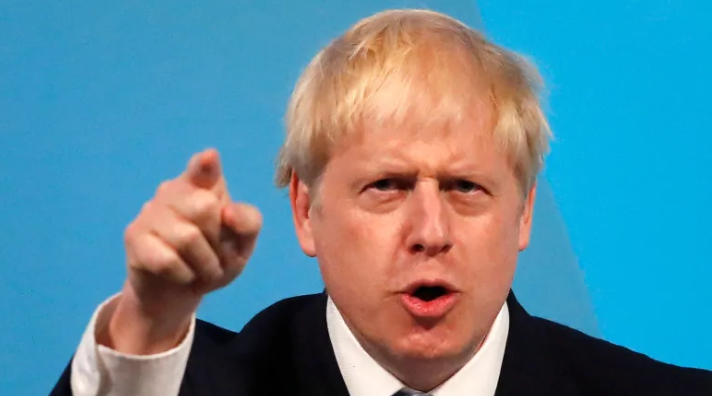
Brexit champion Boris Johnson gestures as he speaks after winning the contest to lead Britain’s governing Conservative Party on Tuesday. He will become the country’s next prime minister.

Party votes to give Brexit champion top job, replacing Theresa May on Wednesday

Boris Johnson, the ebullient Brexiteer who has promised to lead the United Kingdom out of the European Union with or without a deal by Halloween, will replace Theresa May as prime minister after winning the Conservative Party leadership on Tuesday.

May will leave office on Wednesday after going to Buckingham Palace to see Queen Elizabeth, who will formally appoint Johnson before he enters Downing Street.

His victory catapults the United Kingdom toward a Brexit showdown with the EU and a constitutional crisis at home, as lawmakers have vowed to bring down any government that tries to leave the bloc without a divorce deal.

Johnson, the face of the 2016 Brexit referendum, won the votes of 92,153 Conservative members to 46,656 for his rival, Foreign Secretary Jeremy Hunt.

“We are going to get Brexit done on Oct. 31, and we are going to take advantage of all the opportunities it will bring in a new spirit of ‘can do,'” Johnson, 55, said in his victory speech.

“Like some slumbering giant, we are going to rise and ping off the guy-ropes of self-doubt and negativity.”

Johnson said the mantra of his leadership campaign had been to “deliver Brexit, unite the country and defeat [opposition Labour leader] Jeremy Corbyn — and that is what we are going to do.”

Canadian Prime Minister Justin Trudeau congratulated Johnson and said he looks forward to working with him to increase trade between Canada and the U.K.

U.S. President Donald Trump also tweeted his congratulations to Johnson.

But Johnson — known for his ambition, mop of blonde hair, flowery oratory and cursory command of policy detail — takes office at one of the most tumultuous junctures in post-Second World War U.K. history.

Divided Kingdom
The 2016 Brexit referendum showed a United Kingdom divided about much more than the European Union, and has fuelled soul-searching about everything from regional secession and immigration to capitalism, the legacy of empire, and modern Britishness.

Brexit, which has already toppled two Conservative prime ministers, will dominate.

Johnson has pledged to negotiate a new Brexit divorce deal with the EU to secure before Oct. 31. But if the bloc refuses, as it insists it will, he has promised to leave anyway — “do or die” — on Halloween.

It is a step many investors and economists say would send shock waves through world markets and tip the world’s fifth largest economy into recession or even chaos.

A Brexit without a divorce deal would also weaken London’s position as a pre-eminent international financial centre while jolting the northern European economy.

French President Emmanuel Macron congratulated Johnson, and said he hopes they can start discussing Brexit and other international matters, including tensions with Iran, “as soon as possible.” Macron’s views were echoed by Ursula von der Leyen, the future head of the European Commission.

Johnson’s Conservatives have no majority in Parliament and need the support of 10 lawmakers from Northern Ireland’s Brexit-backing Democratic Unionist Party (DUP) to govern. After Johnson’s win, the DUP said its agreement with the Conservative Party would remain and a normal review of the arrangement will take place over the coming weeks.

Even then, the majority is wafer thin, and some lawmakers have threatened to bring down the government, a step that would probably deepen the U.K.’s political crisis and lead to an election.

Jeremy Corbyn, leader of the U.K.’s opposition Labour Party, used Johnson’s win to highlight his call for a fresh general election.

“Boris Johnson has won the support of fewer than 100,000 unrepresentative Conservative Party members by promising tax cuts for the richest … But he hasn’t won the support of our country,” Corbyn said on Twitter.

Johnson, for his part, told Conservative Party members that he does not want to hold an early general election, said senior lawmaker Nicky Morgan, who met with the incoming prime minister on Tuesday.

From private school to PM
The rise of Alexander Boris de Pfeffel Johnson, known simply Boris, to the top of U.K. politics is the grandest twist so far in a career that has taken him from journalism via TV-show fame, comedy and scandal into the political brinkmanship of the Brexit crisis.

Born in New York, Johnson was educated at Eton, Britain’s most exclusive school, and at Balliol College, Oxford. He began his career at a management consultancy in London but dropped out after a week.

He then turned to journalism, but was sacked from the Times newspaper for making up quotes.

Hired by the Daily Telegraph, Johnson infuriated European officials and delighted then Prime Minister Margaret Thatcher by lampooning the European Economic Community with a host of sometimes misleading reports from Brussels.

After entering politics, he was sacked from the Conservative Party’s policy team while in opposition for lying about an extramarital affair.

But his sometimes shambolic personal appearance and disarmingly self-deprecating confidence have allowed him to survive both gaffes and scandal. He served two terms as London mayor, from 2008 to 2016.

In 2016, he became one of the most recognizable faces of the Brexit campaign, which won the referendum by 52 per cent to 48 per cent.

“I know that there will be people around the place who will question the wisdom of your decision, and there may be some people here who still wonder what they have done,” Johnson told party members during his victory speech. “I will just point out to you that no one party, no party has a monopoly of wisdom.” Johnson said.

“Do you look daunted? Do you feel daunted? I don’t think you look remotely daunted to me.”