Archives for May 26, 2019

1.5 Million Americans Supersize Their Retirement Savings. Can You Join Them?

In order to retire comfortably, you have to be cleverer than ever in taking advantage of all the retirement savings options available to you. With so many potential obstacles to making ends meet during your golden years, the more you can save over the course of your career, the easier it’ll be to live the life you want after you’ve stopped working.

Millions of people use IRAs to help them set money aside for retirement. These tax-favored vehicles give savers a chance to get valuable tax benefits on their savings, and they come with a provision that many people don’t even know about. Almost 1.5 million taxpayers took advantage of this special IRA opportunity, and if you qualify, you could join their ranks — and put yourself in an even better position to have the retirement of your dreams.

Using IRAs to catch up on your retirement goals

One of the most difficult aspects of saving for retirement is figuring out when you can comfortably begin to start setting money aside. The earlier you start investing, the more time your money will have to grow, and the power of compounding makes an early start extremely valuable. For instance, if you start saving at age 25, your money will grow to more than double what it would if you start saving the same amount at age 35.

Yet most people have a lot of financial challenges in starting to invest for retirement early in their careers. Many young adults have massive student loan debt to pay off before they can even think about beginning to invest. Competing priorities, like buying a home and starting a family, often lead to the decision to delay retirement savings. As a result, it’s not uncommon for people to wait until well into middle age before seriously addressing the need to save for retirement.

It’s with that fact in mind that lawmakers decided to include provisions in the rules governing IRAs to allow for what are known as catch-up contributions. Each year, you’re entitled to contribute up to a certain maximum amount to an IRA. For 2019, that number is $6,000. However, if you’re 50 years old or older, then you also become eligible to save an extra $1,000. This added amount is intended to help older workers catch up on their retirement savings goals — which they might have neglected earlier in their careers.

A cadre of catcher-uppers

Not everyone takes advantage of the ability to make those catch-up contributions, but many do. Almost 1.35 million Americans took advantage of the catch-up provisions to contribute the full extra $1,000 in the most recent year for which the IRS has made data available. Another 50,000 made catch-up contributions of more than $500 but less than $1,000, while 87,000 made at least some catch-up contribution of up to $500. That adds up to more than 1.48 million taxpayers, and together, the amount of their catch-up contributions totaled almost $1.43 billion.

Moreover, it’s never too late to start catching up. Contributions among those 50 and older were fairly evenly split across age groups, with the number of taxpayers rising in the 55-59 cohort and keeping stable in the 60-64 cohort. Contributor counts declined back to 50-54 levels between ages 65 and 70 1/2. Contributions to traditional IRAs is currently prohibited for those older than 70 1/2 –although Roth contributions are still allowed at any age, as long as you have earned income.

Don’t wait!

Even if you’re not yet old enough to qualify to make catch-up contributions, it’s still a smart idea to start saving for retirement as soon as you can. The earlier you begin, the easier it’ll be. But don’t stress if you’ve waited too long: Catch-up contributions have made a big difference in helping nearly 1.5 million people boost their retirement savings — and you could be one of them.


How To Avoid Medical Debt If You’re Self-Employed

People across the economic spectrum are struggling to pay their medical bills today. A recent survey by the Commonwealth Fund found that 41% of Americans have problems with medical bills or problems paying off medical debt.

The situation is often especially challenging for freelancers with unsteady income. It can be hard to keep pace with medical bills if you’re dependent on clients who may or may not pay you on time.

So how do you avoid medical debt and the unexpectedly large medical bills that cause it?

Recently, I spoke with Robert Goff, co-founder of a nonprofit called End Medical Debt. End Medical Debt, founded in 2014, is a charity that uses algorithms to locate unpaid medical debt, buy it and forgive it. Often, hospitals sell uncollected medical bills for pennies on the dollar to collection agencies and pay them off. The charity works with the credit bureau TransUnion to determine if someone is having financial difficulties, by looking at their credit profile.

In case you’re wondering, you can’t apply to End Medical Debt. Its debt relief is completely random. “If anyone forgives a debt, it is technically a taxable gain to the party relieved of the debt burden,” says Goff. “They are supposed to be issued a 1099 form.” With random debt relief, the IRS does not impose that requirement, he says.

Goff is also co-author of the book End Medical Debt, with Jerry Ashton and Craig Antico—from which they donate all proceeds to the charity. Goff had a 40-year career in healthcare administration management. Ashton and Antico are veterans of the collections industry.

Of course, it’s better to stay out of medical debt than to have to deal with it later. So what can solo entrepreneurs and small business owners do to avoid it or at least mitigate it? There are no magic solution, but Goff has some practical ideas to consider.

Think carefully about your financial exposure. Many people opt for health insurance with the lowest premiums to keep their monthly overhead down. However, those plans often come with the highest deductible, the lowest co-pays and the greatest limitations on coverage, Goff notes. “Should they become sick, their exposure becomes the greatest,” he says.

If you buy a high-deductible policy, make sure you actually fund the deductible, he advises. Some people start a tax-advantaged health savings account to do that, but you can also tuck away the equivalent amount of money in a bank account you don’t use for anything else, he recommends. Many people can’t come up with all of the money to match their deductible at once, but if you make steady contributions every month, you’ll build up some protection for yourself. “That way, if you need it, you’re not scrambling,” he says.

Prevent surprise out-of-network care. Many plans don’t provide out of network coverage or limit it. The problem has surprised so many people with unexpected bills that President Trump recently promised to sign a bill blocking surprise medical bills. Congress is currently considering several bills to block these bills, often tied to out-of-network care.

In the meantime, if your plan does not cover out-of-network care, make sure to say no to care by those providers if you cannot afford to pay for it out of pocket. “If you’re going to have surgery, you have to ask a bunch of questions,” advises Goff. Not only should you ask if the doctor partners with your insurance company but you should also find out if the assistant surgeon, anesthesiologist and pathologist do so, as well, he advises.

Be open about your financial situation with providers. Ask physicians how much a service will cost and, if you can’t afford to pay for it all at once, ask if the treatment can be put on a schedule, Goff advises.

If you’re already gotten the treatment and have been surprised by the cost—and can’t pay the bill all at once—speak up.

“Physicians–particularly those in private practice–are very good about saying “Okay, you’ll send me a check for $50 a month. Hospitals should be willing to do that as well,” says Goff.

The worst thing to do, he says, is to obtain services and wait until you’ve gotten several bills to say you’ve got a problem paying them, he advises. “You’ve got to say something early—‘This is going to be a problem cash-flow-wise for me.’”

It is better to pay small amounts of a medical bill every month than to put it on a credit card, he says. “Now you’re not only paying the medical bill but 29% interest,” he says.

If you send some money, it would be foolish for the provider to turn over the bill to a collection agency, which might keep 30-50% of the bill, he says. “If I have someone on a payment plan, if I’m sending a bill and getting some payment, why would I want to hassle them?” he asks.

Average 401(k) balance by age group: See how your retirement savings compare

If you’re aiming for early retirement Opens a New Window. , you may want to closely monitor your 401(k) Opens a New Window. to ensure you’re contributing enough.

You could even become a millionaire if you manage your money right, particularly those who take advantage of companies who offer matching programs.

Financial services company Fidelity recently reported Opens a New Window. the number of 401(k) accounts with a $1 million balance jumped to 180,000 from 133,800 at the end of the fourth quarter of 2018. This could, in part, be due to a noticeable bump in employer contributions — which are continuing to increase in 2019.

“The average 401(k) employee contribution amount, in dollars, reached a record level of $2,370 in Q1, a 15% increase over one year earlier. In addition, the average 401(k) employer contribution, or company match, reached $1,780 in Q1, a record high and a 6% increase from one year earlier,” Fidelity stated in a May report.

401(k) plans, unlike traditional pensions Opens a New Window. , are retirement plans in which employees contribute a percentage of their earnings (pre-tax) into an account that companies often contribute to via a matching amount (to a certain percentage). But the 401(k) can suffer — or enjoy — the benefits of the market, depending on the market’s volatility.

Earlier this week, the inventor of the 401(k), Ted Benna, advised workers Opens a New Window. to start saving early.

“There’s people who make tons of money who don’t become successful at saving, and then there are others, surprisingly, who shock the heck out of me — they don’t make big bucks but they have substantial savings,” Benna said at an event run by The Wall Street Journal. “The key is learning early in life what you’re going to be.”

Katie Taylor, vice president of thought leadership at Fidelity Investments, stressed in an interview with CNBC Opens a New Window. Thursday that you “don’t need to make a million to save a million.”

According to the news site, the average 401(k) balance is $103,700. But it’s worth noting balances vary greatly depending on age.

Fidelity provided data to CNBC to determine the average amount Americans have in their retirement savings account at each age (as of the first quarter of 2019). Here’s what the company discovered.

  • 20-29: $11,800
  • 30-39: $42,400
  • 40-49: $102,700
  • 50-59: $174,100
  • 60-69: $195,500

The exact amount you should aim to have in your retirement savings account depends on your lifestyle, location, among other factors. However, Fidelity told CNBC most American workers should save at least 15 percent of their income each year.

“Make sure that you’re saving at least enough to get the full match that your employer offers,” Taylor told the news site. “[Then] make a commitment to yourself that you’re going to increase your contribution by 1-2% every year until you get there.”

Scheer outlines ‘vision for Canada’ that includes national corridor for energy, telecom

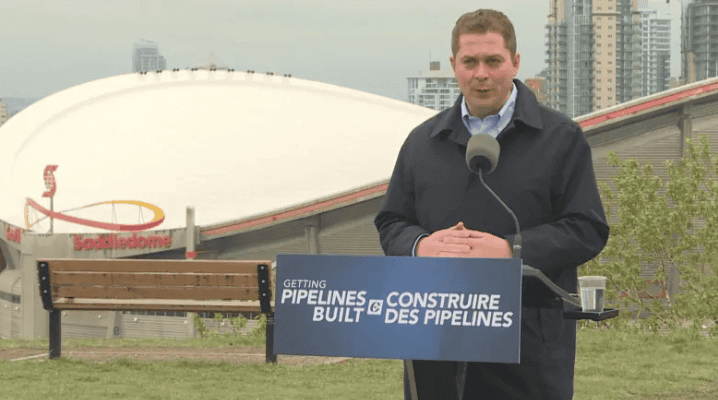
Conservative Party leader Andrew Scheer announces a vision for a national energy corridor on Saturday, May 25.

Conservative Leader would repeal Bill C-69, end ban on tanker traffic through northern B.C.

On Saturday in Calgary, Conservative Party Leader Andrew Scheer laid out his party’s vision for Canada’s future resource development.

There were short-term fixes, but also a long-term pitch for a national energy corridor that Scheer said he believes Canadian premiers will embrace.

“I want to talk about a national corridor that would move Canadian oil, gas, electricity, telecommunications and potentially anything else that runs along the ground,” he said.

Scheer compared his big idea to another big one from another century.

“I believe a national energy corridor can do for Canada what the railway did in the early days of Confederation,” he said.

Pre-approved status

Without specifying geography, cost, or timeline, Scheer said he believes there’s a will among different provinces to find a way to agree to create a route that will move Canada’s natural resources across the country through an area where there will be a kind of pre-approved status that would provide the kind certainty that the private sector craves.

Obviously it’s going to take a lot of work to find the right balance between Indigenous concerns and environmental concerns and any provincial issues

– Andrew Scheer, Conservative Leader

That included increasing refining capacity in New Brunswick, exporting hydroelectricity in Quebec and Manitoba, and shipping oil and gas to tidewater and to eastern Canada from Alberta.

“I’m optimistic. I believe there’s a recognition of the need for it,” Scheer said.

“Obviously it’s going to take a lot of work to find the right balance between Indigenous concerns and environmental concerns and any provincial issues. There may be a lot of private property concerns for any individuals who may be living along the proposed route.

“But if we don’t start now, then it’ll never happen,” he added. “And what we’ve seen in the country in the last four years under this Liberal government is that our resources are becoming landlocked.They’re not being able to be developed.

“Big projects aren’t able to get done.”

“I believe in the benefits of our natural resources — not just in their ability to create wealth, prosperity and opportunity, but their power to bring Canadians together from right across the country,” he said.

6-point plan

In the short term, that vision was articulated as a six-point plan that would see a Conservative federal government, if elected:

  • Scrap the carbon tax.
  • Repeal Bill C-69, a bill to revamp environmental assessment of energy projects that Scheer calls the ‘no more pipelines’ bill.
  • End a ban on tanker traffic in northern B.C.
  • Ban foreign-funded advocacy groups from participating in the regulatory process.
  • Assert federal jurisdiction where necessary.

He also called for the continued development of renewable resources and spoke about the need to create opportunities for innovators to develop new clean energy technologies, but said that Canada has lost its energy sovereignty under the federal Liberals, and needs to reclaim it.

“Now we can pretend — as some do — that the world doesn’t need oil and gas anymore,” Scheer said. “But that’s simply not true, and it sells Canada short.”

“Let’s not forget before Justin Trudeau became prime minister, we had three private companies willing to invest more than $30 billion to build three nation-building projects that would have created tens of thousands of jobs and generated billions in economic activity,” he said.

“Those companies — Kinder Morgan, Enbridge and TransCanada — continue to invest in pipelines,” he added. “Just not in Canada.”

Clean energy part of plan

When asked by CBC’s Helen Pike where clean energy fit into his vision, Scheer said Canada can be a world leader in creating clean technology.

“Obviously clean energy will be a big part of our environmental plan which we will be announcing in a few weeks. Around the world, Canada needs to lead the way and develop those world-class leading technologies — and use them to ensure that other countries can benefit from that to reduce their greenhouse gas emissions as well.

“What we do know is the advancements made in Canada’s energy sector — especially here in Alberta — we’ve come so far, we’ve developed so many new technologies right here at home reducing the environmental impact of energy extraction here in Canada.

“We’re going to continue to do that and continue to make investments and incentives for further development in investment and research and development in clean energy and in renewable energy.”

Failing Canadians

In an emailed response, Vanessa Adams, the press secretary for Minister of Natural Resources Amarjeet Sohi, pointed out former prime minister Stephen Harper’s failure at getting pipelines built.

“The Conservatives spent a decade failing our energy sector and failing Canadians,” she wrote. “For 10 years they ignored Indigenous communities, environmental and local concerns. And for 10 years, they got nothing built to new markets.

“Andrew Scheer’s plan is no better,” she added. “He’s making it up on the fly. And he will use the same outdated approach.

“Canadians won’t be fooled. The result will be the same.”