Archives for May 26, 2019

Stocks to Watch: HIVE Blockchain Technologies Ltd (OTCQX:HVBTF) Up +8.79%

At close of market on Friday, HIVE Blockchain Technologies Ltd (OTCQX:HVBTF) stock finished trading at +8.79%, bringing the stock price to $0.46 on the OTCQX Marketplace. The stock price saw a low of $0.42 and a high of $0.47.

The company’s stock was traded 675 times with a total of 1,407,702 shares traded.

HIVE Blockchain Technologies Ltd has a market cap of $151.64 million, with 326.6 million shares in issue.

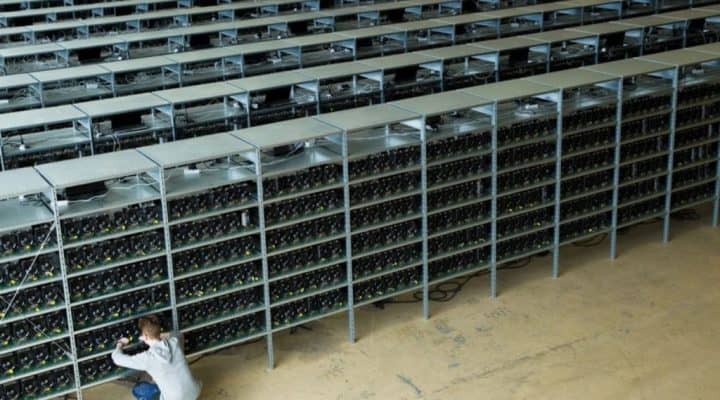
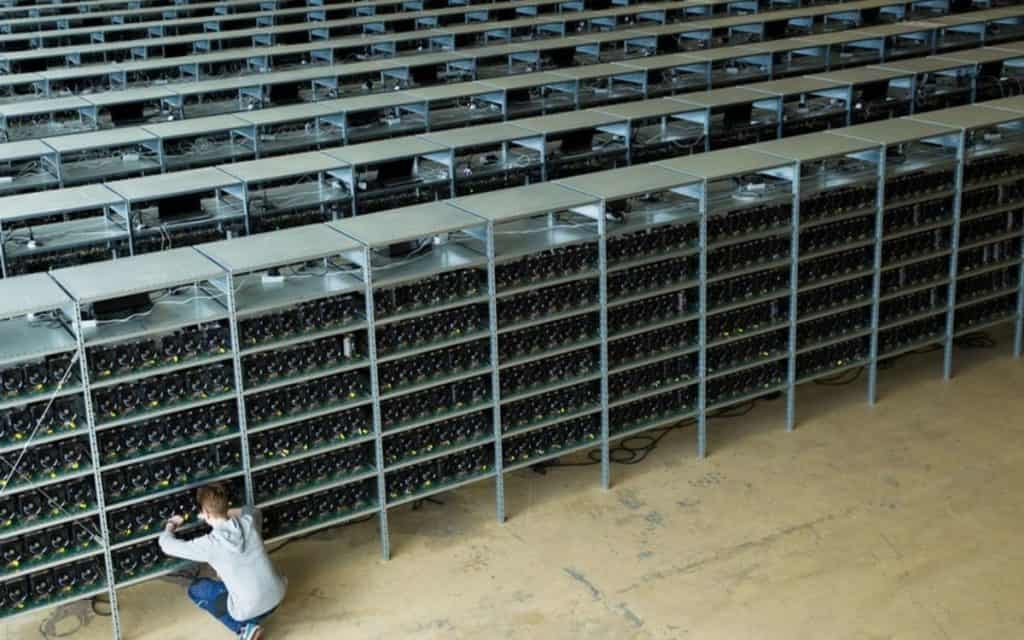
HIVE Blockchain Technologies Ltd is in the business of providing infrastructure solutions in the blockchain industry, including the mining of digital currencies. Its projects include Iceland Cryptocurrency Mining Project.


Stocks to Watch: Liberty Health Sciences (OTCQX:LHSIF) Up +7.49%

At close of market on Friday, Liberty Health Sciences (OTCQX:LHSIF) stock finished trading at +7.49%, bringing the stock price to $0.60 on the OTCQX Marketplace. The stock price saw a low of $0.53 and a high of $0.61.

The company’s stock was traded 999 times with a total of 2,515,145 shares traded.

Liberty Health Sciences has a market cap of $205.18 million, with 341.97 million shares in issue.

Liberty Health Sciences Inc is committed to delivering pharmaceutical-grade cannabis to patients. The company produces pharmaceutical-grade marijuana. The company is based and operates in the United States and Canada. The company generated most of its revenue from medical cannabis.

Raids on black market pot

Dave Young, 17th Judicial District Attorney, center, with U.S. Attorney Jason Dunn, left, and George Brauchler, 18th Judicial District Attorney.

Authorities said Friday they raided hundreds of black market marijuana operations in Colorado that flouted the state’s cannabis law by growing tens of thousands of plants in Denver-area homes and selling the drugs out of state.

Investigators seized more than 80,000 plants and 2,040 kilograms of harvested marijuana, state and federal prosecutors said at a news conference. Officers raided 247 homes and eight businesses and arrested 42 people in Denver and seven nearby counties.

State law allows up to 12 marijuana plants per residence for personal use, but some of the homes had more than 1,000 and many had hundreds, said U.S. Attorney Jason Dunn.

Colorado and nine other states have broadly legalized marijuana use but it remains illegal under federal law. That has created tension between some state and federal officials.

But George Brauchler, district attorney for the south and east Denver suburbs, stressed the investigation was a joint state-federal operation, not the U.S. Department of Justice imposing its will on Colorado.

“Make no mistake, we are equal partners in this,” Brauchler said.

State and federal officials said the nearly three-year investigation showed that illegal marijuana trafficking mushroomed after voters approved recreational use in 2012.

Dunn said Colorado has become the epicenter for a nationwide black market in marijuana.

Brauchler warned that Colorado is becoming “the wild West of weed.” He said the provision in the law that allows small-scale home marijuana cultivation opened the door to big, illegal operations.

Brauchler warned that other states considering allowing home marijuana plants could expect the same but added he was not trying to discourage them from doing so.

“I think states are entitled to do whatever they want,” he said. “But they need to know the reality of this.”

Mason Tvert, a spokesman for the Marijuana Policy Project, which advocates for decriminalizing marijuana, questioned how prosecutors know that Colorado’s law attracted illegal growers.

“Did they conduct a survey of illegal marijuana cultivators to determine why they decided to operate where they did?” he said. “Are they able to know whether those operations existed prior to legalization or not?”

Tvert blamed the illegal operations on states that still ban marijuana, and said if they legalized and regulated it as Colorado does, there would be little illegal production.

Dunn said investigators plan to use federal forfeiture laws to seize 41 homes, 25 vehicles and $2.2 million in cash connected to the marijuana operations.

He said the 41 homes have an average market value of $400,000.

“These grow operations are not occurring in abandoned houses or poor parts of the metro area,” he said. “These are happening in middle- and upper-class neighbourhoods where many of us live and raise families, and they’re occurring all over the metro area.”

William McDermott of U.S. Drug Enforcement Agency said the Colorado operations did not appear to be violent. He said officers seized a few guns but would not say how many.

Sixteen of the suspects were arrested on federal drug charges and 26 on state charges.

Washington First Nations oppose Canadian shipping terminal plan

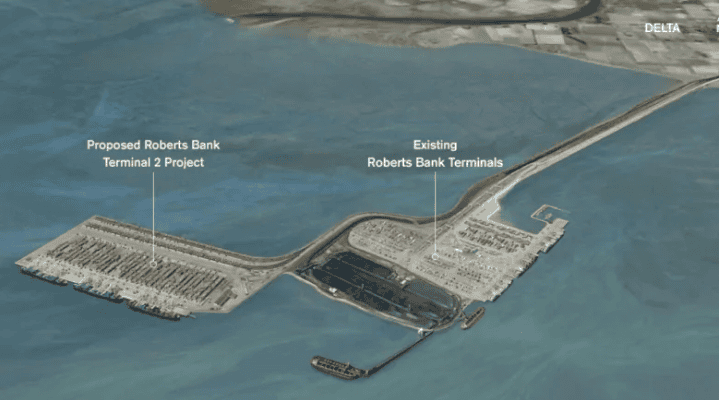
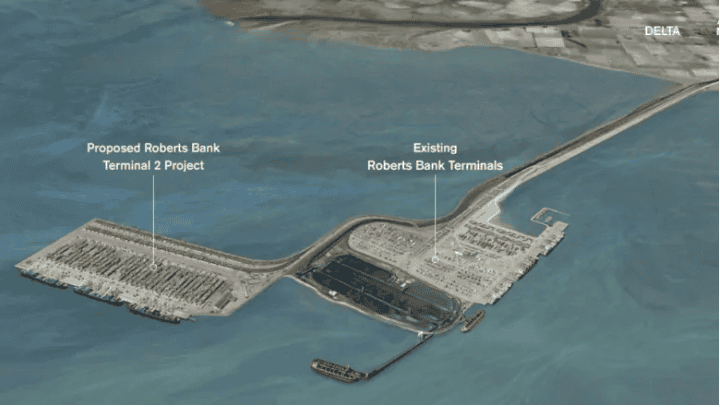
The Vancouver Fraser Port Authority plans to build a major container facility next to the existing Deltaport and Westshore terminals at Roberts Bank.

Members of the Lummi Nation, Swinomish, Suquamish and Tulalip Tribes will speak at review

In a lifetime of fishing on the Salish Sea, Jay Julius of the Lummi Nation in Washington State says he’s seen environmental degradation in the area first-hand.

“We are at the tipping point and I think Mother Nature is speaking very loudly — the salmon, the conditions of the salmon, the conditions of the orca,” said Julius, one of the nation’s leaders. 

Lummi, a Coast Salish nation near Bellingham, is one of four Indigenous communities from the state just south of B.C.’s Lower Mainland sending members to present their case at a federal review panel hearing on the proposed Roberts Bank terminal expansion on Saturday.

The Swinomish, Suquamish and Tulalip Tribes will also be represented.

The Roberts Bank Terminal 2 (RBT2) expansion project would more than double the capacity of the current terminal which sits just north of the U.S. border in Delta.

The Vancouver Fraser Port Authority project would create 108 hectares of new land and add enough capacity to handle 2.4 million 20-foot shipping containers per year.

A female southern resident killer whale breaches in waters of the Salish Sea, between Washington State and British Columbia, Canada.

For Julius, the expansion sounds like a bad idea.

“We know that this is not going in the right direction,” he said, adding that his livelihood — and that of his nation — depends on fishing.

“Is this going to improve the environment? Is it going to improve the condition of the Salish Sea as a whole? Is it going to improve the starvation the orcas are facing and the destruction that we’re doing today to the Salish Sea?” Julius said.

He said he hopes Canadian authorities take the views of First Nations seriously — even if they’re based in the United States — before making a decision on RBT2. Julius noted that his nation has ties to communities, lands and waters in Canada that go back generations — long before the international boundary was created.

Enviro design

Duncan Wilson with the Vancouver Fraser Port Authority says it will work with Indigenous communities to address concerns.

The expansion project has been designed to minimize environmental impacts. Wilson says there are also other environmental initiatives in place such as having vessels are slow down where whales are currently active.

Public hearings on the project began May 14 and will continue through to June 24.

Canadian astronomers seeking potentially dangerous space rocks in nearby ‘swarm’

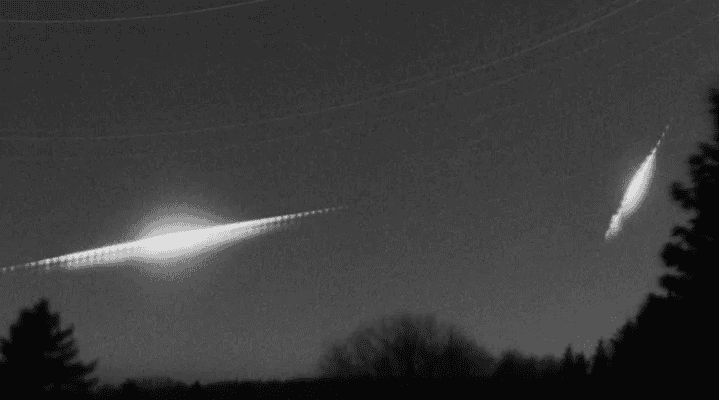
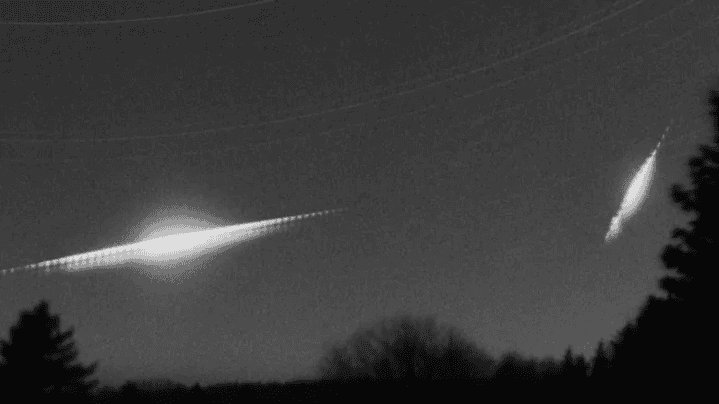
Two fireballs, originating from the fall Taurid meteor shower, are seen here over Poland in 2015.

‘There’s this potential for regular bombardment,’ researcher says

Over the past few decades, astronomers have wondered if a nearby swarm of material — one through which Earth crosses — may hold rocks that could pose a danger to people on Earth.

Now a Canadian research team is calling for closer examination of this region, called the Taurid meteor swarm, as it prepares for its closest pass in more than 40 years during an upcoming meteor shower in June.

David Clark, Peter Brown and Paul Weigert, of Western University in London, Ont., have published a paper in the online repository arXiv.org, outlining the best time for astronomers to search the Taurid meteor swarm for any sign of large, dangerous rocks. The paper has also been accepted for publication in the journal Monthly Notices of the Royal Astronomical Society.

“In the next month or so, we’re going to be making the closest pass to the centre of this Taurid swarm — the closest we’ve made since 1975,” said Brown, a professor of physics and astronomy at Western.

“So for the first time with modern instruments, we can actually test the hypothesis that there’s all this very dense material, home to tens [of metres] to hundreds of metres-sized objects, by actually looking … at that centre.”

In this illustration, the Taurid swarm core is seen passing below Earth.

Though meteors can be seen on any given night, we also get meteor showers, or times of increased activity. There is, on average, a major meteor shower almost every month; they happen because Earth is plowing through debris left behind by a passing comet or asteroid.

The Taurids — associated with the Comet 2P, or Encke — are meteor showers that occur twice a year: Once in June (during the day) and again in October through November (at night).

It’s also believed that Comet Encke is a piece of a larger comet that broke apart, creating a pile of debris that is being held in its orbit by Jupiter’s gravity. This pile is massive: Roughly 75 million kilometres by 150 million kilometres — a ribbon of rocks going around the sun.

Few of the meteors we see in the night sky reach the ground, instead burning up in our atmosphere.

But that isn’t always true for some of the larger rocks, like the 20-metre-wide object that exploded over Chelyabinsk, Russia in 2013, injuring more than 1,000 people after an accompanying air burst caused windows to explode.

The Chelyabinsk meteor is seen here in February 2013.

Finding clues

Some astronomers, including Brown and his team, believe the core of the Taurid swarm could be hiding Chelyabinsk-sized rocks — or larger. And if it is, it could mean that Earth is likely to experience a large space rock exploding in the atmosphere more often than once in a thousand years, as is the current belief. 

The largest impact event ever recorded on Earth took place on June 30, 1908, when the sky over central Siberia seemed as though it had been set afire and a loud bang echoed across the forested landscape.

An occurrence now known as the Tunguska event, it saw a 37-metre-wide, 100,000-kilogram rock enter our atmosphere, travelling at 54,000 km/h, and explode, releasing energy equivalent to 185 Hiroshima bombs.

It’s believed to have flattened more than 80 million trees.

In this 1953 file photo, trees lie strewn across the Siberian countryside 45 years after a meteor struck the Earth in the Tunguska region. The 1908 explosion is generally estimated to have been about 10 megatons; it levelled some 80 million trees for kilometres near the impact site.

Brown and others believe the Tunguska meteor was consistent with the Taurid meteor swarm.

More recently, in 2015, the orbits of two large asteroids — one measuring 250 metres in diameter — were traced back to the Taurid meteor swarm, further strengthening the argument.

‘Potential for regular bombardment’

Astronomers and telescopic sky surveys, however, have already found about 90 per cent of objects large enough that they would cause damage should they collide with Earth. These near-Earth objects, or NEOs, typically originate from two areas: the asteroid belt between Mars and Jupiter, and the Kuiper belt, beyond the orbit of Pluto.

But the rocks that could be lurking in the Taurids would be very different.

“The Taurid swarm is a totally different animal. It’s suspected of having relatively large objects, from 100 metres to one kilometre … and they’re clustered, so they’re not hitting at random times,” said the paper’s lead author, David Clark.

“There’s this potential for regular bombardment. That just changes the stats altogether, both from what’s the probability of us getting hit by something … [to] the distribution. It’s a regular pounding.”

Looking ahead

While this June will mark the closest that Earth has passed to the swarm since 1975, even closer passes are still to come — in 2032 and 2036.

According to Brown, that could be worrisome.

“If the hypothesis of the Taurid swarm being really, really dense is correct, it means, in fact, the impact hazard to Earth may not be a random … process,” said Brown. “In fact, there may be periods of time where the impact hazard is thousands or millions of times greater than the random background [meteors], and there are very specific intervals where we should be concerned about impacts.”

However, these intervals might only come once every century, said Brown.

Finding these large objects will be a challenge, as they will be quite dim. But both Clark and Brown hope to get some time on large telescopes capable of handling the challenge.

Whether or not large objects are found during the June shower, Clark believes the swarm is worthy of further study.

“If we’re talking a 100-metre object, we’re not talking civilization-destroying event. But we’re talking a potential Tunguska ground-clearing event over Toronto, over New York City. It would be a disaster,” Clark said. “It behooves us to understand these objects.”

This one investment move can give you lifetime yearly income in retirement

The investment business is full of theories and recommendations about how to accumulate wealth. But the field has very little to say about the best ways to decumulate, or spend down wealth.

This is an astonishing oversight, considering that the period over which wealth decumulation occurs is often as long as that of accumulation. If the turning point between accumulation and decumulation is 65 years of age, then an investor needs to plan for a potential 30 years or more of decumulation — and that planning needs to begin before age 65.

In contrast, the period during which substantial assets are accumulated typically stretches over 30 or 35 years, starting around age 30 or 35.

The limited attention to formulating a theory of decumulation is all the more surprising, given that, with the retirement of baby-boomers, it is surely the foremost concern of more people than ever before. And it is a subject to which much more meaningful and scientific study can be applied than to wealth accumulation.

The best way to safely decumulate wealth

It is with that in mind that I will explain the surprising result of my own research.

Much of the research in this area has focused on the concept of “safe withdrawal rate.” It has produced some interesting, but limited, results.

A safe withdrawal rate is the percentage of your assets you can withdraw each year without danger of running out of money, no matter how long you live. The seminal work on the subject was written by financial planner William P. Bengen and published in the Journal of Financial Planning in October 1994.

Bengen asked the question, “What percentage of your starting assets can you withdraw yearly for the rest of your life without fear that you will run out?”

His answer, based on simulations using past history, was that you can withdraw 4% a year (adjusted for inflation).

For example, if you start with $500,000, you can withdraw 4% of that, or $20,000. If inflation in the first year is 5%, then the next year you can withdraw 5% more than that, or $21,000.

Bengen assumed a portfolio of 60% stocks and 40% bonds. Because an investor wouldn’t have run out of money given the past history of the stock and bond markets, even over a long life, Bengen declared this withdrawal strategy “safe.”

In Bengen’s words, “In no past case has it caused a portfolio to be exhausted before 33 years [after retirement], and in most cases it will lead to portfolio lives of 50 years or longer.”

But in recent years, stock and bond market conditions have changed. Interest rates are historically low. This has caused some researchers to argue that 4% is not a safe withdrawal rate anymore.

In 2013, three researchers found, using their revised stock and bond market parameters, that as low as a 3% withdrawal rate would still mean a 10% chance of running out of money — too big a chance for comfort.

Is this really the most that a retiree can spend with a high level of protection against running out of money?

The answer to this question unfortunately is, yes, the withdrawal rate from a stock-bond portfolio must be that low for an investor to be reasonably certain that she won’t run out of money (if you can call only 90% certainty “reasonably certain”).

The problem with safe withdrawal strategies from a stock-bond portfolio is that you have to keep a large percentage of your portfolio in storage as a buffer — a kind of “rainy day fund” (or to be more accurate, “rainy years fund”) — against market fluctuations, or a long life.

Chances are good you’ll leave a large portion of this fund behind you when you die. You won’t be able to spend it. If that’s not what you want — if your goal is only to spend as much as you can in your lifetime without running out — my calculations show that there’s a much better way.

Simple annuity

A simple annuity, also called a single premium immediate annuity or SPIA, is a financial instrument that guarantees you a consistent monthly income as long as you live. It should not be confused with the much more complicated, expensive, and much less useful annuities with other names, such as variable annuities or fixed-income annuities.

Many insurance companies offer SPIAs. For example, if you’re a 65-year-old male you can pay $100,000 to receive about $6,700 a year as long as you live.

Don’t confuse that 6.7% payout rate with the rate of return on investment. It is not, because the “principal” — the amount you paid at the beginning — is not returned to you at the end. However, if you care only about lifetime income, this doesn’t matter to you.

The level of safety of this income is confidently high — much higher than 90%. Although insurance companies do occasionally go out of business, insurance industry and government supports make the probability of a default on annuities very low. And unlike the safe withdrawal rate strategy, no “rainy years fund” has to be set aside, so you can spend the whole thing.

My own calculations show that for an investor to be 95% certain of not running out of money with a safe withdrawal strategy from a 60%/40% stock-bond portfolio, the strategy would be to withdraw 3.5% of the initial investment in real (inflation-adjusted) dollars each year.

If the portfolio started with $500,000, for example, the average annual lifetime income would be $23,000. With the SPIA, the average annual lifetime income would be $33,500, and the certainty of achieving it is greater than 95%.

Thus, both the certainty of not running out of money, and the lifetime income, are much greater with the SPIA than with the “safe withdrawal” strategy. This, of course, assumes that the investor has essentially zero interest in leaving a bequest. But this is the case for many baby boomers. Their children are independent, or they want them to be, or they have no children.

In these times of relative hardship for most middle-class retirees, the majority of baby boomers in the United States are more concerned that they will not have enough money to live out their years with a degree of relative comfort than they are with leaving a legacy. Given this objective only, it’s almost impossible to beat a simple annuity.

Because an annuity’s cash flows are rigid and constant, however, one would probably want to keep a small amount of money outside the annuity as “working capital” to even out fluctuations in expenditures. But it makes sense to put the bulk in a simple annuity.