
Archives for May 18, 2019

Asylum claims triple

New figures out this morning from the national statistics office says the number of asylum claims in Canada more than tripled between 2015 and 2018.

Statistics Canada says that in 2015, the year the Trudeau Liberals were elected, there were about 16,000 asylum claimants.

Two years later, in 2017, there were more than 50,000 claims.

Last year, Statistics Canada says, there were 55,000 claimants, showing the pace of growth had slowed, but the total was well above the previous peak for claimants a decade earlier.

Details from the national statistics agency also show that asylum claimants tend to be younger than the general population in Canada, and most are male.

Economically, asylum-seekers fare similarly to other immigrant groups — the longer they are in the country, the higher their average salaries and wages.
Tariff standoff comes to end

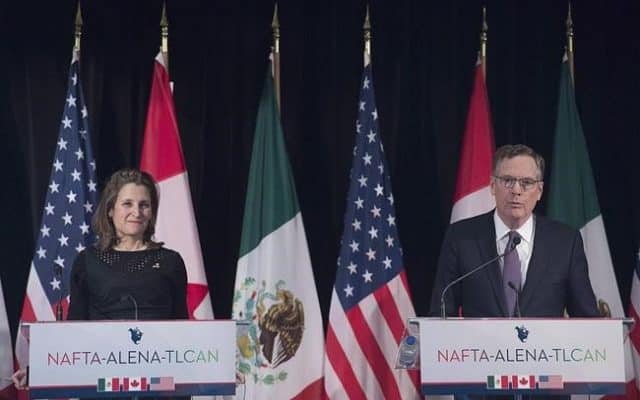
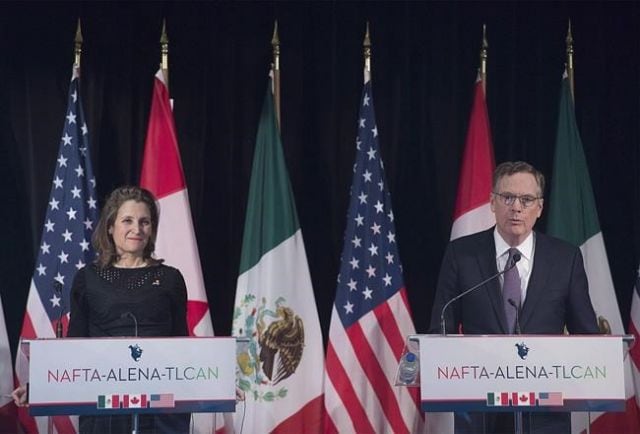
Foreign Affairs Minister Chrystia Freeland and U.S. Trade Representative Robert Lighthizer.

Canada’s year-long standoff with the Trump administration over punitive U.S. steel and aluminum tariffs is finally over, sources say, removing a key hurdle in efforts to ratify the new North American trade pact.

Prime Minister Justin Trudeau is making an unscheduled, last-minute trip to Hamilton, Canada’s steel-manufacturing capital, where he’s expected to confirm the breakthrough at an event at steel giant Stelco with Foreign Affairs Minister Chrystia Freeland and Finance Minister Bill Morneau.

At midday, the news had Stelco shares (TSX:STLC) up $1.79, or 11.7 per cent, at $17.11 on the Toronto Stock Exchange.

Word of the agreement began to trickle out amid reports that U.S. negotiators had backed off long-standing demands for a hard limit on imports of Canadian steel and aluminum, part of an effort to keep cheap Chinese product out of the country.

Late Friday morning, President Donald Trump and Prime Minister Justin Trudeau wrapped up their third phone call in less than a week on the tariff dispute, including Canada’s decision to retaliate with more than $16 billion of its own punitive levies on American products.

“The two leaders discussed the United States’ Section 232 tariffs on steel and aluminum and Canada’s retaliatory tariffs,” the Prime Minister’s Office said in a readout of the call.

They “also discussed relations with China, uranium, and the new NAFTA.”

One year ago, Commerce Secretary Wilbur Ross said the tariffs on Canada, as well as Mexico, were necessary to prevent a flood of cheap Chinese steel into the U.S. through its NAFTA partner countries.

Ross also said the U.S. was imposing tariffs on Canada and Mexico because the trade talks were taking too long, even though they were ostensibly imposed under a section of American trade law that gives the president that authority to do that to protect national security.

The Trudeau government has branded the tariffs as illegal, absurd and insulting, while Canada and Mexico say that it will be tough to ratify the new continental free trade agreement — the United States-Mexico-Canada Agreement — if they remain in place.

Ottawa has also been working to demonstrate to Washington that it has taken steps to stem the flow of cheaper Chinese metals into the Canada.

But Canada has stood firm with the U.S. on one key, related point: it has steadfastly refused to agree to quotas or other limits on its exports in order to get the tariffs lifted.

Canadian sources have described the idea of a quota system as a non-starter and a concession that Canada was not prepared to make.

Now, it appears Canadian negotiators have persuaded their American counterparts to accept that position — paving the way for a compromise that could allow the Trump administration to holster one of its favourite new trade weapons, while claiming to have enlisted the help of an ally in its ongoing fight.

“We have always said we are not the problem and that USMCA wouldn’t pass as long as the tariffs were in place. We would never accept a hard quota. I think they finally heard us,” said one source, speaking on the condition of anonymity, citing the delicate new phase of the current negotiations.

“Now we can work together to deal with over production outside of North America and approve the improved free trade deal.”

SNC cancels sale

SNC-Lavalin Group Inc. has cancelled the sale of part of its stake in 407 International Inc. to the OMERS pension plan but will sell the stake to one or both of the other owners of the Ontario toll highway.

The Montreal-based company said Friday the Canada Pension Plan Investment Board, which already owns a 40 per cent stake in 407 International Inc., has exercised its right of first refusal.

Cintra Global S.E., a Spanish company that owns a 43.23 per cent stake in the toll highway, has also sought to exercise its right of first refusal, but SNC disputes its ability to do so under the circumstances.

The dispute in headed to the Ontario Superior Court with a hearing set for June 21.

However, the companies have agreed that following the court’s initial decision, SNC-Lavalin will be permitted to sell the stake to either CPPIB alone or both CPPIB and Cintra under similar terms it agreed to with OMERS.

OMERS had agreed to buy a 10.01 per cent stake in 407 International Inc. for $3 billion plus an additional $250 million over 10 years, conditional on certain financial targets.

SNC’s position is that Cintra agreed in 2002 to waive its right of first refusal involving purchasers that do not have competing interests “in relation to construction, operations, asset management of, and investment in road or airport infrastructure projects other than solely as a financial investor such as a pension or superannuation fund.”

However, Cintra claims that OMERS is a competitor and does not fall within the waiver’s exception for financial investors.

“SNC-Lavalin remains confident in its position that Cintra’s claims and arguments are entirely without merit and that Cintra does not have the right to disrupt or participate in either the original sale transaction between SNC-Lavalin and OMERS, or in the sale transaction between SNC-Lavalin and CPPIB,” SNC said in a statement.

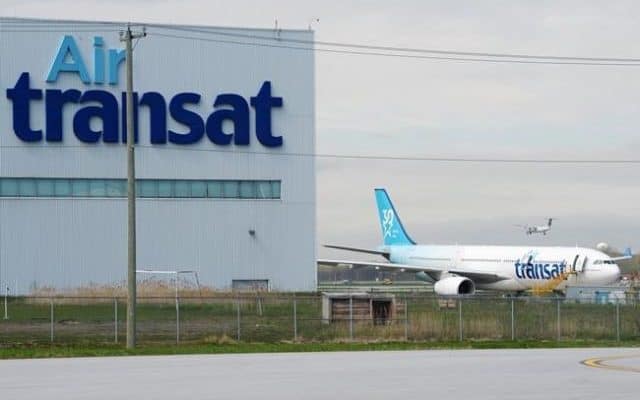
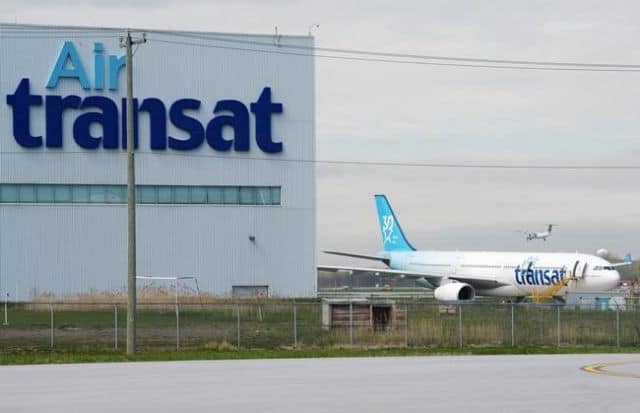
Air Canada’s bid for Transat

Consumers will likely see little change in their travel choices or ticket prices if Air Canada buys Transat AT Inc., industry observers said Friday.

They added it’s unlikely another bidder will upset the proposed merger, nor is it likely to be waylaid by required reviews by federal transport and competition regulators.

Shares in the parent company of airline Air Transat were little changed Friday after rising more than 13.4 per cent on Thursday to a closing price of $12.

That’s a dollar less than the $13 per share or $520 million offer Air Canada announced Thursday, as it said it had entered into a 30-day exclusive arrangement with Transat to try to negotiate its purchase.

Air Canada shares, meanwhile, rose by 1.6 per cent by 3 p.m. EDT on Friday to a new all-time high of $41.04.

“We do not expect a higher bid,” said analyst Kevin Chiang of CIBC World Markets in a report.

He said the offer represents a premium of 148 per cent over the 20-day average share price before Transat announced on April 30 that it was in discussions with unnamed parties for a potential sale.

Some observers said Thursday they fear a successful bid will result in fewer choices and higher ticket prices but AltaCorp Capital analyst Chris Murray said Friday there’s more likely to be an expansion of routes.

“As to competition and pricing, I don’t see the combination impacting competition as you still have a number of Canadian competitors including WestJet and the new ULCCs (ultra low-cost carriers), including Flair Airlines, as well as international carriers,” he said in an email.

Transat offers vacation packages, hotel stays and air travel under the Transat and Air Transat brands, with a primary focus on the transatlantic market during the summer and sun destinations through the winter.

The timing of Air Canada’s announcement was probably linked to last Monday’s news that Toronto-based Onex Corp. had struck a deal to buy Calgary-based WestJet Airlines Ltd. for about $3.5 billion, thus providing a funding source for growth, said independent airline analyst Rick Erickson.

But neither deal is expected to harm travellers.

“We’re going to see very little change in terms of consumer benefit and I see little if anything at all on the cost front,” he said.

He added he doesn’t know of any domestic party that can afford to outbid Air Canada, and pointed out foreign ownership of any Canadian airline is limited to 49 per cent, which makes a bid from outside Canada unlikely.

Travel consumers shouldn’t worry about a lack of competition if the two airline announcements go forward, said Wendy Paradis, president of the Association of Canadian Travel Agents.

“I think we certainly need to watch what happens, pay attention, but I think that, having two really strong carriers in Canada, there still will be lots of choice,” she said.

She added Canada’s other charter airlines such as Sunwing and Sunquest will continue to provide competition on Transat’s holiday routes.

On transatlantic routes this summer, Air Canada has 42 per cent of total industry seat capacity and Transat has 18 per cent for a potential combined 60 per cent, wrote National Bank analyst Cameron Doerksen in a report.