
Archives for May 18, 2019

Scientists create a four-winged robot insect that flies with grace

Bee+ is more poised than its two-winged counterparts.

It’s difficult to make an insect-like flying robot — realistic four-winged bots are typically too heavy, while lighter two-winged models tend to fly erratically. USC researchers have edged one step closer to the dream machine, however. They’ve created Bee+, a four-winged bot (pictured at right) that flies with more of the agility and poise of real insects while weighing just over 0.003oz. The trick was to drop earlier bimorph actuators, cantilevers made of two layers of piezoelectric material with a passive layer in between, with unimorphs that only have one piezoelectric layer. The four actuators combined weigh half as much as bimorphs would at just under 0.002oz, reducing the wing loading and significantly improving control.

The tiny flier can follow paths, dodge obstacles, perch and land. It’s even simpler to build than

There’s still much, much more work to be done before there are robotic insects in service. Bee+ flies tethered, since that saves the team from factoring a battery into the design. Size is also a concern. While the robot is only slightly larger than a penny, it’s still much larger and heavier than most real insects.

This does solve one of the larger problems for minuscule flying robots, though. And importantly, bots at the size of Bee+ could still be useful for a number of tasks, such as scouting hazardous areas and locating survivors in collapsed buildings. The challenge is simply designing a robot that can carry a full payload while remaining small enough to fit into exceptionally tight spaces.


Gmail’s log of all of your purchases pops up in the privacy debate

It could probably use a redesign.

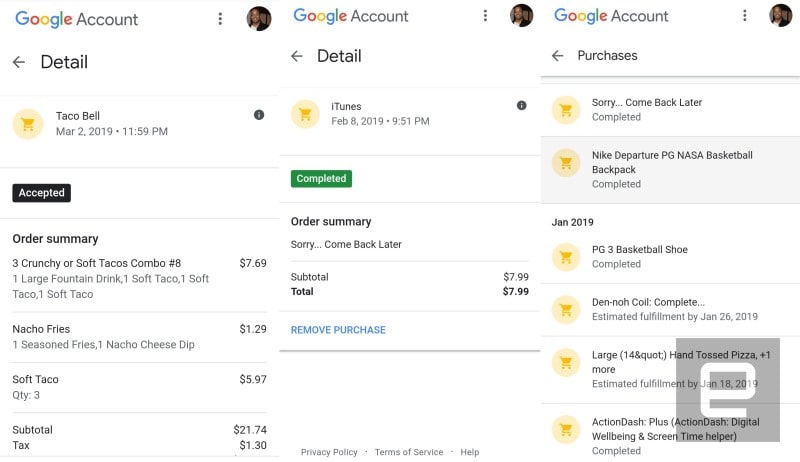
As we become ever more aware about the data companies are tracking about us, we’re even more concerned about how they’re using it. During I/O 2019, Google highlighted efforts to streamline the way people can view and manage the data it stores about their activities, but a CNBC report points out one oddly-designed page that isn’t as easy to access or use.

Purchases
The Purchases page (seen on mobile) has more details than you might remember.

Labeled “Purchases” and available at https://myaccount.google.com/purchases, it’s a sorted log of digital and physical things you’ve bought that Google’s automated scans picked up from receipts sent to your Gmail inbox. In a statement to CNBC Google confirmed that the page is only visible to the user, and “You can delete this information at any time. We don’t use any information from your Gmail messages to serve you ads, and that includes the email receipts and confirmations shown on the Purchase page.”

Still, it’s a lot of information that dates back years and highlights exactly how much Google can access, even when it’s being used for you, automatically highlighting cards for Assistant, personal info in Search or directions for Google Maps. Also, while you can delete the entries, it lacks the abilities recently announced for Location History to eliminate info beyond a certain time period, or any kind of bulk delete button at all. You can turn off this type of tracking, according to Google, but there’s no link to the controls from this page — the company told CNBC it’s looking into simplifying the settings and that seems like the right move.

US carriers say they’ve stopped selling location data

The FCC still has to determine if they broke the law.

You might not have to worry quite so much about carriers selling your phone location data to less-than-diligent third parties. AT&T, Sprint, T-Mobile and Verizon (Engadget’s parent company) have provided responses to FCC Commissioner Jessica Rosenworcel’s request for an update on the practice, with all four saying they’d halted sales to aggregators sometime after promising to do so back in June 2018. AT&T, T-Mobile and Verizon all said they’d terminated their last sales at varying points in March 2019, while Sprint said it was ending its last deal with a location aggregator on May 31st.

To no one’s surprise, the carriers maintained that their sales only allowed specific uses. AT&T’s terms required “approved use cases” and deletion of info, while Verizon said it had a “detailed process” for clearing and screening aggregators’ customers. Sprint was less specific, but said it allowed aggregators to hold on to data for long enough to provide an “adequate response” and limited their access to just the information needed to fulfill their contracts.

It’s not certain those since-ended sales were legal, though. As Ars Technica observed, the Communications Act forbids phone companies from disclosing or using location info without explicit permission from customers. There’s no clear indication the networks obtained consent — customers certainly didn’t intend for the information to reach the hands of bounty hunters.

You might not get a timely response from the FCC, either. Rosenworcel wrote that the FCC had been “totally silent” about reports of companies selling location data, and Chairman Ajit Pai deferred responsibility to recently appointed commissioner Geoffrey Starks despite holding control of the investigation. Carriers may have eventually done more to respect customer privacy, but there’s no guarantee they’ll face punishment if they abused their power.

Google is shutting down the Jump VR platform in June

The company will start deleting data and users on June 28th.

Google’s Jump VR platform will go offline by the end of June, and it has started telling users to download their data before it shuts down completely. The tech giant launched Jump back in 2015 to simplify the creation of 3D 360-degree videos using shots and videos captured by compatible camera rigs, which are typically composed of over a dozen action cameras. Once uploaded, Google uses the power of the cloud to automatically stitch them together.

In an email sent to users and a notice posted at the top of the Jump FAQ page, the tech giant said the platform will stop accepting uploads for processing at 11:59PM Pacific on June 26th. Those who want a copy of the data they uploaded to the cloud will have until June 27th to download them all. On June 28th, Google will start erasing Jump’s cloud data and deactivating accounts.

Based on what the company told users, the declining userbase compelled it to shut the service down. “…[We] have seen the emergence of a number of good alternative solutions for creators, including VR180. As these new cameras, formats, and editing tools became available, we saw usage of Jump Assembler decline.” Thankfully, camera rigs that support Jump, such as GoPro Odyssey and the Yi Halo, will still work with third-party video editing software — they cost tens of thousands of dollars, after all.

When it comes down to it, there’s no excuse for not maxing out your 401(k)

Uncle Sam doesn’t give out too many freebies when it comes to tax time, except in the form of retirement plans.

Surprisingly, not many people take advantage of them. Only 41% of people contribute to a 401(k) when they have the option to do so. A 401(k) allows annual contributions up to $19,000. If you maxed out your contributions, you could save thousands of dollars on your taxes.

Why do more people not contribute?

1. They say they don’t have the money. Wrong — everyone has the money. This is what saving is all about.

2. They don’t know about it. Sounds hard to believe, but I have met people who don’t know about the existence of these tax-advantaged retirement plans.

3. Laziness.

4. Taxes are too hard to figure out.

5. Etc.

Also by Jared Dillian: Couples argue about money a lot — here’s how to stop

That is a lot of money to leave on the table. You know what? If you make $100,000 a year, you can max it out. I guarantee you can do it. You can still have a cup of coffee once in a while!

At a 25% tax rate, you will save almost $5,000 a year in taxes. That is a lot of money to a lot of people.

Smart investors save as much on taxes where they can. Warren Buffett saves pretty much all of his taxes. He hardly has any tax liability at all.

We can’t all be Warren Buffett, but the least we can do is take advantage of very obvious tax breaks where we can.

The SEP IRA

The one retirement plan that goes completely overlooked is the SEP IRA. The SEP is for self-employed people, sole proprietors, single-member LLCs, et al.

With a SEP IRA, you can shield a massive $56,000 a year from taxes. If your tax rate is 30%, that’s almost $17,000 in tax savings. I have been taking advantage of the SEP IRA for years. Some 50-odd thousand goes into my retirement account every year.

You don’t even need any growth in your retirement funds for this to add up quickly. If you do this over the course of your career, you’ll have over $2 million with no investment gains. Not to mention the tax savings.

I run into a lot of self-employed folks who don’t even know of the existence of a SEP IRA. It is very common. If everyone who could contribute, did contribute, I wonder what it would “cost” the government in terms of lost revenue?

Those discussions haven’t started yet. They might some day. The government is spending a lot (an understatement), and currently nobody seems to care about debt.

That might change, in which case the government will be looking for every bit of revenue they can find.

Retirement plans have been sacrosanct, but nothing is permanent. These plans might one day disappear. You can see how the narrative will run: “Who needs a $17,000 tax break? Only rich people.” And so on.

Tax aggression

Some people are very aggressive on their taxes. I am not. There’s not much I can do, anyway. Having said that, I take every benefit I am entitled to.

Let me put it this way: You wouldn’t not take your mortgage interest deduction because … you didn’t feel like it? Or it was hard?

The bank makes it easy; they send you a 1099 with the interest you paid, and you or your accountant plug it in the computer. Retirement plans are really no different.

My guess is that the savings reflex for a lot of people is weak. Maxing out a $19,000 401(k) contribution seems distasteful, compared with the alternatives. To me, Alpo seems distasteful, compared with the alternatives.

If the tax code encourages you to do something — whether it is buy a house, buy a Tesla TSLA, -7.58% save for retirement or something else — I suggest you consider it.

Open up any popular finance website and you will get bombarded with propaganda telling you to save for retirement. The participation rate is nowhere near 100%, for basically the same reason that people don’t refinance their mortgages when interest rates fall.

Lots of people moan about Wall Street taking advantage of Main Street all the time.

Well, that’s because people make it easy.

5 Financial Numbers You Need to Know

Sometimes it’s really hard to know how you’re doing at managing your money. There’s a lot to keep track of and many milestones to achieve to become financially successful, so it can feel exhausting to try to figure out if you’re on track.

The good news is, when you boil down everything down to the basics, many of the most important aspects of your finances can be summed up in a few simple numbers. If you know these numbers, you can track your progress in achieving financial goals, see if you’re on pace to become financially independent, and get a pretty good idea of how you’re doing with your money.

What are the numbers you need to know? Here are five key metrics that paint a pretty comprehensive picture of your financial situation.

1. Your credit score

Technically you have many different credit scores, as different lenders and credit-scoring agencies have their own formulas for determining your score. However, the most important two are your FICO score and your VantageScore, as these are the most commonly used. Both FICO and the latest VantageScore model score you between 300 and 850, and the higher your score the better. Both also take similar factors into account, including the amount of debt you have relative to credit available and your payment history record. 

Knowing your credit score is important because this score determines if you can borrow, and at what rates. It’s also used by many other companies, by landlords when they’re deciding whether to rent to you, and by utility and cellphone companies. A good credit score means you’ve generally been responsible with payments, aren’t maxed out on your credit cards, and have a good mix of available credit. A bad credit score suggests you have some work to do when it comes to managing your debt — and could also make it more difficult and expensive to borrow in the future.

Your credit score can be found using free online websites. Discover, for example, will provide you with your FICO credit score at no cost even if you aren’t a cardholder. You should check your score regularly, as this will give you insight into whether you’re using credit responsibly. 

2. Your debt-to-income ratio

To figure out your debt-to-income ratio, you need to know how much you owe relative to your income. You can find out your DTI by dividing the total amount of monthly debt payments you have by your gross monthly income.

Knowing your DTI is important because this number shows how much debt you have relative to what you earn. It can give you a much more accurate picture of how indebted you are than just looking at your total debt balance alone. After all, if you owe $1,000 but make $1 million a year, you’re a lot better off than if you owe $1,000 but make $30,000 annually. 

A DTI that’s too high doesn’t only mean you’ll probably struggle to make debt payments and may have too little income left to accomplish other financial goals, but it also means many lenders won’t want to give you a loan because they’ll worry you’ve overextended yourself.

The maximum DTI to get a qualified mortgage loan, including your future mortgage payment, is 43%. Many lenders set your DTI even lower, at 36% or below. If your DTI is much higher than that, you need to get serious about either paying down debt ASAP or increasing income or both. Otherwise your debt is likely to have an ongoing adverse impact on your financial life. 

3. Your monthly expenses

Knowing your monthly expenses is important for many reasons. First, once you know how much you spend each month, you’ll know how long it will take you to achieve financial independence. If your total spending is $5,000 per month, you need to produce at least this much income. If your investments could produce $60,000 in annual income, you’d be financially independent because you wouldn’t have to earn a paycheck and could still support your lifestyle.

You also need to know your total monthly expenses so you can determine how much cash should be in your emergency fund. Most experts recommend you have at least three to six months of living expenses saved up for emergencies — but you can’t hit this target until you know what your monthly expenditures are. Finally, when you know your monthly expenses, you can make sure they don’t add up to too large a percentage of your income. Ideally, spending on needs and wants shouldn’t exceed 80% of monthly income, so you’ll have 20% left over to save.

You can figure out your monthly expenses by tracking spending for at least 30 days and seeing where your money goes. If you find your monthly expenses are too high relative to income, look for ways to cut back. And, remember, the lower your essential monthly expenses, the easier it will be for you to become financially independent, because your investments won’t need to generate as much income to maintain your lifestyle. 

4. Your savings rate

Saving for the future is one of the key steps to achieving financial success. While conventional wisdom suggests you should save at least 10% of income for retirement, this wisdom is likely wrong, and aiming to save 15% to 20% of income is best to ensure you don’t end up broke. You should also make sure you’re saving for other things, such as emergencies, big purchases, a home down payment, paying for a car in cash, and accomplishing other financial goals.

To find your savings rate, look at how much income you save per month in all your accounts — including your 401(k), IRA, other brokerage accounts and savings accounts — and compare it to your total monthly income. The higher your savings rate, the better off you’ll be, because you’ll be putting more of your money to good use. If your savings rate is below 10% to 15% of your income, you’ll need to work on saving more. You can automate transfers of money to retirement and other savings accounts to make sure you’re hitting your goals. 

5. Your net worth

The last key number to know is your net worth. Net worth equals assets minus liabilities. It represents the wealth you have. Let’s take a simple example. If you have a house valued at $200,000, a car valued at $20,000, $5,000 in personal property, $1,000 in savings, and a $150,000 mortgage loan, your net worth equals $200,000 + $20,000 + $5,000 + $1,000 – $150,000. This gives you a net worth of $76,000. 

If you have lots of assets and few liabilities, you should have a positive net worth. But if you have lots of debt and few assets, your net worth will be negative. As you start out in life, with student loans and a car loan, it’s normal to have a negative net worth. But as you save, invest, pay down debt, and acquire things of value, your net worth should grow. A negative net worth means you have more work to do, while the higher your net worth the better off you are. You can track your net worth over time to gain a very clear picture of how you’re doing at building wealth. If it’s not increasing, you need to make some big changes.

Do you know your numbers?

Now you know five important numbers that show you how you’re doing with debt, how much you need to earn, how prepared you are for the future, and how close you are to financial independence. If you don’t already know what your numbers are, you’ve also got the info to find them.

So sit down today and figure out your credit score, debt-to-income ratio, monthly expenses, savings rate, and net worth. Then keep track of these numbers as you work toward improving your financial situation. If you do, you’ll always have a clear idea of how you’re doing, and you can make adjustments as needed to ensure you’re on track for a secure financial future.