
Archives for May 17, 2019

Stocks to Watch: Boyd Group Income Fund (TSX:BYD.UN) Up +8.52%

At close of market on Wednesday, Boyd Group Income Fund (TSX:BYD.UN) stock finished trading at +8.52%, bringing the stock price to $163.36 on the Toronto Stock Exchange. The stock price saw a low of $159.20 and a high of $167.41.

The company’s stock was traded 1,020 times with a total of 167,144 shares traded.

Boyd Group Income Fund has a market cap of $3.24 billion, with 19.87 million shares in issue.

Boyd Group Income Fund is a personal services company that provides auto body and auto glass repair services at its portfolio of facilities located across the United States and Canada. The company operates in Canada primarily under the Boyd Autobody and Glass brand name, while its most notable U.S. brand is Gerber Collision and Glass. Boyd Group is one of the largest retailers of auto glass in the United States and provides repair services to its customers both at its numerous workshop facilities and on the side of the road. The company derives the vast majority of its revenue from its activities in the United States. Nearly all of Boyd Group’s revenue is contributed by a concentrated group of large insurance companies that insure its customers’ automobiles.


Stocks to Watch: Gildan Activewear Inc. (TSX:GIL) Up +1.64%

At close of market on Wednesday, Gildan Activewear Inc. (TSX:GIL) stock finished trading at +1.64%, bringing the stock price to $50.02 on the Toronto Stock Exchange. The stock price saw a low of $49.12 and a high of $50.43.

The company’s stock was traded 4,966 times with a total of 650,430 shares traded.

Gildan Activewear Inc. has a market cap of $10.31 billion, with 206.19 million shares in issue.

Gildan is a vertically integrated designer and manufacturer of basic apparel, including T-shirts, underwear, socks, and hosiery. Its primary market is the sale of blank T-shirts to wholesalers and printers (printwear). Gildan also sells branded clothing through retail and direct-to-consumer channels. Brands include Gildan, American Apparel, Comfort Colors, and Gold Toe. Gildan produces most of its clothing at factories in Latin America. The Montreal-based company generates most of its sales in the U.S. and was incorporated in 1984.

Scheer doubles down on oil

Conservative Leader Andrew Scheer pledged Thursday to pursue a coast-to-coast energy corridor, achieve Canadian oil independence within a decade and adjust mortgage rules with the aim of making home-buying more affordable.

With the federal election less than six months away, Scheer used a speech Thursday in Toronto to share his economic pitch to voters.

The address tried to sell the Tories as careful stewards of the public treasury as opposed to the deficit-running Liberals that Scheer accused of using taxpayers’ pockets as a “bottomless pit.”

The Opposition leader told a business crowd that, if elected, he would work to create a dedicated route where it would be easier to approve major energy projects — from pipelines to power lines.

“With a single corridor, we could minimize environmental impacts, lower the costs of environmental assessments, increase certainty for investors, and, most importantly, get these critical projects built,” Scheer said to the Economic Club of Canada.

Planning and consulting for the right-of-way would be done up front, sparing industry of the complicated process of submitting proposals for new projects, he said. The corridor, he added, would be designed in full consultation with provinces and Indigenous communities.

Scheer promised to help ensure Canada no longer needs foreign oil — and be “fuelled exclusively by Canadians by 2030.”

Oil imports from countries like Iran, Venezuela and Saudi Arabia have supported regimes that “abuse human rights and take virtually no steps to protect the environment,” he said.

“The fact is Canada has more than enough oil — not only to displace imports from the aforementioned rogue states — but to put an end to all foreign oil imports once and for all,” he said of a goal that could boost the economy in Western Canada.

Scheer also touched on a housing-policy change that could have a significant impact on the economy and financial stability. Without providing much detail, he promised to adjust the tougher mortgage-lending rules introduced in recent years.

The policies were designed to cool sizzling housing markets in Toronto and Vancouver, and to slow further build-up of household debt loads already at record levels.

“I will re-work the mortgage stress test the Liberals brought in a couple of years ago that have pushed the dream of home ownership out of the reach of so many Canadians across this country,” Scheer said.

He also promised to work with provinces and municipalities to make sure new homes can come on the market at lower prices by eliminating regulatory barriers for construction.

The tightened mortgage rules, brought in by Finance Minister Bill Morneau, mandated would-be borrowers undergo a stress test to determine whether they could still make payments if faced with higher interest rates or less income.

Bank of Canada governor Stephen Poloz has credited stricter mortgage policies — the federal measures as well as those implemented by other levels of government — for helping ease vulnerabilities related to household debt and speculative behaviour in some markets.

Parts of Scheer’s speech followed the Conservatives’ almost-daily criticisms of the Liberals for abandoning their 2015 election vow to post annual deficits of no more than $10 billion and to balance the books by 2019.

Instead, the Trudeau government has run bigger shortfalls, including deficits of more than $18 billion in each of the last two years, without a timeline to return to balance. The Liberals have argued the extra investments have been done in a responsible way and were needed to lift long-term economic growth.

Heading into the election, the fate of the federal balance sheet is poised to be among the most frequently debated issues.

Scheer didn’t provide a Tory vow for eliminating the deficit — but, in a line designed to fend off opponents’ attacks, he stressed that “drastic spending cuts” wouldn’t be necessary to get there.

Pulling plug on solar

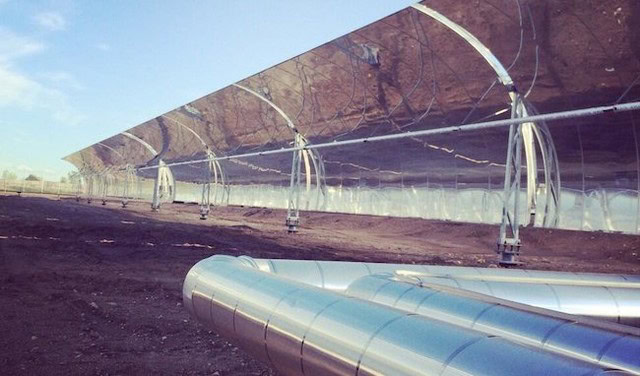
The Southern Alberta city of Medicine Hat is pulling the plug on a $13-million concentrated solar power facility after operating it for about five years.

Coun. Phil Turnbull, who chairs the city’s utility committee, says the project’s goal was to test whether the technology was a feasible way to use the sun’s heat to replace some of the natural gas used to make steam at the city-owned power plant.

The answer, unfortunately, was no, as the project’s small and unreliable contribution to the community’s power needs didn’t justify the cost of maintaining its rows of mirrors and pipes through snowy winters and dusty summer days.

National Energy Board solar energy expert Mike Johnson says Medicine Hat’s experience is consistent with evidence that suggests Canada is too far north and doesn’t get enough sun to make concentrated solar work.

For that reason, a recent NEB report he wrote on the economics of solar power in Canada looked mainly at the use of photovoltaic panel systems, which convert the sun’s energy directly into electricity and are much cheaper to build than concentrated solar.

In Medicine Hat, meanwhile, the utility committee’s next chore is figuring out what to do with the mothballed project, with suggestions including selling the gear to industry, donating it to a research college or creating a renewable energy park on the site.

“I think people sometimes look at what we did and say, ‘What a waste of money.’ But it wouldn’t have been a waste if it had been successful in taking it to the next step,” said Turnbull.

“Sometimes you win on trying to develop new initiatives and sometimes you don’t.”

The solar project’s original $9-million cost was shared equally by federal, provincial and city governments.

The city stepped up to cover subsequent cost overruns.

Manufacturing sales up

Statistics Canada says manufacturing sales increased 2.1 per cent to $58.0 billion in March, boosted by the transportation equipment, petroleum and coal product, and primary metal industries.

Economists had expected a 1.1 per cent increase for the month, according to Thomson Reuters Eikon.

Sales were up in 12 of 21 industries, representing 56.4 per cent of the Canadian manufacturing sector.

Sales of transportation equipment increased 4.5 per cent to $11.1 billion in March, helped by a 6.5 per cent increase in motor vehicle sales.

The petroleum and coal product industry reported sales rose 8.2 per cent to $6.2 billion, while primary metal sales climbed 5.3 per cent to $4.4 billion.

Overall manufacturing sales rose 1.6 per cent in volume terms.

Climate change threatens ‘both the economy and the financial system,’ says Bank of Canada

An Ontario Ministry of Natural Resources Fire Ranger carries sandbags to fortify a wall keeping floodwaters at bay along Alexander Street in Pembroke, Ontario on Saturday, May 11, 2019. For the first time ever, the Bank of Canada is releasing a report on the threat posed to Canada’s financial system by climate change.

Bank of Canada releases its first ever report on climate risks facing nation’s financial system

For the first time ever, the Bank of Canada has released a report examining the threat climate change poses to the country’s financial system.

The central bank’s annual financial system review (FSR), released today, analyzes the resilience of the country’s financial system, cataloguing the main vulnerabilities and risks facing it. Critics have been urging the bank to examine the impact of climate change on financial stability for years now.

“Climate change continues to pose risks to both the economy and the financial system,” the bank said in today’s review.

“These include physical risks from disruptive weather events and transition risks from adapting to a lower-carbon global economy. Economic activity and the environment are intertwined.”

The Bank of Canada recently announced it is joining the Network for Greening the Financial System, a worldwide forum of central banks and financial system supervisors looking to better manage the financial risks of climate change. The network launched in 2017.

“And so for two years, Canada has been absent from that international discussion,” said Kevin Quinlan, a consultant who focuses on climate change and responsible investment and an ex-chief of staff to former Vancouver mayor Gregor Robertson.

“Countries that have very different economies than Canada’s are really setting the agenda … and that’s a real disadvantage for Canada.”

Quebec Provincial Police officers carry Nadia Makhavekova to a boat so she can retrieve some belongings from her flooded home on Friday, May 3, 2019 in Ste-Marthe-sur-la-Lac, Que.

‘When the Bank speaks, people listen’

In late March, as it was joining the Network for Greening the Financial System, the central bank publicly committed to building climate-related risks into its FSR process and developing a multi-year research plan focused on climate change.

“The importance of climate-related issues for financial stability and monetary policy (has) become increasingly clear,” said Bank of Canada Governor Stephen Poloz at the time. “This is particularly true for Canada, where resources play a vital role in our economy and where the natural environment is a defining feature of our national identity.”

Experts argue the Bank of Canada is ideally placed to research and model the potential threats climate change poses to Canada’s economy and financial systems — not only to meet its own mandate of predicting economic growth and setting monetary policy, but also to help guide corporate Canada.

“We’re still at the very beginnings of modelling the impact of climate change on the economy … the Bank should obviously have a leading role in that,” said Céline Bak, president of Analytica Advisors and a senior associate with the International Institute for Sustainable Development.

“When the Bank of Canada speaks, people listen.”

Investing in an age of climate change

Canada made a commitment under the Paris Accord to reduce its greenhouse gas emissions and limit the rise of global temperatures to less than 2 degrees Celsius. Meeting that target requires a greener economy — and getting there will affect corporations and businesses tied to the fossil fuel industry.

The impact on Canadian firms could come though shifts in where Canadians place their investments and pension portfolios, and from government regulatory changes that constrict companies.

Even if Canadians continue to invest as they do now, they can’t make informed decisions about the security of those investments if they don’t know the degree to which their investments are exposed to the costs of climate change.

“Just getting the discipline within mainstream financial statements (on) what the impact of climate change is going to be on the company, and what the company’s impact on climate change is, should be a minimum standard,” said Bak, adding that transparency is the cornerstone of well-functioning capital markets.

But while some members of corporate Canada have started disclosing climate change risks to their shareholders, they’re not required by law to do so and there are no agreed-upon standards on how and what to report.

‘Overly optimistic’

“Any financial reporting that a company does has to be audited. None of that exists with climate disclosures,” said Hugh Smith, an expert in environmental and social governance at Refinitiv, a financial market data provider.

“Companies highlight what they’re doing well. It tends to be very overly optimistic.”

Smith called for mandatory reporting and national standards, arguing that even ordinary investors can play a role in bringing that about.

“Capital has more power to make change than anything else,” he said. “(Climate change) is a material impact to the companies you’re investing in. If you ignore them, that’s just not prudent investing.”

Some argue that Canada’s stock exchanges could compel companies to report their climate change risk as a condition of being listed.

Workers clean up flood debris in Sainte-Marthe-sur-le-Lac, Que., Monday, May 6, 2019.

Another risk posed by climate change is infrastructure damage due to more extreme weather, such as fire and floods. A side effect of that is the exploding cost of insurance claims.

That impact on insurance companies has been the focus of the Office of the Superintendent of Financial Institutions, which regulates Canada’s banks, insurance and trust companies and pension plans.

But experts argue that the economic threats facing Canada go well beyond the physical impacts of climate change — that a resource-dependent economy is vulnerable to an eventual consumer-driven shift away from fossil fuels.

Which is why critics like Quinlan and Bak said they have been disappointed that the Bank of Canada has been so slow to take a leadership role on this issue, unlike European central banks. (The U.S. Federal Reserve has not signed on to the Network for Greening the Financial System.)

In April, Bank of England Governor Mark Carney argued in an op-ed in The Guardian that the financial community urgently needs to prepare for an “orderly transition to a low-carbon economy” to avoid a climate-driven “Minsky moment” — a sudden collapse in asset prices.

With so little modelling done, it’s difficult to estimate the financial impact of climate change on the economy of one country, let alone the world.

“There’s no sense of what the overall bottom line would be,” said Smith. “But that being said, it would be an absolutely massive number.”