
Archives for May 13, 2019

Stocks to Watch: Eyes on Targa Resources Corp. (TRGP), Jack in the Box Inc. (JACK)

The price of Targa Resources Corp. (NYSE:TRGP) went up by $1.88 now trading at $40.43. Their shares witnessed a 20.51% increase from the 52-week low price of $33.55 they recorded on 2018-12-26. Even though it is still -46.45% behind the $59.21 high touched on 2018-10-03. The last few days have been good for the stock, as its price has grew by 1.4% during the week. It has also performed poorly over the past three months, as it lost around -5.25% while it has so far retreated around -15.05% during the course of a year. The stock of TRGP recorded 12.24% uptrend from the beginning of this year till date. The 12-month potential price target for Targa Resources Corp. is set at $49.86. This target means that the stock has an upside potential to increase by 23.32% from the current trading price.

76 institutions entered new Targa Resources Corp. (NYSE:TRGP) positions, 265 added to their existing positions in these shares, 199 lowered their positions, and 73 exited their positions entirely.

Targa Resources Corp. (TRGP) trade volume has increased by 51.77% as around 3,341,430 shares were sold when compared with its 50-day average volume of traded shares which is 2,201,658. At the moment, TRGP is witnessing a uptrend, as it is trading 0.98% above its 20-day SMA, -0.12% below its 50-day SMA, and -13.35% below its 200-day SMA. The company runs an ROE of roughly -3%, with financial analysts predicting that their earnings per share growth will be around 69.52% per annum for the next five year. This will be compared to the -18.6% decrease witnessed over the past five years.

The first technical resistance point for Targa Resources Corp. (NYSE:TRGP) will likely come at $41.18, marking a 1.82% premium to the current level. The second resistance point is at $41.92, about 3.55% premium to its current market price. On the other hand, inability to breach the immediate hurdles can drag it down to $37.75, the lower end of the range. TRGP’s 14-day MACD is -0.7 and this negative figure indicates a downward trading trend. The company’s 14-day RSI (relative strength index) score is 51.15, which shows that its stock has been neutral. The 20-day historical volatility for the stock stands at 33.35 percent, which is high when compared to that of the 50-day’s 29.28 percent.

The shares of Jack in the Box Inc. (NASDAQ:JACK) has increased by 1.01%, and now trading at $77.89 on the Wall Street in the intra-day deal, with their shares traded now around 663,455. This is a rise of 209,815 shares over the average 453,640 shares that were traded daily over the last three months. The stock that is trading at $77.89 went higher by 4.99% from its 52-week low of $74.19 that it attained back on 2018-12-24. The stock recorded a 52-week high of $93.98 nearly 277 days ago on 2018-08-09.

JACK stock hasn’t performed well over the past 30 days, as it lost -2.28% while its price climbed by 0.33% year-to-date (YTD). Looking at the last few days, it has been tough for the stock, as it tumbled -0.06% over the last week. The stock’s 12-month potential target price is now at $91. This means that the stock price might likely increase by 16.83% from its current trading price. 6 out of 14 Wall Street analysts which represents 42.86% rated the stock as a buy while the remaining 57.14% rated it as a hold, with 0% of analysts rating it as a sell.

Jack in the Box Inc. (NASDAQ:JACK) has been utilizing an ROE that is roughly -27%, with stock analysts predicting that the company’s EPS for the next five years will go up by 12.67% per year, following the 20.9% raise that was witnessed during the past five years. The stock at the moment is on a uptrend, trading 0.31% above its 20-day SMA, -0.69% below its 50-day SMA, and -4.74% below its 200-day SMA. In percentage terms, the aggregate Jack in the Box Inc. shares held by institutional investors is 0%. 27 institutions jumped in to acquire Jack in the Box Inc. (JACK) fresh stake, 90 added to their current holdings in these shares, 128 lowered their positions, and 39 left no stake in the company.

The stock’s 9-day MACD is -0.04 and this negative figure indicates a downward trading trend. The company’s 9-day RSI score is 52.56, which shows that its stock has been neutral. The 20-day historical volatility for the shares stand at 11.87 percent, which is less when compared to that of the 50-day’s 14.99 percent. On the daily chart, we see that the stock could reach the first level of resistance at $78.34, sporting a 0.57% premium to the current level. The next resistance point is at $78.78, representing nearly 1.13% premium to the current market price of Jack in the Box Inc. (JACK). On the other hand, failure to breach the immediate hurdles can drag it down to $76.7, the lower end of the range.


Stocks to Watch: Equitrans Midstream Corporation (ETRN) and PPL Corporation (PPL) in the spotlight

The price of Equitrans Midstream Corporation (NYSE:ETRN) went up by $0.9 now trading at $21.04. The last few days have been rough for the stock, as its price has decreased by -0.75% during the week. It has also performed better over the past three months, as it added around 10.97% while it has so far retreated around 0% during the course of a year. The stock of ETRN recorded 5.09% uptrend from the beginning of this year till date. The 12-month potential price target for Equitrans Midstream Corporation is set at $24.11. This target means that the stock has an upside potential to increase by 14.59% from the current trading price.

53 institutions entered new Equitrans Midstream Corporation (NYSE:ETRN) positions, 153 added to their existing positions in these shares, 256 lowered their positions, and 147 exited their positions entirely.

Equitrans Midstream Corporation (ETRN) trade volume has decreased by -15.72% as around 1,513,718 shares were sold when compared with its 50-day average volume of traded shares which is 1,796,010. At the moment, ETRN is witnessing a downtrend, as it is trading -0.84% below its 20-day SMA, 2.33% above its 50-day SMA, and 2.5% above its 200-day SMA. The company runs an ROE of roughly 0%, with financial analysts predicting that their earnings per share growth will be around 27.8% per annum for the next five year. This will be compared to the 0% decrease witnessed over the past five years.

The first technical resistance point for Equitrans Midstream Corporation (NYSE:ETRN) will likely come at $21.39, marking a 1.64% premium to the current level. The second resistance point is at $21.75, about 3.26% premium to its current market price. On the other hand, inability to breach the immediate hurdles can drag it down to $19.65, the lower end of the range. ETRN’s 14-day MACD is -0.46 and this negative figure indicates a downward trading trend. The company’s 14-day RSI (relative strength index) score is 50.75, which shows that its stock has been neutral. The 20-day historical volatility for the stock stands at 28.78 percent, which is high when compared to that of the 50-day’s 26.17 percent.

The shares of PPL Corporation (NYSE:PPL) has increased by 2.58%, and now trading at $31.04 on the Wall Street in the intra-day deal, with their shares traded now around 3,327,565. This is a decline of -977,895 shares over the average 4,305,460 shares that were traded daily over the last three months. The stock that is trading at $31.04 went higher by 22.69% from its 52-week low of $25.3 that it attained back on 2018-06-07. The stock recorded a 52-week high of $32.88 nearly 59 days ago on 2019-03-15.

PPL stock hasn’t performed well over the past 30 days, as it lost -2.21% while its price climbed by 9.57% year-to-date (YTD). Looking at the last few days, it has been tough for the stock, as it tumbled -0.58% over the last week. The stock’s 12-month potential target price is now at $32.17. This means that the stock price might likely increase by 3.64% from its current trading price. 4 out of 14 Wall Street analysts which represents 28.57% rated the stock as a buy while the remaining 57.14% rated it as a hold, with 14.29% of analysts rating it as a sell.

PPL Corporation (NYSE:PPL) has been utilizing an ROE that is roughly 15.7%, with stock analysts predicting that the company’s EPS for the next five years will go up by 0.59% per year, following the 4.5% raise that was witnessed during the past five years. The stock at the moment is on a uptrend, trading 0.01% above its 20-day SMA, -2.13% below its 50-day SMA, and 1.81% above its 200-day SMA. In percentage terms, the aggregate PPL Corporation shares held by institutional investors is 76.3%. 79 institutions jumped in to acquire PPL Corporation (PPL) fresh stake, 415 added to their current holdings in these shares, 348 lowered their positions, and 66 left no stake in the company.

The stock’s 9-day MACD is -0.32 and this negative figure indicates a downward trading trend. The company’s 9-day RSI score is 51.49, which shows that its stock has been neutral. The 20-day historical volatility for the shares stand at 18.82 percent, which is more when compared to that of the 50-day’s 14.56 percent. On the daily chart, we see that the stock could reach the first level of resistance at $31.3, sporting a 0.83% premium to the current level. The next resistance point is at $31.57, representing nearly 1.68% premium to the current market price of PPL Corporation (PPL). On the other hand, failure to breach the immediate hurdles can drag it down to $29.99, the lower end of the range.

Alberta has paid landowners $20M since 2010 as oilpatch defaults on payments

In April, Trident Exploration ceased operations. Months earlier, the company had cut payments to landowners because of its dire financial situation.

Some companies aren’t paying for use of private land due to drop in oil and gas prices

For more than a decade, James Kirstein had an excellent relationship with the company that operates a well pad on his property north of Fort Assiniboine, Alta., about 150 kilometres northwest of Edmonton.

The company produced natural gas and Kirstein received an annual payment as compensation for the use of his land.

The cheques always came in February, except this year, when nothing showed up in the mail. Kirstein got a hold of the company, and it only offered 50 per cent of the scheduled payment because of its poor financial health.

As a semi-retired oilpatch worker, Kirstein sympathized and accepted $2,700 rather than the $5,400 he was due.

The company, Trident Exploration, has since ceased operations, leaving Kirstein and other landowners in a difficult position. Trident’s assets may be sold to another company, or else transferred to the Orphan Well Association to be reclaimed.

Kirstein now faces three challenges. He may not receive another payment again, even though the gas wells are still on his land. His local municipality is raising taxes because too many energy companies in the area are not paying their property taxes. His property value may also fall without the revenue from the wells.

“If the receiver can find another company willing to operate these wells, I will be thrilled,” he said. “If not, I guess we are stuck with an orphan well site, which, rather than being an asset, is now a liability.”

James Kirstein owns a property near Fort Assiniboine, Alta. This year, Trident Exploration offered him 50 per cent of the scheduled payment to use his land.

He can still recoup the remaining 50 per cent of his payment for this year by applying to the Alberta Surface Rights Board, a quasi-judicial tribunal that helps resolve disputes between landowners and operators about compensation for resource development on private land.

He’s hesitant, though.

“I hate to do that, as that money has to come from all other Alberta taxpayers,” Kirstein said.

He’s right. The provincial government pays landowners to make up for the shortfalls of energy companies, and those payments have increased to record levels because of the fall in oil and gas prices.

$20 million in taxpayer money

The Alberta government has paid out more than $20 million since 2010. More than $12 million was paid in the last two years alone.

There is now a backlog of about 3,500 applications by landowners for compensation after energy companies failed to pay, according to the board. The wait time for payment is about 18 months for a landowner applying for the first time.

“We expect application volumes to remain high, and, as you can probably guess, it’s created a number of operational challenges for the board,” said spokesman Mike Hartfield.

The organization said it’s hiring more staff and streamlining its processes.

In early 2010, natural gas prices in the province were about $5.50 per million British thermal unit (MMBtu), but averaged just $1.26 last month. In the last year alone, at least a dozen energy companies have gone bust.

‘A catch-22’

While oil and gas companies’ failure to pay property taxes and compensate landowners is a problem that’s limited to a handful of industry players, it’s a growing one that can have a significant impact.

For instance, after two companies failed to pay their taxes, one Alberta municipality said it  felt “blindsided” as it was suddenly short more than 20 per cent of its expected tax revenue.

Some municipalities and landowners are looking to the provincial government for policy solutions, but industry players are calling for caution.

“We’re in a bit of a catch-22 situation right now,” said Tristan Goodman, president of the Explorers and Producers Association of Canada, which represents junior and mid-sized oil and gas companies.

A sign posted near a Trident Exploration natural gas well near the community of Didsbury, Alta.

“What we don’t want to do is make the problem worse and push more companies into bankruptcy. We want to keep these folks solvent.”

As prices improve, Goodman said there will be opportunities to ensure companies pay their bills.

For landowners like Marc Raedschelders, who owns a property near Pincher Creek in the southwest corner of the province, the uncertainty of what will happen is frustrating.

While the company that extracts natural gas from his land hasn’t gone bankrupt, it still decided to suspend all payments to landowners because of its poor financial situation.

“I have to deal with having that eyesore on my property forever,” he said. “I’m 64; I’d like to retire there.”

Raedschelders has applied to the Surface Rights Board for compensation. He’s owned the property for a decade and, in that time, ownership of the natural gas well has changed hands twice. At this point, he’d prefer the well just be reclaimed.

“I would be perfectly fine if they say, ‘Sorry, we can’t pay you. We’ll cap [the well] and we’re out of here.’ That’s fine with me.”

WestJet to be sold in $5B deal

WestJet will be acquired by Onex Corporation.

Calgary-based airline will become a private company, owned by Onex Corporation, if approved by shareholders

WestJet says it has agreed to be acquired by Onex Corporation and will become a private company in a deal valued at $5 billion. 

Under the agreement announced Monday, Onex will pay $31 per share for WestJet.

Shares in the airline closed at $18.52 on Friday.

Completion of the transaction is subject to a number of conditions, including court, regulatory and shareholder approvals.

Will be based in Calgary

A special meeting of shareholders is expected to take place in July to approve the transaction. 

“I am particularly pleased that WestJet will remain headquartered in Calgary and will continue to build on the success that our 14,000 WestJetters have created,” said Clive Beddoe, WestJet’s founder and chairman in a news release.  

“Onex’ aerospace experience, history of positive employee relations and long-term orientation makes it an ideal partner for WestJetters, and I am excited about our future.”

The deal comes after Onex approached the airline in March.

Special meeting in July

“WestJet is one of Canada’s strongest brands and we have tremendous respect for the business that Clive Beddoe and all WestJetters have built over the years,” said Tawfiq Popatia, a managing director at Onex.

WestJet’s board of directors has unanimously recommended shareholders vote in favour of the deal at meeting expected to be held in July.

The deal is expected to close in the latter part of 2019 or early 2020.

WestJet started in Calgary in 1996 and has expanded from a low-cost domestic airline to an international carrier with flights to the U.S., Europe and the Caribbean. 

Changes and struggles

New of the purchase plan comes after the airline struggled in 2018.

Soaring fuel costs, labour unrest, and steep competition at home and abroad caused the airline to incur its first loss in 13 years during the second quarter of last year, followed by a steep year-over-year drop in the third quarter — which nonetheless bounced back into the black.

Revenues and efficiency were “nowhere near” the airline’s potential, chief executive Ed Sims said at a WestJet investor conference in December 2018.

New enforcement unit adds ‘teeth’ to B.C. tenancy laws

5-member unit investigates complex and urgent tenancy cases and can issue fines of up to $5K per day

Scott McGregor was just one week into his new job when he was assigned to investigate a housing dispute that would ultimately end with 65 people losing their mobile homes and a landlord losing out on her investment.

It was September 2018 and McGregor, 55, a former senior manager with Victoria police, had recently become the director of the British Columbia Residential Tenancy Branch’s new compliance and enforcement unit.

“It was a really, really tragic set of circumstances all around,” McGregor said from his office in Victoria, where he now leads a team of two compliance officers and two investigators. 

The new landlord of the mobile home park in Northern B.C. had wanted to redevelop and expand it to adjacent Crown land to make way for workers of an anticipated LNG facility.

But she quickly discovered that the park was in a bad state of disrepair. She issued dozens of eviction notices, which the residents fought and won.

Then the Crown land sale didn’t go through.

Realizing she wouldn’t get a return on her investment, the landlord used a loophole to turn the entire property into green space. All the residents lost their homes.

“Yeah, so that was my first investigation,” McGregor said. 

22,000 hearings per year

British Columbia’s Residential Tenancy Branch sets out regulations for all housing agreements between landlords and tenants in the province. It regulates rules like how much rents can increase and when landlords can evict tenants.

It’s also where both parties can turn to resolve disputes; McGregor says the RTB arbitrators handle about 22,000 hearings per year.

But McGregor and housing critics agree that, until now, the branch’s hearings didn’t have any real consequences because there was no mechanism in place to enforce the outcome. 

The director of the RTB’s new compliance and enforcement unit says he investigates repeat offenders — whether they be landlords or tenants.

“There are impressions … that there wasn’t a lot of teeth in the legislation,” McGregor said.

The new compliance and enforcement unit is part of the first phase of a series of recommendations issued last September from the province’s Rental Housing Task Force in response to the housing crisis. 

Other recent changes include funding to educate landlords and tenants about their rights, and increasing the number of RTB staff — which the Housing Ministry says has reduced call wait times from an average of 45 minutes in 2017 to only five minutes. 

Fines up to $5,000 per day

McGregor says his staff take on urgent and complex cases, and can issue administrative penalties of up to $5,000 per day. 

“I am really excited about it,” he said. “I honestly feel like we can really make a difference here in an area that’s affecting so many British Columbians.” 

McGregor has been in place since September, but the unit has only been fully staffed for three weeks. He says the unit has conducted about 30 investigations so far.

Some of the cases have been dismissed because of a lack of evidence, McGregor says, while others have been dealt with by simply issuing a verbal or written warning. 

“In most cases we’re achieving compliance just by letting them know we’re here, there are consequences, they’re very real, you should not ignore them,” McGregor said.  

Recently, the unit issued its first $5,000 fine against a landlord in Surrey who has appeared before the branch at five separate hearings for failing to make repairs and repeatedly trying to evict his tenant. 

‘Certainly an improvement’

Andrew Sakamoto, executive director of the Tenant Resource Advocacy Centre, says his organization wanted to see the province put forward bolder changes, but it’s supportive of the new unit.

“Coming from nothing, this is certainly an improvement and I look forward to seeing what sort of difference that can make,” Sakamoto said. “We’ll have to see how it all plays out and whether or not that is enough staff to really make a dent.”

McGregor is quick to point out that it’s not just landlords he’s going after. Of the 20-or-so active files he has on his desk, six involve tenants. Most often, he says, the tenants in those cases moved into their homes with no intention of paying rent.

David Hutniak, president of Landlord B.C., says he’s a huge supporter of the new unit.

“We think this has been lacking for many years,” Hutniak said. “I think there’s only going to be good things coming out of it in the sense that both landlords and renters are going to know that there are consequences.” 

Industry worried new Alberta government will cancel solar-power rebates

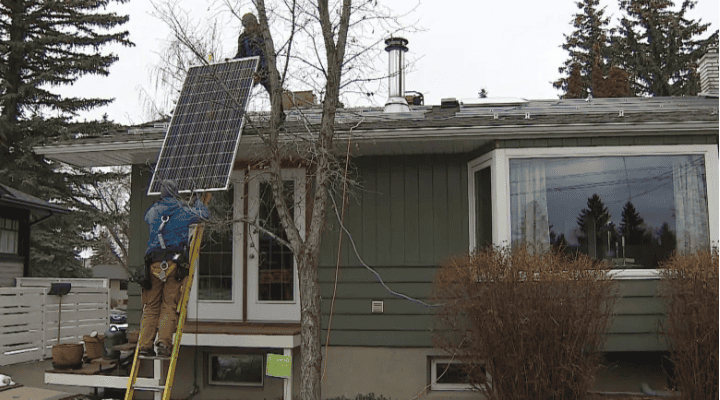
EvolvSolar employees install solar panels on a home in Calgary. The homeowner took advantage of a provincial rebate that covered 35 per cent of the cost, resulting in a final bill of $10,000. 

Province’s pledge to scrap carbon tax is causing uncertainty over the rebates’ future

Gerald Krabbe is taking his mid-century Calgary bungalow into the future with a soon-to-be-connected 5½-kilowatt photovoltaic solar panel system. The panels will supply enough electricity to keep everything running in his 1,400-square-foot home when the sun is shining — and any excess power will be returned to the grid.

Krabbe says he’s motivated to reduce his carbon footprint.

“Hopefully, in the next couple of years, I’ll use considerably less coal and use solar, which is free,” he said.

Krabbe says the solar rebate program brought in by Alberta’s former NDP government played a significant role in his decision to go ahead with the project, but he says it was something he was going to do, with or without the program (whose official name is the Residential and Commercial Solar Program).

“Regardless of the cost, using solar is a step forward,” he said.

Last month’s change in government in Alberta (the United Conservative Party headed by Jason Kenney won a majority) is creating a lot of uncertainty about the future of the rebate program — and the future of Energy Efficiency Alberta, the government agency that administers the rebates designed to encourage Albertans to switch to renewable energy sources.

Gerald Krabbe took advantage of a provincial rebate program that lowered the cost of solar panels for his Calgary house. The program’s future is unclear after the UCP won a majority government in April.

Krabbe, a recently retired math teacher, said the numbers made sense for him. The system cost about $13,000, but the province returned about a third of that, using money from the carbon tax.

But there could be dark clouds on the horizon for Energy Efficiency Alberta and the millions in incentives that have so far been doled out.

“Given that it’s early days for the newly elected provincial government, it will take some time to determine the future of this program,” said Doris Kaufmann Woodcock, a spokesperson for the agency.

“Once decisions are made, we will share information publicly, including with the solar industry,” she added in an email to CBC News.

Kaufmann Woodcock said more than 1,500 residential and commercial solar projects have been completed and 900 more are in the works. Most of them, 2,200, involve residential projects.

The original goal of the program was to invest $36 million to generate 48 megawatts of electricity by 2020.

Kaufmann Woodcock didn’t say how much has been installed so far.

“Alberta’s solar industry is well on its way to meeting this goal,” and $134 million has been invested in solar projects in Alberta, she said.

Customers ‘sitting on the fence’

Mike Daciw, who used to work in oil and gas, is now behind one of about 250 solar companies operating in Alberta.

“Just looking at the trends and the cost of solar coming down over the years, we thought this was kind of the wave of the future, and we just wanted to jump on it,” he said.

Daciw and another oil and gas refugee started EvolvSolar a few years ago. The company now has 23 employees working across the Prairies.

Jayman Built now offers a minimum of six ‘non-negotiable’ solar panels on every new home it builds in Alberta. The program started in January 2019 and the company predicts it will build 750 homes this year.

Daciw fears that as many as 50 of those companies could go dark if the rebates in Alberta end, since demand for solar will likely take a hit without the incentives.

“Without the rebate, the payback would be around 18 years. With the rebate, [it’s] 10 to 12 [years], and lots of homeowners can see that far out,” he said.

Daciw says he’s written about 100 quotes for potential customers who are “sitting on the fence,” waiting to see what the new government will do.

He predicts his company will survive, but will likely pull up stakes in Alberta.

“For the province of Alberta, it’s a shame. Rule 1 of investing is to diversify, and if we [the government of Alberta] put all of our eggs in one basket [in the oil and gas industry], I think it’s a lot of risk to bear,” he said.

2,000 employees in solar sector

The association that represents the solar industry in Canada says the sector has seen massive growth since the rebates were brought in in 2017: 500 jobs in the last few years, bringing the estimated workforce in Alberta to almost 2,000.  

It predicts that number could increase fivefold over the next decade.

“There was a recent study put out in Alberta stating that there could be up to 10,000 jobs in the solar industry sector in the next 10 years,” said Wes Johnston, president of the Canadian Solar Industries Association.

Wes Johnston, president of the Canadian Solar Industries Association, believes the solar industry will create 10,000 jobs in Alberta over the next decade.

An Alberta homebuilder has jumped on the solar bandwagon. Four months ago, Jayman Built announced all of its new homes, roughly 750 per year, will each be equipped with six solar panels, producing about two kilowatts of electricity. The company president describes the policy as “non-negotiable,” and says the reaction from customers has been positive.

“They want to do the right thing when they buy a house,” said Dave Desormeaux.

“They want to decrease their operating costs, and we’ve seen a big uptake; it’s really improved our sales performance.”

The company plans to continue with the program, whatever the future of the rebate program.

“No intention of going back,” he said.

‘This is Alberta’s future’

Energy experts, and even the solar industry itself, realize government-funded incentives will eventually come to an end as the cost of solar comes down and the industry becomes self-sufficient. But they seem to agree that now is not the time for rebates to end in Canada.

“It’s a bad thing in the short term,” said Chris Bataille, an energy and climate researcher at Simon Fraser University in B.C.

“It’s probably a little early in Canada,” he said.

“We’re just on the cusp of a transition in order to meet our Paris Agreement goals; we need to dramatically reduce our emissions.”

But Bataille says rebates should eventually be discontinued.

“Once the industry is built, you really don’t want rebates in the long haul; you want it to move on its own.”

His advice for the new government?

Reduce the rebates if you have to, but don’t kill them just yet.

“Realize that this is a job-builder … This is an industry-builder. This is Alberta’s future that you’re playing with here; you need to encourage the growth of this industry.”