
Archives for May 13, 2019

NASA wants your memories of the Apollo 11 Moon landing

It hopes to document the cultural experience of space exploration.

Were you fortunate enough to watch the Apollo 11 Moon landing as it happened, or know someone who did? NASA wants to hear from you. It recently launched a story program that asks the public to submit audio recordings of their Apollo 11 memories in a bid to create an oral history of the event in sync with its 50th anniversary. All you have to do is record a story or interview (shorter ones are preferred, email it and details to a special address (apollostories@mail.nasa.gov) and check your inbox in case NASA wants a follow-up. There are suggested questions if you’re not sure what to ask.

You have until the end of 2019 to submit recordings, although you’ll have your “best chance” of making it into the official audio series if you send your file before June 14th. Longer clips may be reserved for the web or social networks.

There’s a certain amount of publicity in this for NASA, especially now that it’s aiming to return people to the Moon by 2024. Nonetheless, the crowdsourced history project shows just how far technology has come in nearly 50 years. When Apollo 11 touched down, viewers usually had to be content sharing their experiences with whoever was in earshot. Now, anyone with a smartphone (which is exponentially more powerful than the Apollo 11’s computers) can potentially share their anecdotes with the entire planet.


US charges nine people over $2.4 million SIM hijacking ring

They relied on carrier moles to control accounts and steal cryptocurrency.

American law enforcement just took down a significant SIM hijacking ring. Federal agents have charged nine men with wire fraud and identity theft charges for participating in The Community, a group that transferred phone numbers to SIM cards in their possession, used those to take control of online accounts (particularly those with two-factor authentication) and promptly stole cryptocurrency. The group has been accused of perpetrating seven attacks that stole more than $2.4 million in digital currencies from targets.

Like with some of these schemes, The Community had help from the inside. Three of the charged men (Robert Jack, Fendley Joseph and Jarratt White) worked at wireless carriers, and allegedly took bribes in return for helping the others swipe customer identities. In other cases, Community members would pose as the victims in customer service conversations and swap numbers to SIM cards themselves.

The penalties could be stiff. The fraud and theft charges each carry a maximum 20-year prison sentence. There are also charges for aggravated identity theft in support of wire fraud, although their two-year maximum sentence would be served alongside the actual wire fraud charge.

SIM hijacking charges are still relatively novel — the first sentences have only recently started trickling out. These latest indictments won’t likely serve as deterrents, but they could represent benchmarks for future cases if there are any convictions. They certainly act as reminders to internet users — you can’t assume your accounts are secure simply because you use two-factor sign-ins.

Amazon might start using robots to box your orders

If deployed across Amazon’s US fulfillment centers, the machines could displace more than 1,300 jobs.

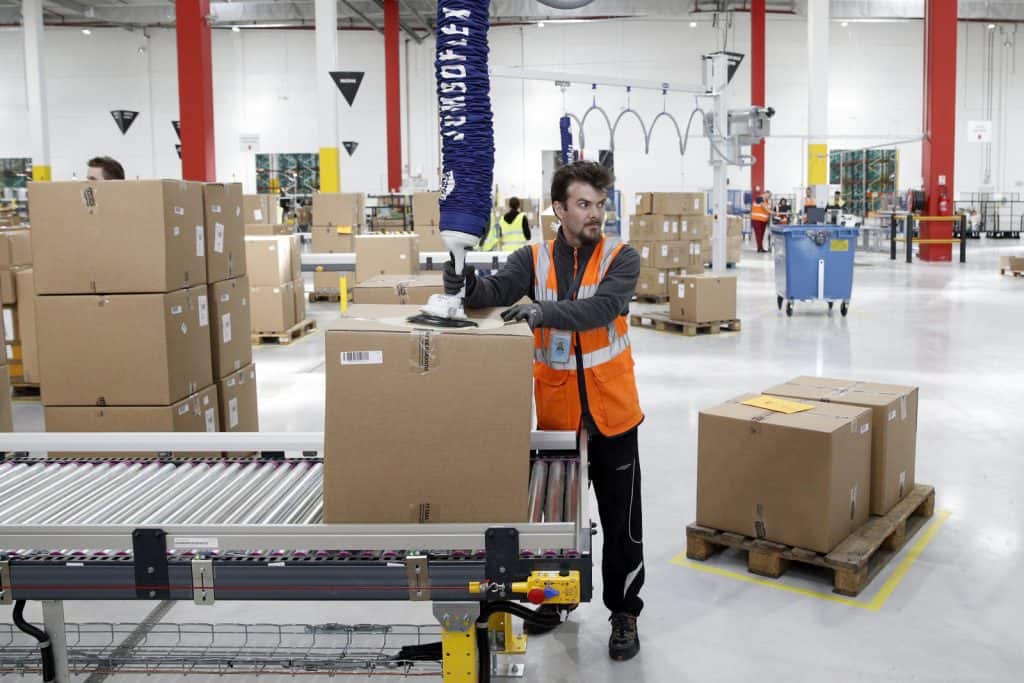
A few weeks ago, Amazon said it will be at least 10 years before the company is running fully-automated warehouses. But partial automation is already underway. According to Reuters, Amazon is considering installing two machines at dozens of warehouses that have the potential to replace at least 24 jobs at each location. If Amazon were to roll the machines out across its 55 US fulfillment centers for standard-sized inventory, that could lead to more than 1,300 job cuts.

Sources told Reuters that Amazon is considering the CartonWrap machines from CMC Srl, which can build boxes around custom orders and add seals and labels. The machines can reportedly build 600 to 700 boxes per hour, which is four to five times faster than a human. And with the machines sold for $1 million, Amazon could recover its costs in under two years, Reuters’ sources said.

Apparently, Amazon has already installed a handful of the machines in warehouses near Seattle, Frankfurt, Milan, Amsterdam and Manchester. They could also find their way into the nearly two dozen US fulfillment centers Amazon is preparing for small and non-speciality inventory. And the company isn’t alone. Walmart Inc, Shutterfly Inc and JD.com Inc also use CMC’s packing machines, sources told Reuters.

This is seen as a way to boost automation while retailers wait for robotics that can delicately lift and sort items. While these machines might replace humans, rather than lay off workers, Amazon might simply stop filling packing roles as they become available. Those have high turnover rates, which is perhaps unsurprising given the working conditions reported in the company’s warehouses. And while this is one of the clearer examples of how automation might reduce warehouse jobs, it could also spare workers from those dangerous roles.

SEC approves a stock exchange built for tech startups

The Long-Term Stock Exchange lets firms go public with less pressure.

For tech companies, going public is often fraught with pressure — they’re suddenly expected to deliver positive news every quarter, and they might push innovation to the wayside in the quest to become proftiable. They should soon have a better alternative, though. The SEC has approved the creation of the Long-Term Stock Exchange, a Silicon Valley-based platform aimed at tech startups that want to go public while taking their time to develop products and services. The exchange will have rules to limit executive bonuses, require more disclosure for milestones and reward long-term shareholders with more voting power.

The green light required revisions before the LTE could receive the SEC’s blessing. Companies on the LTSE will be allowed to list stock on other exchanges.

A number of companies have signaled their intent to list on the exchange when it goes live, although LTSE creator Eric Ries has declined to name them. If there’s enough uptake, though, the platform could influence how the tech world goes public. Many companies wait a decade or more (including Uber) before filing for an IPO, by which point their most dramatic growth is likely over. The LTSE could shorten that period and give tech companies both the money and time they need to bring their ideas to fruition. While this could lead to some high-risk companies going public, it could also help with promising concepts that would otherwise have to lean on private backers to stand a chance.

Stocks to Watch: Aphria Inc. (APHA) and Ugi Corporation (UGI) on the Marquee

The price of Aphria Inc. (NYSE:APHA) went up by $0.48 now trading at $7.22. Their shares witnessed a 92.53% increase from the 52-week low price of $3.75 they recorded on 2018-12-06. Even though it is still -133.52% behind the $16.86 high touched on 2018-09-12. The last few days have been good for the stock, as its price has grew by 4.03% during the week. It has also performed poorly over the past three months, as it lost around -23.44% while it has so far retreated around -19.06% during the course of a year. The stock of APHA recorded 26.89% uptrend from the beginning of this year till date. The 12-month potential price target for Aphria Inc. is set at $0. This target means that the stock has an upside potential to increase by -100% from the current trading price.

92 institutions entered new Aphria Inc. (NYSE:APHA) positions, 115 added to their existing positions in these shares, 22 lowered their positions, and 17 exited their positions entirely.

Aphria Inc. (APHA) trade volume has increased by 20.96% as around 5,733,528 shares were sold when compared with its 50-day average volume of traded shares which is 4,740,144. At the moment, APHA is witnessing a downtrend, as it is trading -6.93% below its 20-day SMA, -19.84% below its 50-day SMA, and -25.34% below its 200-day SMA. The company runs an ROE of roughly 0%, with financial analysts predicting that their earnings per share growth will be around 0% per annum for the next five year. This will be compared to the 0% decrease witnessed over the past five years.

The first technical resistance point for Aphria Inc. (NYSE:APHA) will likely come at $7.38, marking a 2.17% premium to the current level. The second resistance point is at $7.54, about 4.24% premium to its current market price. On the other hand, inability to breach the immediate hurdles can drag it down to $6.58, the lower end of the range. APHA’s 14-day MACD is -0.31 and this negative figure indicates a downward trading trend. The company’s 14-day RSI (relative strength index) score is 39.45, which shows that its stock has been neutral. The 20-day historical volatility for the stock stands at 77.46 percent, which is high when compared to that of the 50-day’s 61.06 percent.

The shares of UGI Corporation (NYSE:UGI) has increased by 1.85%, and now trading at $55.01 on the Wall Street in the intra-day deal, with their shares traded now around 1,276,797. This is a decline of -63,773 shares over the average 1,340,570 shares that were traded daily over the last three months. The stock that is trading at $55.01 went higher by 14.2% from its 52-week low of $48.17 that it attained back on 2018-06-07. The stock recorded a 52-week high of $59.31 nearly 157 days ago on 2018-12-07.

UGI stock has performed well over the past 30 days, as it added 4.05% while its price climbed by 3.11% year-to-date (YTD). Looking at the last few days, it has been good for the stock, as it rose 0.55% over the last week. The stock’s 12-month potential target price is now at $59.6. This means that the stock price might likely increase by 8.34% from its current trading price. 4 out of 5 Wall Street analysts which represents 80% rated the stock as a buy while the remaining 0% rated it as a hold, with 20% of analysts rating it as a sell.

UGI Corporation (NYSE:UGI) has been utilizing an ROE that is roughly 10.4%, with stock analysts predicting that the company’s EPS for the next five years will go up by 8% per year, following the 14.2% raise that was witnessed during the past five years. The stock at the moment is on a uptrend, trading 2.75% above its 20-day SMA, 1.65% above its 50-day SMA, and 0.62% above its 200-day SMA. In percentage terms, the aggregate UGI Corporation shares held by institutional investors is 83.6%. 51 institutions jumped in to acquire UGI Corporation (UGI) fresh stake, 233 added to their current holdings in these shares, 183 lowered their positions, and 46 left no stake in the company.

The stock’s 9-day MACD is -0.19 and this negative figure indicates a downward trading trend. The company’s 9-day RSI score is 61.22, which shows that its stock has been neutral. The 20-day historical volatility for the shares stand at 18.3 percent, which is less when compared to that of the 50-day’s 22.2 percent. On the daily chart, we see that the stock could reach the first level of resistance at $55.42, sporting a 0.74% premium to the current level. The next resistance point is at $55.84, representing nearly 1.49% premium to the current market price of UGI Corporation (UGI). On the other hand, failure to breach the immediate hurdles can drag it down to $53.38, the lower end of the range.

STOCKS TO WATCH NOW: Best Inc. (BEST), Takeda Pharmaceutical Company Limited (TAK)

The price of BEST Inc. (NYSE:BEST) went up by $0.01 now trading at $5.92. Their shares witnessed a 57.03% increase from the 52-week low price of $3.77 they recorded on 2018-12-26. Even though it is still -128.72% behind the $13.54 high touched on 2018-06-12. The last few days have been rough for the stock, as its price has decreased by -10.3% during the week. It has also performed better over the past three months, as it added around 18.4% while it has so far retreated around -53.39% during the course of a year. The stock of BEST recorded 44.04% uptrend from the beginning of this year till date. The 12-month potential price target for BEST Inc. is set at $8.18. This target means that the stock has an upside potential to increase by 38.18% from the current trading price.

18 institutions entered new BEST Inc. (NYSE:BEST) positions, 41 added to their existing positions in these shares, 33 lowered their positions, and 15 exited their positions entirely.

BEST Inc. (BEST) trade volume has decreased by -19.27% as around 987,940 shares were sold when compared with its 50-day average volume of traded shares which is 1,223,728. At the moment, BEST is witnessing a downtrend, as it is trading -0.45% below its 20-day SMA, 5.61% above its 50-day SMA, and 0.13% above its 200-day SMA. The company runs an ROE of roughly -12.5%, with financial analysts predicting that their earnings per share growth will be around 5.94% per annum for the next five year. This will be compared to the 0% decrease witnessed over the past five years.

The first technical resistance point for BEST Inc. (NYSE:BEST) will likely come at $6.03, marking a 1.82% premium to the current level. The second resistance point is at $6.13, about 3.43% premium to its current market price. On the other hand, inability to breach the immediate hurdles can drag it down to $5.71, the lower end of the range. BEST’s 14-day MACD is -0.08 and this negative figure indicates a downward trading trend. The company’s 14-day RSI (relative strength index) score is 52.25, which shows that its stock has been neutral. The 20-day historical volatility for the stock stands at 49.64 percent, which is low when compared to that of the 50-day’s 53.49 percent.

The shares of Takeda Pharmaceutical Company Limited (NYSE:TAK) has increased by 3.83%, and now trading at $19.78 on the Wall Street in the intra-day deal, with their shares traded now around 3,857,607. This is a rise of 1,654,461 shares over the average 2,203,146 shares that were traded daily over the last three months. The stock that is trading at $19.78 went higher by 27.61% from its 52-week low of $15.5 that it attained back on 2018-12-18. The stock recorded a 52-week high of $21.99 nearly 364 days ago on 2018-05-14.

TAK stock hasn’t performed well over the past 30 days, as it lost -0.15% while its price climbed by 17.6% year-to-date (YTD). Looking at the last few days, it has been good for the stock, as it rose 7.79% over the last week. The stock’s 12-month potential target price is now at $28.56. This means that the stock price might likely increase by 44.39% from its current trading price. 2 out of 2 Wall Street analysts which represents 100% rated the stock as a buy while the remaining 0% rated it as a hold, with 0% of analysts rating it as a sell.

Takeda Pharmaceutical Company Limited (NYSE:TAK) has been utilizing an ROE that is roughly 0%, with stock analysts predicting that the company’s EPS for the next five years will go up by 0.07% per year, following the 0% drop that was witnessed during the past five years. The stock at the moment is on a uptrend, trading 6.68% above its 20-day SMA, -0.15% below its 50-day SMA, and -0.04% below its 200-day SMA. In percentage terms, the aggregate Takeda Pharmaceutical Company Limited shares held by institutional investors is 0%. 83 institutions jumped in to acquire Takeda Pharmaceutical Company Limited (TAK) fresh stake, 204 added to their current holdings in these shares, 335 lowered their positions, and 156 left no stake in the company.

The stock’s 9-day MACD is 0.54 and this positive figure indicates an upward trading trend. The company’s 9-day RSI score is 74.49, which shows that its stock has been overbought. The 20-day historical volatility for the shares stand at 20.53 percent, which is less when compared to that of the 50-day’s 25.33 percent. On the daily chart, we see that the stock could reach the first level of resistance at $19.96, sporting a 0.9% premium to the current level. The next resistance point is at $20.15, representing nearly 1.84% premium to the current market price of Takeda Pharmaceutical Company Limited (TAK). On the other hand, failure to breach the immediate hurdles can drag it down to $19.19, the lower end of the range.