Archives for May 8, 2019

U.S. Arctic co-operation

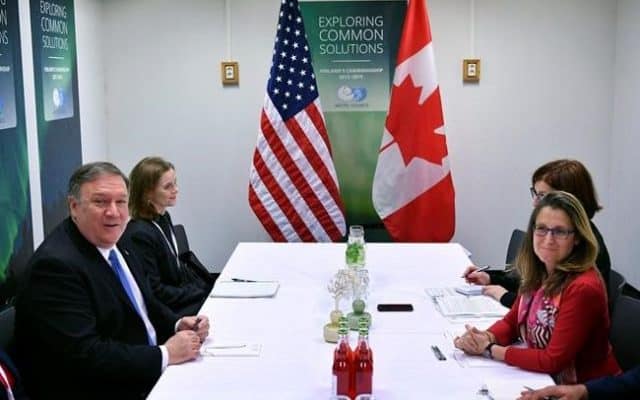
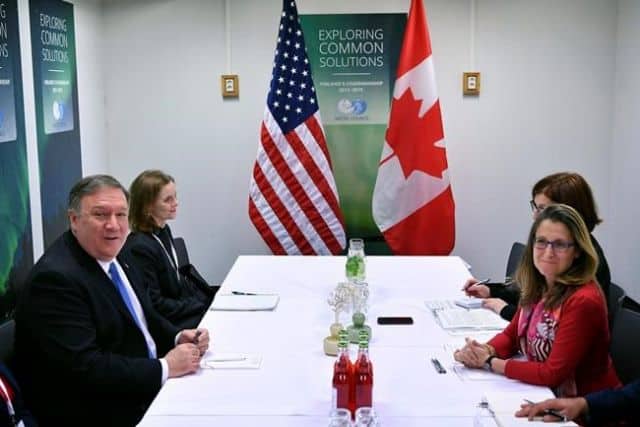
U.S. Secretary of State Mike Pompeo, left, takes part in a bilateral meeting with Canada’s Foreign Minister Chrystia Freeland at the Lappi Areena in Rovaniemi, Finland Tuesday, May 7, 2019.

Canada is holding out hope it can collaborate with the Trump administration on Arctic challenges even though the United States has blocked the Arctic Council from issuing a unanimous declaration acknowledging climate change.

U.S. Secretary of State Mike Pompeo declined to utter the words “climate change” throughout the eight-country summit of Arctic nations that wrapped Tuesday in Finland, including in a meeting with Foreign Affairs Minister Chrystia Freeland.

The American opposition to acting on climate change was not all-encompassing, though, because the Trump administration views melting Arctic ice to be an economic opportunity.

Pompeo says it will open new sea lanes and trade routes, slashing ships’ travel time between Europe and Asia.

Foreign Minister Timo Soini of Finland, which ended its two-year chairmanship of the council on Tuesday, said no joint declaration was possible because the U.S. would not agree to language about climate change.

Freeland did not back away from discussing climate change, but she tried to find common ground with the U.S. over the sovereignty of the Northwest Passage.

“We have a very close, very fruitful collaboration,” she said. “And actually, as we see the conditions of the Northwest Passage changing with our changing climate, I think that’s actually grounds for closer collaboration with the United States.”

Freeland added that “unpredictable weather patterns caused by climate change” are causing security threats and navigation problems.

In a speech in Finland on Monday, Pompeo called Canada’s claim over the Northwest Passage “illegitimate,” language that was criticized as not reflecting the 1988 Arctic Co-operation Agreement that allows Canada and the U.S. to continue to agree to disagree on the issue.

The agreement allows the U.S. to designate the passage as an international waterway while allowing Canada to say that it is a part of Canadian sovereign territory.

The U.S. is more concerned about Russia and China in the Arctic than ownership of the Northwest Passage, said Pompeo.

“The challenges in the Arctic aren’t between the United States and Canada, let me assure you,” he said. “There are others that threaten to use it in ways that are not consistent with the rule of law.”

Pompeo’s views on the economic benefits of climate change met with a muted response during his Monday speech in the northern Finnish Arctic city of Rovaniemi.

“Steady reductions in sea ice are opening new naval passageways and new opportunities for trade, potentially slashing the time it takes for ships to travel between Asia and the West by 20 days,” Pompeo said, as Freeland and the foreign ministers of Denmark, Finland, Iceland, Norway, Russia and Sweden looked on.

“Arctic sea lanes could become the 21st century’s Suez and Panama canals.”

The summit wrapped with a brief joint statement that reaffirmed the council’s “commitment to maintain peace, stability and constructive co-operation in the Arctic.”
Weak rules have made Canada a magnet for money laundering: Don Pittis

National laws and prison penalties are required, C.D. Howe report says

Canada has become a well-known target, even a magnet, for money laundering, and no wonder. 

According to a report out today from the C.D. Howe Institute, a Canadian think-tank, 99.9 per cent of those money launderers are just never caught.

And as British Columbia begins to crack down on the washing of dirty money, the author of the new report, retired corporate lawyer Kevin Comeau, says failure to change national laws just means the crime will go elsewhere in the country.

“It’s highly unfair to law enforcement agencies to say that they’ve been ignoring it,” said Comeau, a member of Transparency International Canada’s working group on beneficial ownership transparency, in a telephone interview. “The problem is that they don’t have the tools to address it.”

Ironically, it is Canada’s reliable rule of law system that attracts the money launderers. Dirty money can come from crime anywhere in the world, including Canada. But much of it is funnelled out of poor countries and autocratic regimes.

But whether the source is drug crimes or political bribery and theft, the people who claim that money don’t want to keep it in those autocratic countries because a more powerful leader could simply take it.

Not so in liberal democracies like Canada where, once you have the legal right of ownership, the law firmly protects that right.

For that reason laundered money in Canada is much more valuable than dirty money elsewhere. And that is why money launderers are pleased to pay well over asking for high-priced real estate, where multimillion-dollar blocks of cash can be cleansed in a single deal.

Former Peruvian president Alan Garcia killed himself after being accused of accepting kickbacks from construction companies. If corrupt leaders can get their money to Canada and laundered, it is hard for the government to get it back.

Unlike perpetrators of many other crimes who can be caught in the act and arrested, money launderers have three big advantages.

“One is the invisibility of the crime. The other is the anonymity of the perpetrators of the crime, and the third is the legal difficulties of tracing the money,” said Comeau. “Because you don’t have a money laundering crime until you can prove that it’s the proceeds from an underlying crime, i.e. drug dealing, political corruption, kickbacks, that kind of thing.”

For all practical purposes, tracing the money back to its original illicit source can be impossible for Canadian law enforcement officials.

Down the rabbit hole

Not only has the money been filtered through a web of corporate entities before it comes to Canada, but sometimes the cash passes through companies headquartered in notorious tax havens such as Saint Kitts and Nevis, where it is actually illegal to reveal the beneficial owner. Comeau describes that as the “rabbit hole” of hidden money.

Comeau says that despite Canada’s fractured securities laws controlled by each province and territory, there are things lawmakers can do now if they are serious about making Canada less of a money laundering oasis and bringing the country up to the standards of other rule of law countries.

Canada allows nominees, companies and trusts to buy and sell property without revealing the person who is the beneficial owner. Comeau said that must change.

‘Clean’ Canadian money is worth a lot more after it has been laundered, making fines almost meaningless. Instead, the C.D. Howe report is calling for prison time as a penalty.

The key provision of any such laws would be that the lawyer or other agent moving money through Canada must reveal the beneficial owner of that money in a publicly searchable database.

Comeau insists it is crucial that the information is not on a private database, but is available for everyone, including people who may have lost that money overseas.

While that conflicts with privacy laws, proponents of the changes says it is well within Canadian law in order to solve this money laundering crime.

Prison time required

To be effective the law must create offences that could include declaring money to be clean when it is not, falsely declaring beneficial ownership, and something called “unexplained wealth orders” that allow authorities to demand the source of money back to its origin.

The other essential part of the new laws must be the inclusion of imprisonment as a penalty for serious violations, because with so much money at hand, fines become meaningless. Prison time would be something else again.

“Then the law enforcement agencies would have something right at the beginning to say to the guy: ‘Tell us who the beneficial owner of all this is or we’re going to charge you,'” said Comeau.

“The money launderers have to bear the very real risk that the person will cut a deal with law enforcement agencies and give them the information leading back to the perpetrators of the original crime.”

Canada to pay for trash

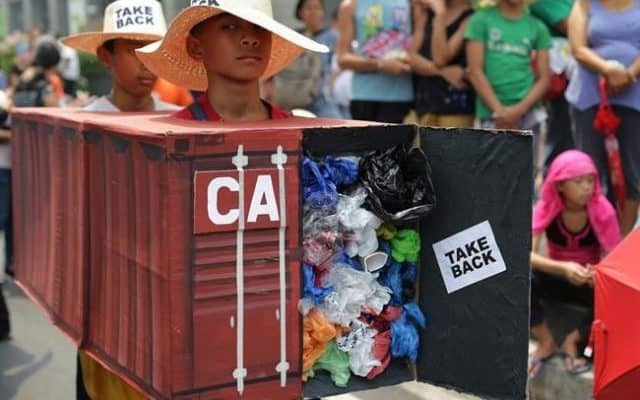
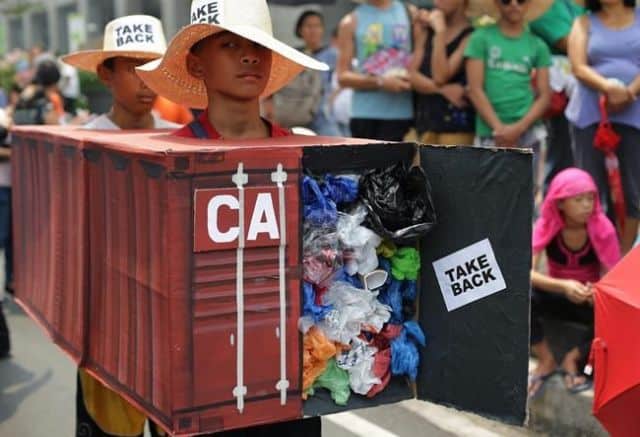
Canada has agreed to pay the full cost of bringing 69 garbage-laden shipping containers back across the Pacific Ocean to Vancouver — but it remains unclear how much it will cost and when it will happen.

The Canadian government made a formal offer to bring back the garbage last month but has remained tightlipped about what the offer contained.

The Philippines has been far more open with information ever since President Rodrigo Duterte threatened to “declare war” on Canada if the garbage was not taken back. He has given Canada until May 15 to get the containers out of the two Philippine ports where they have been sitting for nearly six years.

In a written statement Tuesday, the Philippine Department of Finance said Canada offered in writing on April 24 to arrange for and cover the full cost of shipping the 69 containers that remain from the original 103. A Global Affairs Canada spokesman, who spoke on the condition of anonymity to discuss matters Canada hasn’t yet made public, confirmed the offer included costs, but wouldn’t give any other details.

Environment and Climate Change Canada is in charge of hiring a firm to bring the trash back and then disposing of it in Canada. Caroline Theriault, deputy director of communications for Environment Minister Catherine McKenna, said all the details are still being worked out with the Philippines.

The containers arrived in the Philippines in 2013 and 2014 labelled as plastics for recycling, but were found to mostly contain trash, triggering a long back-and-forth between the two governments over which of them should deal with the problem. There were originally 103 containers but the contents of 34 have already been dealt with in the Philippines.

Canada’s formal offer to pay to bring them back came the same day Duterte made his threat of war, which another government official later clarified was not a true threat but rather made to underscore how unhappy Duterte was that the garbage was still in his country.

Philippine Customs Commissioner Rey Leonardo Guerrero said Tuesday all the export permits needed from the Philippines are in place but that Canada’s import permits are not.

“However, despite the Philippine government’s readiness to re-export the wastes, the Canadian government informed that it might take weeks for them to arrange the necessary documents from their end and that they might not meet the May 15 deadline,” Guerrero said in a statement.

Teddy Locsin, the Philippine foreign secretary, said on Twitter Tuesday he didn’t care about Canada’s paperwork.

“The President expects the garbage to be seaborne by May 15,” he wrote. “That expectation will be met or else…”

MEG Energy $48M loss

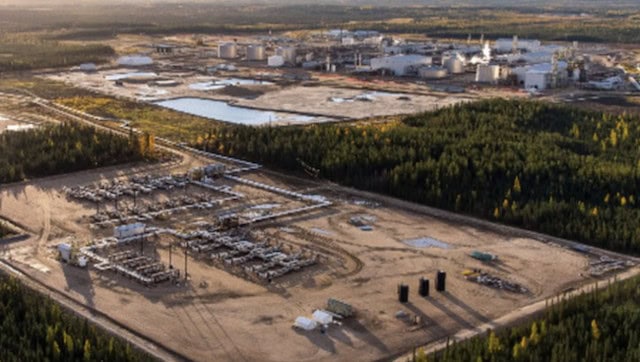
Oilsands producer MEG Energy Corp. is reporting a larger-than-expected first-quarter net loss despite a rise in revenue as its average price for blended bitumen rose by 56 per cent compared with the fourth quarter of 2018.

The Calgary-based company says it lost $48 million or 16 cents per share in the three months ended March 31, compared with a profit of $141 million or 47 cents in the same period a year ago.

Analysts had expected a loss of 13 cents per share, according to Thomson Reuters Eikon.

Revenue came in at $919 million, compared with $721 million in the year-earlier quarter, beating analyst expectations of $651 million.

MEG’s loss included a net foreign exchange gain of $78 million and a loss on hedging contracts of $230 million.

Its net earnings in the first quarter of 2018 included a $318-million gain on the sale of its half interest in the Access Pipeline, a net foreign exchange loss of $108 million, and a loss on hedging of $76 million.

MEG bitumen production was 87,100 barrels per day in the first quarter, down from 93,200 bpd a year earlier (and its capacity of 100,000 bpd) due to the Alberta government’s production curtailment program that began Jan. 1, the company said.

However, it said sales averaged 89,800 bpd as it shipped stored barrels to take advantage of higher prices.