Archives for May 5, 2019

Stocks to Watch: Encana Corporation (TSX:ECA) Up +2.49%

At close of market on Friday, Encana Corporation (TSX:ECA) stock finished trading at +2.49%, bringing the stock price to $9.06 on the Toronto Stock Exchange. The stock price saw a low of $8.71 and a high of $9.10.

The company’s stock was traded 10,474 times with a total of 6,887,990 shares traded.

Encana Corporation has a market cap of $13.1 billion, with 1.45 billion shares in issue.

Encana is an independent oil and gas producer with key assets in the Permian, Eagle Ford, Montney, and Duvernay areas. At the end of 2018, the company reported net proven reserves of 726 million barrels of oil equivalent. Net production averaged 361 thousand barrels of oil equivalent per day in 2018, at a ratio of 43% oil and natural gas liquids and 57% natural gas.


Stocks to Watch: Eldorado Gold Corporation (TSX:ELD) Down -15.84%

At close of market on Friday, Eldorado Gold Corporation (TSX:ELD) stock finished trading at -15.84%, bringing the stock price to $4.57 on the Toronto Stock Exchange. The stock price saw a low of $4.55 and a high of $5.38.

The company’s stock was traded 9,822 times with a total of 3,832,697 shares traded.

Eldorado Gold Corporation has a market cap of $725.72 million, with 158.8 million shares in issue.

Eldorado Gold is a midtier gold producer with mines in Turkey, Greece, and Brazil that produced 349,147 ounces of gold at total cash cost of $650 per ounce in 2018. Eldorado has roughly 17 million ounces of proven and probable reserves and is based in Vancouver, British Columbia.

Canada’s economic mediocrity dilemma: ‘In the new world, bronze doesn’t even show up’

Kevin Carmichael: Complacency is to us what arrogance is to Americans. We embrace it every time we shut down early on Friday to get to the cottage

At least once a quarter, Statistics Canada publishes data on how aggressively mediocre we are.

Most indicators jump around, making us look like world beaters one day and losers the next. But StatCan’s quarterly calculations of labour productivity can be counted on to remind us that the grit we think makes us special on the ice is missing from many of our non-hockey battles.

Labour productivity, the amount of gross domestic product generated per hour of work, dropped 0.4 per cent over the final three months of 2018 from the previous period, according to StatCan’s latest report in March. That followed quarterly increases of 0.2 per cent and 0.7 per cent and a 0.3-per-cent drop in the first quarter.

The United States did better, as it usually does. And early this week, the U.S. Labor Department reported that non-farm labour productivity surged to its fastest rate since 2014 in the first quarter. StatCan hasn’t published similar figures yet. Marker down.

Productivity matters. The Bank of Canada last month lowered the rate at which it thinks the economy can grow without stoking inflation to 1.8 per cent because it estimates the country has become less productive, leaning instead on increased levels of immigration to generate the level of demand to which we have become accustomed.

Imagine if all of those immigrants were joining an economy that matched the aspirational energy that drove them to leave home? Too few of us bother. Wealth has come too easily. All we had to do to get rich was catch fish, fell trees, grow grain, dig up rocks, and mine bitumen. We had preferential trade agreements with the most important economies, first Britain and then the United States.

“The biggest problem with the Canadian mindset is that we are OK with being bronze,” James Keirstead, chief executive of Edmonton-based Levven Electronics Ltd., said in an interview last month. “In the new world, bronze doesn’t even show up.”

Canada spends about 1.5 per cent of GDP on research and development, according to the Organization for Economic Cooperation and Development, a group of 36 wealthy countries. Here are the countries that spend more: Israel (4.5 per cent), South Korea (4.5 per cent), Sweden (3.3 per cent), Taiwan, Japan, Austria, Denmark, Germany, the U.S., Finland, Belgium, France, Norway, the Netherlands, Slovenia, the Czech Republic, and the United Kingdom (1.7 per cent).

Other big economies such as Japan and France are struggling to keep their productivity rates up as their populations age. Those countries have bigger populations on which they can rely. Smaller nations must work harder to generate the wealth they need to support their societies. Australia, Israel, and South Korea are among the advanced economies with stronger productivity rates than ours. That’s probably not a coincidence.

The most innovative countries tend to be the ones whose histories have been “uncomfortable,” said David Johnston, the former governor-general, who devoted a portion of his budget and time at Rideau Hall to studying innovation. Most Canadians understand the benefits of taking risks and becoming more efficient, but “when we get to execution, we have some challenges,” Johnston said in a recent telephone interview. “Life has been very comfortable in Canada.”

Complacency is to us what arrogance is to Americans. We embrace it every time we shut down early on Friday to get to the cottage. We prefer to sell our resources raw rather than put up the money required to develop them at home. Too many technology entrepreneurs are encouraged to sell their companies rather than build them into something greater.

Economists tend to dismiss Canada’s chronically weak productivity numbers as a psychological problem. For them, it’s a condition created by onerous tax policies, cumbersome regulation, and misaligned incentives.

Policy matters, but let’s be honest: This is us. The Rideau Hall Foundation, a charity that Johnston chairs, this week published what it calls the Culture of Innovation Index. The results are based on 20-minute interviews with 2,000 Canadians in early January. Large majorities said it was worth their time to “make something work better” and that it’s “important to take risks that could reap large rewards.” We don’t act on those beliefs. Only half of respondents tried to make things better in their own lives; more than 60 per cent said Canadians were “risk-averse;” and almost 40 per cent identified “inertia” as a barrier to innovation, almost double the number who mentioned “government” and “money.”

Johnston said he thinks it would help if innovation was part of the everyday conversation; two in three Canadians read business news at least once a week, but only one in five report seeing something about innovation, according to the Rideau Hall Foundation survey.

A little discomfort might also help. Levven has developed a wireless light switch that is state of the art. Unfortunately, it did so at about the same time that oil prices crashed. With local construction dead, Keirstead and his fellow executives had to look elsewhere for sales. Levven now has a growing list of American clients that it might not have had if local construction had been stronger.

“Two years ago, we could have had a lot more product here,” Keirstead said. “We have no choice but to go outside Canada. That’s not necessarily a bad thing.”

The changing face of Canada’s judiciary: more women, more diversity

The Liberal government has taken steps to increase diversity in Canada’s judiciary.

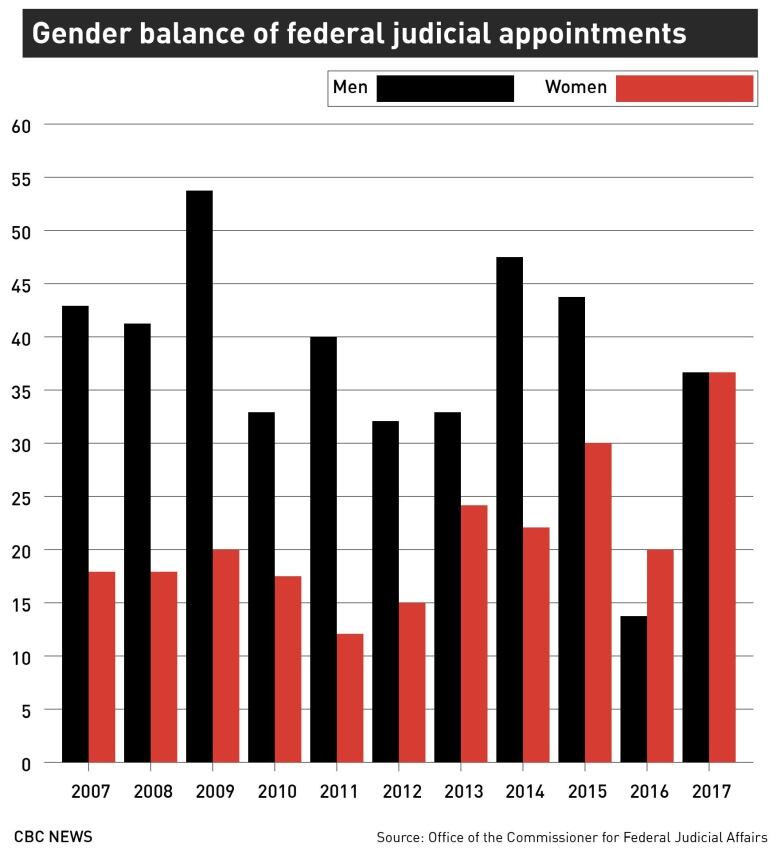
More than half of appointments since 2016 have been women, but Indigenous numbers remain low

Canada’s judiciary is becoming more diverse, with more women, visible minorities, LBGT and Indigenous people on the bench.

The broader mix of judges — and especially the rising number of women hearing cases — is being hailed as historic progress by many in the legal profession. Some worry, however, that targeting “gross demographic categories” could erode a merit-based appointments system.

The number of Indigenous judges also remains low compared to other demographic groups.

The Liberal government overhauled the judicial appointments system in October 2016 in a bid to recruit a more diverse array of candidates and make the selection process more transparent. It made it mandatory to publicly report the number of applicants and appointees from demographics historically under-represented on the bench.

Statistics for the period Oct. 27. 2016 to Oct. 28, 2018, posted online by the Office of the Commissioner for Judicial Affairs, break down the 153 judicial appointments during that period:

  • 83 women
  • 70 men
  • 26 from “ethnic/cultural” groups
  • 16 visible minorities
  • 10 LGBT
  • 6 Indigenous
  • 3 with disabilities

Ray Adlington, president of the Canadian Bar Association, praised what he called the “significant progress” in boosting diversity in federal judicial appointments — which cover superior courts for provinces and territories, courts of appeal, the Federal Court, the Federal Court of Appeal and the Tax Court of Canada. He said he believes it’s crucial for the justice system to better reflect the population.

“If the judiciary visibly represents the society it serves, then it will give that society more confidence that the judiciary is serving the interests of that society,” he said.

“It will promote access to justice, it will promote confidence in judicial administration if the judges actually represent the society. Historically that has not been the case, but we’re certainly moving toward that objective.”

The most dramatic change in the judiciary has been in terms of gender balance, with 2016 marking the first year more women than men were appointed to the bench.

As of April 1, 2019, there were 1,193 federally-appointed judges, 492 of them women.

Andrea Gunraj of the Canadian Women’s Foundation called that progress, but said more needs to be done to achieve gender equity on the bench.

“There are other intersectional forms of equity to consider as well,” she said. “For instance, how many of the judges are Indigenous women? Racialized women? Women with disabilities? A judiciary that reflects all communities, in all their diversities, is so critical.”

More women in law schools

Acadia University law professor Erin Crandall said the key to transforming a judiciary that, historically, has tended to be made up of white men is to get students from more under-represented demographics into law schools.

“It’s a really slow process, because you don’t have somebody going from being in law school to being a judge in Canada. Typically they have 15 to 20 years’ experience,” she said. “Women started to enter law schools in greater numbers in the 1970s, so we’ve had this growth now over several decades.

“In some cases, we’re still building those larger potential applicant pools.”

The number of Indigenous appointees also remains relatively low. According to the Office of the Commissioner for Judicial Affairs, 46 individuals who identified as Indigenous applied for judicial appointments between 2016 and 2018. Twenty-one of them were ‘recommended’ or ‘highly recommended’ by the appointments process. Just six ended up being appointed.

Crandall said more law schools are beginning to launch special streams for Indigenous or black students to encourage more of them to join the legal profession.

The government’s last report on the appointments showed that, as of December 2018, eight of the country’s new justices were Indigenous, 20 identified as visible minorities, 13 identified as LGBTQ2 and three identified as people with disabilities.

The CBC has asked the federal government for more recent data but it has not supplied the information to date.

Justice Minister David Lametti has been fending off criticism about judicial appointments since the Globe and Mail reported that the government consults the Liberal Party’s database of supporters in the course of the appointment process.

Defending the vetting regime, Lametti insisted this week the government has worked to improve transparency and diversity in a merit-based process. The government has appointed or elevated 296 judges since it was elected in 2015, he said.

Justice Minister David Lametti says the government has taken “significant steps” to ensure greater diversity among judges.

“The diversity of these candidates is unquestioned,” Lametti told the House of Commons in question period Thursday. “Fifty-five per cent of them are women and we’re going to continue to ensure that our appointments process is merit-based, continues to be fair, continues to be open and continues to attract the very best candidates.”

LGBT community playing ‘catch-up’

LGBT advocate and Toronto lawyer Richard Elliott said the representation of gay, lesbian and transgender Canadians on the bench is lagging behind other demographics. He pointed out that there has never been an openly gay or lesbian justice on the Supreme Court of Canada. 

Part of the problem, he said, has been the small pool of LGBT candidates graduating from law schools and serving in the legal community.

“For many years, we were considered criminals. The law was used to oppress us and we were excluded from civil life in Canada, including the legal profession. So we’ve been playing catch-up for many years,” Elliott said.

Elliott said judges gain valuable insight into the lives of LGBT Canadians when they have colleagues on the bench who are openly gay or lesbian.

Call for a ‘blind’ appointment process

Some question the pursuit of judicial diversity, however. Philip Carl Salzman, professor emeritus of anthropology at McGill University, said he believes the diversity objective is “highly questionable” because it runs counter to recruitment based on merit.

“Diversity is gender, racial, sexual preference, ethnic, etc. Those seem to me to be a very poor basis for picking people who are supposed to make important decisions,” he said.

Salzman said he has seen a similar trend in academia, of people being hired on the basis of diversity goals over scholarly expertise. He said he believes candidates should not be selected as a result of “gross demographic categories” because it amounts to reverse discrimination.

“You’re going to get people who aren’t as good as you would if you had a colour-blind, sex-blind, gender-blind process,” he said.

Vancouver’s Parq casino looks to refinance amid debt pressure

The company that owns Parq Vancouver is in default after deferring on a May 2, 2019 interest payment deadline.

Company owners have deferred payment on one of its loans twice

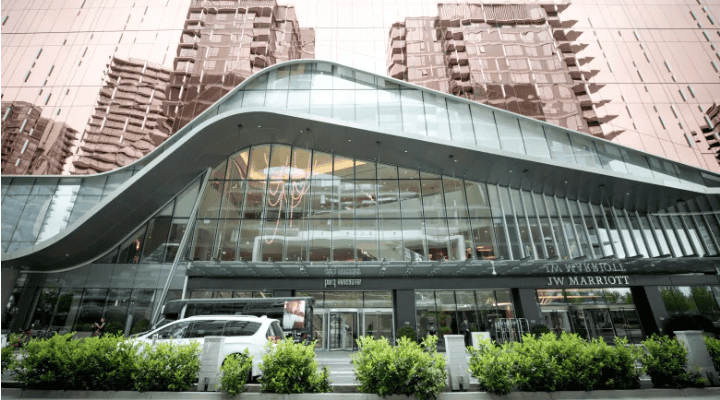
The Parq Vancouver, a luxury casino complex that opened to fanfare in 2017, is seeking to refinance its debt amid increasing financial pressure and missed debt payments.

Andrew Hood, an equity research analyst at M Partners Inc., said since becoming operational, the complex brought in $170 million in revenue, incurred $152 million in expenses, for about $18 million of operating income.

However, its large debt coupled with a high-interest rate completely wiped out any income it made last year. 

“If they want to be feasible moving forward, they must refinance that debt. There’s no way they’re going to make money as a business unless they refinance that debt,” Hood said. 

Parq Vancouver is located in the downtown core of the city.

The building’s owners took on about $450 million of debt in order to build the casino complex, which also includes two luxury hotels and eight restaurants and a conference centre.

Hood says Parq Vancouver made about $18 million of operating income in the 2018 fiscal year. However, he estimates its interest payments were about $30 million a quarter. Interest on its loans vary between over 7.5 to 12 per cent.

The complex has already deferred payment on one of its loans twice, most recently on Monday, Apr. 29. 

Some positives for company

But Hood says Parq Vancouver can turn around its financial situation.

“The positive is the company has said to S&P Global Ratings [a financial services company] that they’re getting close to refinancing [the debt],” he said. 

The facility, which opened in 2017, includes two luxury hotels, eight restaurants and a conference centre in addition to the casino.

The high interest rates on its current loans were because the casino hadn’t been built yet, Hood added. Now that the building is built and operated, there is less risk involved and it can justify getting a lower rate of interest. 

In addition, 2018 was not a typical year for the company. There were still start-up costs — like employee training and extra marketing. 

Once the business is up and running, Hood says it will be able to increase its income. 

Impact of anti-money laundering rules?

Some have cited the B.C. government’s new anti-money laundering regulations, introduced in December 2017, as one reason for Parq Vancouver’s financial troubles. 

But Hood says it’s hard to deduce its impact.

“It’s hard to say what number would be the effect, because it was [the casino’s] first year operating,” he said. “Generally, the casinos in the area have said the anti money-laundering regulations affected revenues … [so] you could say that it’s unfortunate timing.”

He says Parq Vancouver should focus on building up more positive exposure to attract people to the facility.

“It’s an impressive facility … [and] people who visit Vancouver would certainly be interested in visiting it even if they’re not gambling.”

Canada Border Services seizes lawyer’s phone, laptop for not sharing passwords

A Canadian border officer seized lawyer Nick Wright’s laptop and phone when he wouldn’t hand over his passwords.

Concern is mounting over Canadian border officers’ powers to search smartphones

As more people travel with smartphones loaded with personal data, concern is mounting over Canadian border officers’ powers to search those phones — without a warrant.

“The policy’s outrageous,” said Toronto business lawyer, Nick Wright. “I think that it’s a breach of our constitutional rights.”

His thoughts follow a personal experience. After landing at Toronto’s Pearson Airport on April 10, he said the Canada Border Services Agency (CBSA) flagged him for an additional inspection — for no stated reason.

Wright had just returned from a four-month trip to Guatemala and Colombia where he studied Spanish and worked remotely. He took no issue when a border services officer searched his bags, but drew the line when the officer demanded his passwords to also search his phone and laptop.

Wright refused, telling the officer both devices contained confidential information protected by solicitor-client privilege.

He said the officer then confiscated his phone and laptop, and told him the items would be sent to a government lab which would try to crack his passwords and search his files.

Nick Wright poses with his Spanish instructor, Nicks Rocche Chavajay, in San Pedro La Laguna, Guatemala.

“In my view, seizing devices when someone exercises their constitutional right is an affront to civil liberty,” said Wright who’s still waiting for the return of his phone and laptop. Meanwhile, he said he has spent about $3,000 to replace them.

Officers can search your phone

According to the CBSA, it has the right to search electronic devices at the border for evidence of customs-related offences — without a warrant — just as it does with luggage. 

If travellers refuse to provide their passwords, officers can seize their devices.

The CBSA said that between November 2017 and March 2019, 19,515 travellers had their digital devices examined, which represents 0.015 per cent of all cross-border travellers during that period.

Officers uncovered a customs-related offence during 38 per cent of those searches, said the agency.

While the laws governing CBSA searches have existed for decades, applying them to digital devices has sparked concern in an era where many travellers carry smartphones full of personal and sometimes very sensitive data.

A growing number of lawyers across Canada argue that warrantless digital device searches at the border are unconstitutional, and the practice should be stopped or at least limited.

“The policy of the CBSA of searching devices isn’t something that is justifiable in a free and democratic society,” said Wright who ran as a Green Party candidate in the 2015 federal election.

“It’s appalling, it’s shocking, and I hope that government, government agencies and the courts, and individual citizens will inform themselves and take action.”

‘Out of date’ laws

Consumer advocacy group, OpenMedia is already taking action. It has launched an online and ad campaign to raise awareness about digital border searches and pressure the federal government to update the rules that govern them.

“These laws are incredibly, incredibly out of date,” said OpenMedia privacy campaigner Victoria Henry. “The way they treat our digital devices are as mere goods and that’s the same classification as a bag of T-shirts.”

She wants to see separate border rules for digital devices which stipulate reasonable grounds for a search. Henry also said those rules must be clearly laid out to the public.

“We need to have clear and transparent policies and mechanisms for recourse.”

An example of an ad that OpenMedia plans to run, starting in June on the Vancouver Skytrain.

The federal government says that its current policies are both reasonable and necessary to keep Canadian borders secure.

CBSA officers are directed to disable any internet connection and only examine content that is already stored on a device, said Scott Bardsley, spokesperson for Public Safety Minister Ralph Goodale, in an email.

He also said that digital searches “should not be routine” and that “officers may only conduct a search if there are multiple indicators that evidence of contraventions may be found on a device.”

Wright said, in his case, no rationale was provided why his phone and laptop needed to be examined. 

“There were no factors that I’m aware of that would justify the searches.”

‘Respect for privacy’

Public Safety spokesperson Bardsley also said that CBSA officers understand the importance of solicitor-client privilege and are instructed not to examine documents that fall within that scope.

“CBSA officers are trained to conduct all border examinations with as much respect for privacy as possible.”

Wright said that wasn’t his experience. Instead, the officer he dealt with neither expressed knowledge of, nor responded to his concerns that his laptop and phone contained solicitor-client privileged documents, he said.

“His response was only to demand the passwords to access both.”

According to the Canada Border Services Agency, its officers have the right to search any goods crossing the border without a warrant — including electronic devices.

Bardsley said that if travellers have issues or concerns, they can submit a complaint to the CBSA. He added that the government is investing $24 million to enhance oversight by creating an independent review body for the agency.

Wright has already submitted his complaint to the CBSA which includes a demand for the immediate return of his phone and laptop, plus compensation for having to temporarily replace them.

If and when he gets them back, his battle may not be over; Wright is now considering legal action.

“I think it’s important that we all stand up for our civil liberties and our charter rights,” he said.