
Archives for May 1, 2019

Stocks to Watch: Aleafia Health Inc. – Ordinary Shares (OTCQX:ALEAF) Down -2.62%

At close of market on Monday, Aleafia Health Inc. – Ordinary Shares (OTCQX:ALEAF) stock finished trading at -2.62%, bringing the stock price to $1.17 on the OTCQX Marketplace. The stock price saw a low of $1.12 and a high of $1.25.

The company’s stock was traded 914 times with a total of 790,679 shares traded.

Aleafia Health Inc. – Ordinary Shares has a market cap of $317.78 million, with 271.95 million shares in issue.

Aleafia Health Inc is a vertically integrated cannabis health and wellness company which owns three cannabis product and cultivation facilities where it produces a diverse portfolio of commercially high-margin derivative products including oils, capsules and sprays. The company operates national network of medical cannabis clinics and has seen over 60,000 patients to date.


Stocks to Watch: Prometic Life Sciences Inc. (TSX:PLI) Down -14.29%

At close of market on Monday, Prometic Life Sciences Inc. (TSX:PLI) stock finished trading at -14.29%, bringing the stock price to $0.06 on the Toronto Stock Exchange. The stock price saw a low of $0.06 and a high of $0.07.

The company’s stock was traded 467 times with a total of 8,199,443 shares traded.

Prometic Life Sciences Inc. has a market cap of $1.24 billion, with 20.72 billion shares in issue.

Prometic Life Sciences Inc is a global biopharmaceutical corporation supplying technologies for Bioseparations while also developing its own orphan drugs, plasma-derived therapeutics and small-molecule therapeutic products targeting unmet medical needs in the field of fibrosis, autoimmune disease/inflammation and cancer. The company also offers drug purification of biologics, drug development, proteomics and the elimination of pathogens. The company’s segments consist of the Small molecule therapeutics segment, the Plasma-derived therapeutics segment and the Bioseparations segment. Majority of the revenue is derived from the Small molecule therapeutics segment that develops drug candidates for rare or orphan indications.

‘Temporary’ oil solution

The head of Canada’s largest railway says ferrying crude remains a lucrative, albeit temporary solution to Canada’s pipeline quandary.

“The role of the rail industry is a recent role and probably a temporary role. We’re not here to replace pipelines; we’re here to be a compliment for a period of time,” Canadian National Railway Co. chief executive Jean-Jacques Ruest told The Canadian Press in an interview.

“We’re in a position to be a bridge, if you will, between now and the time that pipelines are being built. We could be a bridge for the next year, two years or three years.”

CN Rail ramped up capacity with more track, crews and locomotives, Ruest said, only to see volumes fall this year from record highs last autumn after Alberta lowered the oil production cap to free up export pipeline space and boost the price of Western Canadian Select amid an oil glut.

Attempts to build or expand pipelines have faltered the last few years, leaving railways to pick up the slack. Major projects such as the Northern Gateway and Energy East pipelines were cancelled, and delays continue to snarl the Trans Mountain expansion, Line 3 replacement and Keystone XL pipeline.

Meanwhile CN Rail and Canadian Pacific Railway Ltd. shipped 23 per cent more oil and petroleum in 2018, according to the Association of American Railways. Crude-by-rail exports hit a record 327,229 barrels per day in October, a 58 per cent year-over-year increase, according to the National Energy Board.

CN’s crude-by-rail exports to the U.S. are currently down 40 per cent from December to about 150,000 barrels per day, Ruest said. But year-over-year revenue from petroleum and chemicals still rose 25 per cent last quarter.

“Our assumption at this point is that if the spread goes back to about $15 or higher, then the crude-by-rail business between Alberta and the United States will start to pick up again.”

Ruest declined to comment on whether he’d been in contact with Alberta’s United Conservative Party, which formed government for the first time after Premier Jason Kenney and his cabinet were sworn in Tuesday.

“They’re well-positioned to take action, whichever way they want to go,” Ruest said a few hours later, after CN’s annual general meeting in Montreal. “Time will tell.”

In March, Kenney said a United Conservative government would try to cancel Alberta’s $3.7-billion deal with CN and CP to ship more oil by rail, calling the plan “a catastrophic mistake by the NDP.”

Ruest said private sector producers would likely be ready to pump oil into any void left on the railroad by a potential contract withdrawal or revision by Kenney.

Analyst Cameron Doerksen of National Bank Financial said crude has proven volatile for the railroads due in part to yo-yoing pricing spreads.

“They’re not dependent on crude-by-rail, but they have the available capacity to participate if there is demand and can make good money off of it,” Doerksen said.

“I think it’s probably the case that there’s going to be a rebound in the crude-by-rail volumes, versus what we’ve seen the last couple months, for the remainder of the year.”

Shopify shares soar after tech company pivots to a profit

Shopify Inc.’s share price jumped in Tuesday trading after the company beat earnings expectations and boosted its full-year forecast.

Shares in the Ottawa-based online shopping platform closed up $22.71, or 8.9 per cent, at $325.75 on the Toronto Stock Exchange.

The boost came after the company, which reports in U.S. dollars, said it had adjusted earnings of $10.3 million US or nine cents per share for the first quarter, while analysts had expected a loss of five cents per share, according to Thomson Reuters Eikon.

Revenue of $320.5 million US was up 50 per cent from the $214.3 million a year ago, and above the $310 million expected by analysts.

“Shopify had a surprisingly strong earnings report,” said analyst Colin Cieszynski at SIA Wealth Management Inc. in a research note.

International expansion

The growth comes as Shopify expands internationally and continues to add merchants as it pushes to increase its offerings in the highly competitive online retail space.

The company launched a TV and film content development and production house that will initially showcase entrepreneurial success stories.

Shopify is also pushing to roll out more seamless international currency transactions and support for more languages.

The company faces increased competition from other online platforms that are adding direct sales options, including Instagram’s limited roll-out in the quarter.

Harley Finkelstein, chief operating officer of Shopify, said on an earnings call that growth in the sector will mean more options for its merchants.

“With every new channel that comes to market, whether it’s a social media platform or a new marketplace, what that does is it makes Shopify more valuable as a retail operating system.”

Retail hardware for online merchants

He said the company also makes sure to have deals in place with other online platforms to capture economic benefits from its merchants selling elsewhere.

“We have economics in place to allow us to grow when our merchants sell more.”

In its push for a single simplified solution the company also recently rolled out a new retail hardware collection including a card reader as well as a dock for the reader and a stand for a tablet.

The added products come as more online merchants look to open physical retail stores, said Shopify CEO Tobi Lutke on the call.

“Funnily enough, expanding offline, so to speak, expanding to brick and mortars, is starting to look really good from a cost-per-acquisition perspective, so there are lots and lots of reasons that are pushing retailers back to the retail stores.”

He said that as merchants look to sell offline, as well as on an expanding array of platforms, Shopify is well-placed to serve its clients.

“You need a unified system to run a business across multiple channels…this is something which is just enormously complicated unless the software really, really makes this easy.”

$245M loss at Encana

Encana Corp. shares rose sharply and then fell in early trading on the Toronto Stock Exchange on Tuesday after it reported first-quarter production and financial results that missed analyst expectations.

The Calgary-based oil and gas producer closed the all-shares acquisition of U.S. rival Newfield Exploration Co. in mid-February, thus gaining a new core operating area in the Anadarko Basin of Oklahoma.

The purchase sparked a 15 per cent reduction in the combined companies’ workforce, as well as operational changes that Encana said have already resulted in more than US$1 million per well cost reductions in the former Newfield oilfields.

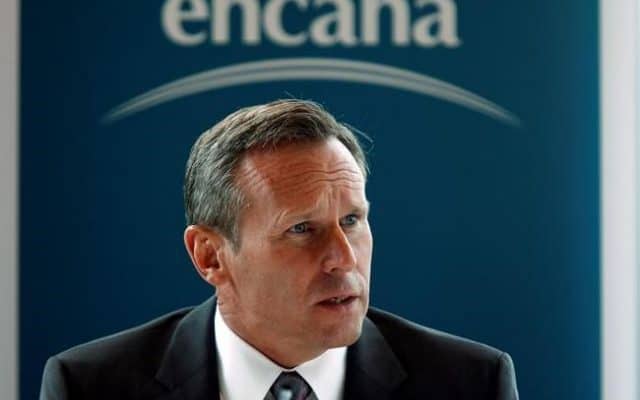
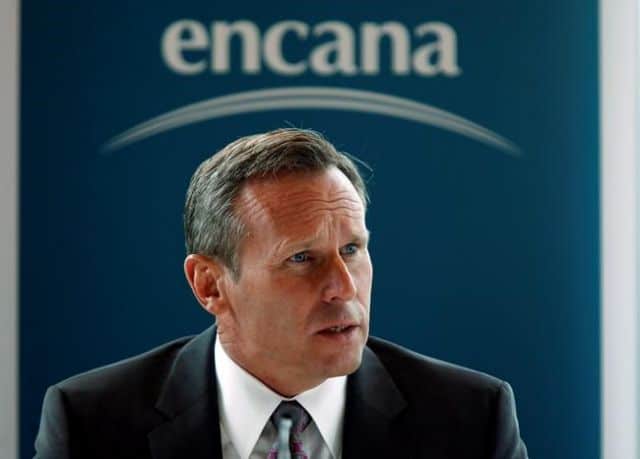
On a conference call, Encana CEO Doug Suttles promised the company will not increase spending beyond the US$2.8 billion it has budgeted for this year despite recent higher oil prices.

The company reported already completing 60 per cent of the 91-million-share buyback program it launched in March.

“We see compelling value in Encana stock today; in fact, we believe that buying our own equity is an incredible value,” Suttles said.

“Although higher oil prices are certainly a nice tailwind, I want to be very clear that higher oil prices will not translate into higher capital spending.”

Encana shares rose by as much as 4.5 per cent to $9.98 early Tuesday before trailing off to $9.36, down two per cent, by noon EDT.

Encana, which keeps its books in U.S. dollars, reported a net loss of $245 million in its latest quarter as it was hit by $113 million in employee severance and outplacement costs and non-cash losses of $427 million from its commodity hedging program.

It earned a net profit of $151 million in the same quarter a year earlier.

Annual general and administrative cost savings from the Newfield purchase are now expected to be $150 million, up from the earlier estimate of $125 million, Suttles said, noting the company is realizing more savings by measures including selling or subletting unneeded real estate.

Analysts said Encana’s first-quarter production of 468,000 barrels of oil equivalent per day — including a month and a half of Newfield output — was lower than consensus expectations of 478,000 boe/d.

Slightly better than expected Anadarko volumes were offset by third-party midstream outages that caused reductions in production from Texas Permian wells and from the Montney region in Western Canada.

“Overall, while the quarter was messy, we do not see anything structurally broken and as such expect any weakness to be bought by the market in anticipation of a stronger Q2,” said AltaCorp Capital analyst Thomas Matthews in a report.

Encana said its adjusted operating profit for the first quarter totalled $165 million, compared with an operating profit of $156 million a year ago.

It reaffirmed its production targets for 2019, including approximately 15 per cent liquids growth from its three core growth assets.

Economy contracting?

Statistics Canada’s offices at Tunny’s Pasture in Ottawa are shown on Friday, March 8, 2019. Statistics Canada says the economy contracted in February after strong growth in January.

Statistics Canada says the economy contracted in February after showing strong growth in January.

The agency says gross domestic product pulled back 0.1 per cent in February as both goods-producing and services-producing industries declined. Growth in January was 0.3 per cent.

Economists had expected no change in gross domestic product for February, according to Thomson Reuters Eikon.

The mining, quarrying and oil and gas extraction sector fell 1.6 per cent overall, with mining and quarrying down 4.4 per cent and oil and gas extraction slipping 0.6 per cent.

Transportation and warehousing fell 1.6 per cent, due to a 10.8 per cent drop in rail transportation as cold weather, heavy snowfalls and a derailment in B.C. that closed an important rail line through the Canadian Rockies hurt the sector.

The utilities sector gained 1.5 per cent in February as cold temperatures contributed to higher demand for electric power generation, transmission and distribution and natural gas distribution.