
Archives for April 11, 2019

AT&T’s mobile 5G goes live in seven more cities

Austin and San Francisco are two of the cities getting real 5G.

American carriers are still engaged in their endless game of 5G oneupmanship. AT&T has expanded its fledgling mobile 5G network to “parts” of seven more cities, including Austin, Los Angeles, Nashville, Orlando, San Diego, San Francisco and San Jose. The move puts AT&T’s real 5G in a total of 19 cities, making Verizon’s (Engadget’s parent company) two-city rollout seem modest by comparison. With that said, the usual caveats apply.

To begin with, current 5G coverage tends to be spotty, usually due to high frequencies that limit coverage and affect signals indoors. There’s also the not-so-small matter of device support. Right now, you’re relegated to a Netgear 5G hotspot. Smartphones like the Galaxy S10 5G won’t start arriving until later in the spring. This is an important step toward mainstream adoption of 5G, but it won’t come close to normalcy until you don’t have to be picky about where and how you use the technology.
Self-healing space suits among 18 ideas to receive NASA funding

Other concepts include spider-inspired microprobes and shields that take us closer to the Sun.

It once required an open mind and an active imagination to believe we could launch humans into space. Now, we take human space flight for granted, but we still need that out-of-the-box thinking to push the boundaries of exploration in this solar system and beyond. That’s where NASA’s Innovative Advanced Concepts (NIAC) program comes in. It’s meant to foster ideas that sound borderline science fiction but have the potential to become new technologies. Today, NASA announced 18 innovative concepts that will receive NIAC funding.

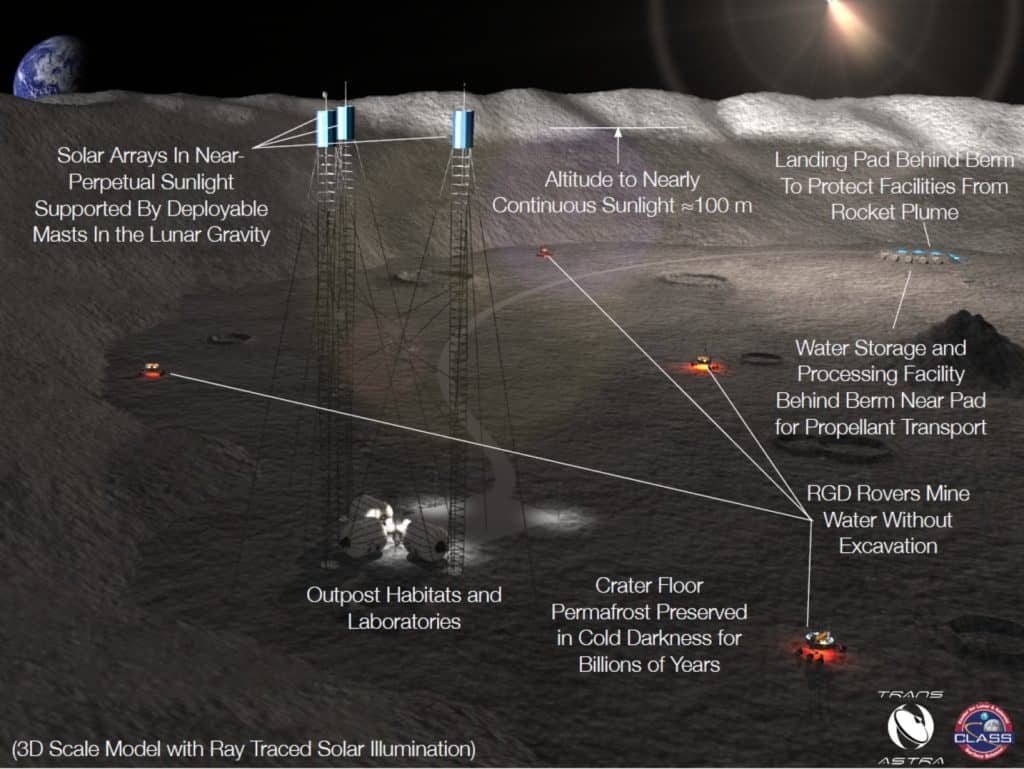
In Phase I, there are 12 concepts, including a smart spacesuit with soft robotics and self-healing skin. There’s also an idea for microprobes inspired by spiders that could help us study planetary atmospheres. Other concepts include lunar ice mining outposts (pictured above), an inflatable flier designed to explore the atmosphere of Venus and nuclear electric propulsion systems that might make it feasible to fly through water plumes on the surface of Europa, one of the moons of Jupiter.

NASA also selected six Phase II concepts, which in theory, are a bit closer to implementation. Those include a flexible telescope that can be deployed in a cylindrical roll and mounted on a 3D-printed structure once it’s in space. There’s also a study to analyze material shields that could take us closer to the Sun than ever before.

Each of the Phase I awards is worth $125,000, and if the ideas show promise after the nine-month feasibility phase, they’ll be able to apply for Phase II, which comes with up to $500,000 over two years. This summer, the NIAC program will select one project for a Phase III study worth $2 million. Most of these concepts will require at least a decade of development, so it’s not likely we’ll see spider-inspired space probes anytime soon.

Rogers buys up frequencies

Rogers Communications will spend $1.72 billion to acquire spectrum licences from the federal government, making it by far the biggest spender in a hard-fought auction that pitted Canada’s wireless companies against each other.

The Canadian treasury will get a total of nearly $3.47 billion from auctioning 104 licences to Canada’s wireless networks, which are racing to get ready for fifth-generation technology that will roll out over a decade or so.

This year’s auction was for the 600 megahertz band of frequencies, which can cover large areas and easily penetrating buildings.

Next year’s auction will be for 3,500 MHz licences, which are even more valuable because they’re more widely used in fifth-generation networks around the world.

Canada’s three national carriers were only allowed to bid on 64 of the available licences in this year’s auction because of restrictions imposed by the Department of Innovation, Science and Economic Development.

ISED Minister Navdeep Bains said some of the licences were set aside for smaller carriers in order to stimulate competition which, he said, will bring down consumer prices.

“I’m confident this strategy — in the short, medium and long-term — will benefit consumers.”

He said the money from the auction will be added to the federal government’s general revenue incrementally over the life of the licences — generally 20 years.

Rogers won 52 of the licences it was eligible to bid on, covering territorial blocks in southern and northern Ontario, northern Quebec, Atlantic Canada, Manitoba and the three territories.

“This spectrum is vital to the deployment of 5G in Canada and we are well-positioned to bring the very best of 5G to Canadians,” Rogers chief executive Joe Natale said in a statement.

“We went into this auction with a clear, disciplined plan and seized this opportunity for the benefit of our customers and shareholders.”

Telus Corp. spent $931.2 million for 12 licences, making it the second-biggest spender in the 600 megahertz auction.

Freedom Mobile — which operates networks in Ontario, Alberta and British Columbia — spent nearly $492 million for 11 licences in its territories, making it the third-highest spender overall.

The CEO of Shaw Communications, which owns Freedom, said it’s becoming a true alternative to the incumbents.

“The addition of this 600 MHz low band spectrum will not only vastly improve our current LTE service but will also serve as a foundational element of our 5G strategy providing innovative and affordable wireless services to Canadians for years to come,” Brad Shaw said in a statement.

Quebecor Inc.’s Videotron — which operates in Quebec — spent $255.8 million. The rest of the licences went to a number of smaller companies, including Bragg (Eastlink), TBayTel, SaskTel, and Xplornet.

BCE Inc.’s Bell Canada — owner of one of the three national wireless businesses — said it decided not to acquire any of the available licences.

“Given the supply of other low-band spectrum that Bell already possesses, 600 MHz is not required for Bell to deliver broadband 4G and 5G services,” it said in a statement.

The company noted that its main U.S. peers have also chosen not to own any 600 MHz spectrum in their markets.

“Bell looks forward to participating in upcoming federal auctions of the mid band 3500 MHz and high band millimetre wave spectrum that will be required to drive the fifth generation of wireless,” said Stephen Howe, Bell’s chief technology officer.

Porter CEO hands over reins

The founder of Porter Airlines is handing over his responsibilities as chief executive to his son to run the small airline that flies from its base at Toronto’s Billy Bishop Airport.

Michael Deluce becomes president and CEO effective immediately after serving as vice-president and chief commercial officer.

Robert Deluce has become executive chairman and the company’s accountable executive for Transport Canada.

Don Carty remains chairman of the board while Paul Moreira remains chief operating officer.

Moving to fill Michael Deluce’s role as chief commercial officer is Kevin Jackson, who will maintain his duties as chief marketing officer.

Porter Airlines, which started operations in 2006, flies Bombardier Q400 turboprops to 19 destinations in Canada and the United States, along with seasonal service to three locations.

Food guide unaffordable?

A new study by Vancouver based Angus Reid Institute indicates half of low-income households say the new Canada Food Guide diet is unaffordable.

The study also shows nearly half of all Canadians say it has grown more difficult to afford to put food on the table over the last 12 months, and four-in-ten say adhering to the diet recommended in the recently updated Canada Food Guide would make paying their household’s food bill even more challenging.

Canadians’ views on the price and nutritional value of the food they eat have changed and there is a sense that food is getting harder to afford for many, particularly Canadians in lower-income households.

Study respondents with household incomes under $50,000 say they are considerably more likely to have chosen less healthy, cheaper options, or to have cut back on meat and vegetables as a response to their affordability challenges.

Furthermore, half of lower-income Canadians say it would be difficult for them to afford to eat a diet based on the new food guide.

The new Canada Food Guide diet places greater emphasis on plant-based foods and less on meat as a source of protein. Lower-income Canadians are also four times more likely to have used a food bank in the past year.

Get economy running

A processing unit is shown at Suncor Fort Hills facility in Fort McMurray, Alta.

Getting Alberta’s economy running on all its fossil-fuel-powered cylinders is at the heart of the province’s election campaign.

But some of Canada’s top energy thinkers — as well as international experts — warn there’s no pedal any premier can stomp to make that engine rev like it used to.

“No policy of any Alberta government can change things,” said Mark Jaccard, an energy economist at B.C.’s Simon Fraser University, who has advised governments on climate policy and helps write reports for the Intergovernmental Panel on Climate Change.

“If Albertans are unwilling to accept a steady oilsands output, with the resulting employment, I fear for them.”

The University of Manitoba’s Vaclav Smil, one of Canada’s most widely quoted energy analysts, said any move to renewable energy will take decades, not years. The transition, however, may be felt sooner.

“All energy transitions are slow,” he said. “Oil will be with us for decades to come — but not necessarily with high annual growth rates.”

The world has changed, said Andrew Grant of the London-based research group Carbon Tracker.

“Companies (are) much more reluctant to invest capital in projects that require very, very high capital outlay and take years and years to pay back. That encapsulates the oilsands.”

Grant’s group has recently published research suggesting that while renewables are still small, they play a big role in meeting new demand.

Solar and wind power provide three per cent of global energy demand, the report said. But between them they account for a quarter of all new generation.

It said that by early next decade, power from solar and wind is expected to be as cheap or cheaper than fossil fuels anywhere in the world. Since 2012, more new power generation has come from renewables than fossil fuels.

High-cost fossil fuels will become less attractive investments, Grant said. Even without carbon pricing, his group expects fossil fuel demand to peak early next decade.

“It’s not necessarily that the change to renewables will be quick,” he said. “But it’s quick enough to make up all of the growth in future energy demand fairly soon.”

The same logic applies to transportation. A tiny fraction of the world’s cars are electric, but they make up 22 per cent of growth in sales.

Jaccard has run the numbers.

In a paper published last year, he concluded that if the world honours its pledge to keep global warming under two degrees Celsius, there’s less than a five per cent chance that new oilsands investment — including pipelines — will be profitable over the next 30 years.

“When the global demand for oil stabilizes and starts to fall, Alberta will be hit first,” he said. “It’s (oilsands) among the highest emissions per barrel with the highest production costs.”

Nor is the oilpatch as job-rich as it once was.

Between 2014 and 2016, production grew by nearly 10 per cent, but 39,000 fewer people were employed. “Albertan oil output increased over the last four years while the jobs were lost,” Jaccard said.

Not everyone is as convinced the oilsands have had their day.

The International Energy Agency forecasts slightly increased oil demand — about six per cent — through 2040.