
Archives for April 11, 2019

Why everyone should save like they’re going to retire early

The growing movement among some millennials and members of Generation X to aim for an extremely early retirement in their 40s, 30s, even 20s, which goes by the acronym “FIRE” (financial independence, retire early), is getting a lot of attention right now.

To some, early retirees are an inspiration, showing what’s possible when you opt out of society’s consumer narrative. But too often, stories on early retirees focus on intense money-saving tactics and present those in the movement as oddities. Highlighting the novelty of the movement, and the extreme lifestyle choices of a few adherents, distracts from the more important reality: For far too many Americans, early retirement is not a novelty, but an inevitability.

More than half of U.S. workers over age 50 are pushed out of long-held jobs before they choose to retire, according to a new analysis of Health and Retirement Study data by ProPublica and the Urban Institute, often resulting in irreparable financial harm that imperils their retirement and therefore the rest of their lives. Many never find work again, and those who do often have to take a massive pay cut or make other sacrifices that significantly diminish their quality of life. Only one in 10 ever matches their prior income before they were forced out.

Couple that with the fact that pensions are disappearing rapidly at the same time that retirement savings are stagnating. According to Economic Policy Institute (EPI) research, roughly half of retirement savings are accumulated after age 50, and even for those closest to retirement, aged 56-61, the median family retirement savings are only $17,000.

Our collective narrative insists that anyone can achieve the American Dream, and that we control our own destiny. We believe it’s our decision when we’ll retire. The problem is that for most of us, we’ll never actually get the choice.

Whether it’s getting downsized at work and being unable to find another job because of an ageist job market, being forced to quit by illness or disability as we collectively grow sicker, or needing to stay home to care for someone else, the fact is that most of us will not retire when we intend to. It’s why we see a continual increase in the age at which Americans expect to retire, from 60 in 1995 to 66 in 2018, but a large and persistent mismatch in terms of when Americans actually do retire. The average retirement age is 63, not the intended 66.

And of course we all know that automation, outsourcing, and shifts within industries are an ever-present threat to long-term job security. What you do now simply may not exist as a job by the time you’re 50 or 60, the years during which workers do most of their retirement savings. So even if you love your job and have zero desire to leave it before your 60s, you may not ultimately have that say, and you’re so much better off if you can give yourself the financial flexibility to leave work at a younger age than you plan to work to.

We need to better prepare ourselves for an early retirement, which starts by changing how we think and talk about retirement, not as something that can be predicted with perfect precision, but more like a natural disaster: something that can strike at almost any time, without warning. And early retirement must become something we all anticipate, not something we treat as a fringe phenomenon for entitled millennial tech bros.

Most of the oxygen in personal finance advice currently goes toward trying to convince people to work longer, for example, Suze Orman pushing people not to retire or claim Social Security until at least age 70. That’s great advice for those who have the choice to keep working until then, but the data show that that’s an increasingly small minority. And you can’t know whether you’re in that lucky few or not until it’s too late to do much about it. Those of us giving personal finance guidance need to continue advising people to work as long as they can if they’ve undersaved, but to balance it with more urgency to save more and save it sooner.

To truly address this, we also need policy solutions, including better options than 401(k) plans and individual retirement accounts (IRAs), investment vehicles that largely benefit the already-rich and which, according to EPI, fail most workers and do not adequately substitute for the pensions of the past. Those solutions must include pathways for lower income people to save more, too. The disappearance of pensions has created greater disparities between white Americans and people of color, according to EPI, and we must fix that.

We also need more financial education in schools. Currently, only five states earn an A grade for turning out financially literate students from the Champlain’s College Center for Financial Literacy. And 30% of states earn a D or F. Most American high-school students are never required to take a personal finance class to graduate.

But on a personal level, the best thing any of us can do is to see retirement not as something far off in the distant future, but as something you might transition to in the near term. Save more and save it sooner. Accept that even if you love your job, you may not always have the choice to keep doing it. Given the data we have, aiming to be fully set for retirement by age 50 should be our new universal financial goal, not 65, 70, or beyond.

The extreme early retirement movement may appear to many as an oddity, but it does offer hope to those with disposable income that it’s possible to transform your financial habits and future security entirely if properly motivated to do so. Now it’s time to make planning for early retirement not just some fringe movement, but the norm for everyone.


What Is the Average 401(k) Return?

MANY PEOPLE SAVE AND invest in a 401(k) plan with the hope that they can accumulate enough to eventually pay for retirement. In addition to your savings rate and employer contributions, your 401(k) investment returns have a big impact on your final account balance.

The average 401(k) return can vary, depending on:

  • How consistently you save.
  • The number of years until retirement.
  • How comfortable you are with risk.
  • The ups and downs of the market.

To make the most of your 401(k) plan and increase your chances of a high rate of return, “your portfolio has to be right for you,” says Emmet Savage, chief investor and co-founder of MyWallSt, an investing education app. “Taking a small amount of time to understand your options and make adjustments can reap massive benefits.” Consider the following factors to determine the return you might get on your 401(k) plan.

Saving Regularly Can Increase Returns

If you have funds taken from your paycheck and put into a 401(k) every month, over the years the continuity could pay off. The average 401(k) plan account balance for consistent participants grew every year from 2010 to 2016, according to a November 2018 report by the Employee Benefit Research Institute. Overall, the average account balance increased at a compound annual average growth rate of 14.2 percent from 2010 to 2016. (The report points out that account balances are influenced by three factors: new contributions to the account; investment return, which is tied to the performance of the financial markets and the mix of assets in the 401(k); and withdrawals from the account.)

“Automatic payroll deductions keep you investing at regular intervals, reaping the benefits of dollar-cost averaging and preventing you from making emotional decisions,” Savage says. Dollar-cost averaging refers to the strategy of purchasing the same amount of an investment or group of investments at set intervals.

Some companies automatically enroll eligible employees in a 401(k) plan. They might also increase the contribution percentage periodically, which participants can also do on their own. “If you do these two things, you’ll save much more than a person who only does one or neither of these,” says Jake Sensiba, an investment advisor at CRG Financial Services in Brookfield, Wisconsin.

Your Retirement Date Can Impact Your 401(k) Rate of Return

If you have several decades left before retirement, you might opt to invest in mutual funds that offer a potentially higher rate of return but also carry more risk. For those close to retirement, funds that offer a lower return in exchange for less risk might have more appeal.

Target-date mutual funds are set up to help align your investments with your estimated retirement date. You might choose a target-date fund focused on the year you plan to retire. The rate of return can fluctuate, as funds might initially be allocated more heavily toward higher-risk investments like stocks and over time shift to more lower-risk investments like bonds. Regarding the rate of return in a target-date fund, “For a 2050 fund, it’ll probably be somewhere between 6% and 10%,” Sensiba says. “For a 2025 fund, it’ll be mostly in bonds, so that rate of return would probably be between 2% and 5%. These figures are also at the mercy of the market.”

Your Risk Tolerance Can Impact Your Rate of Return

If you tend to be a conservative investor, you might consider low-risk investments like certificates of deposit and bonds. The average rate of return for a 60-month CD at the beginning of April 2019 was 1.27%, according to the Federal Deposit Insurance Corporation. The rate for a 30-year U.S. Treasury bond was 2.89% at the beginning of April 2019, according to the U.S. Department of the Treasury.

If you opt for higher-risk investments like stocks, you might receive a higher potential rate of return. The one-year return of the Dow Jones Industrial Average, an index of 30 large, publicly traded U.S. companies, was 8.74% at the beginning of April 2019. Individual stocks can fluctuate significantly from month to month and year over year. “In the early stages of your career, you may want a more aggressive portfolio, switching to a more conservative one as you approach retirement,” Savage says.

The Past Doesn’t Reflect the Future

From 1926 to 2017, government bonds returned 5.5% compounded annually, according to historical data from Ibbotson Associates. Large stocks returned 10.2% compounded annually during that same time, while small stocks returned 12.1%.

Focusing on the past doesn’t always help predict the future. “It is common for investors to want to adjust 401(k) allocations to be more aggressive after periods of positive performance and more conservative following periods of negative performance,” says Kurt Rossi, president and wealth advisor at Independent Wealth Management in Wall, New Jersey. “Be careful when using the rear-view mirror approach when determining your strategy, as market timing is not advisable for a long-term 401(k) strategy.”

Consulting a financial advisor can help you make investment decisions. “Consider basing your 401(k) allocation on your personal financial goals, risk tolerance and time horizon,” Rossi says. Ask a professional about portfolio stress testing, which allows you to see how your investments might perform if a recession hits and the stock market drops sharply. After evaluating the scenarios, you’ll be able to decide what mix of assets you’re comfortable with during both up and down markets.

What successful couples know about money that you don’t

Relationship advice — “be honest, talk it over, respect each other’s feelings” — often goes right out the window when you’re in an actual relationship.

Take money. Who talks about it honestly? Who can have calm discussions when tempers are running high over someone’s spending habits?

“We don’t talk about money with anyone, even our partners,” said Ashley Gerstley, a money coach in Hoboken, New Jersey, who wrote “The 30-Day Money Cleanse.”

Yet learning to communicate about finance is a critical part of a successful relationship. Newlyweds or couples deepening their relationship can save themselves a lot of misery if they learn to talk about money.

Learning about money is a journey, Gerstley said, “and we often cheat ourselves by giving up too quickly.”

Mantras such as “I can’t save!” can become self-fulfilling prophecies when people take actions to prove these internal messages, Gerstley said.

People who are successful usually have a specific mindset: They believe they can improve and grow.

Live on less

Some characteristics that define a person also define her finances. Moriah Joy Sollie, 21, and her husband, Rolf, have a shared vision. Between them, they bring in about $60,000. Yet they also manage to stay ahead of her student loan debt and contribute 15% of salary into their 401(k) plans.

Each month Sollie, an editorial assistant in Sacramento, California, and her husband pay $1,000 toward her student loan debt. (Her husband graduated debt-free.) They are also building an emergency fund with $100 a month and a car fund (also $100 monthly). What’s left over — about $2,600 — is theirs to live on.

In addition to the emergency fund and savings accounts, the couple also pays into an adventure fund. When they go to Texas at Thanksgiving, the travel costs come from that fund, as did their new dog and related veterinary expenses.

Although their financial habits aren’t identical — Sollie describes her husband as a huge saver, while she sometimes needs an occasional, unplanned treat — they have plans.

The couple uses an app to track their spending, and Sollie posts her monthly net worth on her personal finance website. “It helps me keep accountable and helps keep some of my spending habits in check,” she said.

Sollie’s husband is a committed saver: “He makes sure we know where our money is going.”

Even $20 or $30 can take a bite out of their budget. They generally have the money for whatever they want, Sollie says. Not communicating about spending is what throws things off-balance.

Throw a money party

Since people tend to put off dealing with financial tasks, these half-finished items can cause stress. Gerstley recommends scheduling regular get-togethers for couples to go through the list — which, let’s face it, is going to be never-ending.

Instead of letting these conversations come up at random when they can pollute an otherwise good mood or cause fights, this method helps people put money in its place.

The money date is a catchall for anything, from “We need to call the bank about some fee” to revisiting a subscription that needs canceling. “Whenever something comes up, I add it to the agenda in the calendar,” Gerstley said.

You can look at expenses since the last time you talked, check on progress toward goals to see if you are saving as much as you want. Pain points are important: Maybe you’re spending way more than you’d planned on dining out. Scout a few strategies to cut costs, such as ditching appetizers, eating out less frequently or choosing a less expensive restaurant.

Discuss this, not money

It’s no wonder money is such a big issue, says David Baughier, 41. No two couples are alike, and each person in a relationship may have very different backgrounds, customs and ideas of what money means.

Instead of money, the most useful conversations come from talking about values, says Baughier, an instructor in military strategic planning in Chesapeake, Virginia, who has his own personal finance site.

“That’s where you’re going to find if there are major differences related to money,” Baughier said.

Those differences will definitely bleed into your finances. Trouble comes when a couple isn’t willing to negotiate to bring those values into better alignment.

“Ask what your perfect day looks like,” Baughier said. It’s a good starting point for two people to see what their life together could look like, and those idealized views will show people what’s important, what their values are.

If one person wants to travel and the other is a homebody, perhaps they can compromise: Maybe they travel for a week instead of two weeks. “Have that conversation to figure out a median that works for both,” Baughier said. The key is to find some middle ground, and the discussion shouldn’t try to find an all-or-nothing solution.

“The challenge comes when you have someone who’s too hard-headed, or someone who values the travel over the love they have for the other person,” Baughier said. Relationships start to crumble when you have finger pointing and blame.

Opposites not always a plus

Katie Patterson, 33, an engineer in Dallas, married at age 19, while she was still in college.

The couple’s different financial styles emerged quickly: Patterson graduated, began working and immediately saving for retirement through her company’s 401(k) plan. Her ex-husband was a few years older and worked as a video game tester and didn’t save, she said.

Initially she accepted his career path. “I didn’t have a lot of insight into finances at that point,” Patterson said. “As we started out, he was working, and we bought a house with a 15-year mortgage.”

She said vacations were a high priority for her but he never wanted to spend the money.

They agreed on not having kids, but Patterson said she was determined to secure her future financially and her ex-husband was unsure where he wanted to go in his career. “I didn’t mind supporting that for a while, but eventually it got old,” she said.

About three years after their purchase, they decided to divorce. Patterson was immediately on the alert, because at age 28, she had saved about a year’s salary in her 401(k) plan. “Texas is a community property state,” she said. “Everything, including retirement accounts, is split 50-50.”

She told her lawyer she didn’t want her husband touching her retirement savings. In return, she said, her ex got the house and the mortgage. The house value had shot up from its original price of $150,000 to about $250,000 now, she said.

If she ever decides to combine finances with someone, Patterson said, she’d have to be certain their long-term goals match up with hers. “That’s where that failed, I think,” she said. “I want to work hard and ambitiously now, so that when I’m in my 50s or 60s I don’t have to still be working hard.”

Financial literacy matters. Here’s what we need to do about it

The lack of financial understanding by consumers has been signaled as one of the main reasons behind savings and investing problems faced by many Americans. To that point, a variety of financial research and reports have made it clear that we, as a country, need to focus on financial literacy.

The TIAA Institute-GFLEC Personal Finance Index, or P-Fin Index, shows that only about half of Americans grasp the concepts behind managing debt, saving for retirement or insuring against major risks. This is the knowledge needed for savvy financial decision-making.

Too many people just don’t have it, and that does not bode well for families, their communities or the country.

The index gauges overall personal finance knowledge and provides a nuanced analysis of eight areas where individuals routinely make financial decisions.

The latest findings are sobering for two reasons. First, financial knowledge is especially low where it is most needed: in the area of risk and risk management. Second, financial literacy is not improving over time.

This is the third time this annual survey has been conducted. There is little change from the 2017 results.

Even though we see little progress on the financial literacy front, the data does give us additional insight. It tells us that knowledge is low, even among older respondents and others who have already made financial decisions with far-reaching consequences.

Practice does not make perfect when it comes to money management. Financial literacy, it seems, does not improve much with experience.

There’s something else that underscores why it is urgent that we address this challenge: Financial literacy is especially low among the young. And that’s a major disconnect since they are about to make — or already have made — important and consequential financial decisions.

Many have invested in their education, taking on student loans, or they have contributed to retirement accounts. But they have done so without fully understanding the long-term implications.

Lagging behind

It’s not just the young who are lagging behind.

There is also a financial literacy gender gap — and in 2019 it remains sizable.

While men correctly answered about 56% of the financial literacy questions, women only knew the answers to 47%. Not only does this gap stand tall, it is stubborn. It has persisted over time and surfaces for women in every age group.

When there is improvement in financial literacy, it is concentrated among those who started out with higher levels of financial knowledge, mostly men, or those with higher annual incomes ($100,000 or greater), leaving women further behind.

The latest P-Fin survey also shows a clear link between financial knowledge and financial well-being, including the ability to handle a financial shock, such as unexpected medical bills or a needed car repair.

Financial well-being also means being on track to meet money goals in both the short and long term. Findings here tell us that people with higher financial literacy are on the path to more stable and secure financial futures.

In part, that’s because the financially literate are much more likely to plan for retirement and stay on course. They’re also better positioned to weather a shock. The government shutdown earlier this year was a stark reminder of what happens when you have no — or not enough — precautionary savings.

A call to action

The findings are a call to action.

We must improve everyone’s financial literacy and especially for those who are farthest behind.

For starters, we should applaud states that have added financial education in their schools. We need to empower young people with knowledge before they make life-changing financial decisions so that they can begin their careers on a strong footing.

This is why in March we launched the Fast Lane website, a one-stop resource center for anyone interested in promoting much-needed financial education in school.

We also need to salute employers who have been proactive in offering financial wellness programs in the workplace. Those programs have a special advantage: They can be tailored to match the needs of the groups they serve, helping to bring up women, people with low income levels and others whose financial literacy trails. The financial wellness programs that we helped design are available on our webpage.

The financial wellness and education initiative of CNBC and Acorns is also an example of what media and financial firms can do together to raise both the awareness and the financial knowledge of Americans.

We need to focus on financial literacy because, pure and simple, it matters. Let’s make this year’s Financial Literacy Month a purposeful beginning so that next year we can actually celebrate in April.

Microsoft says FCC data on improved broadband coverage is misleading

It’s a well-known fact that large swathes of the US remain without broadband connectivity — indeed, some $22 billion has been poured into closing this gap over the past five years. However, exactly how many Americans are going without is up for debate. As a new blog post by Microsoft explains, “official” data from the Federal Communications Commission (FCC) can’t be trusted.

According to the FCC, some 25 million people don’t have access to broadband. In leveraging data from its various online services, however, Microsoft says that some 163 million people “do not use the internet at broadband speeds.” Evidently, not having access to broadband and not using the internet at broadband speeds are not the same thing, but such huge discrepancies in the numbers — because you’d expect those with broadband to at least use it occasionally — prompted Microsoft to dig a little deeper.

FCC broadband data vs Microsoft broadband data

The company cites Washington as a case study. “FCC data indicates that 100 percent of Ferry County residents have access to broadband. When we spoke to local officials, they indicated that very few residents in this rural county had access and those that did were using broadband in business. Our data bears this out, showing that only two percent of Ferry County is using broadband.”

A raft of other places, rural and urban, produce similar data. So what’s going on? According to Microsoft’s chief analytics officer, John Kahan, this mismatch “across nearly all counties in all 50 states indicates there is a problem with the accuracy of the access data reported by the FCC.”

As Microsoft explains, this data is not independently checked by the FCC, but merely reported to the FCC by internet providers, which the FCC simply declares. Providers report their coverage via Form 477, where genuine mistakes (such as a few extra 0s) can happen and, and where large providers exaggerate their coverage so they don’t have to fork out the cost of filing in blank spaces.

This isn’t a new problem, and even FCC officials have expressed concern with the way the data is obtained. Microsoft has suggested to Members of Congress ways for the system to be tweaked, making it harder for ISPs to both make “errors” and falsehoods on their coverage reports. It’s this ongoing pressure that will hopefully lead to a more accurate way of identifying true broadband coverage, which will make sure it eventually finds its way to those who still need it.

Your Android phone’s volume key can unlock your Google account

Now, your phone can be your security key.

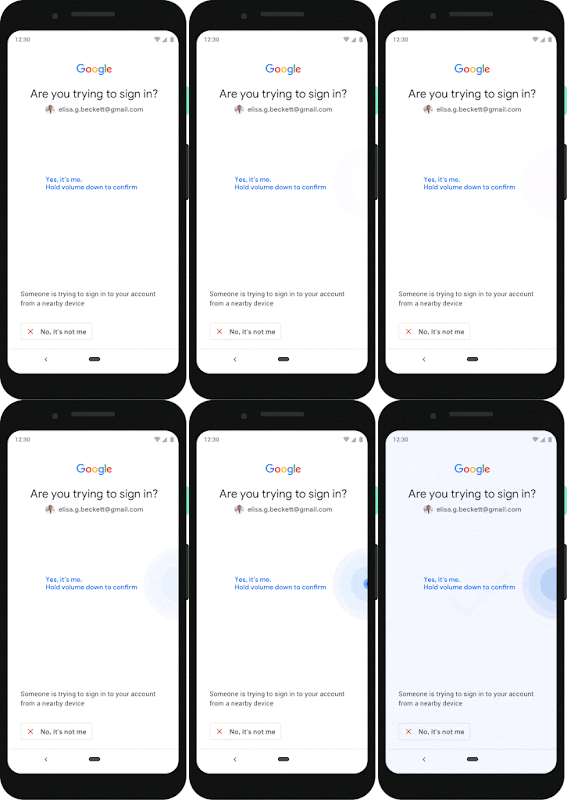
Google just made two-step verification a little easier for Android users. Android phones running 7.0+ Nougat or newer can be used as a physical security key to confirm a user’s identity when logging into a Google account with the Chrome browser. When prompted, users will simply hold the volume button on their phone to verify their log-in attempt. This isn’t the only option for two-step verification, but it will likely be faster and more convenient than, say, using a physical key fob.

Users will have to activate the security key on their device before it works, and it’s only compatible with Chrome browsers on Bluetooth-enabled Chrome OS, macOS X and Windows 10 devices. Users will also need to have another two-step verification method set up — like receiving an SMS code or using the Google Authenticator app. That method will be used on mobile devices and browsers other than Chrome, and it’ll be helpful in the event that you lose your phone. The built-in security key works with both standard and business Google accounts. While this new method of verification won’t work everywhere you might log in with your Google account, it’ll make getting set up on your main computer a good bit quicker.

Google