Archives for March 10, 2019

B.C. hospitals using virtual reality to help kids cope with painful procedures

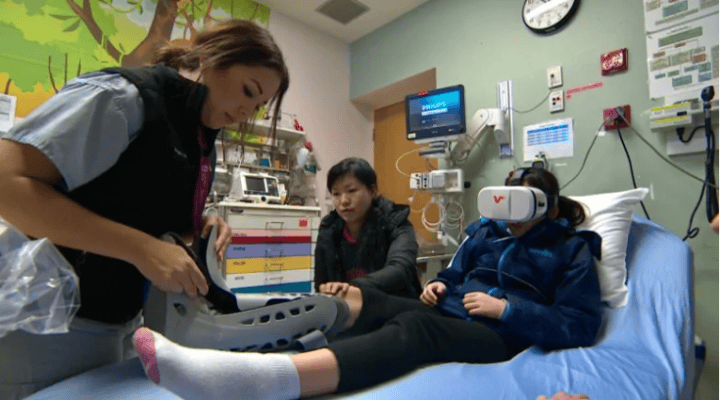
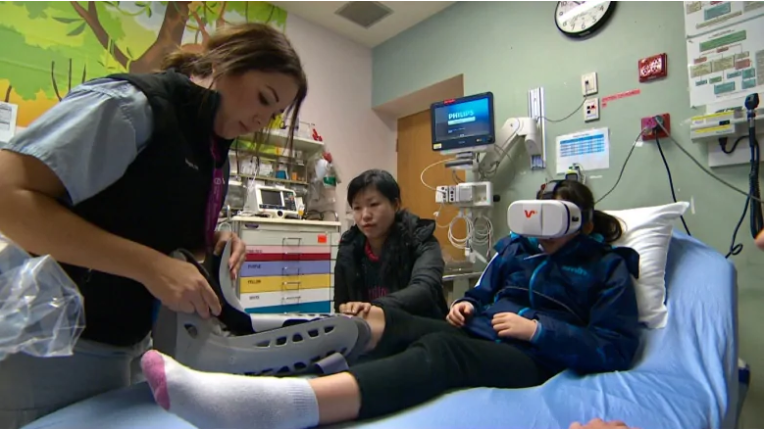
10-year-old Amy Wu went to the Peace Arch Hospital in White Rock, B.C. on Feb. 13 because of a broken toe. As she was fitted for a boot, she wore virtual reality goggles.

ER doctor says seeing kids go from crying to smiling while using VR goggles is ‘magical’

Inside a conference room at BC Children’s Hospital in Vancouver, more than a dozen child life specialists test out virtual reality goggles, moving their heads from side-to-side as they get a 360-degree view of the simulated roller-coaster ride they are experiencing.

The health-care professionals work with children and families to help them prepare for and cope with medical treatment — and the goggles are their newest tool when it comes to distraction.

“We thought that it would be incredible to take this very accessible technology nowadays, and bring it to the bedside,” says Dr. Ran Goldman, an emergency physician who is leading a workshop on how to use VR.

This month, 20 pairs of the VR goggles will be rolled out across the entire hospital. Every department will have access to the headsets, which Goldman believes will be a Canadian first.

More than 500 pediatric patients have already tried the headsets as part of a research project undertaken by him and a team at the hospital’s Innovative Virtual Reality Pain Lab.

The goal of the research is to better understand how virtual reality can help make children less anxious during often painful medical procedures.

Goldman says it’s not only helpful to the young patients, but also to staff.

“Nurses and physicians are telling us that their level of satisfaction from their work and their ability to communicate and to help children is much better when children are comfortable.”

Child life specialists, who help families and children prepare and cope with medical treatments, are being trained in workshops on how to use the virtual reality goggles at BC Children’s Hospital in Vancouver.

VR is being increasingly used in hospitals as the technology becomes cheaper and more accessible. Some facilities in Canada, such as the Stollery Children’s hospital in Edmonton, use virtual reality as a an educational tool, giving patients a tour around an operating room before going into surgery.

However, there is growing research related to how VR can be used for pain management. Los Angeles based Cedars-Sinai Medical Center started using VR headsets in 2016 as part of a pilot project. They’ve since used the technology with more than 2,500 patients.

Last year, Rockyview General hospital in Calgary started using two headsets to help alleviate pain and stress for those patients in the wound care ward. 

Dr. Ran Goldman, a physician with BC Children’s Hospital, shows 10-year-old Ellen Smith how the virtual reality goggles work while she waits for results back on an X-ray on her wrist.

In addition to reviewing research carried out by other academic institutions, Goldman and others conducted randomized controlled studies over the past two years, involving children that were six years of age and older.

Half of the patients were given the VR goggles to wear, and half went without. When they were finished receiving their treatment, the children were asked to rate their level of pain during the procedure.

“VR is extremely beneficial to patients, especially children,” Goldman says. 

“They get distracted and it reduces their level of anxiety and pain.” 

Emergency room physician Dr. Amir Behboudi started using virtual reality goggles in 2017, and is so impressed with their power to distract children during uncomfortable and painful procedures, that he uses them when his own children need to get immunizations.

The research at BC Children’s Hospital began in 2017 in collaboration with Dr. Amir Behboudi, who was already using the goggles at Peace Arch hospital in White Rock, B.C., where he works as an emergency room physician.

Behboudi said seeing kids in severe pain is heartbreaking for medical professionals.

He said seeing a patient using VR shift from a “crying child to a child that’s smiling, for us, it’s magical.”

Behboudi, who also uses puppets and iPads to try and distract children during appointments, wasn’t seeing enough pediatric patients in White Rock to be able to do a full-scale study on VR, which is why he partnered with BC Children’s Hospital.

Searching for distractions

Back in 2017, Behboudi purchased two pairs of the $20 goggles and downloaded a free app on his cellphone which allows the viewer to get a first-person perspective as a roller-coaster circles up and down.  

He estimates he now uses VR now with about ten per cent of his patients.

In February, when 10-year-old Amy Wu hopped into a hospital room and propped her right leg up on the bed, she was told she had a broken toe and needed to be fitted for an aircast boot.

But before nurses got to work on that, Behboudi brought out the goggles and after first checking with her mother to see if a VR roller-coaster ride would be suitable fo her daughter, he placed them on her head.

She didn’t take them off until five minutes after the nurse was done.

“I think it is very good for kids,” says her mother Nancy Dhang.

“Maybe she will not feel scared when she is in the hospital.”

Behboudi also took videos of some of the first patients he treated. They wore the VR goggles while getting needles and stitches in their faces.

He says a few of the children were so relaxed at some points they even fell asleep.

“Show me another way to do this … without medication,” he says while re-watching video of some of his first patients.

“This is where magic is.” 

Conception Bay North ambulance company served termination notice

Moore’s Ambulance will no longer be funded to provide ambulance services in the Conception Bay North region after April 6.

Department of Health says there will be no interruption in service

The Department of Health and Community Services says it has provided a 30-day termination notice to Moore’s Ambulance, which serves Conception Bay North.

In a statement, the department said ambulance services will be provided as normal until April 6, at which point Moore’s will no longer receive provincial funding.

The department said there will be no disruption in service. Eastern Health and local operators Broughton’s Ambulance and Young’s Ambulance will serve the area after April 6.

“People in our communities expect reliable and responsive ambulance services. That is why, we are taking this action,” Haggie said in a statement.

I want to reassure people living in the area that they will have reliable and responsive services. We have a plan in place.”

Conception Bay North residents are reminded to call 911 in the event of an emergency.

Dozens rescued after being trapped on Lake Erie ice floe

Authorities say nearly four dozen fishermen trapped on an ice floe in Lake Erie have been rescued by the U.S. Coast Guard and local emergency personnel in northern Ohio.

‘Out of nowhere that wind just picked up and everything broke fast,’ rescued fisherman said

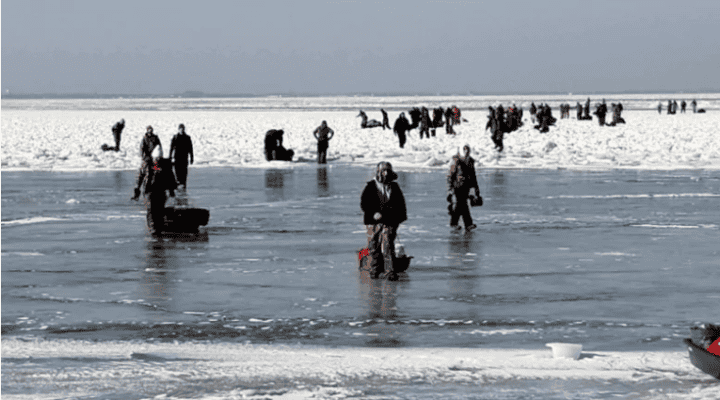
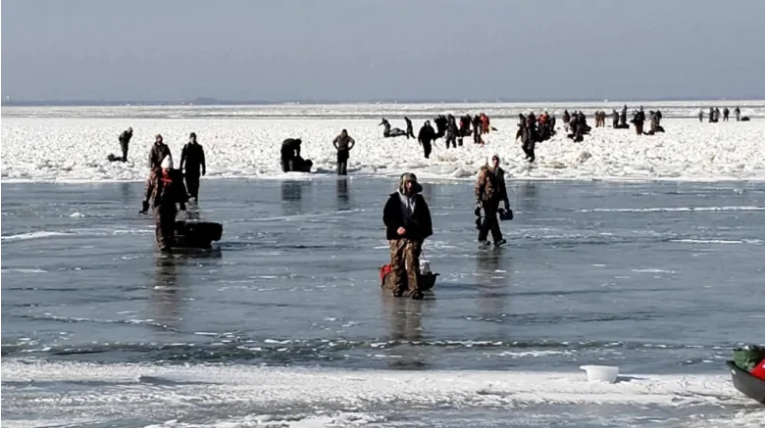
A sheet of ice holding fishermen on Lake Erie broke loose in windy weather Saturday morning, sending many of them scrambling to safety but leaving nearly four dozen stranded on the floe for three hours more than a mile offshore until emergency crews could rescue them.

About 100 of 146 fishermen out on the ice were able to grab their gear and make it back to shore before any additional ice broke off, The Blade of Toledo reported.

One of the stranded fishermen, 42-year-old Tony Adkins, said the ice began to crack quickly and soon there was a huge gap between the ice floe and the shore.

“Thank God the Coast Guard was here for us,” Adkins, of Akron, Ohio, told The Blade. “You live and you learn, I guess.”

The U.S. Coast Guard and the Ottawa County Sheriff’s Office began receiving reports around 8:30 a.m. Saturday that a large number of people had become stuck on a floe broken off from the main ice pack connected to Catawba Island.

The Coast Guard launched helicopters out of Detroit, and along with local rescue personnel, sent airboats to retrieve the stranded fishermen, said Coast Guard Petty Officer Brian McCrum. Forty-six people were rescued, he said, including two fishermen who were hoisted by helicopter and medically examined.

A helicopter from Coast Guard Air Station Detroit assists with the rescue.

It ended up that no one was injured, authorities said.

James Gibelyou said he was too far from shore to make a run for it as he and others painfully watched the ice break.

“We were out about a mile and a half [2.4 kilometres], and out of nowhere that wind just picked up and everything broke fast,” said Gibelyou, 33, of Wakeman.

Gibelyou said that he noticed the weather was getting warmer Friday and that ice conditions were beginning to change. The fishermen should have called it quits then, he said, and “not come out this morning.”

Emergency personnel prepare to rescue stranded fishermen off Catawba Island State Park in Lake Erie on Saturday.

The weather wasn’t suited for fishing Saturday morning and caused a threat to the safety and lives of those who were on the ice floe, said Toledo fisherman and ice guide Mark Duszynski.

“The wind started shifting and opening up the ice. They can’t get across the cracks when they open that quick,” said Duszynski, who watched the rescue action from the shore. “They shouldn’t have been out that far. They couldn’t get back across. When that ice has room to move, it moves fast.”

In February 2009, one fisherman died and dozens of others were stranded on a Lake Erie ice floe.

Montreal-Fort Lauderdale flight makes emergency landing due to smoke

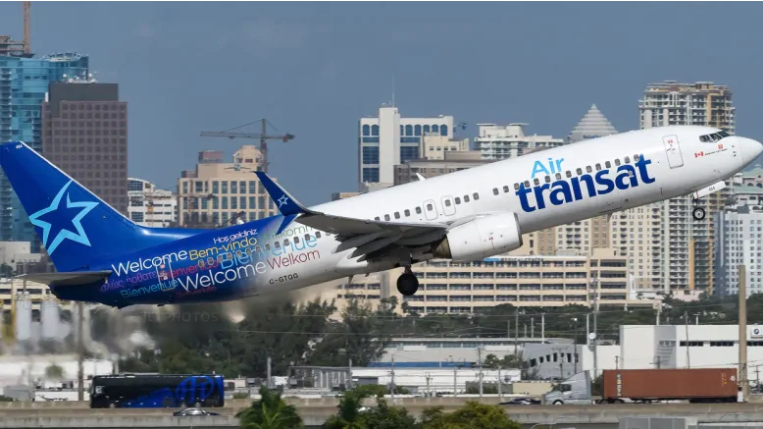
An Air Transat flight heading to Fort Lauderdale, Fla., from Montreal was forced to land in New Jersey Saturday morning.

Passengers used emergency slides to exit plane soon after it landed in Newark

An Air Transat flight from Montreal to Fort Lauderdale, Fla., was forced to make an emergency landing Saturday morning due to reports of smoke in the cargo hold.

Flight TS942 took off from Montreal around 7:10 a.m. ET and landed safely in Newark, N.J., around 8:30 a.m.

The 189 passengers made an emergency evacuation from the Boeing 737 plane soon after, said Air Transat spokesperson Debbie Cabana.

They exited the plane onto the runway using emergency slides, according to the Federal Aviation Administration (FAA).

Television images from the airport showed the plane on the tarmac surrounded by emergency vehicles. Workers towed the aircraft off the runway at about 11 a.m., the FAA said.

Another plane will be sent to Newark shortly in order to continue the flight, Cabana said.

Steve Coleman, spokesperson for the Port Authority of New York and New Jersey, told Radio-Canada two passengers reported minor injuries — one had a panic attack, and the other was injured during the evacuation.

One of the injured passengers was taken to hospital for treatment.

He said no fire was found but there was a lot of smoke. The cause remains under investigation.

Flights in and out of Newark airport were halted for about 10 minutes but have since resumed.

‘You don’t want to live that twice’

Julie Chauvin said she and nine of her family members were flying to Fort Lauderdale for a cruise when the loudspeaker clicked on and a voice instructed passengers to follow emergency landing procedures.

Passengers were told to crouch forward with their heads against the seat in front of them, said Chauvin, who is from Beloeil, Que., just east of Montreal.

“We didn’t know what was happening,” she said. “We were scared. We were leaning forward and waiting, and the pilot told us we were making an emergency landing.”

Once the plane was on the ground, it took only a few minutes for authorities to arrive and instruct passengers to jump out onto the cushioned mattresses.

The emergency was managed in an orderly fashion and passengers were treated well, she said, but her money and personal belongings were still on the aircraft Saturday afternoon and it remained unclear when she would reach her destination.

Overall, she said it was not an experience she would like to repeat.

“You don’t want to live that twice,” Chauvin said. “It was very stressful.”