Archives for January 17, 2019

These stocks could surge the most if and when US and China reach a trade deal

  • A resolution on trade between the U.S. and China could be a big catalyst for a relief rally in the stock market.
  • Tariff-sensitive stocks have underperformed significantly and their valuations are getting cheap, according to HSBC.
  • U.S. stocks with revenue exposure to China of more than 20 percent, including Skyworks Solutions, Broadcom, Micron Technology and Marvell Technology Group can be big winners if a trade deal comes through, says HSBC’s Ben Laidler.

For investors who have been jockeying for the right way to play the U.S.-China trade deal, here’s your game plan if the light at the end of the tunnel gets here.

A resolution on trade between the world’s two biggest economies could be a big catalyst for a relief rally in the stock market. BlackRock Chairman and CEO Larry Fink said Wednesday on CNBC’s “Squawk Box” that there would be “a surge in investment sentiment” if both sides call off tariffs on each other’s goods.

Washington and Beijing reached a 90-day truce last month to halt any new levies as they seek to work up a long-term deal through negotiations. There has been mixed feedback on the trade talks — Sen. Chuck Grassley, R-Iowa, said recently that U.S. Trade Representative Robert Lighthizer saw no progress on key issues , while President Donald Trump tweeted about “big progress” with China. In the latest development, China’s vice premier, Liu He, has accepted an invitation to Washington this month for trade talks.

Fears of a full-on trade war with China have been on top of investors’ minds for months. The volatile stock market suffered its worst year since the financial crisis in 2018, with the S&P 500 tanking a whopping 14 percent in the fourth quarter. U.S. companies have also sounded alarms on the trade war’s impact on their business.

“Any deal would likely see a relief rally as we believe markets have meaningfully priced in risks of trade tensions escalating,” said Ben Laidler, HSBC’s global equity strategist, in a note Tuesday. He also pointed out that tariff-sensitive stocks have underperformed significantly and their valuations are getting cheap.

To find the best names to buy on a trade deal pop, HSBC ran a screen looking for stocks with three main attributes:

  • Listed U.S. stocks with revenue exposure to China of more than 20 percent.
  • Underperformance during this three-month market pullback on trade deal concerns.
  • Cheap valuation on a forward price-earnings basis.

The names that came up were focused in tech including Skyworks Solutions SWKS , Broadcom AVGO , Micron Technology MU and Marvell Technology Group MRVL .

To be sure, this is lining up to be a risky binary trade. These names (and the whole market) could be hit hard if there is not a trade deal.

If the negotiations go nowhere and a 25 percent tariff is imposed on all Chinese goods, HSBC estimated 4.5 percentage points would be subtracted from 2019 earnings growth, more than halving the growth rate from current levels, Laidler said in the note.


TSA Absentee Rate Still High, but Down From Sunday’s Peak

A TSA worker helps passengers at the Salt Lake City International Airport, Wednesday, Jan. 16, 2019, in Salt Lake City. The government shutdown has generated an outpouring of generosity to TSA agents and other federal employees who are working without pay. In Salt Lake City, airport officials treated workers from the TSA, FAA and Customs and Border Protection to a free barbecue lunch as a gesture to keep their spirits up during a difficult time.

TSA officials say the rate of TSA screeners missing work during the partial government shutdown has stabilized just days before a three-day holiday weekend.

TSA officials say the rate of airport screeners missing work during the partial government shutdown has stabilized just days before a three-day holiday weekend that is likely to bring bigger airport crowds.

The Transportation Security Administration said Wednesday that 6.1 percent of its airport screeners missed work Tuesday.

That’s nearly double the absentee rate on the same day last year but the second-straight decline after the sick-out rate surged to 7.7 percent Sunday.

A TSA official said screeners this week should have received $500 bonuses and, for some, an extra day’s pay, for working over the Christmas and New Year’s holidays.

Meanwhile, air traffic controllers who are also working without pay lost an effort to force the government to pay them. A federal judge Tuesday rejected their union’s request for an immediate temporary restraining order.

The National Air Traffic Controllers Association and the Treasury Department employees’ union argued that the Trump administration is violating the Constitution and federal labor law by requiring members to work without pay. Another hearing in the case is set for Jan. 31.

The ranks of unpaid federal workers are growing. This week, the IRS said it will recall thousands of workers to handle tax returns, and the Federal Aviation Administration plans to bring 2,200 safety inspectors back to work.

The percentage of TSA officers missing work rose steadily last week but has declined slightly this week, according to the agency.

TSA could be facing a test by Friday of its ability to process airport crowds with fewer workers. Last year, nearly 8 million people flew between Friday and Monday of the Martin Luther King Jr. Day holiday. While that is less than the 9 million who flew around the Memorial Day holiday, it is busier than most January weekends.

TSA Administrator David Pekoske announced last weekend that the agency would pay each officer a $500 bonus and that TSA processed pay for screeners who worked Dec. 22, the first day of the shutdown. An agency spokesman said officers should have received the money by Wednesday.

Pekoske said he was able to make the payments “because of unique authorities provided TSA in law.” He said he hoped they would ease the financial hardship facing many of the workers. Most of them earn between $26,000 and $35,000 a year, according to a TSA spokesman.

Lone PG&E Bull Refuses to Ditch ‘Buy’ Rating Even After 80% Wipeout

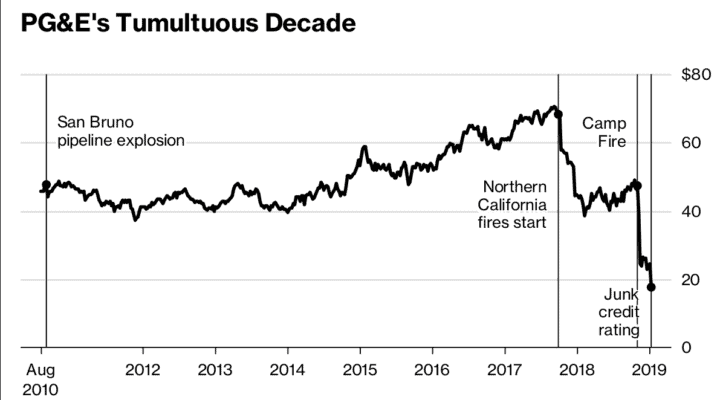
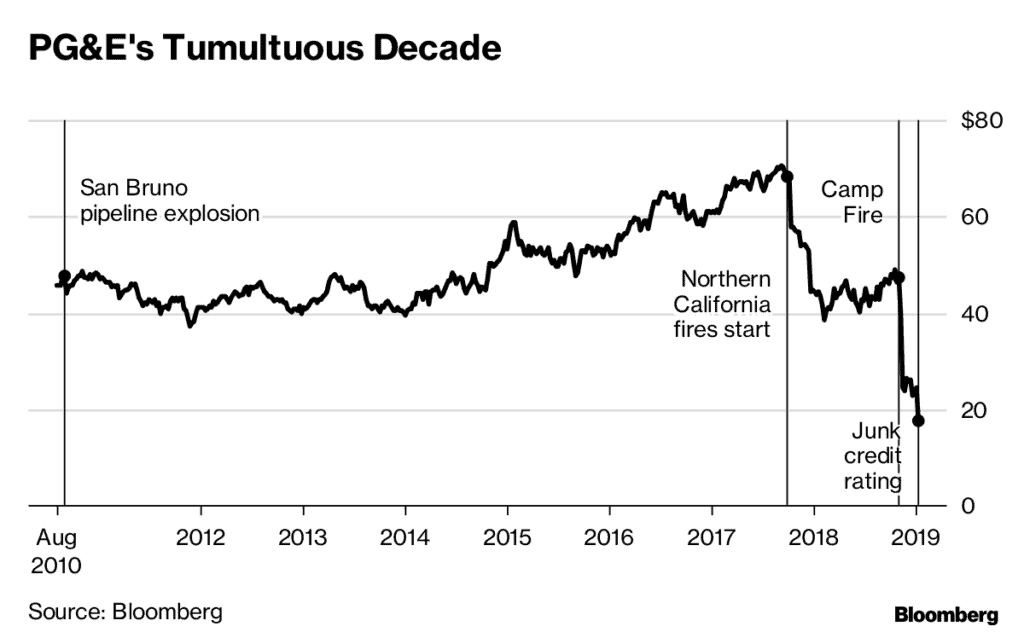
If you liked PG&E Corp. at $47 a share in early November, you’ll love it at six bucks now.

That, in a nutshell, is what the troubled utility’s last remaining bullish analyst is telling investors after reiterating his “buy” rating on the shares.

On Tuesday, Morningstar’s Travis Miller said in a note that PG&E, which is on the brink of bankruptcy after losing over 80 percent of its market value since early November, offers a substantial return for those who are “willing to hold through several years of uncertainty.” His new price target for PG&E is $11 a share, which implies a 59 percent gain from Tuesday’s price of $6.91. (His rating of four out of five stars on Morningstar’s rating scale is equal to a “buy,” according to Bloomberg.)

PG&E shareholders will likely “retain post-bankruptcy equity value” that’s greater than the market is pricing in, he said in the note. Later in an interview, he added that “if regulatory and legal outcomes happen as we think they will, buyers could see a substantial return on their investment today.”

Before PG&E woes came to light, the bullish analyst had plenty of company. On Nov. 8, when the shares closed at $47.80, half its analysts had “buy” ratings and the other half had “hold” ratings, data compiled by Bloomberg show. Now, Miller is the only one out of 17 with a “buy.”

Wildfire Liabilities

PG&E said Monday that it planned to file for Chapter 11 by the end of this month in the face of mounting wildfire liabilities that could reach $30 billion or higher. Several analysts have since slashed their ratings on the company’s stock, with Wells Fargo’s Neil Kalton cutting his price target Wednesday to $10 because the firm sees a “highly complex and lengthy” bankruptcy process.

Miller argues that regulators are already creating a so-called stress test that will limit the company’s liabilities from 2017 wildfires. He also notes that government officials including California Governor Gavin Newsom have said they want healthy, investor-owned utilities. What’s more, the company’s financially strong gas and power transmission business must have an “equity layer” if they are going to have access to capital, he said.

Miller, who noted that his price target fits within a range of other analysts on Wall Street, has been a longstanding PG&E bull. Apart from a four-week period in December when he temporarily dropped his rating to “hold,” he’s been recommending that investors buy the shares since April, when it traded at roughly $45, data compiled by Bloomberg show.

Here are top analysts’ 5 favorite growth stocks for 2019

The jury is still out on what 2019 will bring for investors. Despite an encouraging start to the year, investors are worried that earnings season may reveal share prices are still overvalued.

However, even in these uncertain times, there are still compelling growth stocks to be found. You just have to know where to look. Here we turned to TipRanks’ Stock Screener to pinpoint the best growth stocks out there right now. These are stocks with a strong outlook for the year ahead.

TipRanks uses a natural language processing algorithm to rank analysts based on their success rate and average return. That allows us to filter for growth stocks with a ‘strong buy’ consensus from only the top-performing analysts who consistently outperform the market.

Let’s take a closer look at their five favorite growth stocks for 2019 now:

Twilio

Cloud communications platform Twilio had a killer 2018. Accelerating revenue growth and improving profitability, coupled with multiple expansion, contributed to TWLO shares more than tripling last year.

What’s interesting is that even after this tremendous run, the stock remains a stellar bet for 2019. Indeed, TWLO boasts only buy ratings from the Street right now. That’s with 11 consecutive buy ratings from top analysts over the last three months. Their average price target stands at $102.

One of these analysts is KeyBanc’s Brent Bracelin (Track Record & Ratings). According to TipRanks, this is a top 10 analyst out of over 5,000 tracked analysts (and the number 1 analyst for 2018).

“We see multiple upside levers to consensus growth of 31 percent in 2019 vs. 68 percent last quarter and are raising our estimates and PT to $114 from $103” he wrote in a January 7 report. These potential growth drivers include new products; improving sales productivity; and higher usage and pricing.

And while further multiple expansion is less likely in 2019, Bracelin believes growth fundamentals remain strong and could warrant additional price appreciation.

It’s also worth bearing in mind the recent $2 billion acquisition of API-centric email platform SendGrid. “Our scenario analysis of the SendGrid acquisition suggests that base-case revenue could exceed $1B next year and then triple to $3B within five years” says Bracelin.

Lululemon

Athletics apparel retailer Lululemon is buzzing right now. Shares surged after LULU provided an update on its performance over the 2018 Holiday period demonstrating continued robust top-line momentum.

Susquehanna’s Sam Poser (Track Record & Ratings) has a Street-price target on LULU of $195. From current levels that translates into sizable upside potential of more than 30 percent. “Perhaps more than any other retailer, LULU knows who they are, why they exist, and commits to their purpose” Poser wrote in a January 7 report.

LULU has stuck close to its comfort and performance DNA and will continue to reap the benefit of being one of the most authentic brands in the eyes of the consumer, says the analyst.

He concludes: “Exceptional execution, best-in-class customer engagement, and innovative product is driving top-tier results which we anticipate will continue through the balance of FY18 and into at least FY19.”

Notably, top-rated Buckingham analyst Eric Tracy (Track Record & Ratings) has also just upgraded LULU from ‘hold’ to ‘buy’ while boosting his price target to $157 from $151. Tracy made the move on January 9, citing a “superior” fundamental algorithm that’s supportive of a premium valuation.

Thirteen top-performing analysts have published recent LULU buy ratings, with only two analysts rating the stock a ‘hold’. Their average price target stands at $167.

MongoDB

Cloud stock MongoDB calls itself the ‘most popular database for modern apps.’

Oppenheimer’s Ittai Kidron (Track Record & Ratings) highlights Mongo one of his top picks for 2019. The analyst, who is ranked No. 13 out of over 5,000 analysts tracked by TipRanks, reiterated his MDB buy rating on January 7. That’s with a $90 price target for 22 percent upside potential.

Analysts have stuck to their bullish thesis after Amazon’s AWS unveiled a new cloud database called DocumentDB that emulates API functionality similar to MongoDB.

While calling AWS’ competitive move ‘undoubtedly a negative development’, Oppenheimer’s Kidron says he has more questions that answers at this time. As a result, the analyst remains ‘comfortable’ with the MDB story.

Kidron reminds investors, “MongoDB has executed well in the face of such competition, illustrated by its committed user base, excellent brand, and strong growth.”

Similarly, KeyBanc’s Brent Bracelin (Track Record & Ratings) wrote on January 9, “We remain bullish on the prospects for MDB to sustain high growth.” He sees ample room for MongoDB to compete and win its fair share within one of the largest TAMs within software.

Indeed, the database market represents one of the largest categories of software that could grow into a $63B TAM by 2020 vs. $44B in 2016. Plus multi-cloud and new functionalities only available in MDB’s latest version release represent ‘key differentiators’ that help mitigate the potential threat of AWS’s new offering.

What also stands out is that Mongo has scored only buy ratings from top analysts in the last three months. These top analysts see the stock spiking 28 percent from current levels.

Amazon

Five-star JP Morgan analyst Doug Anmuth (Track Record & Ratings) picks e-commerce giant Amazon as one of his best ideas for 2019. He calls the valuation ‘compelling’ and predicts a revenue re-acceleration in Q1 2019.

That’s with Amazon Web Services and advertising driving 80 basis points of operating margin expansion to 6 percent this year. As a result, Anmuth reiterated his buy rating and $2,100 price target on January 9.

Even though AMZN is already one of the world’s largest retailers, with one of the world’s largest software businesses, its potential for growth is still significant.

“Amazon is massive, but small in context of the commercial opportunity the company is pursuing” says top-rated Pivotal Research analyst Brian Wieser (Track Record & Ratings). He has just initiated coverage of the stock on January 7 with a buy rating and $1,920 price target.

“With a focus on selling as many consumer goods as possible and much success in attempting to do so, we see Amazon’s retail activities as a play on global consumer spending” the analyst explained.

He points to a recent Euromonitor estimate of global consumer spending as equaling $45 trillion in 2018- and believes this is the figure investors should be looking at. “Given Amazon’s ambitions and its demonstrated abilities, we think this is a reasonable TAM (total addressable market) to consider.”

From this Wieser calculates that AMZN is currently only covering an approximate 1 percent share of its TAM potential.

In total, AMZN scores an extremely impressive 34 buy ratings from top analysts over the last three months vs only 2 hold ratings. The $2,140 average price target suggests shares can surge 34 percent from current levels.

Sarepta Therapeutics

Last but not least we have healthcare stock Sarepta Therapeutics. Sarepta is a biopharma focused on precision genetic medicines to treat rare neuromuscular diseases.

So far the company has one drug on the market, Exondys 51, for the treatment of Duchenne muscular dystrophy (DMD). This is a genetic disorder characterized by progressive muscle degeneration and weakness.

“Based on strong Exondys 51 uptake, positive US sales guidance, and potentially transformative gene therapies clinical development that could reach a substantially larger proportion of the DMD population, we rate Sarepta Outperform” wrote RBC Capital’s Brian Abrahams (Track Record & Ratings).

He has a buy rating on Sarepta with a $175 price target. Right now the stock is trading at $119, following a 93 percent growth spirt in the last year. However, in the last three months Sarepta has experienced a slight pullback of 10 percent.

Abrahams calls this weakness ‘unfounded’ and, in a January 7 report, recommends buying the shares. He believes the market misunderstood an investor presentation on SPRT’s limb girdle muscular dystrophy (LGMD) data and on the regulatory/ manufacturing path for microdystrophin gene therapy.

“Following our discussion/clarifications with the company, we believe timelines and prospects for both remain intact and we remain bullish on both programs” the RBC analyst told investors.

The rest of the Street agrees. The stock has 100 percent Street support right now, with 11 consecutive buy ratings from top analysts. These analysts, on average, see shares rising 64 percent to $197.