

Archives for January 15, 2019

Auto show ‘business as usual’ despite boil water advisory

Water fountains have signage, but also have had the water supply cut off.

‘Everything is going well’

It’s business as usual at the North American International Auto Show (NAIAS) despite a boil water advisory for downtown Detroit.

The Detroit Water and Sewerage Department (DWSD) issued the advisory after a Saturday evening water main break.

The pipe is managed by the Great Lakes Water Authority and while no service has been interrupted, the advisory was put in effect as a precaution.

At the auto show, where thousands of people from around the world will come through the doors, they dealt with the advisory quickly.

These signs are on the washroom doors at Cobo Center for the North American International Auto Show.

“We cut all water supply to make sure people couldn’t access the water,” said Amanda Niswonger, public relations manager for NAIAS. “We put signs on every washroom.”

Niswonger said they also got ice from the “safe areas” outside the boil water advisory zone.

“We also trucked in five gallon tanks of water to wash dishes and produce,” said Niswonger, adding that the dishwasher gets hot enough that it can use the regular water supply.
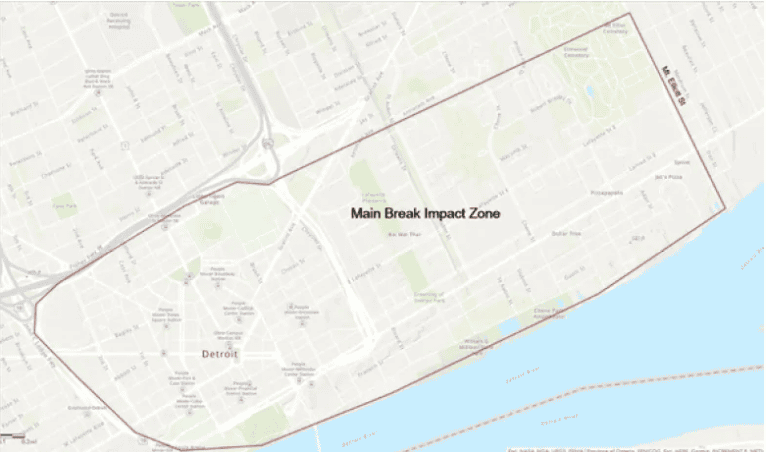
The Detroit Water and Sewerage Department issued this map of the boil water advisory zone. Cobo Center, where the North American International Auto Show is taking place, is included in the zone.

According to the DWSD, the advisory is a “precautionary action” and is put in place anytime a temporary loss of water pressure occurs in the water distribution system.

“During the show, most people don’t drink the tap water anyways,” said Niswonger. “Everything is going well.”

Niswonger said they expect the water to be back on by Thursday.

“But if you want to keep your fingers crossed for Wednesday, that would be nice.”

‘Pain and suffering’: Calgary’s business community fears tax hikes

From left, business owners David Smith, Terry Steinke and Don Lee are concerned about rising property taxes for businesses outside downtown Calgary.

$300M shortfall has some people wondering if homeowners should pay more

A $300-million drop in non-residential property values, mostly in downtown Calgary, has some in the business community suggesting homeowners should pay more to cover the shortfall. 

It may not be a popular position to take, but even the city’s top bureaucrat suggests it may be the only option for city council as it struggles to fill that massive decline in the value of downtown office buildings.

The so-called business property tax shift was essentially triggered by falling oil prices, which led to layoffs, a drop in demand for office space and a steep plunge in the value of office towers.

Big drops in assessments mean lower tax bills. The city, though, still has to collect about the same amount of money, so that means someone else has to pick up the difference.

It means increases in tax bills for business properties outside of the downtown core. 

For each of the past two years, city council has reached into savings for more than $80 million to limit tax increases to no more than five per cent.

At Alberta Fire and Flood, a disaster restoration company, the firm is dealing with its own tax problems: a doubling of its tax bill in five years.

“I don’t think that administrations are getting the pain and suffering that small- and medium-sized businesses are incurring and the load that’s being transferred,” said David Smith, one of the company’s owners.

“I think that there’s a lot of companies that are really struggling to keep themselves afloat, and having your property taxes double in five years, for a lot of businesses that is going to be a real difficult problem.”

Smith hasn’t seen the company’s property assessment for 2019 yet, but he expects his tax bill to reach $80,000 this year.

Not fair, no empathy

At Fairplay Stores, a pet supply store in northwest Calgary, owner Don Lee says the city, well, isn’t playing fair.

“You’re not putting words in my mouth at all, this isn’t fair,” said Lee.

“I mean, eventually this is going to cripple small businesses. We hear stories all the time of restaurants and small businesses going out of business,” he said.

The city has provided tax relief the past two years by limiting non-residential property tax increases. 

Between 2015 and 2017, non-residential properties in downtown Calgary lost $12 billion in value. It means many commercial properties outside the core are facing higher tax bills this year.

So far, no decision has been made on whether the so-called “phased tax program” will be renewed again this year. Council is looking at different scenarios that could include another five per cent cap — or possibly 10 per cent.

A five per cent cap for 2019 would cost $89 million.

“I know that the city has dipped into its rainy day fund to try and help, but listen, that’s not a long-term solution,” he said.

Lee says city spending needs to be trimmed, including wages and salaries. 

“It’s hard sometimes as a small business owner. We’re not millionaires and we see some of the salaries that are being paid to city employees. Our fellows come in here and they’re making $18, $19, $20 dollars an hour and they see somebody out there on the end of the shovel making $30. Well, maybe we need to take a hard look at that,” he said.

Homeowners should pay more

Terry Steinke owns Map Town in downtown Calgary. He knows what suburban business owners are going through after he experienced rising property tax bills when downtown commercial property values spiked several years ago.

While he’s seeing a break on his tax bill now, he feels the city also needs to restrain spending to ease the tax burden for all businesses.

“What I would like to challenge the mayor and city council is try to control your expenses,” said Steinke.

“Do we have to have property tax increases every single year?” he asked.

He says one possible solution is to shift more of the burden onto homeowners, not businesses.

“If your property taxes went up, say, by $25 a month, or $250 a year, is that going to make or break your household?” 

Smith, at Alberta Fire and Flood, says it won’t be popular but it should be looked at.

“Residential property taxes are still undervalued, I think, in Calgary, compared to other cities,” he said.

“But I mean it’s a pretty tough thing when people, especially seniors and people on fixed incomes, to suddenly find out that you’re going to have another $2,000 on your residential tax bill in the next year,” he said.

‘Most vexing problem’

City manager Jeff Fielding says Calgary is facing quite the conundrum.

“This is the most vexing problem I’ve ever faced, and it was such a dramatic change over such a short period of time on a specific segment of our assessment base, said Fielding.

While council has yet to decide how to tackle the issue this year, Fielding says the residential tax base must be considered.

“Really, the only way that you’re going to get at it specifically is start moving the ratio of non-residential to residential. And you know we do enjoy the lowest residential taxes in the country,” he said.

“That’s only the immediate solution that you have and it would have to have take place over a gradual period of time,” he said.

City council is expected to make a decision on a possible relief program before tax rates are finalized in April.

Coal-fired plants shutting down, despite Trump’s promises

The Dave Johnson coal-fired power plant is silhouetted against the morning sun in Glenrock, Wyo., on July 27, 2018. The Trump administration has rolled back Obama-era regulations on coal-fired power plant emissions.

With cheaper natural gas and renewables, aging coal generators too expensive to keep up

More U.S. coal-fired power plants were shut in President Donald Trump’s first two years than were retired in the whole of Barack Obama’s first term, despite the Republican administration’s efforts to prop up the industry to keep a campaign promise to coal-mining states.

In total, more than 23,400 megawatts (MW) of coal-fired generation were shut in 2017-2018 versus 14,900 MW in 2009-2012, according to data from Reuters and the U.S. Energy Information Administration (EIA).

Trump has tried to roll back rules on climate change and the environment that discouraged coal generation adopted during the Obama administration to fulfil pledges to voters in states like West Virginia and Wyoming.

But the second highest year for coal shutdowns was in Trump’s second year, 2018, at around 14,500 megawatts, following a peak at about 17,700 megawatts in 2015 under Obama.

One megawatt can power about 1,000 U.S. homes.

Coal capacity peaked in 2011

The number of U.S. coal plants has continued to decline every year since coal capacity peaked at just over 317,400 MW in 2011, and is expected to keep falling as consumers demand power from cleaner and less expensive sources of energy.

Cheap natural gas and the rising use of renewable power like solar and wind have kept electric prices relatively low for years, making it uneconomic for generators to keep investing in older coal and nuclear plants.

Generators said they plan to shut around 8,422 MW of coal-fired power and 1,500 MW of nuclear in 2019, while adding 10,900 MW of wind, 8,200 MW of solar and 7,500 MW of gas, according to Reuters and EIA data.

The predictions come from estimates compiled by Thomson Reuters and U.S. Energy Information Administration data.

Since taking office in January 2017, the Trump administration has announced its intention to leave the 2015 Paris Agreement on climate change and is relaxing Obama-era rules on emissions from power plants as it seeks to boost domestic production of oil, gas and coal.

U.S. carbon dioxide emissions rose in 2018

U.S. emissions of carbon dioxide, the main greenhouse gas, spiked in 2018 after falling for the previous three years as cold weather spurred gas demand for heating and the booming economy pushed planes and trucks to guzzle fuel, according to a study by Rhodium Group, an independent research group.

After falling to 5,144 million tonnes in 2017, the lowest since 1992, the EIA projected U.S. energy-related carbon emissions will rise to 5,299 million tonnes in 2018.

“There will be a limit to what increasingly cheap renewable power and continuously cheap natural gas can deliver with respect to emissions reductions,” said John Larsen, a director at Rhodium Group who leads the firm’s power sector research, noting the rising use of gas to produce power as coal plants shut. Natural gas emits about half the carbon as coal.

The Trump administration has also tried to slow the retirement of coal and nuclear plants through a directive in 2017 from Energy Secretary Rick Perry to subsidize the aging units, arguing they make the electric grid more resilient.

That plan was bashed by advocates for gas, renewable power and consumers and unanimously rejected by the U.S. Federal Energy Regulatory Commission (FERC), led by former Chairman Kevin McIntyre. The plan could resurface now that Trump has a chance to replace McIntyre, who died on Jan. 2.

Newmont Mining to buy Goldcorp in huge gold merger

Goldcorp’s takeover follows the merger of rival Barrick Gold with Randgold. (Goldcorp)

Newmont Mining Corp. has signed an agreement to acquire Canadian miner Goldcorp Inc. in a deal it valued at about $10 billion US.

The companies announced Monday that Newmont will exchange 0.328 of a share and two cents in cash for each of Goldcorp’s outstanding common shares.

The combined company will be called Newmont Goldcorp and will be owned 65 per cent by current Newmont shareholders and 35 per cent by Goldcorp shareholders

The agreement follows the recently completed merger of Barrick Gold Corp. and Randgold Resources Ltd.

Goldcorp president and CEO David Garofalo said Newmont Goldcorp will be one of Canada’s largest gold producers, with a North American regional office in Vancouver that will oversee more than three million ounces of gold production.

The companies said Goldcorp’s Vancouver headquarters will also be the base for some of its global functions, including oversight of Indigenous community relations.

“The strategic rationale for combining Goldcorp with Newmont is powerfully compelling on many levels, and both teams are fully committed to delivering on the transaction’s value proposition for all of our stakeholders,” Garofalo said in a statement.

The deal has the unanimous support of the directors of both companies, but requires approval by shareholders of both companies as well as regulatory approvals in several countries.

Newmont chief executive Gary Goldberg will lead the combined company and Newmont president and chief operating officer Tom Palmer is also expected to remain in the same role.

Newmont chairwoman Noreen Doyle will head the board of the combined company, while Goldcorp chairman Ian Telfer will be deputy chairman.

The companies said the combined entity is expected to maintain a significant Canadian presence on its board and among the management of its Canadian properties.

Goldberg said the company expects to generate up to $100 million US in annualized “synergies” before tax and operate in the Americas, Australia and Ghana.

Newmont Goldcorp will also divest between $1 billion US and $1.5 billion US of assets over two years to optimize gold production of six to seven million ounces annually.