
Archives for January 15, 2019

Police ended a gas station standoff by using a robot to deliver a vape pen

California Highway Patrol Golden Gate Division Air Operations, Facebook

Peak 2019.

A six-hour stand-off between police and a 40-year-old man threatening to set alight a convenience store was brought to a peaceful end by a robot carrying a vape pen. Local media reports described a tense situation on Saturday morning in Novato, California that led to the closure of a Safeway store and McDonald’s amid fears that the suspect may have been armed. The incident was caught on tape, including the moment the robot handed the man (identified by police as Juan Roman) a smartphone for communications.

The assistant manager at the Circle K convenience store told KGO that the suspect “took a gas can from his pick up and poured it all over the store” following a payment dispute over the pumps. He then attempted to unsuccessfully set the floor mat ablaze before fleeing to the Safeway location in a pickup truck.

It was at this point that police summoned by the Circle K worker caught up to the man — who they claimed was angry over family issues and had previous crises that had resulted in police interventions. According to the Marin Independent Journal, officers evacuated the area after they spotted what they thought was a rifle or shotgun in a bag in the suspect’s truck.

They sent in the robot to deliver a phone to the man’s vehicle, which officers were eventually able to use for negotiation purposes. The suspect’s initial demand for a cigarette was reportedly denied due to the fire threat and a vape pen was sent to the truck instead. According to KPIX, Roman was finally arrested without injury and “charged…with attempted arson and vandalism.” No firearms were found in the truck.

This isn’t the first time US law enforcement agents have used robots to defuse a hostile situation. In 2016, a remote-controlled bomb squad droid was used to snatch a rifle from under an armed and violent suspect in Los Angeles County.


Tesla offers Model 3 as a reward to security researchers

Pwn2Own attendees will have a chance to hack and win a Tesla.

The annual Pwn2Own contest at the CanSecWest conference in Vancouver, Canada usually ends with security researchers taking home the laptops they’ve exploited. This year they could take home a Tesla.

Tesla has announced that it’s partnering with Trend Micro (the company that puts on the annual event) and will offer up a Model 3 to be “pwnd.” It’ll be the first vehicle in the competition’s new “automotive category.” Security researchers will attempt to find security issues with the Model 3 and if they do, they could drive home in a new car.

Trend Micro announced that over $1 million in cash and prizes will be available to researchers in this year’s contest. In addition to Tesla, the security company is partnering with Microsoft and has VMWare as a sponsor. This isn’t Tesla’s first foray into security around its vehicles.

The battery and car maker launched a bug bounty program back in 2014. In 2018, it increased the bounty from $10,000 to $15,000 and announced that as long as research is done in good faith with its bug bounty program, it would not void the warranty of vehicles used for research.

“We develop our cars with the highest standards of safety in every respect, and our work with the security research community is invaluable to us,” said David Lau Tesla’s vice president of vehicle software. “We look forward to learning about, and rewarding, great work in Pwn2Own so that we can continue to improve our products and our approach to designing inherently secure systems.”

Of course, Pwn2Own contestants will be looking forward to figuring out how they can get their hands on a Model 3.

Symantec Corporation (SYMC) Dips 2.82% for January 14

Among the S&P 500’s biggest fallers on Monday January 14 was Symantec Corporation (SYMC). The stock experienced a 2.82% decline to $19.32 with 6.99 million shares changing hands.

Symantec Corporation started at an opening price of 19.75 and hit a high of $19.96 and a low of $19.23. Ultimately, the stock took a hit and finished the day at $0.56 per share. Symantec Corporation trades an average of n/a shares a day out of a total 638.89 million shares outstanding. The current moving averages are a 50-day SMA of $n/a and a 200-day SMA of $n/a. Symantec Corporation hit a high of $29.20 and a low of $17.43 over the last year.

Symantec provides cybersecurity solutions through its two segments: consumer digital safety and enterprise security. The consumer segment sells Norton-branded security services and LifeLock identity protection. The enterprise security segment sells endpoint, network, web, and cloud security solutions. The enterprise business contributes the bulk of the company’s revenue, but the consumer digital safety business is responsible for the majority of profits. The company was founded in 1982 and went public in 1989. It is headquartered in Mountain View, California. In 2016, Symantec acquired LifeLock and Blue Coat.

With its headquarters located in Mountain View, CA, Symantec Corporation employs 11,800 people. After today’s trading, the company’s market cap has fallen to $12.34 billionAs for its value, has a P/E ratio of <11, a P/S of 3.59, a P/B of 2.08, and a P/FCF of n/a.

Bitcoin moves higher despite lingering security concerns

Bitcoin futures pare early losses

Bitcoin, the No.1 digital currency, moved higher on Monday, after dipping below $3,500 on Sunday, marking its lowest level since Dec. 18 and inching toward the psychological support at $3,000.

In Monday trading, a single bitcoin BTCUSD, +0.07%  was fetching $3,707.16, up 4.6% since Sunday’s level at 5 p.m. Eastern Time on the Kraken exchange.

The cryptocurrency hit a weekend low below $3,480 and according to one analyst, security concerns — namely what’s known as a “51% attack” on the Ethereum Classic network — are starting to weigh on the broader market.

“BTC the flagship cryptocurrency took a deep dive to 35, $3500 that is, coincidentally in the wake of the 51% attack on the Ethererum Classic. These types of security breaches usually cause a drop in investor confidence,” wrote Stephen Innes, head of Asia-Pacific trading at Oanda.

“I don’t have a particularly exciting view of why this happens other than to suggest investors start to think If it can happen to A, it can happen to B and C; then people panic because someone big is selling to move the markets,” he said.

A 51% attack occurs when a party is able to take control of the mining hashrate or computing power. By controlling the majority of the network, the party can prevent confirmation of other users’ transactions as well as reverse transactions, enabling what is known as double-spending.

What are altcoins and futures doing

After stumbling over the weekend, altcoins — cryptocurrencies other than bitcoin — have pushed higher on Monday. Ether was up 11.2% at $129.21, LitecoinLTCUSD, +1.13% was up 7.5% to $32.20, Bitcoin Cash BCHUSD, -0.46% had gained 8.9% at $134.60 and XRP, XRPUSD, +0.26% was up 6% at 33 cents.

After opening sharply lower, bitcoin futures pared losses and closed marginally higher on Monday. The Cboe Global Markets February contract XBTG9, -0.12%finished up 0.2% at $3,640, and the CME Group February contractBTCG9, -0.27% gained 0.3% to $3,630.

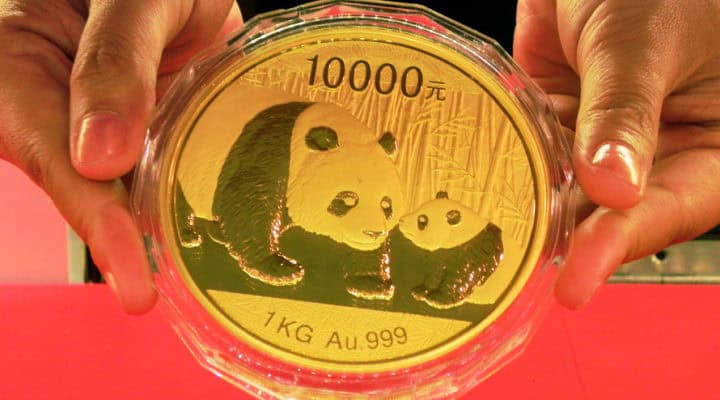
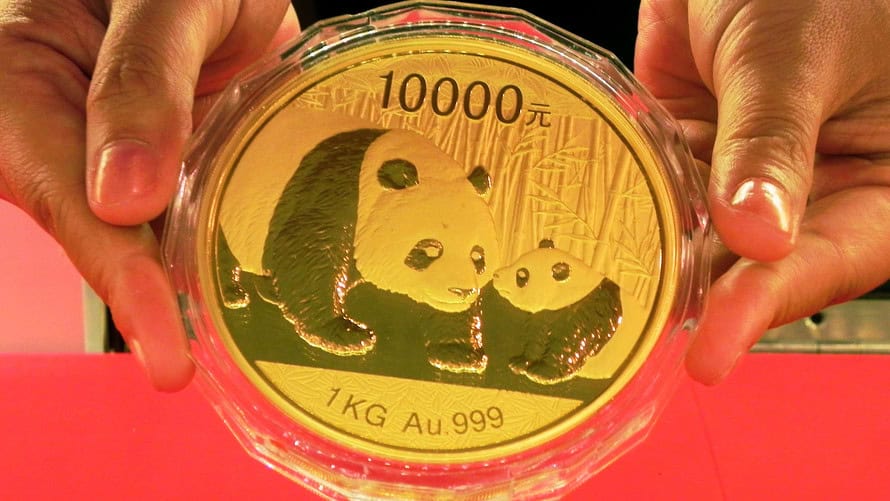
Gold prices finish higher, but $1,300 remains just out of reach

Gold-miner Newmont announces $10 billion deal for Goldcorp

Gold futures finished higher on Monday as weakness in global stocks and the U.S. dollar helped to buoy the yellow metal, but the psychologically important $1,300-an-ounce price remained out of reach.

“Clearly, concerns toward the global economy have been fomented [Monday] by the first monthly decline in Chinese exports in over two years,” analysts at Zaner Precious Metals wrote in a daily note. “Adding into the economic uncertainty is soft European data and escalating fears of an exit wreck,” they said, referring to the U.K.’s withdrawal from the European Union.

February gold GCG9, -0.04% rose $1.80, or about 0.1%, to settle at $1,291.30 an ounce, after closing on Friday with a 0.3% weekly advance. Futures prices, which touched an intraday high of $1,296.60, again failed to settle at the psychologically significant level at $1,300, which could underscore upward bullish price momentum in bullion.

Prices for the metal, based on the most-active contracts, tapped an intraday high of $1,300.40 on Jan. 4, but haven’t managed to settle at or above $1,300 since June.

Meanwhile, March silver SIH9, +0.09% added 3 cents, or 0.2%, to end at $15.686 an ounce, following a 0.8% weekly loss last week.

The ICE U.S. Dollar index DXY, -0.04% was off by 0.1% at 95.556, after putting in a weekly loss of 0.6% on Friday. Weakness in the buck can help drive appetite in assets priced in dollars, like gold, among buyers using other currencies.

A downdraft in stock markets across the globe on Monday was partly behind gold gains to start the week, with China data showing an unexpected decline in imports and exports in December, which weighed on equities and commodities, fueling fears of a further slowdown in the Chinese economy that could hinder global growth—amplified by a protracted trade spat between Washington and Beijing.

That backdrop has enlivened expectations for higher prices among gold bulls, who believe that purchases of so-called haven commodities among investors will accelerate as riskier assets, including stocks, exhibit more volatility in 2019.

“The gold trade is continuing to become more fashionable as investors’ appetites grow. Indeed, the climb in geopolitical concerns are behind what is now developing to be a new bull run. We continue to look for higher prices and think a breakout above $1300 is around the corner,” wrote Peter Cardillo, chief market economist at Spartan Capital Securities.

Meanwhile, the gold-mining giant Newmont Mining Corp. NEM, -8.89% announced a $10 billion deal to purchase Goldcorp Inc. G, +7.54% creating one of the largest gold companies in the world.

“With Newmont Mining buying [Goldcorp], that adds an additional element of investment interest to the long side argument of gold today,” said analysts at Zaner Precious Metals.

Among exchange-traded funds, the gold-backed SPDR Gold Shares GLD, +0.24% followed gold prices higher, tacking on 0.2% in Monday dealings, while the VanEck Vectors Gold Miners ETF lost 0.4%.

Newmont’s acquisition of GoldCorp, “hot on the heels of Barrick Gold’s merger with Randgold effective January 2nd, comes with the gold price up almost 10% since August,” said Danny Dolan, managing director of China Post Global. “This consolidation activity makes good strategic sense; controlling costs is one of the biggest challenges across the gold mining industry.”

Also, “both of the recent major acquisitions are great news for investors in gold mining sector ETFs, which should benefit strongly from the cost savings and strategic synergies of combining these companies,” he said in emailed commentary.

Most other metals ended lower on Comex, with March copper HGH9, +0.53% at $2.635 a pound, down 1%, while April platinum PLJ9, +0.51% shed 1.9% to $802.50 an ounce.

Palladium, however, extended its streak of gains to a 10th consecutive session and seventh straight record settlement. March palladium PAH9, +0.34% added 0.3% to $1,282 an ounce, trading less than $10 below the per-ounce price of gold. The last time palladium settled higher than gold was in October 2002.

A half-dozen companies to watch in IPO-land this year

If they do go public, it remains to be seen whether they do so with a splash, or a behind-the-scenes ripple

If they do go public, it remains to be seen whether they do so with a splash, or a behind-the-scenes ripple

Silicon Valley’s most valuable unicorns are moving toward the public markets this year, despite recent months’ stock market turmoil and the ongoing U.S. government shutdown. Which ones will make a grand entrance, which will languish and which will stay private? After years of will-they-or-won’t-they toying with investors’ expectations, here are some predictions for tech’s most closely watched companies in what promises to be a very eventful 2019.

Uber and Lyft

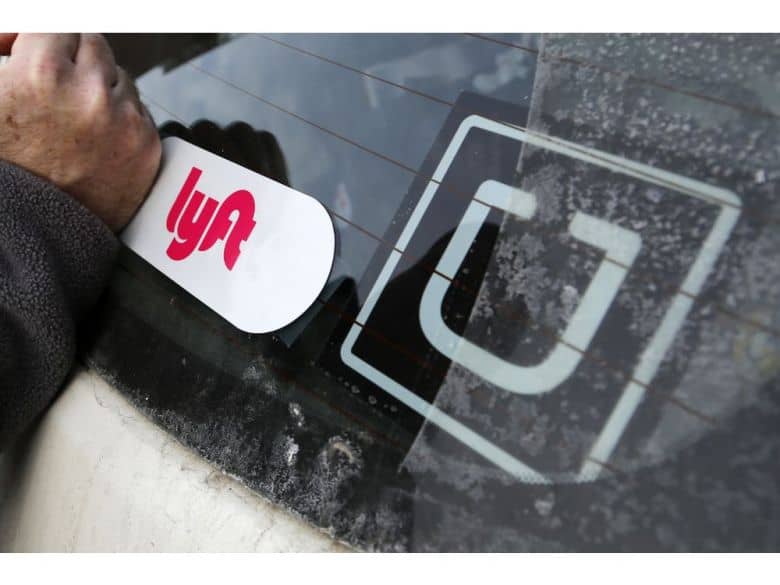
Barring total financial or governmental collapse, Uber Technologies Inc. and Lyft Inc. look destined to go public this year. Many of the pieces are already in place. Both companies have picked their bankers. In Uber’s camp, there’s Morgan Stanley, with Goldman Sachs Group Inc. expected to play a supporting role. And for Lyft, JPMorgan Chase & Co. is leading the public offering, along with Credit Suisse Group AG and Jefferies Financial Group Inc.

That doesn’t mean there won’t be bumps in the road, though. After both companies filed confidentially to go public on Dec. 6., both are now waiting for feedback on their paperwork from the Securities and Exchange Commission. But if you call the regulator right now, an answering machine will tell you it’s closed for business and not really listening to voicemails. Until the government reopens, Uber and Lyft are in a lurch. Whether and how much the shutdown delays their timetable will depend on how much feedback the SEC has for them and when it is sent back.

But Washington hijinks are unlikely to derail the ride-hailing giants’ march toward IPO. That’s partly because both companies need a steady stream of investor cash to keep operating. If they didn’t list, they would probably need to tap the private markets again. Another key reason for Uber is that, when it raised money from SoftBank last year, the company agreed to free up some shareholders to sell on the private markets if it didn’t go public in 2019. That’s a situation the startup probably wants to avoid. And finally, the jockeying between Uber and Lyft only ups the competitive pressure for each to list before the other sucks up all the oxygen and investor money.

Slack

Slack Technologies Inc. has the name recognition of a social media company, but the reliable revenue stream of business software. The company is clearly targeting a public offering, and has hired Goldman Sachs for the job, according to a person familiar with the matter who requested anonymity because the agreement is private. But a 2019 IPO is far from a sure thing.

For one, it’s a much younger service than the other companies on this list. While Slack was founded in 2009 as a gaming company, it didn’t turn into a message application until 2014. Second, Slack isn’t as money-hungry as Uber or Lyft. While its financials aren’t public, the messaging app is likely a leaner business than Uber, which has consistently lost about US$1 billion a quarter.

On the other hand, Slack has always been a precocious company. With a US$7.1 billion private valuation, it’s almost worth as much as public messaging app Snap Inc. Last year, Slack filled out its board with independent directors and hired a chief financial officer. Never say never.

Airbnb

Airbnb Inc. is another big-name San Francisco unicorn in the mix for an IPO this year. For a while, the home-sharing company’s IPO plans seemed to be on ice: The startup, last valued at US$31 billion, fell out of love with its CFO, Laurence Tosi, in 2018, in part, over a disagreement with the founders over when to go public. Then, in November, Airbnb hired another high-profile CFO — Dave Stephenson from Amazon. That’s certainly a move back in the direction of a public listing.

Will it happen this year? Or, since the company didn’t raise money last year, will it turn back to the private markets for additional cash? It’s worth noting that Airbnb is the rare high-flying unicorn that hasn’t taken a big cheque from SoftBank.

If I had to guess, I’d say that Airbnb wants a once-in-a-generation public offering. If it doesn’t want to go public in Uber’s shadow, it would likely need to wait until 2020, once Uber has had its turn. On the other hand, Airbnb is facing more and more competition from publicly traded Booking Holdings Inc. Airbnb may want a public stock to make it easier to acquire companies and piece together a more complete travel offering.

Palantir and Pinterest

The sheen may have worn off these two unicorns a while ago, but each year investors’ IPO dreams resurface before being crushed. Maybe 2019 is different? Palantir, for its part, is finally hiring salespeople, an unusually conventional move for the contrarian company. Morgan Stanley is advising Palantir, though that’s not the same as getting hired for a public offering. Palantir’s public offering documents would be among the most exciting to read because Peter Thiel’s 15-year-old startup has long been such a financial mystery.

Pinterest, on the other hand, is struggling to carve out a niche as social media stocks crumble. Pinterest sees itself as something much different from Snapchat or Instagram. People don’t always use its service daily, but when they do, they’re often thinking about buying things. The startup was on track to hit US$700 million in revenue last year, the New York Times reported. Still, social media stocks with better user engagement have tanked, leaving Pinterest vulnerable.

Direct listings

The last thing to consider here is not only if and when this backlog of high-profile unicorns will go public, but what route they’ll take. Will they do the standard IPO, or will they follow Spotify’s example and list without a fancy roadshow? Uber and Lyft appear to be doing it the old-fashioned way, but Airbnb and Slack reportedly considered a different path.