
Archives for January 14, 2019

Ryuk ransomware banks $3.7 million in five months

Computer code on a screen with a skull representing a computer virus / malware attack.

It has the knack for staying dormant and focusing on big targets.

The Ryuk ransomware hasn’t just causing grief for newspapers — it’s also quite lucrative for its operators. Researchers at CrowdStrike and FireEye both estimate that the code has produced the equivalent of $3.7 million in bitcoin since August, spread across 52 payments. The key, analysts note, is the willingness to be patient and focus on big targets.

The attacks typically start by infecting systems with TrickBot malware (typically through methods like spam email) that gains access and, importantly, lets the intruders study their targets to determine the money-making potential. They look for the most critical systems and, as Ars Technica noted, will even pass on launching the Ryuk ransomware if the organization isn’t large enough. This scouting will be somewhat familiar if you’ve seen campaigns like SamSam (the ransomware that hit the city of Atlanta), and it’s just as disconcerting.

The operators are patient, too. They’ll wait as long as a “full year” to encrypt a victim’s data and demand a ransom, FireEye said.

It’s not certain just who the perpetrators are, but the two security groups don’t believe the users are North Korean despite the name. Instead, CrowdStrike (which nicknamed the attackers Grim Spider) suggests they might be Russian based on internet addresses and the occasional language reference. Either way, it’s clear that ransomware is becoming all too profitable and could be a serious problem for larger companies and governments in the near future.

Samsung will fight its phone sales slump with models built for India

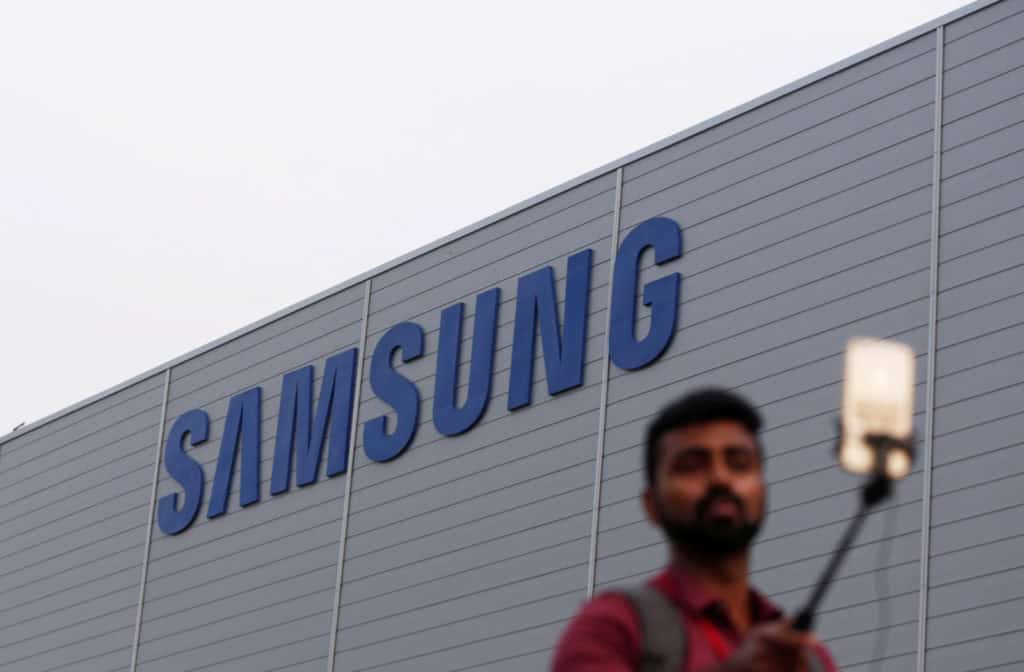
A journalist uses a mobile phone as he works outside the Samsung Electronics smartphone manufacturing facility in Noida, India, July 9, 2018. REUTERS/Adnan Abidi

The Galaxy M series is meant to thwart Chinese competition.

Samsung knows it’s facing tough times, and it’s not just counting on the Galaxy S10 to get out of its funk. It’s launching a trio of Galaxy M-series phones in late January that are designed expressly for “Indian millennial consumers,” the company’s Asim Warsi told Reuters. They’ll launch in India first before a wider rollout, and they’ll only be available through both Samsung’s website as well as Amazon India.

Warsi didn’t dive too far into specifics, but said the phones would cost between 10,000 to 20,000 rupees (about $142 to $284) and would include features that don’t always make their way to lower-cost phones, like beefy batteries and fast charging. Earlier leaks suggest the Galaxy M10, M20 and M30 would use newer mid-tier Exynos 7-series chips, feature “waterdrop” notch displays (think OnePlus 6T) and include at least one model with a giant 5,000mAh battery.

It’s no secret why Samsung is setting its sights on India: it’s a prime battleground. Chinese brands like Xiaomi and Vivo are thriving in the country, and Samsung is currently playing second fiddle with 22 percent. In theory, the Galaxy M line scoops up people who otherwise had their heart set on a Chinese device. Whether or not it works is another story. India’s phone space is fiercely competitive, and doing well there won’t necessarily be enough to offset problems in other parts of the world.

Soulja Boy’s latest sketchy console looks like a PS Vita

The ‘SouljaGame Handheld’ boasts a 480 x 272 ‘HD’ resolution.

Soulja Boy is shrugging off possible legal threats from gaming giants with another rip-off console. In the wake of his ill-fated Nintendo emulator swag, his latest attempt at plagiarism marries the design of a PS Vita with the specs of a PlayStation Portable (a 480 x 272 resolution on a supposed “HD” screen is just the tip of the iceberg). It’s probably only a matter of time till Sony tells Soulja — real name DeAndre Cortez Way — to pull the plug or face legal action.

If you want to peep the “SouljaGame Handheld” before its inevitable demise, it’s up for sale on the “SouljaWatch” merch website for $100, though there’s no mention of compatible games. As with his Nintendo knock-offs, it seems Soulja is just drop-shipping the portable device from China (at least according to this AliExpress listing of an identical $33 “Onleny” handheld) and charging triple the original asking price.

The SouljaWatch homepage also features a “SouljaGame” console that looks like an Xbox One with elongated PS4 controllers. Other product highlights include Apple AirPods knock-offs, a SouljaPad tablet, an Apple Watch lookalike and a smartphone (which we assume comes preloaded with a Crank That (Soulja Boy) ringtone).

To be clear, Soulja Boy is a massive gaming nerd who’s named mixtapes after Mario and even reviewed Braid, so he likely knows the value of his third-rate wares. His other hapless dalliance with tech included hoverboards that were snapped up by fraudsters, leaving Soulja with a $175,000 bill for Stripe payments that never materialized.

Cadillac drops teaser pics of its first electric vehicle

GM plans to use this platform to build all kinds of EVs.

GM plans to use this platform to build all kinds of EVs.

Shortly after GM revealed Cadillac will take the lead in its electrification push, the brand has given us a peek at its first-ever electric car. Following a couple of hybrid attempts, the new vehicle doesn’t come with a name or any details, but from the looks we’d expect a Model X-fighting luxury crossover. The most important part may be what’s under the skin, as this shows off the “BEV3” platform that GM plans to use for a number of electric cars going forward.

Cadillac president Steve Carlisle said: “The architectural design will allow the battery packs to fit into the vehicle like ice cubes in an ice cube tray, you can put in as much water as you want to make as many cubes as you need — the tray still takes up the same space in the freezer.” The point of the design is flexibility, so that any kind of vehicle can have a unique design without reducing range. The drive units are similarly targeted for flexibility, with front-, rear- and all-wheel-drive configurations supported.

The announcement came tonight at a North American International Auto Show event in Detroit where Cadillac showed off its new three-row XT6 crossover, as well as plans for a revamped Escalade and a new performance sedan that will see it release new models at a rate of one every six months through 2021. The one we’re most interested is this one of course, but it could be a little while before we find out more.

3 Cybersecurity Stocks to Watch in 2019

As a whole, 2018 was a good year for the cybersecurity industry. While that’s great news for businesses, it’s not-so-great news for consumers, as a significant number of data breaches and cyber-attacks put millions of people’s personal information at risk.

While it’s difficult to predict what will happen in 2019, we can guess that cyber criminals will find new ways to carry out their dirty work. Some experts suggest that criminals may use malicious chat bots to interact with consumers and manipulate them into giving personal information.

Cybersecurity goes beyond using a virtual private network (VPN), like Goose VPN. Today, cybersecurity companies are focused on cloud-based security and preventing attacks using well-known strategies. Cyber security providers will have to evolve and innovate to overcome new challenges, particularly because traditional security measures aren’t effective on the cloud.

But these three cyber security stocks are poised to gain from these trends.

1. Varonis Systems

When it comes to cyber security, much of the focus is on external attacks. But companies also face threats from within their own walls. To help protect themselves from insider attacks, many corporations are turning to Varonis Systems (NASDAQ:VRNS).

Varonis analyzes user behavior and activity. If things seem out of the ordinary, like unusually large volumes of data being downloaded, the system will send an alert.

The system can also limit data breach damage by locking down sensitive data.

Performance-wise, Varonis’ customer base is quickly growing. In the third quarter, the company added 188 new customers, which drove revenue 25.7% higher to $67.1 million. The company expects revenue to rise by 26% to $271 million for the year.

Varonis still has plenty of room for growth, as its revenue base accounts for just a small portion of a $15-billion market.

2. Okta

Okta (NASDAQ:OKTA) provides enterprise-level identity management services to more than 5,600 businesses. The company manages and secures digital access rights to their network, such as login processes, passwords and employee on-boarding.

Okta’s single sign-on system makes it easy for customers to give users access to the right apps when they need them.

The company’s services are in high demand. In the third quarter, revenue soared 58% year over year to hit $105.6 million. The company is not profitable yet, but it produced positive free cash flow for the first time in the third quarter.

Okta is targeting 30% annual revenue growth over the coming five years.

3. Zscaler

Zscaler (NASDAQ:ZS) provides cloud-based protection that allows users to securely connect to their applications from anywhere and using any device. The company has 100 data centers across six continents, with users in 192 countries. Each day, Zscaler protects against 100 million threats.

The company is seeing rapid growth. Revenue soared 59% in the first quarter of 2019, hitting $63.3 million. Zscaler expects full-year revenue to fall between $268 million and $272 million.

3 Things to Watch in the Stock Market This Week

Netflix, Wells Fargo, and CSX shareholders could be in for a volatile few trading days ahead.

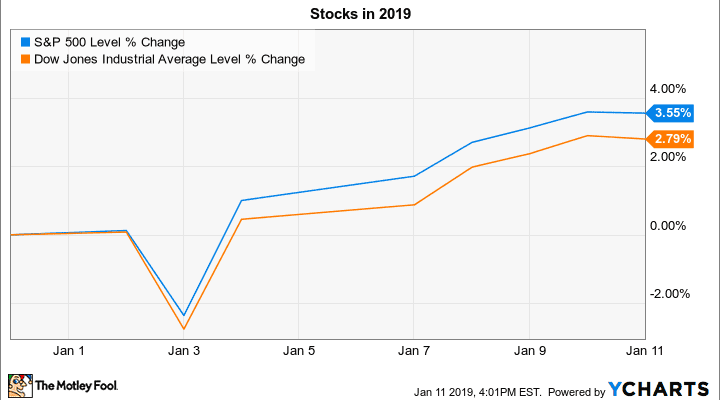
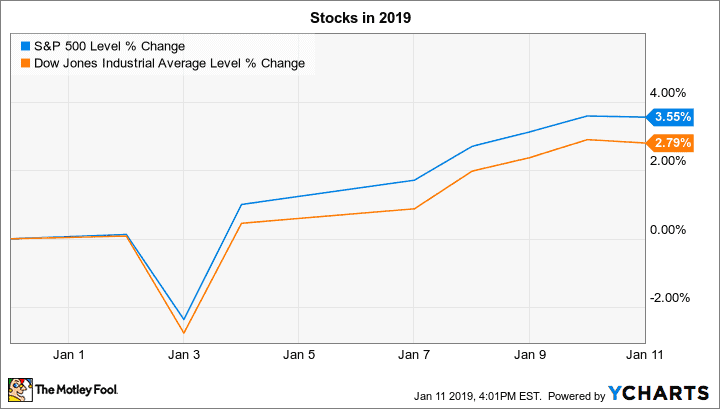
Stocks posted significant gains last week, with both the Dow Jones Industrial Average (DJINDICES:^DJI) and the S&P 500 (SNPINDEX:^GSPC) rising by more than 2%. The boost left shares up about 3% so far in early 2019 following a 6% decline last year.

Fourth-quarter earnings season is ramping up, with several major announcements anticipated over the next few trading days that could support the rally or send stocks back lower again. Below, we’ll take a closer look at a few of the biggest companies reporting: Netflix (NASDAQ:NFLX), CSX (NASDAQ:CSX), and Wells Fargo (NYSE:WFC).

Netflix’s spending plans

Netflix was one of 2018’s most volatile large-tech stocks, nearly doubling at one point in the year before shedding about 40% of its value from October through December. Those wild swings indicate investors aren’t at all clear about Netflix’s long-term potential, and so its earnings report on Thursday is likely to attract lots of attention.

The business hasn’t shown any signs of slowing. In fact, the streaming-video giant is on pace to notch its fifth straight year of accelerating global-subscriber gains, even as rising prices help boost operating profit margin to new highs. But as Netflix bears point out, the company’s content costs are soaring and cash is disappearing from the books at close to $3 billion per year.

Thursday’s report should address whether incoming CFO Spencer Neumann has any plans to shift strategies in dealing with that cash outflow. Investors also will get their first peek at Netflix’s spending plans for 2019, which should include content spending of nearly $10 billion.

CSX’s efficiency gains

Railway earnings reports can provide a clear view into current economic growth trends, which is just one of the reasons why CSX’s Tuesday afternoon announcement will be closely watched on Wall Street. The company fared a bit better than peers last year, thanks mainly to higher efficiency, which shows up in the operating-ratio metric. That figure improved to 70% over the first nine months of 2018 from 60% in the prior-year period, in fact.

Investors this week are hoping to see more progress along those lines when CSX closes out its fiscal 2018. Other key themes to watch include volume and pricing trends and the so-called “intermodal” transport segment that management sees as supporting higher margins in the future. The outlook CSX issues for the 2019 year will be important, too, whether it relates to growth forecasts and efficiency targets or to updated goals for shareholder cash returns.  

Wells Fargo’s deposit growth

Wells Fargo will announce its fourth-quarter results before the market opens on Tuesday. The banking giant underperformed the S&P 500 by a wide margin last year, especially when concerns of a global growth slowdown peaked in December. Beyond that general exposure to economic downturns, Wells Fargo shares suffered under the weight of its fake-accounts scandal this past year. That brand hit, plus the impact of a few other scandals, helped push many of the bank’s key operating metrics, including deposit and loan growth, efficiency, and profitability, below that of its peers.

On Tuesday investors will be scrutinizing Wells Fargo’s report for signs that it’s putting these operating stumbles behind it. Other potential good news would include indications of healthy loan volumes that suggest economic growth is chugging right along. The biggest driver of better returns will come from the slow progress toward mending its brand with consumers, though.