
Archives for January 8, 2019

How to Dodge a Market Dip That Threatens Your Retirement

The recent volatility in the stock market can make older investors feel vulnerable. Here are some strategies to make sure your money lasts as long as you do.

You’ve heard it before: When the markets become erratic, or seem poised for a prolonged downturn, the best thing you can do is nothing at all.

But if you’re on the cusp of retirement — or, perhaps worse, newly retired — a turbulent stock market can make you feel particularly vulnerable.

While there’s some validity to those feelings, it’s more productive to redirect any panic into prudence, which will help ensure your money lasts longer.

For older people invested in stocks, the performance of the market in the early years of your retirement can have a lasting effect on your portfolio, which will remain a dynamic entity for perhaps three more decades. If you have to start selling investments when they are worth less, you’ll have to to sell more shares to get the cash you need — and the repercussions build on themselves.

“That can really start digging a hole in your portfolio that becomes harder to dig out of,” said Wade Pfau, professor of retirement income at the American College for Financial Services. “It is really the first 10 years of the market performance in retirement that are going to drive your outcome.”

While the S&P 500 lost 6.2 percent last year, the final three months of the year were especially volatile. It’s unclear where the market will go tomorrow, or the next decade. But whether you’re getting close to retirement or just starting to work, part of your financial success is a matter of chance: The growth of your portfolio is largely determined by when you started investing and when you retire.

Let’s say a person saved 15 percent of her earnings — a flat salary that grew with inflation — during a 30-year career. If that person retired in 1982, she would have accumulated just over five times her final salary. If she retired in 2000, however, she would have amassed 17 times her salary.

The same type of variability can occur based on the sequence of your market returns in retirement — except it’s amplified because instead of adding to the money you’ve invested, you’re spending it.

There are very simple strategies to try to reduce the effects of an ill-timed downturn or cancel them out altogether: Work longer or pick up a part-time job. Those aren’t feasible for people with health problems, or those who were laid off by their employers a few years shy of when they intended to retire. But they tend to be the most effective ways to help your money last.

Here are some other steps retirees can take to lengthen the life of their savings when markets are less than cooperative:

Portfolio Check. Retirees need to ask themselves a couple of key questions. Is my portfolio broadly diversified in low-cost investments, such as index funds? Is my allocation to stocks more than my stomach can handle should the market plummet 50 percent, as it did in 2008 and 2009?

If you answer “no” to these questions, you should reassess (preferably with a pro) how reducing your stock exposure might change your ability to spend what you want in retirement.

Mindful Spending. One of the most widely cited rules for retirement spending might be what’s known as the 4 percent rule. It suggests that retirees who withdrew 4 percent of their initial retirement portfolio balance, and then adjusted that dollar amount for inflation each year thereafter, would have created a paycheck that lasted for 30 years. (The numbers crunched by a financial planner more than two decades ago were based on a portfolio evenly split between stock and bonds.)

But if your portfolio value takes a significant hit, your withdrawal rate may have to increase to support your spending. If that rate starts to approach 5 percent, and certainly 6 percent, there’s a greater chance you’ll outlive your portfolio, Mr. Pfau warned. So adjustments may be in order.

The simplest way to deal with a dip would be to hold your spending steady, rather than increasing it with inflation. That approach can be enough to steady your finances even if your portfolio were to drop by 25 percent from its original value at retirement, according to Judith Ward, a senior financial planner with T. Rowe Price, based on a recent study. She suggested to keep spending steady for two to four years, depending on when the portfolio rebounds.

“Keep in mind, steady spending over a number of years may still result in some kind of spending cuts depending on the inflation environment,” she said. “That may be the easiest and most intuitive approach for many retirees.”

Create a Smoother Ride. Traditionally, investors reduce their exposure to stocks as they approach retirement. But one novel approach is to cut that exposure even further — then get back into the market as you age.

This strategy, studied by Mr. Pfau and Michael Kitces, director of wealth management at Pinnacle Advisory, is to increase your stock holdings over time. Portfolios that started with about 20 to 40 percent in stocks at retirement, and then gradually increased to about 50 or 60 percent, lasted longer than those with static mixes or those that shed stocks, according to their analysis.

Another option is to buy a guaranteed paycheck with a portion of your savings. With an immediate annuity, you pay a lump sum to an insurer in exchange for a guaranteed stream of income for life. A common approach is to consider how much of your must-have basic expenses — like food, shelter, property taxes — are covered by Social Security and any additional income, such as a pension. Then, buy enough annuity income to cover the gap. It also simplifies your financial life, which becomes increasingly important as you age.

But be careful with annuities: There are many types, and they can be complex — and not necessarily sold to you by someone who is legally required to put your financial interests ahead of his or her own.

Hold a Cash Reserve. If you’re approaching retirement and worried about a significant market correction, there’s another strategy that might provide some peace of mind: Keep up to two years of basic living expenses in cash to cover, say, the costs of housing, food and other essentials. With that sort of buffer, you can try to avoid tapping your investment portfolio for a while, giving it some time to recover.

Putting too much money in cash, however, may weaken overall returns because you will have less invested to begin with, and therefore less to build on.

Look for Higher Returns. This does not involve chasing after some hot stock or growing sector. It’s far more boring and counterintuitive, but guaranteed to deliver a higher paycheck in retirement over the long run: delay Social Security as long as you reasonably can.

“The effective return of delaying Social Security is much higher than what you will earn in the market today,” said David Blanchett, head of retirement research for Morningstar. “It is like a 10 percent guaranteed return.”

Your benefits generally rise by 8 percent for each year you wait to collect the check beyond your “full retirement age” — that is, the age you’re eligible for a full benefit, which is currently 66 years and 2 months for people born in 1955.

Someone set to receive a full benefit of $1,413 monthly (the average benefit amount), who instead waited two more years, would receive roughly $1,640 — an amount that would rise with inflation.

You can think of the money you don’t receive while you delay benefits as a payment for higher guaranteed income later on. And that payment buys you far more in annuity income than if you tried to buy it from a commercial insurer.

Get Help. If you doubt you have the strength to avoid temptation and stay the course — or you want assistance developing a coping strategy — this is the time to seek professional help. It can potentially make or break your retirement.

But you need to get the right type of help, which means avoiding salespeople and brokers who call themselves advisers but get paid only when they sell you something. Instead, find a certified financial planner who isn’t afraid to promise in writing that he or she will act as a fiduciary, which is legal speak for putting your interests ahead of their own.
A Foolish Take: How Much Did Social Security Go Up?

Living on a fixed income is difficult, but for millions of people on Social Security, the monthly benefits they get make up the vast majority of the money coming in during retirement. Fortunately, during most years, Social Security payments go up modestly to make up for increases in living costs. However, even those regular boosts aren’t enough to make things much easier for America’s older population.

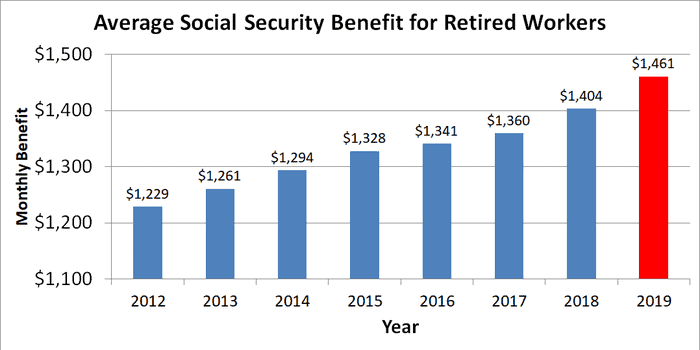
For 2019, retirees got better news than they’ve gotten in a long time. A fairly high cost-of-living adjustment produced a big raise for Social Security recipients, and that was primarily responsible for the increase that sent the average Social Security benefit for all retired workers to $1,461 per month in January 2019. That was the biggest increase in dollar terms in years, and you have to go back to 2011 to find a larger percentage boost.

Unfortunately, there’s a catch. When cost-of-living adjustments are high, it’s typically because the expenses that seniors have to pay have gone up. In fact, many argue that the measure of inflation that the Social Security Administration uses to calculate annual increases in benefits is fundamentally flawed, tracking a mix of expenses that fails to reflect the goods and services that older Americans need.

Moreover, not everyone gets this much money. Surviving spouses can expect to get an average of $1,386 this month, or about $75 less than a retired worker. Couples in which both spouses get benefits will average $2,448 for the month — roughly $475 less than double the per-worker amount. For each individual, benefits depend on length of career, average earnings, and the type of benefit you’re entitled to receive.

Because the recent adjustment reflects price increases that they already had to pay over the past year, Social Security recipients will be glad to see their benefit checks finally catch up. It might not be as much as they’d like, but Social Security still plays a vital role in helping retirees make ends meet financially.

You can save more toward retirement in 2019. Here’s how to make the most of it

If you haven’t made retirement savings a priority, now is a great time to start catching up.

That’s because retirement plan contribution limits have been pushed higher for 2019.

The IRS has increased the amount employees can sock away in their 401(k) plans in 2019 to $19,000. That’s up from $18,500 in 2018. That limit also applies to 403(b), Thrift Savings and most 457 plans.

The maximum amount you can put away in your individual retirement accounts has also been bumped up for the first time since 2013. In 2019, you will be able to save up to $6,000 in your IRA, up from $5,500 in 2018.

If you are 50 and over and looking to make up for lost time, catch-up contribution limits will remain the same for 2019: For 401(k) and other employee plans, you can put in an additional $6,000 in 2019, and for IRAs, it’s an additional $1,000.

Many workers — young and old — could stand to save more for retirement. The average 401(k) balance reached $106,500 in the third quarter, according to Fidelity Investments.

That’s still far less than most individuals will need to live on once they stop working in their later years.

If you’re like most Americans, saving more this year is high on your list of financial resolutions.

Even if you are not approaching the maximum contribution limits to your retirement plans, you can take steps to ramp up your savings.Set a savings target

Individuals should strive to save 15 percent annually toward retirement, including your company match, according to Meghan Murphy, vice president at Fidelity Investments.

But if you are far from that goal, there’s another target you want to make sure you hit: your employer’s match. Many companies will match the money you save, dollar for dollar or 50 cents per dollar, up to a certain threshold, say 4 percent or 6 percent.

If you don’t meet those savings levels, that is extra money you are leaving on the table.

“This is a really good time to look at that,” Murphy said. “If employers are making changes to their retirement plans, they [tend to] happen at the beginning of the year.”Boost your contributions

Even if you are contributing 6 percent to your retirement savings now, getting to 15 percent may seem daunting.

One way to gradually get there: Increase your savings rate by 1 percent each year. You may not notice the difference this year. That change could add up big over time.

“Those small jumps by just 1 percent or 2 percent over a 20-year or 30-year career can really make a big difference in the end,” Murphy said. “The longer that money is in the plan and has time to grow, the better off you are.”

Add in your raise or bonus

When extra money comes in, that is a great time to increase your retirement savings.

“Aligning an increase in your savings to your 401(k) with a raise always makes the increase less painful,” Murphy said.

One-time annual bonuses are also a great opportunity to add to your retirement funds, said Ted Jenkin, CEO of Oxygen Financial.

“A lot of people get that annual bonus and they have it already spent on a truck or a new bathroom remodel or a vacation in the Caribbean, but that doesn’t help you retire,” Jenkin said.Check in annually

Setting it and forgetting it can be one of the worst mistakes retirement savers can make for several reasons.

If you have been automatically enrolled in a retirement plan, chances are you are saving at a rate that is lower than what you would have chosen, according to Anne Lester, portfolio manager and global head of retirement solutions at J.P. Morgan Asset Management.

That’s because many employers will automatically enroll you at 3 percent or 6 percent, for example. But savers who elect their own savings rates will often choose bigger, more round numbers, such as 5 percent or 10 percent, Lester said.

Market fluctuations can also lead to your investments getting out of line with your savings goals. Check to make sure you’re not too exposed to equities, especially as you get closer to retirement, Murphy said. Also double-check that your investments match your risk tolerance for your age.

And finally, don’t forget to brush up on the fees you’re paying for your investments. Investments that are too expensive can undermine your efforts to build a strong financial foundation.

“The vast majority of people we talk to don’t understand the fees associated with the account,” Murphy said. “If you don’t understand, ask the question.”

Want to Max Out Your IRA in 2019? Here’s How Much to Save From Each Paycheck

Millions of Americans want to do a better job of saving for retirement. An individual retirement account, or IRA, can be a great way to not only build a retirement nest egg, but to save money on your taxes as well.

Contributing the maximum allowable amount to your IRA in 2019 would be a great step on the road to financial freedom in retirement. However, many people can’t afford to contribute thousands of dollars all at once, so here’s how much you need to save out of every paycheck in 2019 in order to maximize your IRA contribution.

The 2019 IRA contribution limit

In 2019, the IRA contribution limit is $6,000, with an additional $1,000 catch-up contribution allowed if you’re 50 years old or older. The base contribution has increased by $500 from 2018, while the catch-up allowance has remained the same.

It’s important to point out that this is a per-person limit, not a per-account limit. In other words, if you have more than one IRA, your combined contributions to all accounts cannot exceed your appropriate limit.

All Americans with earned income are eligible to contribute to a traditional IRA, but the ability to take the valuable tax deduction for contributing is income-restricted if you are eligible to participate in an employer’s retirement plan such as a 401(k). On the other hand, the ability to contribute to a Roth IRA is income-restricted for everyone, meaning that anyone who earns more than a certain threshold cannot contribute to an account at all.

How much to save if you want to max out your IRA contributions

While it’s certainly useful to know the IRA contribution limit, most people understandably can’t contribute all of this as one lump sum. It’s also not an ideal situation to try and max out your contribution over the last few months. It can be significantly easier to spread out your contributions evenly throughout the year.

With that in mind, here’s how much you’d need to set aside out of every paycheck in order to max out your IRA contribution in 2019.


One more note: If you’re reading this and we’re already well into 2019, note that you can technically make your contributions until the April 2020 tax deadline. So, if you still want to spread out your contributions and we’re still within the first few months of 2019, just start the one-year clock with your first contribution. You can still divide your 2019 contribution evenly over an entire year.

What maxing out your IRA contribution could mean to you

There are a few good reasons why it’s such a good idea to max out your IRA contributions. For starters, there are some great tax benefits to doing so. Traditional IRA contributions may be tax-deductible, and although Roth IRA contributions aren’t deductible, qualified withdrawals will be completely tax-free.

While the tax benefits are certainly nice, it is the long-term tax-deferred compounding power that is the real reason to contribute as much as you can to an IRA.

Let’s say that you contribute $6,000 to an IRA every year, and that you maintain an age-appropriate allocation of stock and fixed-income investments. Historically, it’s been reasonable to expect annualized returns of about 7% from such a strategy over long periods of time.

Here’s the point: $6,000 annual contributions compounded at this rate for 10 years would grow to about $83,000. After 20 years, you’d have $246,000, and after 30 years, you’d have built a $567,000 nest egg. After 40 years — well, you get the idea. Maxing out your IRA every year over a period of decades could provide serious financial security in retirement.

Ensure your success: Make it automatic

As a final piece of advice, if you plan to contribute the maximum to your IRA in 2019 and make gradual contributions throughout the year, it’s a smart idea to make it automatic. In other words, if you’re under 50 and get paid biweekly, set up an automatic transfer from your bank account for $230.76 to take place every payday. Not only will this save you the hassle of having to remember to make 26 separate contributions throughout the year, but doing so will make your retirement contributions a part of your routine and will greatly increase the chances that you’ll actually max out your IRA contributions in 2019 and beyond.

Sony’s ‘super-large’ 8K TVs are coming home this year

Sony’s ‘super-large’ 8K TVs are coming home this year

This year at CES Sony is one of the TV makers jumping into 8K with two “super-large” Z9G displays that are big enough, at 98- and 85-inches, to make use of the format’s 33-million pixel resolution. According to Sony, these screens have “completely new” full array LED backlighting, plus a Picture Processor X1 Ultimate to manage the signal and upscale any lower-res video, which is important since 8K content will be hard to find for a while.

Sony didn’t mention much about content, but they are ready for IMAX Enhanced content, which will be available via the Privilege 4K service in the spring, and all of its TVs have support for Netflix Calibrated Mode. Plus, like so many other TVs we’re seeing this week, all of the Sony models announced here will get support for Apple AirPlay 2 and HomeKit later this year.

That high-res screen is surrounded by four speakers, with two at the top and two at the bottom, which Sony says can deliver an experience similar to its OLED TVs that deliver “Sound-from-Picture”reality. Assuming you have a home theater speaker setup (and for TVs like these we’d expect you would), it can also make the TV a center channel. It didn’t call out support for HDMI 2.1 in the press release, but with 8K, as well as home theater equipment supporting features like Enhanced Audio Return Channel (eARC), we’d bet on having it.

If you’re not ready to make the move to 8K (or just don’t have space for a 98-inch screen) then 4K TVs are still available, including a new line of Sony OLED TVs, the Master A9G series. Ready in 77-, 65- and 55-inch versions, this edition keeps the Acoustic Surface Audio+ speaker built into the display itself and can also be used as a center channel in a home theater, while a new wall mount makes it possible to get the screen even closer to the wall than last year’s version. Sony is still relying on Android TV to power all of its smart features with Google Assistant voice control and tie-ins to smart speakers. A redesigned remote relies on RF instead of IR, and the user interface has been reworked as well.

If you need a new Blu-ray player or sound bar to fill out your home theater then Sony has those on the way too. The HT-X8500 promises Dolby Atmos and DTS: X all in one slim package that has built-in dual subwoofers to deliver 2.1ch audio without any additional speakers and eARC support. The HT-S350 soundbar uses a separate wireless sub, and its UBP-X800M2 player is ready for all the HDR-10, HLG, or Dolby Vision 4K content you can throw at it.

The A8G series of 4K OLED TVs drops some of the image processing enhancements and the Acoustic Surface from the A9G, and they’re only available in 55- and 65-inch sizes, and share built-in “Acoustic Multi-Audio by Sound Positioning Tweeters” with standard X950G 4K LCD screens that will go on sale in 85-, 75-, 65- and 55-inch versions. There’s no word on pricing or release dates yet but that information should be available in the spring.

Nikon’s video-centric Z6 camera now comes in a ‘Filmmaker’s Kit’

It also unveiled an ultra-wide 14-30mm f/4 zoom for the Z-Mount.

Thanks to its true full-frame super-sampled 4K and 10-bit external video output, Nikon’s Z6 is now possibly the best full-frame mirrorless camera for video. To help you better harness that power, the company has introduced a “Filmmaker’s Kit” for the Z6, much as it did with its D850.

Along with the Nikon Z6 camera and a Nikkor Z 24-70mm f/4 S zoom lens, you get an Atomos Ninja V 4K HDR 5″ monitor/recorder to capture that 10-bit 4K video, along with a MOZA Air 2 three-Axis gimbal stabilizer. The company also threw in a Mount Adapter FTZ for Nikon F-Mount lenses, a Rode VideoMic Pro+ external microphone, a 12-month Vimeo membership and even a filmmaking course from Nikon Ambassador Chris Hershman.

Nikon also unveiled a new lens that normally wouldn’t be newsworthy, but it’s just the third Z-Mount model available. Interestingly, it’s an ultra-wide angle Nikkor Z 14-30mm f/4 S zoom, an odd choice considering the limited lineup so far. A 70-200 zoom telephoto, for instance, would probably be more popular.

The lens again shows what Nikon can do with the huge Z-Mount, as it’s relatively small for such a wide lens — 29 percent lighter and 32 percent shorter than the 16-35mm f/4G VR AF/S model. It also managed to make the front of the lens flat enough that you can install regular 82mm screw-on filters, a first for any of its 14mm range zoom lenses, Nikon said.

The new products will be a boon for the nascent Z-Mount ecosystem, which is still pretty threadbare. The Nikkor Z 14-30mm f/4 S lens arrives in spring 2019 for $1,300, while the Z6 Filmmaker’s Kit will cost $4,000 and hit shelves in late January.