Archives for December 24, 2018

U.S. stock futures point to a Christmas Eve bounce for battered equities

Treasury Secretary Mnuchin conducted calls with major banks over the weekend

U.S. stock futures rose Monday, indicating markets could bounce in a holiday-shortened session after the worst week of trading since the financial crisis of 2008.

How are benchmarks performing?
Dow Jones Industrial Average futures YMH9, +0.28% rose 125 points, or 0.6%, to 22,533, while S&P 500 futures ESH9, +0.31% gained 15 points, or 0.6%, to 2,429.25. Nasdaq-100 NQH9, +0.56% futures rose 38.75 points, or 0.6%, to 6,102.

On Friday, the Dow Jones Industrial Averages DJIA, -1.81% fell 414.23 points, or 1.8%, to 22,445.37, while the S&P 500 index SPX, -2.06% fell 50.84 points, or 2.1%, to 2,416.58. The Nasdaq Composite Index COMP, -2.99% COMP, -2.99% traded down 195.41 points, or 3%, to 6,332.99.

The Nasdaq officially entered bear market territory Friday, down 21.9% from its Aug. 31 highs. That’s as the S&P and the Dow inch closer to bear market territory, with the S&P off 17.5% from its Sept. 20 highs, and the Dow down 16.3% from an Oct. 3 high.

The weekly performances for the Dow — off 6.9% — and the Nasdaq — down 8.4% — were the worst since 2008. The S&P fell 7.1% for its worst weekly showing since 2011. Friday’s volumes were the heaviest since August 2011.

What’s driving the market?
Equity and bond markets will finish early to mark Christmas Eve and will be closed on Tuesday for the Christmas holiday. The rest of the week will see normal trading hours. However, with many traders out for the holidays, volumes are expected to be thinner and move could be exaggerated.

Monday’s potential bounce came as China’s Ministry of Commerce said “new progress” had been reached in “vice-ministerial-level” trade discussions with the U.S. in a teleconference Friday, the South China Morning Post reported on Sunday.

Stock futures rebounded from lower levels seen after the Treasury Department tweeted Sunday that Secretary Steven Mnuchin had spoken with the CEOs of the country’s six biggest banks — Bank of America BAC, +0.13% , Citi C, -0.44% , Goldman Sachs GS, +0.28% , JPMorgan Chase JPM, +0.83% , Morgan Stanley MS, -3.16% and Wells Fargo WFC, -2.00% —to ensure they had ample liquidity in case stock should resume selling off on Monday.

Mnuchin will also hold a call Monday with the President’s Working Group on financial markets “to discuss coordination efforts to assure normal market operations.” The Treasury chief is on vacation in Cabo San Lucas, Mexico.

Meanwhile, White House advisors over the weekend tried to ease investor concerns that President Donald Trump could fire Federal Reserve Chairman Jerome Powell amid anger over the Fed’s recent interest-rate hike that spurred more market losses. Mick Mulvaney, the president’s incoming chief of staff, told ABC’s “This Week” on Sunday that Trump “now realizes” he cannot remove Powell, while Mnuchin stated Saturday that the president had not suggested firing Powell.

Friday saw another day of extreme volatility on Wall Street, as investors digested the implications of an impending government shutdown, tighter U.S. monetary policy, flagging global growth and uncertainty surrounding U.S.-China trade relations.

How are other markets trading?
Asian stocks had a mixed session, with China’s Shanghai Composite SHCOMP, +0.43% modestly higher, while the Nikkei NIK, -1.11% was closed for a holiday. European stocks SXXP, -0.43% pointed to a weaker start.

The ICE Dollar Index DXY, -0.16% was down 0.2% to 96.78, while gold GCG9, +0.47% rose 0.6% to $1,265.40 an ounce. February West Texas Intermediate crude CLG9, -0.20% rose 0.3% to $45.77 a barrel.
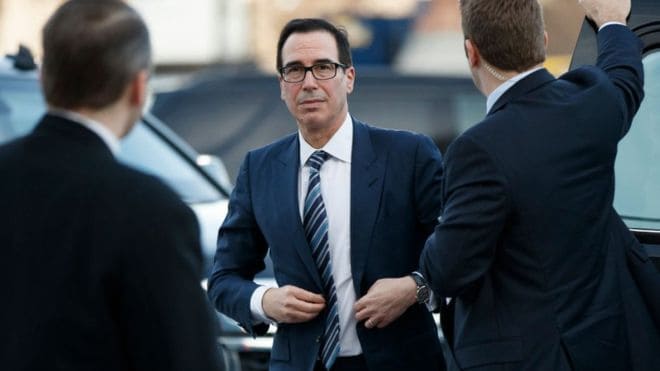
Mnuchin calls big US banks after huge stock market falls

US Treasury Secretary Steven Mnuchin has made calls to the heads of the country’s six largest banks, a move to reassure investors after huge falls in US stocks.

Last week, US stocks suffered one of the worst weekly falls in a decade as an interest rate rise and US-China trade tensions rattled markets.

Mr Mnuchin said banks confirmed they had “ample liquidity” for operations.

It also comes amid a partial government shutdown over spending plans.

“The [bank’s chief executives] confirmed that they have ample liquidity available for lending to consumer, business markets, and all other market operations,” the Treasury said in a statement attached to a tweet from Mr Mnuchin.

“[Mr Mnuchin] also confirmed that they have not experienced any clearance or margin issues, and that the markets continue to function properly,” the Treasury’s statement said.

All three US indexes closed lower last week, with the technology-focused Nasdaq down 20% since its peak, placing it in so-called “bear market” territory.

US investors are worried about a range of factors including slowing economic growth at home and internationally.

In addition, a partial US government shutdown began at midnight on Friday after opposition Democrats resisted President Donald Trump’s demand for $5bn (£4bn) for his Mexico border wall.

The shutdown over budget spending could continue right up to the opening of the next Congress on 3 January.

Mr Mnuchin is now set to meet with the President’s Working Group on Monday, the Treasury statement said.

The group includes market regulators and Federal Reserve governors, among others. They will discuss “coordination efforts to assure normal market operations”, the statement said.

Green Xmas for millions

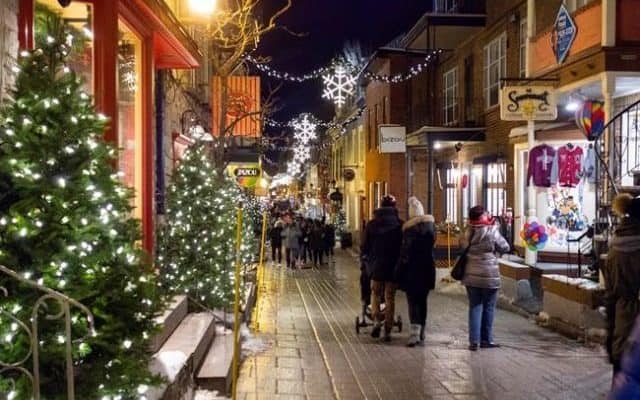
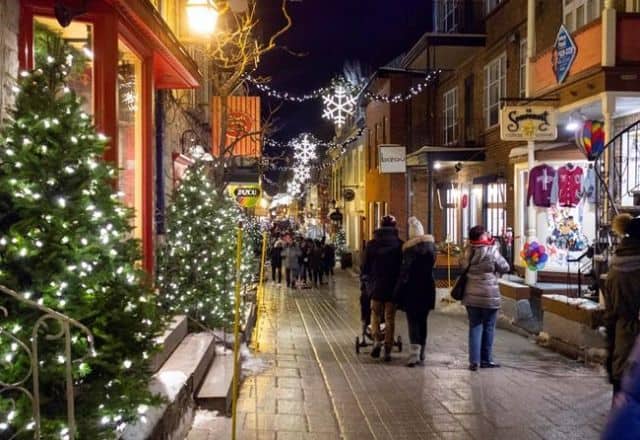
Most Canadians won’t be getting a white Christmas this year, The Weather Network forecasts.

“For Christmas Eve specifically, the weather is really quiet across the country — unusually quiet. Typically this time of year we’re talking about somebody getting clobbered with a storm,” said the network’s chief meteorologist, Chris Scott.

While most metropolitan areas such as Toronto, Montreal and Vancouver will get zero to very little snow, Edmonton, Winnipeg and Regina are “guaranteed” to get a white Christmas, Scott said.

He said travellers should always be cautious around this time of year, but added that the relatively calm weather means good road conditions for most of Canada on Christmas Eve going into Christmas Day.

British Columbia

It won’t be a cold Christmas in British Columbia as temperatures are expected to be around 5 C and 7 C, which Scott said could be a sliver of good news for thousands of residents on the coast who are still without power after Thursday’s powerful windstorm.

The network is predicting about 10 millimetres of rain on Boxing Day, but Scott said Christmas Day will be pretty dry for the province.

“There’s no snow whatsoever in the lower mainland or the south coast, but there’s a lot of snow in the mountains. So once you go up in elevation, there’s some really great skiing to be had,” he said. “There’s great skiing conditions and no significant travel troubles.”

The Prairies

“It will certainly be a white Christmas in every aspect for all of Manitoba,” said Scott. He said the province already has snow on the ground and it be -12 C on Monday and -16 C on Tuesday.

In Saskatchewan Scott said there isn’t a lot of snow on the ground, but there’s enough to make it a white Christmas as about one centimetre of snow is expected to top it off for Christmas Days in most parts of the province. Scott added that travel conditions should be fine as winds are low and temperatures will be around -11 C.

Scott said southern Alberta isn’t getting any snow this Christmas, but the northern part of the province could get one to three centimetres on Christmas Day and it will be -8 C.

Ontario and Quebec

Scott said much of Quebec will get a high of -7 C on Christmas Eve and a high of -9 C on Christmas Day, and the province will generally be free of snow.

Southern Ontario can expect a light snowfall on Christmas Eve of about a centimetre, Scott said, adding that it won’t stick as mild temperatures are expected at around zero. Scott said northern Ontario will be colder at about -6 C on Monday and -7 C on Tuesday.

But while this part of Canada won’t see a white Christmas, Scott said the network is tracking a storm that could bring 15 to 20 centimetres of snow over the weekend.

“There’s going to be snow, there could be some ice in some places. The bottom line is, if you’ve got travel plans later this week, please keep an eye on this storm,” said Scott. “This storm at the end of this week is something that you might be altering plans for, and that might be a real mess.”

Atlantic Canada

“Basically we’ve lost most of the snow we’ve had,” said Scott. “It’s basically gone now. There’s patches, but it’s pretty much gone.”

On Christmas Eve and Christmas Day, the network predicts it’s going to be chilly with around average temperatures for this part of Canada, but Scott said no major snow systems are expected.

The network is forecasting temperatures for Christmas Day and Christmas Eve to be around -2 C in Newfoundland and Labrador, -4 C in Nova Scotia and – 8 C in Prince Edward Island and New Brunswick.

“There’s really great travel conditions, with just a few flurries in the west coast of Newfoundland, but otherwise looks great,” said Scott.

Northern Canada

Those in Northern Canada can expect typical weather conditions for this time of year.

“There’s snow on the ground with cold conditions,” Scott said, adding that there will generally be light snow across the territories.

The weather network predicts for the Northwest Territories it will be about -22 C on Christmas Eve and -24 C on Christmas Day, but feeling like -32 C and similar temperatures for Nunavut.

Across Yukon, it will be about -14 C on Monday and Tuesday but feeling closer to -20 C.

More oilpatch convoys

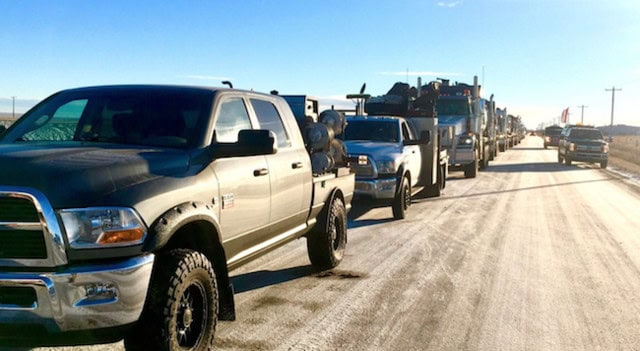
Convoys of trucks rolled slowly through Alberta and Saskatchewan on Saturday as demonstrations in support of Canada’s ailing oil and gas sector continue.

Police in Medicine Hat, Alta., estimate that 650 vehicles took part in a convoy that began on the Trans-Canada Highway east of the city and continued west to weigh scales before turning around and dispersing.

A similar event in Estevan, Sask., brought around 450 trucks, according to a police estimate.

Truck convoys began last weekend in Alberta. One event on Wednesday brought more than a thousand vehicles to Nisku, south of Edmonton.

Jerry Sabine, an organizer of the convoy in Medicine Hat, says trucks were driving slowly to show people “the frustration of how slow the oilfields are.”

Saskatchewan Premier Scott Moe tweeted his support for the event in Estevan, saying people across Western Canada are fed up with what he called the Trudeau government’s indifference toward the energy sector.

“What a strong message sent today from the truck rally in Estevan,” Moe said. “Your SK government stands with you in support of this critical industry.”

Other recent rallies, including a large one in Calgary on Monday, have targeted federal actions that critics say will make building pipelines more difficult. They include Bill C-69 to revamp the National Energy Board and Bill C-48 which would ban oil tanker traffic on British Columbia’s northern coast.

Supporters of Saturday’s convoys lined the streets in both cities. Most of the signs they held had messages calling for pipeline construction, an end to carbon taxes and the defeat of Prime Minister Justin Trudeau.

A few of the signs also expressed opposition to the United Nations.

Jay Riedel, an organizer of the Estevan convoy, said concern over Canada signing the United Nations migration pact is part of the protest, noting he believed the pact surrenders Canada’s immigration policy to outside powers.

“We definitely need immigrants coming into Canada but we also need to get jobs going for us and them,” Riedel said.

“If we don’t have jobs for these people to have, then our whole social system is going to fail.”

More convoys are planned, including one that will travel to Ottawa in February.

City’s archaeological secrets

Quebec Premier Francois Legault speaks about archeological find in Quebec City.

In the knee-deep mud of a future Quebec City condominium project, it was a spot of dark soil that led archaeologists to uncover the edge of an axe-hewn wooden stake, preserved in wet clay far below the surface.

What eventually emerged last fall was hailed as a major find: a 20-metre segment of a wood palisade, built in 1693 by French troops and settlers to protect against attacks from British and Indigenous groups.

“For the history of Quebec City, it’s extremely important, because these were the first ramparts,” said Jean-Yves Pintal, who led the dig on behalf of archaeological firm Ruralys. “There were small forts before that,” he said, but nothing like the defence these palisades offered.

But for some, the discovery of part of the 325-year-old Beaucours palisade was a reminder that North America’s best-preserved fortified city still has secrets to reveal, including a major mystery that has stumped archaeologists for over a century.

“The palisade was one of a few secrets that remained to be cleared up or understood,” Quebec City Mayor Regis Labeaume said at a November press conference announcing the find. “There’s one left, and that’s Champlain’s tomb.”

Samuel de Champlain, the French explorer who founded Quebec City in 1608, has been dubbed “the father of New France.” His name graces streets, bridges, and a major lake on the Canada-U.S. border, but his final resting place remains unknown. Despite intense public interest and multiple efforts, archaeologists say they’re no closer to finding his tomb.

While Labeaume’s remark was made jokingly, the search for the grave has become a minor sore spot for archaeologists, said Pintal. Even the announcement of one of Quebec City’s earliest fortifications was overshadowed by remarks about the search for the founder.

“Every time we dig a hole in Quebec City, people ask if we’re searching for Champlain,” he said with a laugh. “It’s a never-ending story.”

For independent archaeologist Carl Lavoie, who has taken an interest in Champlain, the subject is no joking matter. Lavoie says past failed attempts to find the founder have somewhat “discredited” the subject and led to Champlain fatigue among some of his peers. But he sees no reason why the search should not be treated seriously.

“Every nation, every country would like to know where their founders, their great figures can be found,” he said. “The mayor may have said that with a smile, but I think that he’d also like to find him.”

Even Lavoie acknowledges the search is an uphill battle. Records suggest Champlain died on Christmas Day in 1635, and his remains were moved to a chapel that was later burned to the ground. A Jesuit text from 1642 refers to a priest who was buried alongside the founder and another friend, but there is no record of where that burial took place.

“It is likely the remains were moved, but nobody knows when or where,” Lavoie said.

Serious efforts to find the tomb began in the mid-1800s. Scientists began “digging left and right” to find Champlain, he said, but without success. More recently, an archaeologist who shared the name of former Quebec premier Rene Levesque led a series of digs in the 1980s and 1990s that proved equally fruitless.

Lavoie believes the location of the original “Champlain chapel” to which his remains were moved has been found in the old city. Lavoie believes there’s a good chance Champlain could be lying somewhere beneath Quebec City’s basilica, either on his own or in a common grave.

But the search for the founder’s remains are at a standstill, and even if found, they would not be easy to identify. Champlain fathered no children and left no descendants, which eliminates the possibility of DNA matching. To confirm the identity, researchers would have to match up remains with what little that is known about Champlain physically — for example traces of the arrow wounds he suffered during a 1613 conflict with the Iroquois.

While it’s a long shot, Lavoie points to the case of English King Richard III — whose remains were found under a Leicester parking lot in 2012 — as a reason to not give up. “We can still dream a little,” he said.

More days with no power

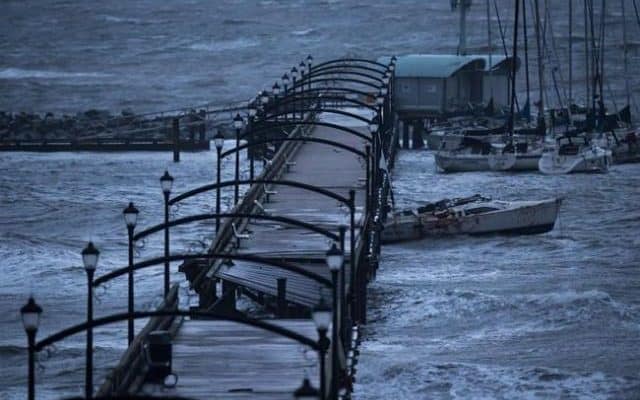
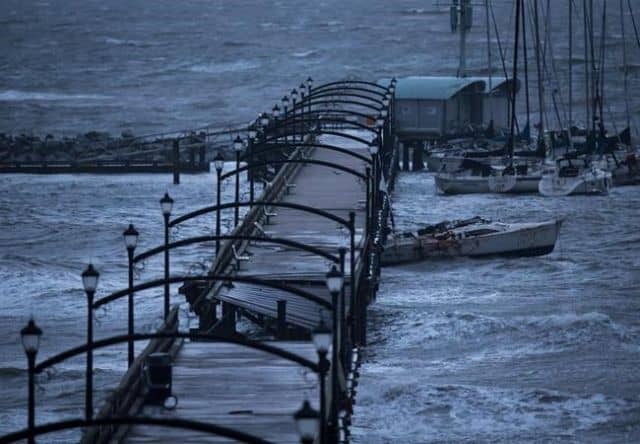
A boat is battered by waves and is slammed into the White Rock Pier that was severely damaged during a windstorm, in White Rock, B.C., on Thursday December 20, 2018.

Crews continue to repair fallen transformers and restring hydro lines after last week’s powerful windstorm in southwestern British Columbia, but officials say some customers will remain without power for several more days.

BC Hydro says it has restored power to more than 550,000 customers since the windstorm hit Thursday and about 44,000 customers are still waiting.

Vancouver Island and the Gulf Islands were among the hardest hit and hundreds of downed trees have left some roads impassable, which means BC Hydro has not been able to complete full damage assessments.

About 4,000 of its customers waiting for power are on the Lower Mainland and the Fraser Valley and BC Hydro says it could take another three days before power is restored to rural areas.

BC Hydro says the windstorm was among the worst in 20 years.

The RCMP say it killed one woman in Duncan when a tree fell on her tent, while it also caused Nanaimo’s water treatment plant to break down and destroyed a 30-metre section of White Rock’s pier.