Archives for December 13, 2018

U.S. stock futures point to modest gains as trade concerns dominate

U.S.-China trade relations remain at center stage.

Jobless claims fall

U.S. stock-index futures are pointing to a flat start for Wall Street on Thursday, as investors continue to digest headlines surrounding the potential for a U.S.-China trade deal.

How are the benchmarks trading?
Dow Jones Industrial Average futures YMZ8, +0.27% rose 46 points, or 0.1%, to 24,609, while S&P 500 index futures ESZ8, +0.38% rose 6 points, or 0.2% to 2,685. Nasdaq-100 futures NQZ8, +0.72% were up 34 points, or 0.5% to 6,803.

On Wednesday, The Dow Jones Industrial Average DJIA, +0.18% rose 157.03 points, or 0.6%, to end at 24,527.27, while the S&P 500 index SPX, +0.11% advanced 14.29 points, or 0.5%, to 2,651.07. The Nasdaq Composite Index COMP, +0.06% climbed 66.48 points, or 1%, to 7,098.31.

What’s driving the market?
U.S.-China trade concerns will remain at fore of investor minds Thursday, as they continue to digest headlines from earlier in the week that suggested the Chinese were ready to make significant concessions to their industrial policy and reduce tariffs on imported autos, while President Trump indicated he would intervene in the arrest of Huawei’s chief financial officer Meng Wanzhou if it would help ensure a trade deal with China.

On Thursday, reports that China has stopped requiring local governments to work toward its “Made in China 2025” strategy have added support to the thesis that China is willing to slow its push to strengthen its high-tech industry at the expense of foreign rival firms.

Traders are also focused on Thursday’s jobless claims data, which showed a significant decline in the number of Americans newly applying for unemployment benefits. The statistic, which is a leading indicator for labor markets and the economy, had been rising in recent months, albeit from historic lows.

Investors are also beginning to consider the tail risks associated with special counsel Robert Mueller’s investigation of the Trump administration. S&P 500 futures dipped Wednesday evening, after reports that the National Enquirer’s parent company, privately held American Media Inc. had agreed to tell prosecutors everything it knows about President Trump.

What data are in focus
The Labor Department announced Thursday morning that initial jobless claims fell in the week ended Dec. 8 by 27,000 to 206,000, easing fears that layoffs have been steadily rising.

The government also announced that U.S. import prices fell 1.6% in November, their largest decline in three years, led by the falling cost of oil.

What stocks are in focus?
Shares of General Electric Co. GE, +9.84% are in focus Thursday, after announcing the firm would launch a $1.2 billion industrial “internet-of-things” company, and after JP Morgan separately upgraded the stock from underweight to neutral. The stock is up more than 13% in premarket action.

Aflac Inc. AFL, +4.85% stock is up 4.7% in premarket trade Thursday, after the insurer confirmed it is in talks with Japan Post Holdings Co. Ltd. to take a minority stake.

Shares of Delta Air Lines Inc. DAL, -2.61% are trading down 1.2% before the bell Thursday, after the firm announced 2019 earnings guidance of between $6 and $7 per share, versus the consensus of $6.70, per FactSet.

How are other markets trading?
Stock markets in Asia rose broadly Thursday, with Hong Kong’s Hang Seng Index HSI, +1.29% Japan’s Nikkei NIK, +0.99% and the Shanghai Composite Index SHCOMP, +1.23% all ending the day higher.

In Europe, stocks are mixed as investors digest news of the end of the European Central Bank’s bond buying program, and as uncertainty around Brexit continues to weigh on sentiment. The Stoxx Europe 600 SXXP, +0.21% was trading flat, while the FTSE 100 UKX, +0.07% was down 0.2%.

Crude oil CLF9, -0.90% prices are falling Thursday, while Gold GCG9, -0.23% was down 0.4% and the U.S. dollar was virtually unchanged.

Stocks making the biggest moves premarket: VZ, MNK, AEO, MAR, NVDA & more

Check out the companies making headlines before the bell:

Verizon was downgraded to “equal-weight” from “overweight” at Morgan Stanley, which notes Verizon’s year-to-date outperformance compared to both the S&P 500 and rival AT&T. Morgan Stanley feels the stock is now fairly valued and that good news is already priced in.

Mallinckrodt – The Food and Drug Administration declined to approve a reformulated version of the British drug maker’s opioid painkiller Roxicodone. The new version was designed to deter opioid abuse.

American Eagle Outfitters – American Eagle reported quarterly earnings of 48 cents per share, in line with analyst forecasts. The apparel retailer’s revenue was slightly below forecasts, as was same-store-sales growth of 8 percent.

Dave & Buster’s Entertainment – Dave & Buster’s beat estimates by six cents with quarterly profit of 30 cents per share, and the entertainment and restaurant chain also saw revenue beat estimates. However, the shares are being pressured on weaker than expected comparable sales as well as a downbeat 2019 revenue growth forecast.

First Solar gave an upbeat forecast for fiscal 2019, helping boost the shares in extended hours trading. In October, the solar power systems company had lowered its fiscal 2018 forecast due to lower-than-expected sales of solar modules and higher manufacturing costs.

Credit Suisse said it planned to increase its dividend by at least 5 percent from 2019 onward, and announced a $1.5 billion share buyback. The news follows a three-year revamping by the Switzerland-based bank.

Marriott’s recently revealed cyberattack has been linked to a Chinese government spy agency, according to a report in the New York Times. Separately, Marriott and competitors Hyatt and Host Hotels were downgraded to “neutral” from “buy” at Citi, which cited a more cautious view on lodging in general due to heightened macroeconomic concerns.

Nvidia – Japan’s SoftBank is planning to sell its stake in the graphics chipmaker early in 2019, according to a Bloomberg report citing people familiar with the matter. The sale could provide SoftBank with a profit of about $3 billion.

Lululemon was upgraded to “buy” from “neutral” at Citi, which notes that even winning brands among athletic apparel maker have been taken down on fears of a macroeconomic slowdown. However, Citi said Lululemon has improving fundamentals and standout growth prospects.

Bank of America, Morgan Stanley – The two stocks were both downgraded to “market perform” from “outperform” at Keefe, Bruyette, and Woods amid the firm’s overall downgrade of the banking sector to “market weight” from “overweight”. KBW said it doesn’t see many positive catalysts for the bank stocks heading into 2019, and is cutting its rating on B of A and Morgan Stanley because its previous scenario of improving global growth and solid U.S. economic growth is not playing out as expected.

EBay – The stock was downgraded to “equal-weight” from “overweight” at Morgan Stanley, which also cut its price target on the online marketplace operator’s stock to $33 per share from $55 based on tepid projections for growth.

Pivotal Software lost five cents per share for its third quarter, three cents less than analysts had expected, and the cloud software provider also saw revenue come in ahead of forecasts. Subscription revenue was up 53 percent from a year earlier.

Major Toyota Lexus recalls

Toyota is recalling about 70,000 Toyota and Lexus brand vehicles in North America to replace air bag inflators that could explode and hurl shrapnel at drivers and passengers.

The recall covers the 2003 to 2005 Corolla, the 2002 to 2005 Sequoia, the 2003 to 2005 Tundra and the 2002 to 2005 Lexus SC.

Takata uses the chemical ammonium nitrate to create a small explosion and inflate the bags. But it can deteriorate and burn too fast, blowing apart a metal canister.

The Toyota and Lexus vehicles were recalled previously and the inflators replaced with new ones that still used ammonium nitrate. In the latest recall, Toyota will use inflators made by another company with a safer chemical.

Owners will be notified early next year. Toyota says it has replacement parts available.

About 65,000 of the recalled vehicles are in the U.S.

Toyota says it’s doing the recall a year ahead of a schedule set by the U.S. National Highway Traffic Safety Administration.

At least 23 people have died worldwide due to the problem caused by inflators made by Takata Corp., resulting in the largest series of auto recalls in U.S. history. They cover 37 million vehicles and about 50 million inflators in the U.S. About 100 million inflators are being recalled worldwide.

The recalls forced Takata of Japan to seek bankruptcy protection.

Space tourism taking flight

In this Jan. 11, 2018 photo provided by Virgin Galactic, the VSS Unity is released from the WhiteKnightTwo aircraft during a gliding test for SpaceShipTwo near Mojave, Calif. The spaceship isn’t launched from the ground but is carried beneath the special aircraft to an altitude around 50,000 feet (15,240 meters). There, it’s released before igniting its rocket engine and climbing.

Richard Branson’s Virgin Galactic is gearing up to finally send its tourism rocket ship to the edge of space.

If successful, it would be a major step toward the long-delayed dream of commercial space tourism.

The next test flight could come as early as Thursday with two pilots taking Virgin Space Ship Unity high above California’s Mojave Desert.

CEO George Whitesides said Wednesday they will try to exceed an altitude of 50 miles, which Virgin Galactic considers the boundary of space. Whiteside said that’s the standard used by the U.S. Air Force and other U.S. agencies.

That differs from a long-held view that places the boundary at 62 miles. But Whiteside cited new research that favours the lower altitude and said that as a U.S. company it will use the U.S. standard.

Reaching the threshold of space would demonstrate significant progress toward the start of commercial flights that were promised more than a decade ago. Virgin Galactic’s development of its spaceship took far longer than expected and endured a setback when the first experimental craft broke apart during a 2014 test flight, killing the co-pilot.

“It’s a day that we’ve been waiting for for a long time,” Whitesides said.

More than 600 people have committed up to $250,000 for rides in the six-passenger rocket, which is about the size of an executive jet. They have been waiting years to feel the kick of the rocket’s ignition, a near-vertical high-speed ascent into the blackness of space and several minutes of weightlessness with a view of the Earth far below.

The spaceship isn’t launched from the ground but is carried beneath a special plane to an altitude around 50,000 feet. It then detaches from the plane, ignites its rocket engine and climbs. The rocket is shut down and the craft coasts to the top of its climb — and then begins a descent slowed and stabilized by unique “feathering” technology. The twin tails temporarily rotate upward to increase drag, then return to a normal flying configuration before the craft glides to a landing on a runway.

Hearings set on LNG line

The National Energy Board is scheduling hearings over the next three months to consider a jurisdictional challenge of the approval of a pipeline needed to supply natural gas to the recently sanctioned $40-billion LNG Canada project.

But planning for construction to begin early next year will continue based on the $6.2-billion Coastal GasLink Pipeline’s provincial approvals and permits, said a spokeswoman for the project.

The NEB hearings will consider only the question of whether the British Columbia Oil and Gas Commission had jurisdiction to issue approvals for the project, the NEB says.

If it decides the project should be under federal jurisdiction, the regulator says the proponent will have to make a formal NEB application and undergo a separate process to win federal approval.

“If the NEB decides Coastal GasLink is to be federally regulated, then the project believes the NEB will need to address transition from provincial to federal jurisdiction,” pipeline spokeswoman Jacquelynn Benson said in an email on Wednesday.

“If that situation occurs, Coastal GasLink will review that decision to determine its path forward.”

The NEB actions are in response to a challenge by B.C. resident Mike Sawyer who argues that because TransCanada Corp. will own and operate the proposed pipeline and its connected Nova Gas Transmission Ltd. system together, they form a single system that crosses the Alberta-B.C. boundary and therefore must be regulated by the federal government.

The NEB says on its website it will accept additional written evidence from the builder late this month, take written evidence from interveners in January and gather information requests and responses from parties in January and February before holding final oral arguments in March.

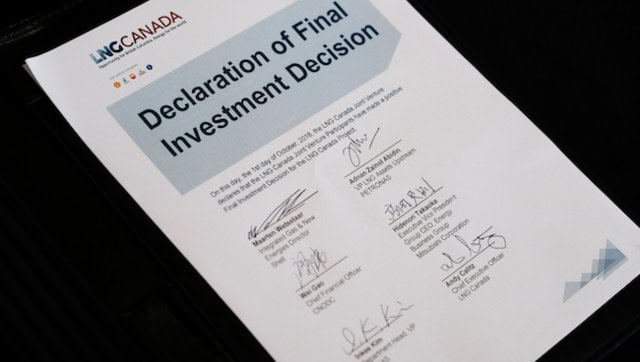
LNG Canada announced in October its partners — Royal Dutch Shell, Mitsubishi Corp., Petronas, PetroChina Co. and Korean Gas Corp. — had made a final investment decision to proceed with the project after delaying it in 2016 due to poor global prices for LNG.

The 670-kilometre pipeline would have an initial capacity to bring up to 2.1 billion cubic feet per day of natural gas from wells in northeastern B.C. to the proposed liquefied natural gas export facility near Kitimat.

Via orders $989M in trains

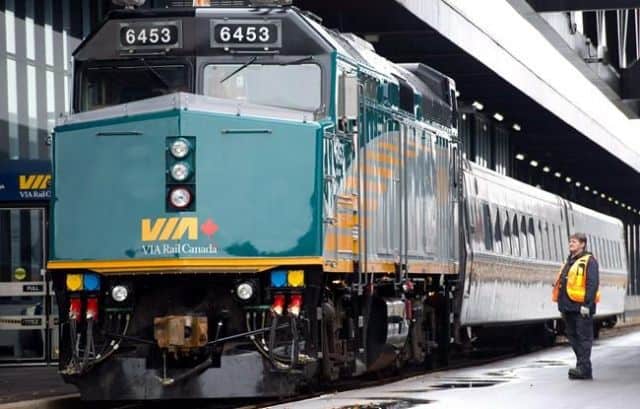
Via Rail has selected Germany’s Siemens over Bombardier Inc. for a $989-million contract to build new rolling stock as the Canadian passenger rail service renews its fleet of locomotives and cars for the rail corridor between Quebec City and Windsor, Ont.

The company confirmed the contract that will see trains built in California.

Deliveries will begin in 2021 for entry into service the following year.

Via Rail and Siemens also announced a 15-year technical services and parts agreement valued at $355.5 million.

The Canadian rail company requires 32 new trains to maintain its current capacity of 9,100 seats. The equipment must be able to run on electricity once that is installed along the route.

Federal Transport Minister Marc Garneau has said the decision to bypass Bombardier and workers at its plant in La Pocatiere, Que., is justified because Canada’s free trade agreements with the European Union and the United States doesn’t allow Via Rail to favour Bombardier in the awarding of contracts.